

You carried an armful of split wood inside, and now something with wings is crawling across the hearth rug. The instinct is to reach for a can of spray, or to move the pile into the garage. Both make things worse.
Insects riding in on one log are a nuisance your dry house handles alone. The pile on bare soil or against siding is the part with a repair bill — and August is when people pick that spot for the winter.
The August mistake: you are managing the wrong risk
Almost everyone searching for firewood bugs is asking about the log in their arms — the low-stakes half. Iowa State Extension is blunt about the worst case: termites carried indoors in firewood "can not establish a new nest and will not damage your home or your furniture."
Now the half nobody asks about. Mississippi State Extension lists "stacking firewood or lumber against the building" as a conducive condition for termites, adding that direct contact of soil, mulch or leaves with any wooden part of the house "will provide a ready entry point." Same wood, opposite consequence, decided by where the pile lives. The durable fix is a placement decision rather than a product — the logic running through our approach to handling pests yourself.
What is actually living in your woodpile
Wood borers developed inside the log — roundheaded and flatheaded borers, bark beetles, horntails. They chew out through the surface, leaving round or oval exit holes and sawdust-like frass. Hitchhikers only sheltered in the bark: the University of Maine notes that flies, mosquitoes, wasps and earwigs "overwinter in spaces in and under bark of logs." Add spiders, pillbugs and wood roaches for most of the rest.
Both do the same thing indoors: warmth wakes them, they come out, head for a window, and die. Nothing in the house is food or habitat, and a vacuum handles it. Nobody has published what share of firewood carries insects, so expect the possibility, not a number.
The furniture myth, and the one exception that keeps it alive
The fear behind most of this searching is that firewood beetles will migrate into the dining table. Illinois Extension gives the mechanism that kills the myth: "the wood in our homes and furniture is too dry for them to live in". Michigan State puts a number on "too dry": wood held below 20% moisture content is poor territory for powderpost beetles.
A flat denial would overclaim, though. The University of Kentucky concedes that lyctid powderpost beetles "sometimes infest firewood," while stating this is "seldom the reason other materials become infested within a home." Lyctids go after hardwood flooring, molding and furniture, not the softwood studs and joists behind your walls. Mostly false, one narrow exception. Insects on the hearth are not an emergency; fresh exit holes and powder in finished hardwood are a professional identification job.
Carpenter ants and termites: why the pile outranks the log
These two get conflated constantly. Termites imported on a log cannot start anything. Carpenter ants are the real exception: Iowa State rates the odds of firewood ants nesting in your house as "very slim," while Maine notes they "may cause structural damage if a new nest is established in the timbers of a home." Low probability, serious consequence.
Placement decides it. Colorado State Extension notes that carpenter ants "prefer to nest in decayed, often water-damaged wood." A pile left in ground contact becomes exactly that — damp, punky and parked against the one structure you did not want colonized. If you find either insect indoors, start with the identification differences between the two wood-destroyers.
Stacking it right: four free moves
Get it off the soil. Pallets, scrap lumber rails, cinder blocks with pipe across them. Kentucky Extension says to avoid stacking wood directly on the ground because it "will keep the wood from getting too wet and reduce the chances for infestation by termites and ants." Soil contact is where wood goes to die — the same mechanism behind protecting outdoor wood from ground-driven rot.
Get it off the wall. Illinois Extension gives the only specific setback in university material: "keep stacks of wood at least 3 feet away from structures." The 20 and 30 feet quoted online trace to pest-control blogs, not research. Treat 3 feet as the sourced floor and extra distance as free insurance — no extension source measures how risk falls off with distance.
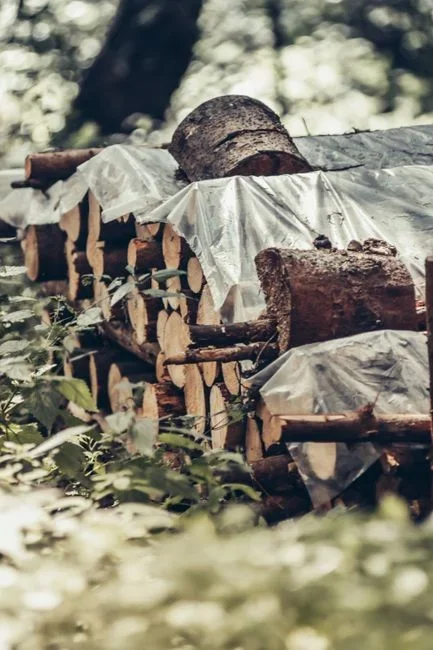
Cover the top only. EPA Burn Wise is explicit: store wood outdoors, off the ground, "with only the top covered -- covering the sides traps in moisture." Michigan State describes plastic that laps onto the sides but does not touch the ground. A tarp strapped to the dirt makes a humid box, which is habitat.
Burn the oldest wood first. Kentucky's rotation rule: "Use the oldest wood first, it is most likely to be infested." The part people skip: do not stack this year's delivery on last year's.
Seasoning outdoors is supposed to happen, and so are the bugs
Michigan State and EPA both put the minimum at at least six months, and EPA adds that wood burns best below 20 percent moisture — a general floor, since species, split size and climate all move it. The dryness that makes wood burn cleanly makes it poor housing for borers. Insects in a seasoning pile are not evidence it failed.
Overrated: turning the garage into a woodshed
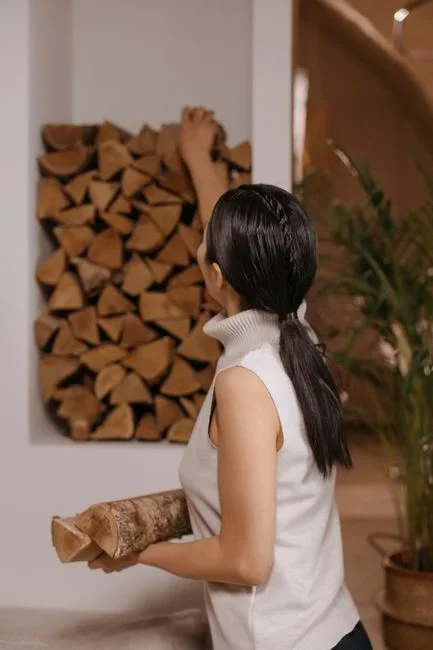
"Never bring wood inside" is too blunt, and not what the sources say. Kentucky endorses staging — bring in small amounts "that can be used up in a day or so and keep it stacked in a cool area (e.g., garage or porch)." The variables are quantity and warmth, not the room.
What fails is bulk storage in a heated or attached space: warmth wakes cold-stunned insects, and a garage stacked to the rafters is a woodshed sharing a wall with your house. Sources disagree on the margin. Illinois says a day or two worth, Colorado State only wood about to be burned, Michigan State about a week indoors, Maine up to a two-week supply. Follow the day-or-two version; the failure mode is a winter's worth stacked warm, not the armful by the stove.
Dangerous: never spray the wood you plan to burn
Four independent authorities land in the same place. Illinois Extension: "Do not apply pesticides to firewood. The pesticides will not affect any insects that have bored into the wood. Additionally, harmful fumes could be produced when they are burned." Kentucky calls it "unnecessary and potentially dangerous due to fumes". The spray misses insects already tunneled into the log, so it fails on its own terms — and then that log goes on an open fire indoors.
Extend the rule to anything treated or painted: EPA says never burn garbage, plastic or pressure treated wood, and the National Pesticide Information Center is flatter still — "Never burn treated wood. The ash and the smoke can contain toxic chemicals." For treated scrap, NPIC points to local or state waste programs and warns against chipping or composting it.
No substitute belongs here either — not dust, not borate, not an essential-oil mix. No agency or extension source endorses treating firewood with anything; placement, elevation and rotation are the answer. Keep children and pets away from smoke off questionable wood, ventilate if a fire smells chemical, and call Poison Control or a physician if anyone develops symptoms.
Dangerous: the cheap truckload from two counties over
The frugal decision with a real external cost. The National Park Service explains why healthy-looking wood proves nothing: beetles, eggs and fungal spores "cannot travel far on their own, but can travel hundreds of miles hidden within a firewood bundle in your car or RV." USDA adds that some pests survive in firewood more than three years.
The Don't Move Firewood rule of thumb: "50 miles is too far, and 10 miles or less is best." Packaged wood carrying a USDA APHIS or state heat-treatment seal is considered safe to move; a "kiln-dried" label alone is explicitly not that certification.
State rules vary, usually a set distance of 10, 25 or 50 miles, so check your own — there is no single national limit. The federal emerald ash borer quarantine ended January 14, 2021, but state, tribal and private rules remain and other pests are still regulated. Cheap wood hauled across county lines can still be illegal.
The woodpile is also a mouse decision
Rodents read a ground-contact pile the way termites do: shelter with a wall on one side. UC IPM lists rat nests in a firewood stack among the signs of infestation, and says tidy, off-the-ground storage reduces the suitability of the area. No source gives rodent-specific heights or setbacks, so the pallet-and-3-feet setup does double duty — though it never replaces sealing the building, covered in our cheap checklist for keeping mice out.
Common mistakes
| Verdict | Move | Why |
|---|---|---|
| REAL | Pallets or rails, at least 3 ft off any structure | Breaks soil and wall contact at once |
| REAL | Cover the top only, sides open | Side covers trap moisture, per EPA |
| REAL | Burn the oldest wood first | Oldest wood is likeliest to be infested |
| REAL | Carry in a day or two at a time | Warmth wakes dormant insects |
| MYTH | Firewood beetles infest the furniture | Indoor wood is too dry; lyctids the narrow exception |
| MYTH | Tarp the whole pile to keep it dry | Traps moisture, slows seasoning |
| OVERRATED | Bulk storage in garage or basement | A day's staging is fine; a winter's worth is not |
| DANGEROUS | Spraying insecticide on firewood | Misses borers, and burning it can produce fumes |
| DANGEROUS | Hauling cheap wood from far away | Moves pests; may violate state rules |
FAQ
Beetles came out of a log indoors. Do I need an exterminator?
No. Extension services call these emergents nuisance insects, and house wood is too dry to support them. Vacuum them and carry in less wood at a time. Get a professional identification only if fresh exit holes and powder appear in finished hardwood.
Is it safe to burn wood that has insect holes in it?
Yes, if the wood is untreated and seasoned. Insect damage does not make wood unsafe to burn; treated, painted or pressure-treated wood is the real hazard and should never go in the fire.
Can I take firewood to a campground?
Buy it where you burn it, or use packaged wood with a USDA APHIS or state heat-treatment seal. Check your state's rule first — some moves are prohibited outright.
The takeaway: The bugs in the log will die in your dry house on their own, so spend your effort on the pile — off the soil, 3 feet off the wall, top covered only, oldest burned first. Spend less. Live more. — The Thrifty Almanac






0comments