


Here's the fact that changes how you think about mice: a house mouse can fit through a hole the width of a pencil, which the CDC puts at about a quarter-inch, or 6 millimeters, across. If you can slide a pencil into a gap, a mouse can follow it. That's why chasing them with traps alone feels like bailing a boat without plugging the leak. You can catch three tonight and have five more by the weekend, because the door is still open.
The good news is that this is one of those rare jobs where cheap beats expensive, as long as you use the right cheap material. A little steel wool, a tube of caulk, and an afternoon with a flashlight will do more lasting good than a service visit that never seals the gaps — mouse-proofing is one of the highest-payoff jobs in any do-it-yourself pest-control plan. The trick is knowing which materials a mouse can chew through and which stop it cold, and both the CDC and university extension services are refreshingly specific about that.
A mouse needs a gap the width of a pencil
Start with the number, because it reframes everything. The CDC states plainly that mice can fit through a hole the width of a pencil, roughly a quarter-inch or 6 millimeters. The University of Nebraska-Lincoln Extension's rodent-proofing guide, publication G1530, puts it another way: mice need only "slightly more than a ¼-inch gap" to get in, while rats need "slightly more than a ½-inch gap." The old rule of thumb holds up: if a dime can pass through a gap, so can a mouse; if a quarter can, so can a rat. A mouse's skull is the widest part of it, so if the head fits, the body follows.
Once you internalize that, trapping-only stops making sense as a strategy. Traps deal with the animal in front of you. The gap deals with every animal that hasn't shown up yet.
Prevention beats extermination
Poison and snap traps handle the mice already inside. Sealing handles every mouse that would otherwise come in after — the same reason baiting outperforms spraying for ants comes down to treating the source, not the symptom. One is a bucket; the other is a fix. If you only do one thing, seal the house.
Mice come indoors chasing warmth, food, and shelter. You can't do much about warmth in a cold snap, and you're not going to make your home less sheltering. So the whole game comes down to the two levers you actually control: close the gaps they use, and take away the food that makes the trip worthwhile. Do both, and the mice move on to somewhere easier.
The audit: walk your house like a mouse

Before you buy anything, grab a flashlight and do a slow loop of the house, inside and out. Mice keep to walls and edges rather than crossing open floors, so follow the baseboards inside and the foundation line outside. You're hunting for daylight, drafts, gnaw marks, and greasy dark smudges along repeated travel paths.
Before you clean up droppings or nests, do it the safe way. Dry-sweeping or vacuuming rodent droppings, urine, or nesting material can send virus particles into the air, so the CDC says to open doors and windows to air out the space for 30 minutes first and leave the room, then put on rubber or plastic gloves, spray the mess with a bleach solution (about 1½ cups bleach per gallon of water) or an EPA-registered disinfectant until wet, let it soak 5 minutes, and wipe it up with paper towels rather than sweeping. Bag the waste, disinfect the area, and wash your hands. This matters most in closed-up spaces like under-sink cabinets, garages, and basements.
One warning worth taking to heart before you decide a gap is "too small to matter": UNL Extension cautions "Don't ignore smaller crevices as rodent gnawing can quickly enlarge them." A hairline gap a mouse can't quite use today becomes a doorway once its teeth get to work.
Door bottoms and thresholds
The gap under an exterior door is the number-one entry point in most homes. Close the door and look for light along the bottom. Any light means a mouse can get under it. Crumbled weatherstripping at the sides counts too.
Under-sink plumbing
Open the cabinets under your kitchen and bathroom sinks. Where the pipes disappear into the wall or floor, there's almost always a ragged hole cut wider than the pipe. That gap is a highway. Check behind the washing machine and dishwasher while you're at it.
Dryer vents and exhaust openings
Your dryer vent, bathroom fan, and range hood all punch through an exterior wall. If a flap is broken, stuck open, or missing its cover, that's a wide door with a warm draft mice love.

The garage
Garages are the soft underbelly. The bottom corners of the garage door often gap where the rubber has worn, and the door from the garage into the house is frequently missing a proper sweep. Seal both and you close a major route into the living space.
The foundation and utility penetrations
Walk the outside perimeter. Look where cables, gas lines, AC lines, and hose bibs pass through the wall. Check foundation vents, gaps along the sill plate where the house meets the concrete, and any spot where siding meets brick. Weep holes and gaps behind gutters are common too.
What to seal with, and why metal wins
The reason the cheap fix outlasts the expensive one is simple: the right cheap material is something a mouse physically cannot chew through, and most materials aren't. UNL Extension notes that rodents "can gnaw through a wide variety of materials, including aluminum sheeting, wood, rubber, vinyl, plastic, and concrete block." That list should end the debate about what to reach for. The rule is: put metal wherever the mouse can reach.
- Steel wool or copper mesh — This is the actual barrier. Packed tightly into a gap, it's something a mouse can't compress out of the way or comfortably chew. The CDC's instruction for small holes is exactly this: "Fill small holes with steel wool." UNL Extension recommends wedging copper or stainless steel wool tightly into gaps under ¾ inch, and notes that plain coarse steel wool works as a temporary alternative. Because the extension points to copper or stainless steel for the more permanent fix, those are the better pick for damp or outdoor spots. Either one costs only a few dollars.
- Caulk — The steel wool is the barrier; the caulk is what holds it there. The CDC says to "Put caulk around the steel wool to keep it in place." Without it, a mouse can eventually work the plug loose. A tube runs a few dollars.
- Hardware cloth — and get the mesh size right — For larger openings like vents, the CDC calls for "lath screen or metal, cement, hardware cloth, or metal sheeting." Here's the detail most guides botch: to exclude mice specifically, UNL Extension specifies 24-gauge, ¼ x ¼-inch mesh. The heavier ½-inch mesh only stops rats — a mouse walks through it. Buy the quarter-inch, or you'll screen an opening and leave it mouse-sized. For sheet metal, the extension recommends 24 gauge or heavier.
- Door sweep or fresh weatherstrip — The one spot worth a few dollars for exterior and garage-to-house doors, so the under-door gap simply stops existing.
Correcting the spray-foam myth. You'll read that spray foam is useless because mice chew through it. That's half-right and half-wrong. Standard expanding foam on its own is not a barrier — a mouse can gnaw through it. But foam isn't forbidden. The CDC actually lists it as an acceptable finish, saying to put caulk around the steel wool "or use spray foam." The point isn't "foam bad." The point is that the metal is the barrier and the foam or caulk just holds it in place and blocks the draft. Pack the steel wool first; then cover it with whichever you like.
Dollar figures here are rough retail ballparks, not sourced facts — steel wool, a tube of caulk, and a small roll of hardware cloth each land in the low-single-digit to low-double-digit range depending on where and when you buy. Here's how that adds up in practice: a pack of steel wool or copper mesh, a tube of caulk, and one door sweep typically run a few dollars apiece, so the core kit that seals most of a home's entry points comes in around $15 — and that same steel wool and caulk stretch across every under-sink, foundation, and utility gap on the list. The same few-dollars-fix-it logic runs through controlling mosquitoes for about $3 a month. Extra door sweeps are the main thing that pushes you past it, since those are a per-door cost.
Step-by-step: sealing a typical entry point
- Clean the gap. Pull out loose debris, crumbling old foam, and chewed material so your new seal sits against solid surfaces. If there are droppings or old nesting in the way, don't dry-sweep or vacuum them — follow the CDC's wet-cleanup steps above first, wearing gloves.
- Pack coarse steel wool or copper mesh into the hole firmly, pushing it in with a flathead screwdriver. You want it wedged tight, not loose — the CDC and UNL both treat the packed metal as the barrier.
- Run a bead of caulk over and around it to lock it in place and seal the remaining draft, per the CDC's "caulk around the steel wool" instruction. Foam works here too if you prefer it.
- For openings bigger than about an inch, cut a patch of 24-gauge, quarter-inch hardware cloth an inch larger than the hole on all sides, then screw or staple it flat. Pack steel wool behind it if there's depth.
- For doors, cut the sweep to width and fit it so the rubber or bristle just kisses the threshold with the door closed. No daylight should show.
- Let the caulk cure per the directions on the tube before you call it done.
Work top to bottom on each wall so you don't miss anything, and recheck exterior seals in spring and fall, since rubber and caulk crack over time. The autumn pass does double duty, because the same gaps are where stink bugs slip in after massing on warm siding.
Cut off the food and they lose the reason to stay
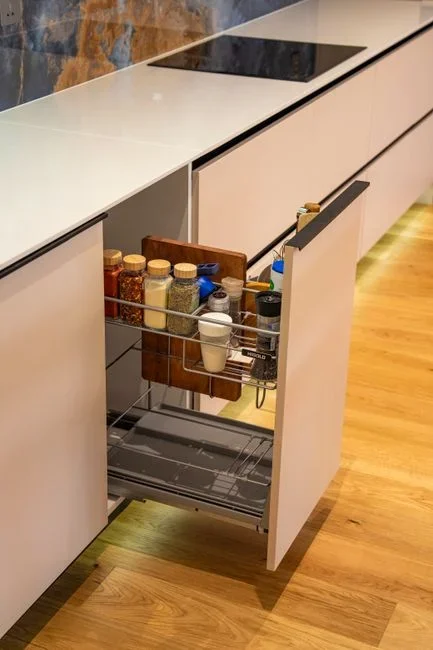
Sealing is half the job. A house with no accessible food is a house not worth breaking into, and mice get by on remarkably little, so "the kitchen looks clean" isn't the bar. The CDC's prevention guidance is concrete on this front.
- Move pantry staples, pet food, and birdseed into thick plastic, metal, or glass containers with tight lids, which is exactly what the CDC recommends. Cardboard and bags are no barrier at all.
- Don't leave pet food out overnight. The CDC says to put pet food away after use; free-feeding is a 24-hour buffet.
- Keep trash covered and clean up spilled food right away — again straight from the CDC's list. Wipe counters and sweep under the stove and fridge where crumbs hide.
- Store bulk pet food and garden seed in metal cans with lids, not their original paper bags, especially in the garage and basement.
The entry-point cheat sheet
| Entry point | Material to use | Approx. cost |
|---|---|---|
| Under-door gap (exterior / garage-to-house) | Door sweep or new weatherstrip | A few dollars per door |
| Under-sink pipe holes | Steel wool or copper mesh + caulk | Pennies from shared supply |
| Dryer / bathroom / range vents | 24-gauge ¼-inch hardware cloth or vent cover | A few dollars |
| Foundation cracks & sill gaps | Steel wool + caulk | Pennies from shared supply |
| Utility line penetrations (cable, AC, gas) | Steel wool + caulk | Pennies from shared supply |
| Garage door corners | New rubber corner seal / weatherstrip | A few dollars |
Note on the vent row: use the quarter-inch mesh, not the half-inch. Half-inch hardware cloth stops rats but lets mice through, per UNL Extension's mesh specs. Costs above are approximate retail ranges, not sourced figures, and vary by region and retailer. Mesh sized to stop mice will not hold a bigger chewer: squirrels working open a gable vent or roof edge need heavier gauge metal and a different repair.
On traps, poison, and being humane
Seal first, and you'll rarely need lethal control at all. When you do have mice inside while you work, the gentler options are live-catch traps or well-placed snap traps, which kill quickly. Glue boards are the harshest common option because they cause slow, prolonged suffering — a position held by the American Veterinary Medical Association and animal-welfare organizations, not a government finding, so treat it as an ethics judgment rather than a settled fact. A few jurisdictions have moved to restrict glue traps, but rules vary, so check yours rather than assuming.
Poison is the option to think hardest about. The EPA restricts the most hazardous second-generation anticoagulant rodenticides — brodifacoum, bromadiolone, difenacoum, and difethialone — because of the risk they pose to non-target wildlife and pets. That risk includes secondary poisoning: a hawk, owl, fox, or family pet that eats a poisoned mouse can be poisoned in turn. The EPA also requires residential rodenticides to be sold in bait stations that keep the poison away from children and non-target animals. Between the wildlife risk, the danger to pets and kids, and the fact that a poisoned mouse often dies inside a wall to rot, sealing the gaps is the cleaner move for most homes.
Common mistakes
- Relying on foam or caulk with no metal behind it. Foam over packed steel wool is fine; foam alone is a snack. Always put metal in the hole first.
- Buying the wrong mesh. Half-inch hardware cloth only excludes rats. For mice you need the 24-gauge, quarter-inch mesh.
- Sealing the inside but skipping the outside. The real entry points are usually on the exterior and low to the ground. Walk the whole perimeter.
- Ignoring the small gaps. People plug the fist-sized hole and skip the pencil-width one — and the pencil-width one is the one being used. Extension services warn that gnawing enlarges small crevices, so they don't stay small.
- Setting traps while leaving pet food out. You're competing with an all-night buffet. Remove the food or the traps underperform.
FAQ
How small a hole can a mouse really get through?
About a quarter-inch, or 6 millimeters — the width of a pencil, per the CDC. The skull is the widest part, so if the head fits, the rest follows. When in doubt, seal it.
Will peppermint oil or ultrasonic plug-ins keep mice out?
Treat repellents as a supplement, not a substitute. A scent might make one spot briefly less appealing — and the evidence on peppermint oil against mice bears that out — but it won't stop a mouse that smells food on the other side, and no repellent closes the gap the way packed metal does. Physical sealing is the part that actually works.
How long does a steel-wool-and-caulk seal last?
Generally a long time, with one caveat: plain steel wool can corrode in damp spots, which is why UNL Extension points to copper or stainless steel wool for the more durable fix. Recheck your seals each spring and fall and touch up any cracked caulk.
When should I just call a professional?
If you're hearing activity inside walls you can't reach, seeing droppings across multiple rooms, or dealing with a large or recurring infestation, a pro can find hidden entry points and knock the population down faster. Sealing still matters afterward — it's what keeps them from coming back.
The takeaway: mice aren't a pest problem so much as a hole problem, so spend an afternoon and a few dollars packing metal into the pencil-width gaps and clearing the food, and you fix the reason they came in the first place. Spend less. Live more. — The Thrifty Almanac






0comments