

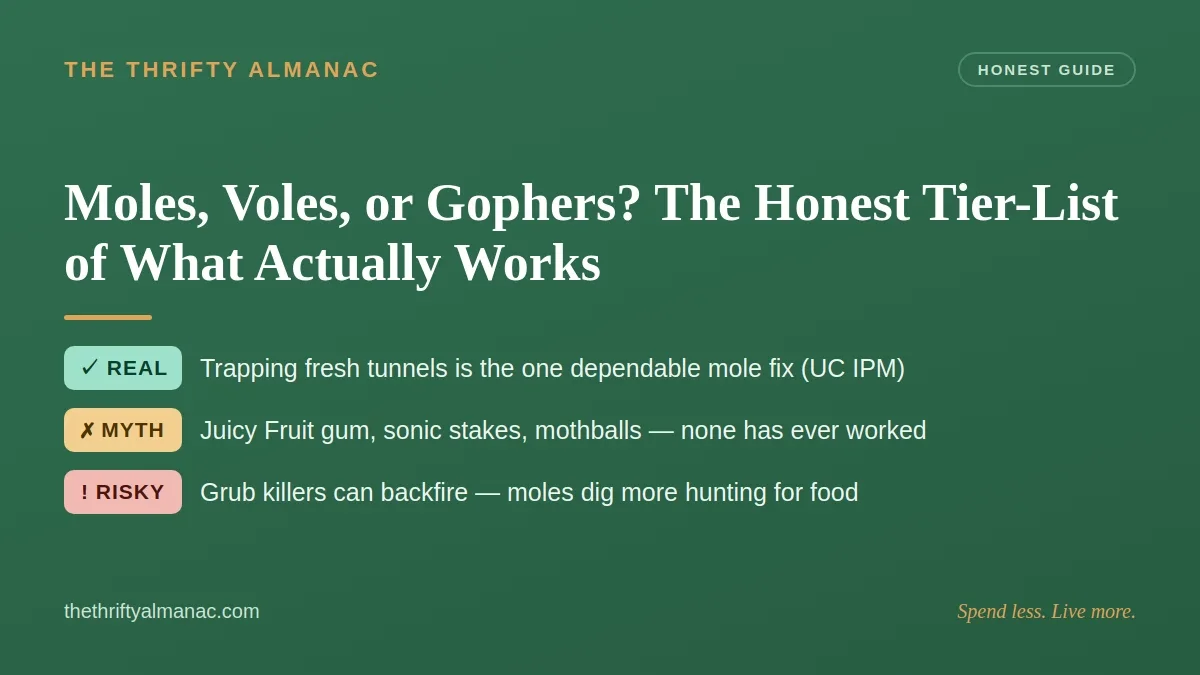
You walk out to the yard, see a fresh dirt mound and a raised ridge snaking across the grass, and reach for your phone. Within minutes a video is telling you to bury sticks of Juicy Fruit gum in the tunnels, plant a vibrating stake, or drop mothballs down the hole. Save your money. Almost every "mole cure" sold in stores and videos is folklore, and the reason is simple: a mole is a meat-eater hunting live worms underground, so it never smells, tastes, or eats the thing you just buried.
Here is the honest tier-list, what is REAL, what is a MYTH, and what is a waste of a whole summer. The single most important step costs nothing and comes first: correctly identify the animal. It is the same identify-before-you-treat habit behind any level-headed approach to DIY pest control. A mole, a vole, and a gopher eat entirely different food, which means the fix for one will always fail on the others. Getting the ID wrong is exactly why so many people "try everything and nothing works."
First, figure out what you actually have
WHAT: a 60-second ID check before you buy anything. Three different animals get lumped together as "the thing wrecking my lawn," but only one of them is a mole, and the tell is the food they eat and the mess they leave.
HOW, read the animal and the mound:
- Mole. Look for the "paddle-like forefeet, which are bent sideways for digging" with large claws, and eyes and ears "concealed in the fur," per Penn State Extension. The mole leaves round, volcano-shaped mounds with the plug in the middle, plus shallow feeding burrows just beneath the surface that "leave a raised ridge to mark their path," according to UC IPM. Those surface ridges are the giveaway.
- Vole. Mouse-like, with "relatively large black eyes, small ears, a blunt face" and "prominent orange front teeth for gnawing," per Penn State. Voles run in visible surface pathways worn through the grass and chew on plants, and they are herbivores that "eat a variety of grasses, seeds, and roots."
- Pocket gopher. Its mounds are "crescent- or horse-shoe-shaped when viewed from above," with the plugged hole "off to one side of the mound," per UC IPM. Gophers are herbivores too, feeding on "roots and fleshy portions of plants."
WHY it matters: the mole is a carnivore; the vole and gopher are plant-eaters. Every method below is built around what the animal eats. A mole trap set in a gopher tunnel will sit empty, and a plant-based repellent means nothing to an insect-eating mole. The food source dictates the fix.
LIMIT: if you see chewed plants and worn surface runways but no volcano mounds or raised ridges, you probably do not have a mole at all, you have voles, and the rest of this mole guide will not apply. Reassess before you spend a cent. A lingering vole colony can also draw the predators that hunt them, so if garden snakes start turning up too, here is how to keep snakes out of your yard.
The myth graveyard: what to stop wasting money on

WHAT: the popular "cures" that research has never backed up. These sell well because they feel clever, not because they work.
MYTH: Chewing gum (Juicy Fruit) kills moles
False, and it cannot work by its own logic. "Moles primarily feed on insects and earthworms, so grain-based bait is not likely to be eaten by moles," per the Internet Center for Wildlife Damage Management (ICWDM). A mole hunts live, wriggling prey. Gum is just sugary bait it has no reason to bite, and it never does.
MYTH: Vibrating, ultrasonic, or pinwheel stakes scare them off
False. "No frightening devices have been proven effective for the control of moles, including vibrational, magnetic, electronic, sonic, and pin-wheel devices," per ICWDM. Every category of scare gadget has been tested, and every category has failed.
MYTH: Mothballs (or bleach, lye, glass, razor blades, human hair) drive them out
False. Of the long list of home remedies people drop in burrows, "broken glass, razor blades, thorny rose bush branches, bleach, mothballs, lye, and even human hair," the verdict from UC IPM is blunt: "None of these approaches has proved successful in stopping mole damage or in driving moles from an area." Mothballs carry an added problem covered in the safety notes below. Aromatic remedies fail the same way indoors, which is why peppermint oil never actually keeps mice out.
MYTH: Kill the grubs and the moles will leave
Mostly false. This one feels logical, which is why it spreads. But earthworms, not grubs, are a mole's staple, so "a lawn can be free of grubs and still have moles," per ICWDM. Worse, if you wipe out the soil insects, "moles may increase digging in search of food, possibly increasing damage to turf or gardens." It is the same trade-off gardeners face when they try to kill weeds without wrecking the soil beneath them. You can pay for a grub treatment and end up with more tunneling. (The same caution applies to lawn products in general: several viral fixes, from mystery powders to miracle feeds, are lawn-care myths that waste money or even harm the grass.)
WHY the debunk sticks: once you picture the mole as a small predator swimming through soil after live worms, the folklore collapses on its own. It does not eat sugar. It does not read scent-cues you plant. It does not flee vibrations. The standard here is honest, these tactics are "not proven effective," which is exactly how the extension sources phrase it.
The one remedy with any evidence: castor oil
WHAT: the single home-adjacent product with real, if weak, research behind it, commercial castor-oil repellents such as Sweeney's Mole and Gopher Repellent.
HOW: these products have "shown minor effectiveness in repelling moles," per ICWDM. Set your expectations low and specific: applied thoroughly and watered in per the label, castor oil may make a treated tunnel unpleasant enough that a mole moves on. It will not stop the animal from digging a brand-new run somewhere else nearby.
WHY it has any effect at all: unlike gum or vibration, castor oil is something the mole genuinely encounters underground. It contaminates the soil and the prey the mole is hunting, giving a taste and smell the animal wants to avoid. That is the difference between "minor effectiveness" and "no effectiveness," the mole actually meets it.
LIMIT: the research is thin and regional. Castor-oil repellents have "shown some efficacy for eastern moles," but "no published research has been done on moles in the western United States, so their effectiveness on these species remains unclear," per UC IPM. This is a nudge, not a cure, and not a guaranteed fix anywhere.
What actually works: reduce, protect, and trap

WHAT: the approach the extension services actually endorse, trapping as the gold standard, physical protection for prized plants, and a realistic read on the food-source angle.
HOW:
- Trap the animal. "Trapping is the most universally applicable and dependable method of mole control," per UC IPM. Traps are set into active tunnels, the surface ridges that are freshly raised. Success improves when you tamp a ridge down, mark it, and set your trap on the runs the mole rebuilds within a day or two.
- Match the trap to the animal. Trap designs are species-specific. A mole trap is built for a mole's shallow runs, and a gopher trap is built for a gopher's deeper tunnels; the wrong trap in the wrong tunnel catches nothing. This is the ID step paying off.
- Protect what you value. For prized plantings threatened by root-eating voles or gophers, line planting holes or raised beds with hardware-cloth root cages or buried mesh barriers. This is the one place a physical fix beats chasing the animal.
- Skip the grub crusade. Because earthworms sustain the mole, chasing grubs alone is unreliable and can backfire, per ICWDM. Put that money toward a trap instead — and if the turf damage turns out to be grubs working on the roots, treat that as its own problem, not a mole strategy.
WHY it works: trapping removes the actual animal rather than trying to gross it out or scare it off. It is the only approach the research consistently supports, which is why every extension office circles back to it.
LIMIT: follow the trap's label directions and your state and local wildlife-trapping rules, which vary, so check local regulations before you set anything. And expect ongoing management, not a one-and-done. Moles are territorial, and once a run is empty a new individual can move in, so treat this as maintenance rather than a permanent kill. That steady-management mindset carries over to other outdoor pests, which is how you rid your yard of fleas naturally without dosing the lawn with anything that could reach your pets.
Safety notes before you dig in
- Mothballs are not a lawn remedy. Scattering them in the yard or dropping them in burrows is off-label pesticide use, which goes against the product label, and the naphthalene or paradichlorobenzene inside is toxic to kids and pets who unearth and swallow them. Keep them sealed in storage where they belong.
- Traps have moving parts. Spring and harpoon-style mole traps can injure fingers and are a hazard to curious pets and small children. Mark set traps, keep the area off-limits, and read the instructions before setting.
- Read every label. Castor-oil products and any pesticide are only as safe as their directions. The label is the law.
- When to call a pro. If the tunneling undermines a foundation, patio, or septic field, or if you are dealing with a persistent gopher problem in an area with trapping restrictions, a licensed wildlife-control operator knows the local rules and the right hardware.
Common mistakes recap
- Buying a "cure" before identifying the animal, mole, vole, and gopher each need a different fix.
- Burying gum, mothballs, or scare stakes; none is proven to work.
- Paying for grub control expecting the moles to leave, earthworms, not grubs, feed them.
- Treating castor oil as a guaranteed cure instead of a minor, temporary deterrent.
- Setting a mole trap on a gopher, or the reverse, then wondering why it stays empty.
- Expecting one treatment to be permanent, a new mole can recolonize an empty run.
FAQ
Does chewing gum really kill moles?

No. Moles feed on insects and earthworms and do not eat sugary bait, so grain- or gum-based baits are unlikely to be eaten at all, per ICWDM. It is folklore.
What about the vibrating stakes sold at the hardware store?
Not proven to work. No frightening devices, vibrational, magnetic, electronic, sonic, or pinwheel, have been shown effective for mole control in research, per ICWDM.
Does castor oil actually do anything?
A little. Commercial castor-oil repellents have "shown minor effectiveness," with supporting research only for eastern-US moles and none for western species, per UC IPM. It may push a mole out of a treated tunnel but will not stop new digging.
If I get rid of grubs, will the moles leave?
Usually not. Earthworms are the mole's main food, so a grub-free lawn can still have moles, and killing off soil insects can even increase digging as they hunt for food, per ICWDM. Trapping is the dependable route.
The takeaway: identify the animal first, ignore the gum-and-gadget folklore, and reach for trapping, the one method the research actually stands behind. Spend less. Live more. — The Thrifty Almanac



0comments