

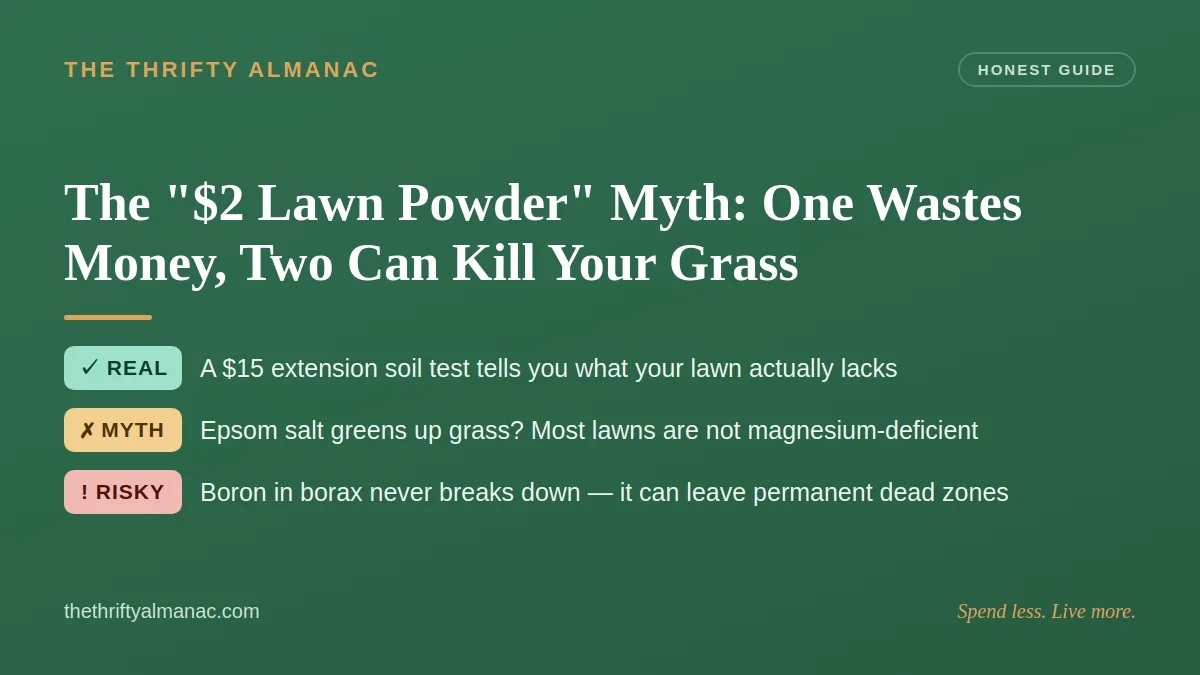
There's a video all over lawn-care feeds with one irresistible promise: your lawn doesn't need fertilizer — it needs a $2 powder from the grocery store. A hand shakes white powder over sad yellow grass; a jump cut later, the yard is golf-course green.
Here's the honest version. These videos almost always push one of three cheap white powders — Epsom salt, baking soda, or borax — and university turf programs have looked at all three. One wastes your $2; the other two are documented ways to injure or kill grass. What genuinely improves a lawn is boring, extension-backed, and mostly free — the same unglamorous truth behind getting rid of aphids without buying ladybugs. Let's sort it: what's real, what's a myth, what's dangerous.
So what is the "$2 powder"?
The clips rarely name the product up front — the mystery keeps you watching — but the box is nearly always one of these three:
Epsom salt (magnesium sulfate)
The claim: instant green-up, because magnesium sits at the center of the chlorophyll molecule. What it actually is: a magnesium-and-sulfur supplement — two nutrients most established lawns already have.
Baking soda (sodium bicarbonate)
The claim: a "natural" fix for lawn fungus, moss, and weeds. What it actually is: a sodium salt — the same element that kills grass along salted winter roads.
Borax (sodium tetraborate)
The claim: wipes out creeping Charlie and other weeds without "harsh chemicals." What it actually is: boron plus sodium, and boron is a plant nutrient with a razor-thin line between necessary and toxic.
Why your lawn almost certainly doesn't need Epsom salt
Epsom salt fixes exactly one problem: magnesium deficiency. The catch: the research behind the green-up claims comes from intensively produced crops that were already deficient. When Washington State University horticulturist Linda Chalker-Scott reviewed the evidence, her conclusion was blunt: magnesium deficiency "does not appear to be a serious issue for most turf grasses, and therefore, Epsom salts addition is unnecessary."
Where deficiency does turn up, it's mostly in soils described as light, sandy, and/or acidic, plus heavily leached ground — not the typical established lawn. You can't diagnose it by eye, either: pale grass has likelier causes — low nitrogen, compaction, drought stress. A soil test is the only way to confirm it.
"Harmless even if it doesn't work" is a myth too. The same WSU review warns that an automatic application to soil that isn't deficient is "a poor management strategy that can injure the plants and contaminate the soil," and in one study 49% of the applied Epsom salt leached away, contributing to water pollution. The marketing routinely outruns the evidence: North Dakota State University Extension notes it can't fix tomato blossom end rot, a calcium problem, since "Epsom salt contains magnesium sulfate — no calcium at all."
The two powders that can actually kill your lawn
Borax: the damage doesn't wash out
Start with the fact the videos never mention: boron does not break down in soil. University of Wisconsin–Madison Extension, summarizing turf research from UW and Iowa State, reports that borax used on creeping Charlie "is typically not very effective and can injure turf and other plants as well, causing stunting and yellowing." Boron is "necessary in very small amounts for plant growth but is toxic in larger doses" — and because it persists, repeated or excessive applications "can result in bare areas where no vegetation can grow."
That's the whole problem: too little does nothing, too much injures everything nearby, and the mistake stays in your soil. You won't find a borax recipe here, on purpose. If creeping Charlie is the real issue, a labeled broadleaf herbicide or hand-pulling after rain beats laundry powder. Store the box away from kids and pets, and call Poison Control if anyone swallows it — a warning that goes double for slug bait that can kill a dog.
Baking soda: salting your own soil
This one isn't hypothetical. In a documented Ask Extension case, a homeowner spread baking soda and the grass died; the expert's verdict: "It's likely the baking soda (sodium bicarbonate) destroyed the grass." The prescribed fix was to water the area heavily to leach the sodium out of the soil before laying new sod — the same injury pattern as road-salt damage. Any "treatment" that ends with a soil-rehab project is not a treatment.
The $15 test that ends the guessing
Every powder debate above dissolves against one boring purchase: a routine soil test from your state's university extension lab — about $15 at many labs (prices vary by state; search "your state extension soil test"). The report covers pH, lime requirement, and phosphorus, potassium, magnesium, and calcium, "along with lime and fertilizer recommendations for the crop specified." It doesn't just measure — it tells you what to add and what to skip, including whether yours is one of the rare lawns genuinely short on magnesium.
The process is quick: scoop small samples from several spots around the yard, mix in a clean bucket, dry, bag, and mail per the lab's instructions.
Free upgrade #1: mow tall and follow the one-third rule
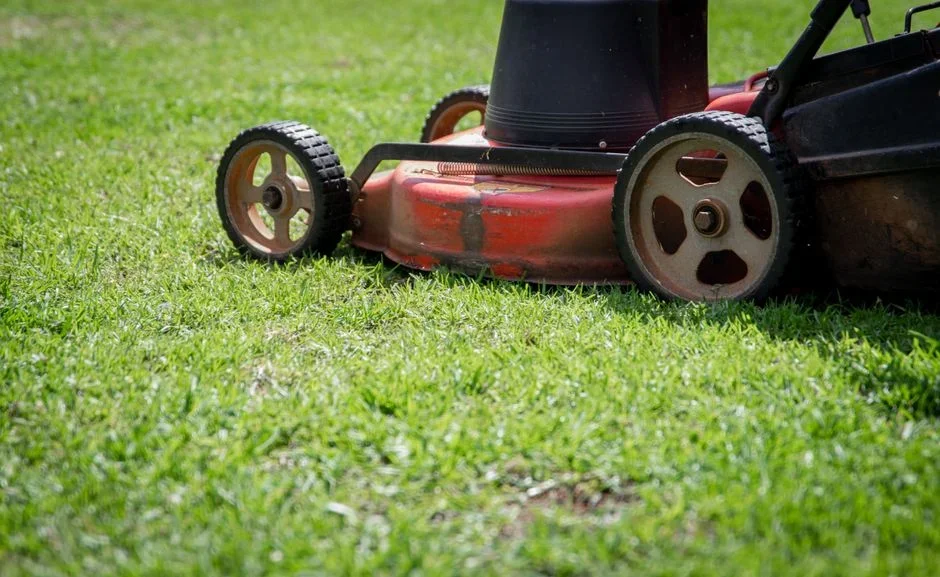
Mowing height is the cheapest weed control there is: University of Maryland Extension reports that mowing at the proper height can reduce weeds and diseases by 50% to 80% in tall fescue lawns, which should be kept 3 to 4 inches tall — and it calls low mowing a major contributor to lawn deterioration and weed abundance, crabgrass especially. (Warm-season grasses run shorter.)
Michigan State University puts the broader recommended range at 2 to 3.75 inches, paired with one habit: never remove more than one-third of the leaf surface in a single mowing. Keep the lawn at 3 inches and that means mowing before it reaches about 4.5. Tall, dense turf shades out weed seedlings — and steady mowing pulls double duty on pests, as in our guide to killing and preventing ticks in your yard cheaply.
Free upgrade #2: leave the clippings
Grasscycling — leaving clippings where they fall — is the closest thing to genuine free lawn food. Michigan State reports that returning clippings means nitrogen applications can be reduced by as much as 1 pound per 1,000 square feet per year. Penn State measured it directly: over three years, Kentucky bluegrass clippings contained 46 to 59 percent of the nitrogen that had been applied as fertilizer — nitrogen you either recycle or throw away. Maryland's framing rounds it out: recycling clippings and other organic matter for at least two years can supply about 25% of your lawn's annual nutrient needs.
The old objection — "clippings cause thatch" — is flat wrong. MSU calls it "a common misconception… This is not true," and Penn State found clippings decompose too quickly to contribute to thatch. The one real rule: mow often enough that clippings don't clump.
Free upgrade #3: water deep, not often
Daily light sprinkling trains roots to loiter near the surface. Clemson Extension's guidance runs the other way: most turfgrasses need about an inch of water a week, and plants that receive deep but infrequent irrigation are healthier. Maryland lands on the same target: about 1 inch of water per week, applied deeply rather than in daily sips.
Measuring is a tuna-can job — set a few empty cans on the lawn, run the sprinkler, and note how long the inch takes. Sandy soil drains fast, so Clemson suggests splitting that inch into smaller, more frequent waterings; clay holds water, so one slow soak covers the week. The same deep-and-slow logic runs our garden-bed favorite, olla watering, which actually works.
When you do need real fertilizer
One more correction, in the other direction: "your lawn doesn't need fertilizer" is only half true. Nitrogen is the one nutrient lawns steadily draw down, and extension programs still recommend a well-timed feeding — for cool-season grasses, fall is the classic window. The honest rule: you almost never need a mystery powder, but a real nitrogen application at the rate your soil-test report specifies is money well spent. Take the timing from your state extension's lawn calendar, not a stranger's video.
The honest verdict: your $2, ranked
Same honest tier-list treatment we gave moles, voles, and gophers — ranked by extension research, not view counts.
| Tier | Move | Cost | The honest why |
|---|---|---|---|
| S | University extension soil test | About $15 | The only way to know what your lawn is missing — including magnesium |
| A | Mow tall + one-third rule | Free | Proper height cuts weeds and disease 50–80% in tall fescue |
| A | Grasscycling (leave clippings) | Free | Clippings return 46–59% of applied nitrogen; no thatch risk |
| A | Deep, infrequent watering | Free | About an inch a week grows deeper, tougher roots |
| B | Well-timed nitrogen fertilizer | Varies | Legitimate when your soil test and state lawn calendar call for it |
| D | Epsom salt on the lawn | $2, wasted | Treats a deficiency most turf doesn't have; excess leaches away |
| F | Baking soda on turf | Can kill grass | Sodium injury — documented lawn destroyed, soil needs leaching after |
| F | Borax on turf | Can kill grass — permanently | Boron persists; bare areas where no vegetation can grow |
Common mistakes
- Diagnosing by eye. Pale grass is usually nitrogen, water, or compaction — not magnesium. Test before you treat.
- Assuming "pantry item" means "safe." Sodium and boron are as chemical as anything in a jug, and boron stays in your soil.
- Bagging clippings, then buying nitrogen. You're throwing away fertilizer you paid for.
- Scalping the lawn to mow less often. An open invitation to crabgrass.
- Watering a little every day. Shallow sprinkling builds shallow roots.
- Swearing off fertilizer entirely. A well-timed nitrogen feeding is legitimate — the mystery powders aren't.
FAQ
Will Epsom salt at least do no harm?
Not necessarily. WSU's review found that applying it to soil that isn't magnesium-deficient can injure plants and contaminate the soil, and much of it leaches into groundwater. If your test says you're not deficient, it's a cost with no upside.
I already put baking soda on my lawn — what now?
Follow the documented extension playbook: water the area heavily to leach the sodium from the soil, then lay sod — or let a few weeks of rainfall do the leaching before you reseed.
Isn't a tiny bit of borax fine, since boron is a nutrient?
The margin is too thin to hit with a laundry-aisle box: Wisconsin Extension notes too little gives poor control while too much injures surrounding plants — and the excess doesn't break down. Use a labeled product instead.
What's the single best small purchase for my lawn?
The soil test. For about $15 you get pH, nutrient levels, and a written fertilizer recommendation from a university lab — the document that makes every powder debate irrelevant for your yard.
The takeaway: skip the mystery powder — buy one soil test, then let the free habits (mow tall, keep your clippings, water deep) do the feeding. Spend less. Live more. — The Thrifty Almanac



0comments