

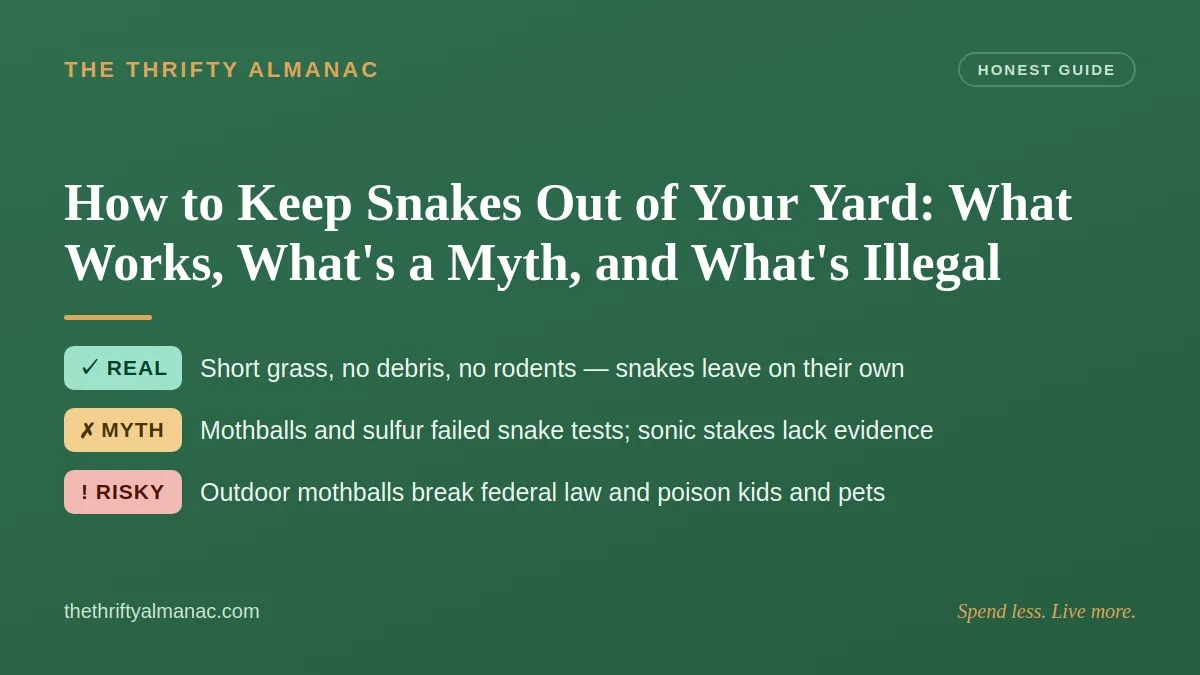
Every spring the same advice resurfaces: scatter mothballs along the fence line, pour a ring of sulfur around the garden, screw a few solar "sonic" stakes into the lawn, and the snakes will leave. Cheap, folksy, and exactly what an old-timer would swear by.
The problem: university extension services have tested most of these tricks, and they fail. Worse, the most popular one — mothballs — violates federal pesticide law and puts kids, pets, and your soil at risk. What genuinely keeps snakes out of a yard is unglamorous and nearly free. This is the honest tier-list.
The 60-second verdict: what works, what wastes money, what breaks the law
| Tier | Methods | The receipt |
|---|---|---|
| REAL | Rodent control, short grass, removing debris piles, sealing the house to the ¼-inch rule, a spec-built snake fence | Recommended across the board — Colorado State, Florida, Utah State, Mississippi State, Illinois |
| MYTH (waste of money) | Sulfur, snake-repellent granules, sonic/vibration stakes, essential-oil sprays, "snake-repelling" plants | Failed in Colorado State testing; the FTC formally warned the ultrasonic-device industry |
| DANGEROUS / ILLEGAL | Mothballs outdoors, handling or killing snakes, folk first aid (cut-and-suck, tourniquets, ice) | Off-label mothball use is illegal under federal pesticide law; most bites happen to people who engaged the snake |
The mothball myth: doesn't work, and it's a federal violation
The National Pesticide Information Center is blunt: mothballs are commonly believed to repel snakes, but they have little effect on snakes and were never intended for that use.
Then there's the legal part. A pesticide label is the law, and mothball labels cover one job: killing clothes moths in sealed containers. Any other use — including scattering them around a yard against snakes — is illegal and can harm children, pets, and other animals and contaminate soil, plants, and water. State pesticide regulators, via Clemson University, have publicly warned against exactly this misuse.
To a toddler or a dog, a mothball in the grass looks like candy — which is why this tier isn't "waste of money" but "dangerous."
Sulfur, repellent granules, and sonic stakes: the tested failures
Most of the store-bought options have been formally tested — and failed.
Snake-repellent granules. Colorado State University Extension reports that Dr. T's Snake-A-Way — a mix of 7% naphthalene and 28% sulfur — failed to repel gopher snakes, western rattlesnakes, brown tree snakes, and plains garter snakes. Mississippi State Extension adds that no fumigant or toxicant is federally registered for snake control at all.
Sulfur. The "pour a sulfur line around the property" trick fails as an ingredient (28% of Snake-A-Way, above) and on its own. Mississippi State tested lime, sulfur, mothballs, and cayenne pepper spray — none worked. Utah State Extension puts it in one sentence: "Do not use snake repellents or sulfur, as they are ineffective."
Kitchen-cabinet sprays. Colorado State's roundup also covers cedar oil and cayenne against black rat snakes — none repelled them. Florida's UF/IFAS sums up the category: advertised snake repellents "simply do not work."
Sonic and vibration stakes. There's no scientific evidence these repel snakes, and the category already has a federal credibility problem. In 2001, the FTC sent warning letters to more than 60 manufacturers and retailers of ultrasonic pest devices because no research supported their rodent and insect claims. Spend the money on caulk.
The pattern shows up across natural pest repellents that actually work — the loudest marketing usually has the thinnest evidence.
What actually works #1: make your yard a terrible place to hide
A snake stays where it has two things: cover and food. The extension services cited in this article — Colorado State, Florida, Utah State, Mississippi State, Illinois — all land on the same free fix: remove the cover. None of them puts a number on it — no extension has measured a percentage — so treat this as unanimous expert consensus, not a statistic. The weekend checklist:
- Mow short, mow often. Utah State notes snakes avoid short grass because it exposes them to predators like owls and hawks. Bonus: the same habit is step one to kill and prevent ticks in your yard.
- Clear brush, wood, and rock piles. Illinois Extension recommends removing debris piles and replacing loose rock walls with tight-fitting material — every gap is a den.
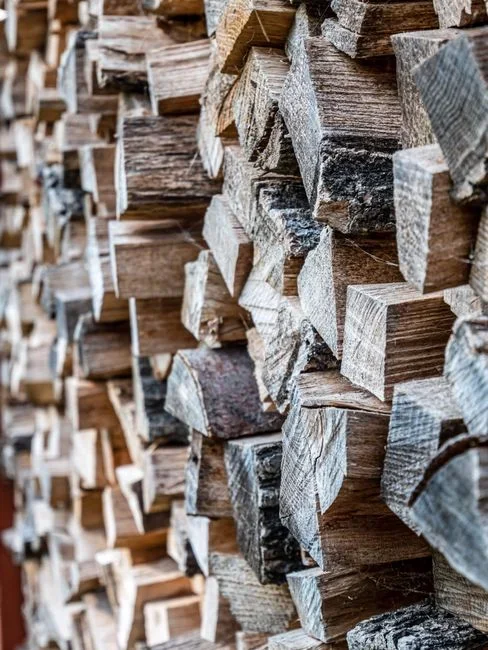
- Raise the firewood. Mississippi State says to store it at least 12 inches off the ground; Florida's extension likewise recommends raised racks.
- Rethink the bird feeder. Utah State flags ground birdseed as a rodent magnet, and Illinois suggests taking feeders down in spring and summer — seed feeds the mice that feed the snakes.
- Ease off the sprinklers. Utah State points out overwatered landscaping attracts the worms, slugs, and frogs that draw snakes in.
What actually works #2: cut off the buffet (rodent control)
Snakes don't move in because they like your landscaping — they follow prey. UF/IFAS notes that ratsnakes turn up in attics, garages, and sheds when rodents are present, and leave once the rodents are exterminated. That makes rodent control the single highest-leverage snake move — it removes the reason a snake hunts your property at all. The cheap version is covered step by step in how to mouse-proof your home for under $15 — do that first, and the snake problem often solves itself.
What actually works #3: seal the house to the ¼-inch rule
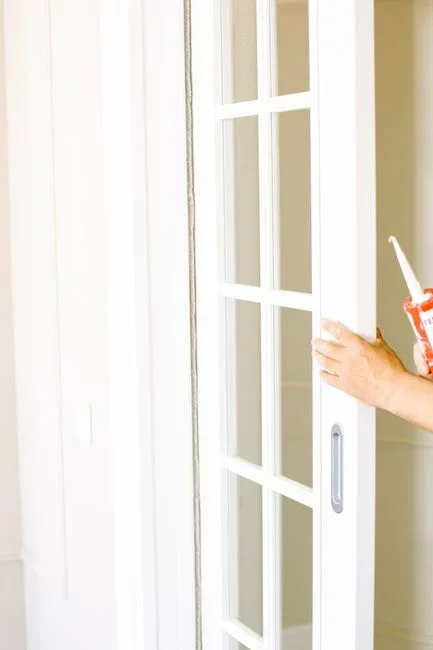
The nightmare scenario isn't a snake in the flowerbed — it's one in the laundry room. Florida's extension warns that some small snakes can slip through an opening no larger than a pencil. Colorado State's rule: seal every gap ¼ inch or larger with mortar, caulk, expanding foam, or 1/8-inch hardware cloth.
Do a slow lap with a caulk gun and a flashlight: foundation cracks, gaps around water and gas lines, dryer vents, the garage-door gasket. Mississippi State adds an often-missed spot — open drainpipes, which should be covered with ¼-inch mesh hardware cloth. One caution: weep holes and vents exist for airflow, so cover them with mesh rather than solid fill, and check local building codes first. The payoff is double — the same ¼-inch rule keeps mice out too.
Snake fencing: the only barrier with a university spec
In rattlesnake country, one physical barrier has university backing — and even its backers call it the expensive, high-maintenance tier. Colorado State's spec: 36-inch-high galvanized hardware cloth with ¼-inch mesh, buried 6 inches deep, slanted outward at a 30-degree angle, with vegetation kept clear so nothing gives a snake a ramp over the top. Florida's version runs 2–3 feet high, buried 6 inches, and is described as a last-resort, high-maintenance measure that deters most snakes — "most," not all. Nobody credible promises a snake-proof yard.
The thrifty play: don't fence the whole perimeter. Fence the zone that matters — the kids' play area, the dog run — and get most of the peace of mind for a fraction of the hardware cloth.
You see a snake anyway: back away (this is where bites come from)
The highest-value tip in this article costs nothing. Texas Parks & Wildlife states that most bite victims are people who deliberately came in contact with snakes — hunting, catching, handling them. The old-timer advice to grab a shovel is precisely how people get hurt. The CDC goes further: never handle a venomous snake, not even a dead one or its decapitated head.
Back away, keep kids and pets inside, and give it a clear exit. For identification, skip head-shape rules of thumb — the CDC's venomous groups (rattlesnakes, copperheads, cottonmouths, coral snakes) vary by region, so check your state extension or wildlife agency's photo guide from a safe distance. Call a professional wildlife remover for a venomous snake in the house or garage, one that won't leave a high-traffic area, or one you can't identify. Expect the visit to average about $340, from roughly $130 for an easy nonvenomous pickup to $600 for a difficult venomous job — not cheap, but far cheaper than guessing wrong with a venomous snake.
If a bite happens: the CDC checklist (and the folk remedies that make it worse)
Per the CDC, 7,000–8,000 people are bitten by venomous snakes in the US each year, and about 5 die — odds that good exist because antivenom works when people reach the ER fast. The treatment is the hospital.
Do: Call 911 and seek emergency care immediately; stay calm and still; remove rings and watches before swelling starts; wash the bite with soap and water. Poison Control adds: keep the limb at heart level, loosen tight clothing, and keep the person quiet. Their experts answer around the clock at 1-800-222-1222.
Don't: The folk first aid that circulates alongside the mothball advice is actively harmful. The CDC and Poison Control both prohibit tourniquets, cutting the wound, sucking out venom, ice, and alcohol. And don't risk a second bite trying to capture or kill the snake — a phone photo from a distance is plenty.
Common mistakes
- Buying granules or sonic stakes after a viral video. Tested failures and unsupported claims — put the money toward caulk and hardware cloth.
- Scattering mothballs outdoors. Ineffective against snakes, and illegal off-label use that endangers kids, pets, and water.
- Killing every snake on sight. That's how most bites happen, and harmless snakes eat the rodents that attract trouble.
- Sealing the house but leaving the wood pile against the wall. Cover plus food cancels out your caulk work.
- Feeding birds year-round in snake country. Spilled seed feeds the mice that feed the snakes.
- Reaching for folk first aid. No tourniquets, no cutting, no ice, no whiskey — 911 and Poison Control only.
FAQ
Do snake-repelling plants like lemongrass or marigolds work?
There's no scientific evidence for any plant repelling snakes, and no university extension recommends one. Concentrated cedar oil and cayenne failed in testing, so a living plant emitting far less scent is a poor bet. Plant them because you like them, not as a barrier.
If I see one snake, does that mean there are more?
Not necessarily — many sightings are one animal passing through. Repeated sightings mean your yard offers cover or food; work back through the checklist and fix what's feeding them.
Should I kill harmless snakes to be safe?
No. Garter snakes and ratsnakes are working for you — UF/IFAS notes ratsnakes show up where rodents are present and leave when the rodents are gone, and attacking any snake is the classic way to get bitten.
What about human hair, coffee grounds, or vinegar lines?
All untested folk claims — no .gov or university extension source supports any of them. Harmless to try, unlike mothballs, but expect nothing.
The takeaway: Skip every bottle, granule, and gadget that says "snake repellent" — mow it, clear it, seal the gaps, and let hungry snakes move on to a messier yard. Spend less. Live more. — The Thrifty Almanac




0comments