

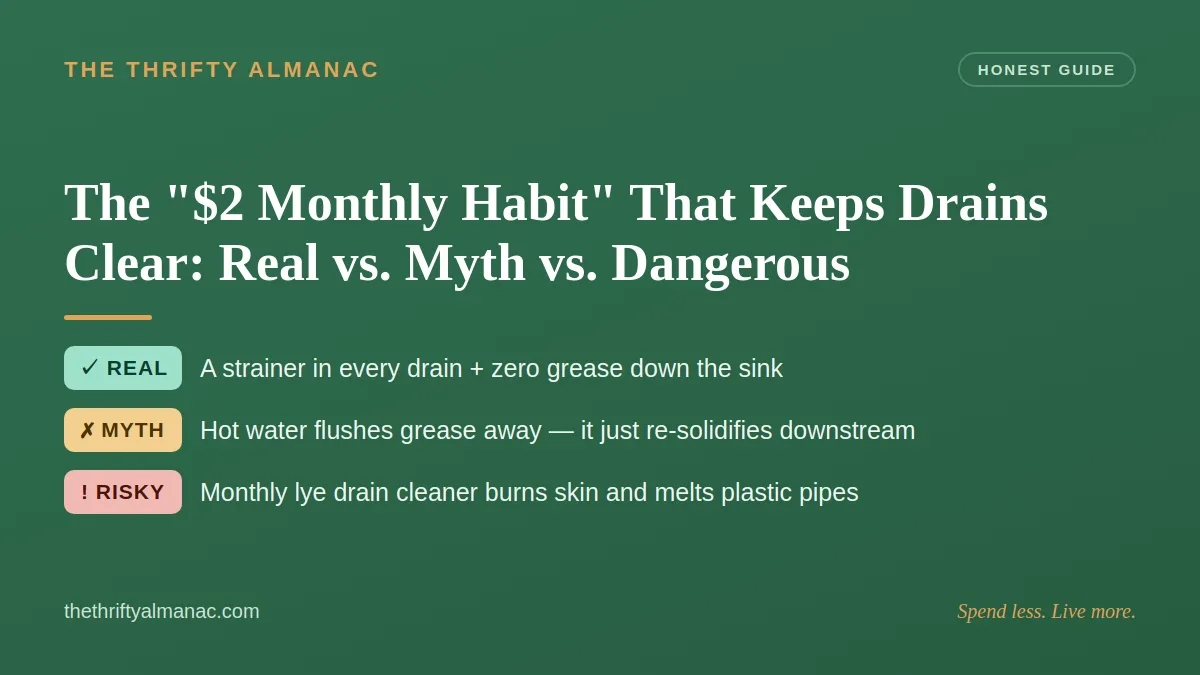
The video is everywhere: a plumber swears his drains never clog thanks to one "$2 monthly habit" — usually hydrogen peroxide, sometimes a fizzing shot of baking soda and vinegar. Half of it is true: cheap prevention beats an emergency call-out. The recipe is what's wrong.
Plumbers' drains stay clear because nothing clog-forming goes down them — not because of a potion. Here's the honest tier list: what's real, what's half-true, what's a myth, and what will quietly buy you new pipes.
The "$2 habit" plumbers swear by isn't what the videos say
Every version of the viral clip gets one thing right — a few dollars of prevention beats a triple-digit pro visit — and sells the wrong mechanism. The habits that matter are physical: keep hair and grease out, and give the pipe nothing to grab. Here's the whole system on one table.
| Tier | The habit | Verdict |
|---|---|---|
| REAL | A mesh strainer in every drain, emptied often | The actual cheap habit — stops hair, floss, and food at the surface |
| REAL | Zero grease down any drain, ever | The top cause of sewer blockages; hot water can't fix it |
| REAL (slow) | A monthly enzyme treatment, overnight | Pipe-safe maintenance for the organic film — never a clog-buster |
| SORT-OF | A hot-water rinse | Hot tap water helps soap residue; boiling water can damage plastic pipe |
| MYTH | Monthly baking soda + vinegar or peroxide "flushes" | Fizzy theater — the rinse water afterward does the work |
| DANGEROUS | Monthly caustic drain cleaner | Burns people, can melt cheap plastic pipe, endangers old plumbing |
Why drains actually clog: hair upstairs, grease downstairs
Bathroom clogs and kitchen clogs are different animals. In the bathroom, the problem is tangles: This Old House calls hair the biggest cause of bathroom drain clogs, and Florida's Department of Environmental Protection warns that hair, dental floss, and other string-like items tangle in drains, snagging soap scum until the pipe chokes.
In the kitchen, the problem is coating. Fats, oils, and grease — FOG — pour in as a liquid, cool, and harden on the pipe walls. Per EPA data cited by Clemson Extension, grease is the most common cause — 47% — of reported sewer blockages, and the EPA estimates at least 23,000 to 75,000 sanitary sewer overflows per year in the U.S., not counting sewage backing up into buildings.
REAL: a strainer in every drain — the actual "$2 habit"
If the viral videos mean anything by "$2 habit," it's this: a mesh strainer or hair catcher in the shower, tub, bathroom sink, and kitchen sink stops clogs at the surface, where cleanup takes seconds. Florida DEP's advice is blunt: "Use sink and shower drain strainers and empty them frequently." In the kitchen, the same screen catches food particles that expand when wet or attach to buildup in the pipe.
Cost honesty: basic hair catchers run a few dollars each at hardware stores, less at dollar stores — a one-time few bucks per drain, not a strict two. Empty them into the trash whenever you see buildup — weekly is a good default — and de-hair pop-up stoppers while you're there.
REAL: keep grease out entirely — hot water will not save you

The most stubborn kitchen belief is that grease is fine as long as you chase it with hot water and dish soap. Clemson Extension kills this one directly: "Hot water and soap do not eliminate F.O.G. because it will eventually reform and solidify in pipes." The hot-water trick just pushes grease past your trap to harden somewhere less convenient, sometimes in the buried line you own.
The routine that works costs nothing. Clemson's rules: never pour fats, oils, or grease down a disposal, sink, or storm drain — cool it, seal it in a can or bottle, and trash or recycle it, then wipe the pan with a paper towel before washing. An empty soup can by the stove makes it automatic.
Extend the never-list: Florida DEP says no coffee grounds and no flour down the drain — grounds settle into sludge, flour turns to paste — and no wipes down the toilet, even "flushable" ones.
REAL, with caveats: a monthly enzyme treatment for the organic film
If you want a pour-something-monthly ritual, this is the only one that survives a fact-check. Bio-enzymatic drain products "break down stuck material into smaller particles, which beneficial bacteria then digest," as Consumer Reports puts it — and they're safer for your pipes than chemical drain cleaners, plus septic-friendly.
Now the caveats — they're the whole story. Enzyme products are slow: they need to sit several hours or even overnight and may need repeat applications. Pour before bed per the label and don't run water afterward. It's maintenance for the film a strainer can't catch — if water is already standing, an enzyme bottle will disappoint you. No government extension service formally endorses them for household drains; the strongest reviews come from independents like Consumer Reports and This Old House, which calls enzyme-based cleaners safe for pipes and septic systems. Ingredient-wary? Screen products through EPA's Safer Choice database.
SORT-OF: the hot-water rinse (and the boiling-water mistake)
A rinse with the hottest water your tap makes has one legitimate job: This Old House notes it helps dissolve soap residue near the fixture. It won't clear grease, and it won't touch hair.
Don't upgrade the tip to a kettle. Per the manufacturer's technical bulletin, PVC pipe has a maximum recommended operating temperature of 140°F — while water at a full boil is 212°F at sea level, far past the material's rating. Repeated kettle dumps can soften and warp plastic traps. Metal lines tolerate boiling water, but most homes mix materials, so the rule is simple: hottest tap water, fine; kettle, no.
MYTH: baking soda, vinegar, or peroxide as a monthly "flush"
The fizzing volcano is chemistry theater. Mix vinegar and baking soda and the acid and base neutralize each other — a University of Tasmania chemistry lecturer writes that a balanced mix gives you "just water, carbon dioxide and sodium acetate" — essentially salty water. He concedes the fizz can nudge an existing blockage in rare cases — but that's not prevention; the flush of water afterward does the real work. Full teardown in the baking soda and vinegar drain myth.
Peroxide is the newer flavor of the same myth — the "pour it down every drain tonight" videos. No utility, extension service, or plumbing authority lists hydrogen peroxide as drain maintenance. The drugstore bottle is heavily diluted — nearly all water — and dissolves neither hair nor grease; breaking down hair takes a strong alkali, precisely the property that makes real drain chemicals dangerous. We sorted what peroxide is genuinely good for around the house — drains didn't make the list.
DANGEROUS: monthly chemical drain cleaner is how you buy new pipes

Caustic and acid drain openers work by being violent. MedlinePlus lists the ingredients — lye (sodium hydroxide), potassium hydroxide, hydrochloric or sulfuric acid — and the injuries: eye burns with possible permanent vision loss, chemical skin burns, burns or even holes in the esophagus if swallowed. If anyone is exposed, call Poison Help at 1-800-222-1222.
Pipes fare little better. Consumer Reports warns chemical cleaner can melt cheap plastic replacement pipes if it sits too long and is a particular worry in older homes with rusted plumbing — on top of harmful fumes. These products do open some clogs; the danger is the "monthly habit" framing. Treat them as an occasional last resort: never as maintenance, never mixed with or poured after another product (splashback causes eye injuries), never right before plunging. A clog that keeps coming back is a symptom — a job for a pro, not a stronger bottle.
Your monthly drain routine, on one card
Everything above collapses into a few dollars up front and minutes a month.
| Cadence | What to do |
|---|---|
| Every day | Strainers stay in; greasy pans get a paper-towel wipe; grease cools in the counter can. |
| Every week | Empty strainers into the trash; quick hottest-tap rinse for soap residue. |
| Every month | Enzyme treatment overnight per the label; pull and de-hair pop-up stoppers. |
| Never | Grease or oils, coffee grounds, flour, "flushable" wipes, boiling water into plastic pipe, caustic cleaner as routine. |
If a drain keeps slowing anyway, stop pouring and start diagnosing — the fix is usually mechanical and cheap. Our guide to the $15 plumbing fixes that replace a pricey pro call-out covers zip tools, trap cleaning, and when the call is worth it.
Common mistakes
- Chasing grease with hot water. It re-solidifies farther down the pipe; grease goes in the trash, always.
- Pouring boiling water into plastic drains. PVC is rated far below boiling — hottest tap water only.
- Expecting enzyme cleaner to open a clogged drain. It's slow, overnight maintenance; standing water needs mechanical help, not bacteria.
- Treating the baking soda volcano as prevention. The reaction mostly neutralizes itself; the water you flush after does the work.
- Using caustic drain cleaner on a schedule — or stacking products. Routine use risks your pipes; mixing chemicals risks your eyes and lungs.
- Installing strainers and never emptying them. An overflowing strainer just moves the clog to the rim; emptying is the habit.
FAQ
Can I pour boiling water down the drain if my pipes are metal?
Metal lines tolerate it — the 140°F ceiling applies to PVC and other plastics. But most homes mix materials: a metal sink drain often feeds a plastic trap you can't see, so the kettle adds risk without benefit.
Do enzyme drain cleaners really work?
As maintenance, yes — with patience. Consumer Reports describes them breaking down buildup for bacteria to digest over several hours or overnight, sometimes with repeat treatments. They keep the film from thickening; they won't rescue a blocked drain.
What should I do with a drain that's already slow?
Go mechanical: de-hair the pop-up stopper, run a plastic zip tool, or clean the trap with a bucket underneath. Slow drains are almost always tangles and buildup, not something a liquid dissolves. If the same drain clogs repeatedly — or several slow at once — the blockage is deeper and it's time for a pro.
Are "flushable" wipes actually safe to flush?
They clear the bowl, not the system. Florida DEP warns that even products labeled flushable can increase the risk of sewer overflows. Wipes and hygiene products belong in the trash — a lidded bathroom bin ends the debate.
The takeaway: Drains stay clear when nothing clog-forming goes in — a strainer in every drain, grease in the trash, and at most a slow overnight enzyme treatment, never a fizzy potion or a monthly dose of lye. Spend less. Live more. — The Thrifty Almanac






0comments