

You've seen the video. Someone tapes a furnace filter to a cheap box fan, calls it "the air purifier that beats them all," and collects a few million views. Most viral hacks fall apart the moment you check the receipts, like the $12 "water from thin air" trick. This one mostly holds up — which is why it's worth building right.
Here's the honest verdict before the details: a well-built box-fan air cleaner (the design engineers call a Corsi-Rosenthal box) cleans fine airborne particles about as well as a small commercial purifier, for a fraction of the price. It does not beat every purifier, it does not remove odors or gases, and it's only safe if you use the right fan.

The viral claim vs. the honest verdict
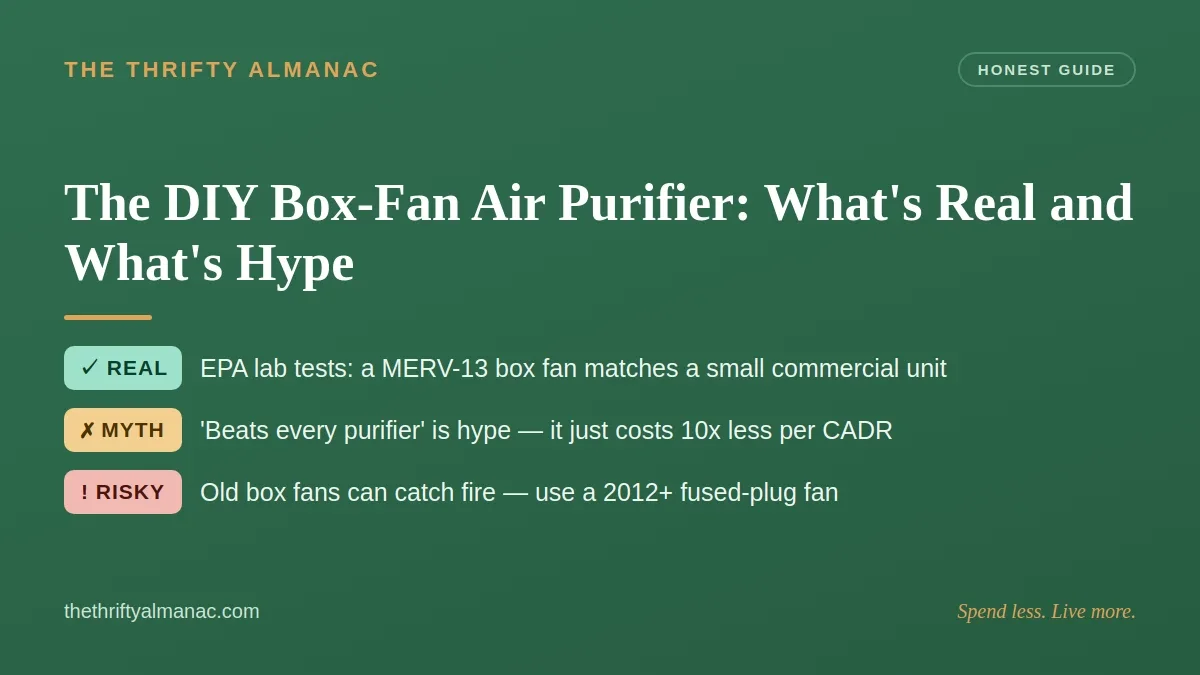
The "beats them all" framing oversells it — and the truth is impressive enough. EPA laboratory testing found that DIY air cleaners were "as effective as a small commercial air cleaner in reducing fine particle (PM2.5) concentrations" — while running louder and drawing more power. The real headline: it ties a small store-bought unit on particles and wins on cost — it doesn't outperform everything on the shelf.
| Verdict | The claim | The reality |
|---|---|---|
| REAL | "Cleans the air as well as a bought purifier" | Matches a small commercial unit on fine particles in EPA lab tests, at roughly ten times lower cost per unit of clean air. |
| REAL | "Great for wildfire smoke and allergies" | High airflow through big filter area makes it strong on smoke particles, dust, and pollen. |
| MYTH | "Beats them all / HEPA-grade" | MERV-13 catches fewer particles per pass than HEPA. The box wins on airflow and filter area, not per-pass efficiency. |
| MYTH | "Kills odors and smoke smell" | Particles only. Gases and smells pass right through unless you add a carbon filter. |
| DANGEROUS | "Any box fan works" | Older fans lack fused plugs and thermal cutoffs — EPA says use a 2012-or-newer fan. |
What the research actually found
This hack has real data behind it from three directions.
EPA's airflow ladder. EPA measured how clean-air delivery climbs with design. A box fan with one 1-inch MERV-13 filter moved 111 cubic feet per minute of smoke-free air; adding a simple cardboard shroud pushed that to 156 cfm — a 40% gain for no added cost. A single 4-inch filter with the shroud hit 248 cfm, and a full four-filter cube reached 401 cfm. More filter area, more clean air.
The CDC/NIOSH study. A peer-reviewed study by federal researchers built a four-filter cube and measured clean-air delivery on the order of 450 cfm. One cube cut aerosol exposure to about 22% of the baseline — close to a 78% reduction — and two-unit setups reached reductions up to 73% depending on placement. The same researchers note MERV-13 filters remove at least 50% of the smallest 0.3-1 micron particles, at least 85% of 1-3 micron particles, and at least 90% of 3-10 micron particles — lower per-pass efficiency than HEPA, but effective because the fan pushes so much air through so much filter.
The inventors' own study. The design was created in 2020 by environmental engineer Richard Corsi and filter-maker Jim Rosenthal. A 2022 UC Davis study of a five-filter cube measured clean-air delivery of about 600 to 850 cfm depending on fan speed, at roughly $0.08 per unit of CADR — about ten times cheaper than commercial purifiers. The full peer-reviewed paper is in Aerosol Science and Technology (2022).
The pattern: there is no single "Corsi-Rosenthal number." Output runs from about 111 cfm for a bare single-filter build to 850 cfm for a five-filter cube.
How to build it right
Most disappointing builds fail on details, not concept. Get these four right.
- Use MERV-13 filters. EPA recommends 20x20-inch filters, 1-inch or 4-inch, rated MERV 13, and notes multi-filter designs "showed increased air cleaning capacity and were more cost-effective." A lower MERV catches fewer fine particles; a much higher one can choke a box fan's airflow.
- Point the arrows toward the fan. Every filter has a printed airflow arrow. All arrows point into the fan, which pulls air through the filters and blows clean air out the top.
- Seal every gap. Tape all seams airtight — any leak lets dirty air bypass the filters.
- Add the cardboard shroud. A cardboard ring over the fan face, covering the corners the blade doesn't reach, is the best free upgrade — EPA's tests credit it with a big airflow gain.
Two builds cover most needs. A single-filter box fan is the fast, cheap version for a small room. A full four-to-five-filter cube assembles in about 15 minutes and delivers the big airflow numbers for a living room.
The real limits nobody mentions
This is where the hype videos go quiet. And a box fan only cleans the air already in the room — during a wildfire-smoke event, sealing the drafty gaps around windows and doors is what keeps new smoke from pouring back in.
It filters particles, not gases. The EPA's consumer guide is blunt: most filters handle either particles or gases, and removing gases takes a separate activated-carbon or sorbent filter — with no widely used performance rating, so "No air cleaner or filter will eliminate all of the air pollutants in your home". A MERV-13 box won't remove cooking odors, the VOCs off fresh paint, or the lingering smell of smoke — only the smoke particles. It also does nothing for carbon monoxide; that's what a CO detector is for.
It won't dry out a room, either. A fan filters air; it doesn't pull moisture — dampness is a different job (see our $5 salt trick for a damp room). Musty air from mold? Filtering spores helps, but you still have to remove the mold at the source.
It's louder and thirstier. EPA flagged that DIY units run louder and pull more power than a comparable commercial cleaner. That's minor day to day — until you plan to run one through a grid outage, where a box fan is a real draw on any battery. Check the math before counting on a cheap backup power box.
Dirty filters stop working. The EPA found DIY cleaners with filters loaded with smoke or dust were "almost completely ineffective, so be sure to replace dirty filters". There's no magic interval — swap them when they look gray or the airflow drops off, and sooner during a smoke event.
Safety: the box-fan fire risk you can't ignore
One caveat is not optional: EPA notes a box fan running with filters restricting its airflow could overheat.

The reassuring news: in Underwriters Laboratories testing of DIY setups, EPA reports "None of the scenarios tested posed any observable fire hazards", and a separate 2021 UL study confirmed that adding filters didn't create a fire hazard. The catch: those findings apply to newer fans. EPA says to use only a box fan from 2012 or newer, which has safety features like a fused plug and a thermal cutoff, kept "clear of obstructions" and run "with common sense precautions." Older fans lack those protections. Check the label before you build, keep the unit away from curtains and clutter, and retire any fan with a damaged cord.
Cost and clean air vs. a store-bought HEPA
Money is where this hack earns its reputation — but the viral price tag describes the bare-bones version, not the real thing. A single-filter build costs little more than the fan, one filter, and a roll of tape. A true four-to-five-filter Corsi-Rosenthal cube runs about $50 to $150 in materials. For comparison, room purifiers with HEPA filtration range from under $50 to well over $500.
The fair comparison isn't sticker price, it's cost per unit of clean air delivered. On that measure the UC Davis team found the DIY box about ten times cheaper per CADR than commercial purifiers. Budget for replacements — a cube swallows four or five filters at a time, and clogged filters stop cleaning. What you give up: a commercial unit is quieter, more compact, and — with a carbon stage — can handle some gases the box can't.
Bottom line: who should build one
Build one if your problem is particles: wildfire smoke, seasonal pollen, household dust, pet dander. It punches far above its price and is worth the 15 minutes to build.
Skip it, or pair it with the right gear, if you need to remove odors, VOCs, or smoke smell (add activated carbon or buy a hybrid), or if you need silent operation in a bedroom. Treat it the way federal researchers do — a temporary, supplemental cleaner, not a permanent replacement for tested commercial units or for fresh air when the outdoors is clean. It earns its place among the home hacks worth actually trying.
Common mistakes
- Using an old box fan. The one real safety error. Use a 2012-or-newer fan with a fused plug and thermal cutoff.
- Buying cheap low-MERV filters. Below MERV-13 you catch far fewer fine particles, and the whole point is lost.
- Skipping the shroud. You're leaving a free airflow gain on the table.
- Leaving gaps in the tape. Any leak lets dirty air sneak past the filters.
- Running clogged filters. A loaded filter is nearly useless — replace it when it grays.
- Expecting it to kill smells. Particles only. Odors and gases need a carbon filter.
FAQ
Does a box-fan air cleaner really work as well as a HEPA purifier?
On fine particles, EPA lab tests show it matches a small commercial cleaner, far more cheaply. It isn't "HEPA-grade" per pass — MERV-13 catches fewer particles each time — but high airflow and big filter area make up the difference in a real room.
How often do I replace the filters?
There's no fixed schedule. EPA found dirty filters become almost useless, so swap them when they look gray or the airflow noticeably drops, and sooner during a wildfire-smoke event.
Will it get rid of smoke smell or cooking odors?
No. It removes smoke and dust particles, not gases or smells. Odor and VOC removal needs a separate activated-carbon filter, per the EPA's air-cleaner guide.
Is it safe to run overnight?
The testing that found no fire hazards used newer fans. Stick to a 2012-or-newer box fan with a fused plug and thermal cutoff, keep it clear of curtains, and never use an old fan or a damaged cord.
Which build should I make — single filter or full cube?
A single-filter box fan is cheapest and fine for a small bedroom. A four-to-five-filter cube moves far more air — up to 600 to 850 cfm in testing — and suits a living room or open space.
The takeaway: The box-fan air cleaner is the rare viral hack that delivers on particles — build it with MERV-13 filters and a newer fan, respect its limits, and never trust an old box fan to run all day. Spend less. Live more. — The Thrifty Almanac





0comments