

A viral video claims razor cartridges are "designed to dull after three shaves" so manufacturers can keep selling you refills. It's a satisfying story — big company, hidden kill-switch, your wallet the victim. It's also not what's happening at the edge of your blade.
The real reasons blades die are duller than the drama: microscopic chips you'll never see, and mineral crust left behind when water dries on the edge. The second is almost entirely in your control, and the fix costs nothing but a towel and a moment. Here's the honest breakdown — what's real, what's a myth, and where the thrift turns dangerous.
"Designed to dull after three shaves"? The physics says otherwise
Give the conspiracy its due: blades do die faster than they should, and refills are priced like printer ink. But there is no timer inside a cartridge. The "three uses" figure comes from viral videos, not from any manufacturing evidence. It's the same genre of clip that oversells the $12 water-from-thin-air trick. When MIT engineers put razor blades under an electron microscope to see why they actually fail, they found ordinary — if surprising — physics, published in the journal Science in August 2020.
Two processes kill a blade: microchipping, where individual hairs crack the ultra-thin edge, and corrosion plus mineral deposits, where water left sitting on the blade attacks and crusts it over. You can't do much about the first. The second is the whole reason this article exists.
| Claim or habit | Verdict | The honest detail |
|---|---|---|
| Dry the blade after every shave | REAL | The best-documented life extender |
| Store the razor outside the shower | REAL | Standing moisture drives both edge corrosion and mineral scale |
| Strop the blade on denim or your forearm | MOSTLY MYTH | Refines a still-sharp edge; can't revive a dull or chipped one |
| "Blades are engineered to die after three uses" | MYTH | No kill-switch exists — dulling is chips, corrosion, and scale |
| "No visible rust means the blade is still good" | MYTH | The edge is nanometers wide; it fails long before rust shows |
| Shaving on with a tugging, nicking blade | DANGEROUS | Cuts, irritation, ingrown hairs — a ragged edge is false economy |
| Sharing a razor to save money | DANGEROUS | A bloodborne-infection route; never do it |
What actually dulls a razor blade (two mechanisms, one you control)
Microchipping: how soft hair beats hard steel
The MIT team expected blades to slowly wear round and smooth. Instead, their experiments showed very little rounding — and that a single human hair, though about 50 times softer than the blade's steel, can chip the edge outright. Chips form when hair meets the blade at an angle or at a weak, uneven spot in the steel's microstructure; hairs cut dead-perpendicular didn't chip the edge at all. Once a microcrack starts, a mechanism called stress intensification grows it rapidly into a chip. The edge fails by cracking, not by wearing smooth — so much for the old belief that whiskers slowly polish a blade dull.
Before you despair: chipping is real but slow. Metallurgist John Verhoeven found that after as many as 140 shaves, microchips still covered too little of the edge to noticeably hurt shaving smoothness — and he saw no visible corrosion or pitting at 50x magnification. So if your blade tugs by week two, chips alone aren't the culprit.
Water: the everyday killer at a nanometer-wide edge
Verhoeven lists four ways blades dull: corrosion of the steel, wear from whiskers, mineral deposits left by poor drying, and microchipping. In an ordinary bathroom, the deposits are the headline act. When water dries on the blade, its dissolved minerals stay behind as carbonate scale — metallurgists call the crust "evaporites" — sitting right where the cutting happens.
Why doesn't stainless steel shrug this off? It resists rust through a self-healing chromium-oxide film only about 3 nanometers thick (it takes more than 10.5 percent chromium), which reforms whenever oxygen is present. But the film can break down locally in confined, stagnant, low-oxygen wet spots — exactly the environment between the blades of a cartridge parked in a shower caddy. It's also why "no visible rust" proves nothing: the cutting edge is only nanometers wide, and invisible edge damage dulls it long before rust shows on the flats.

The one habit that works: dry the blade after every shave
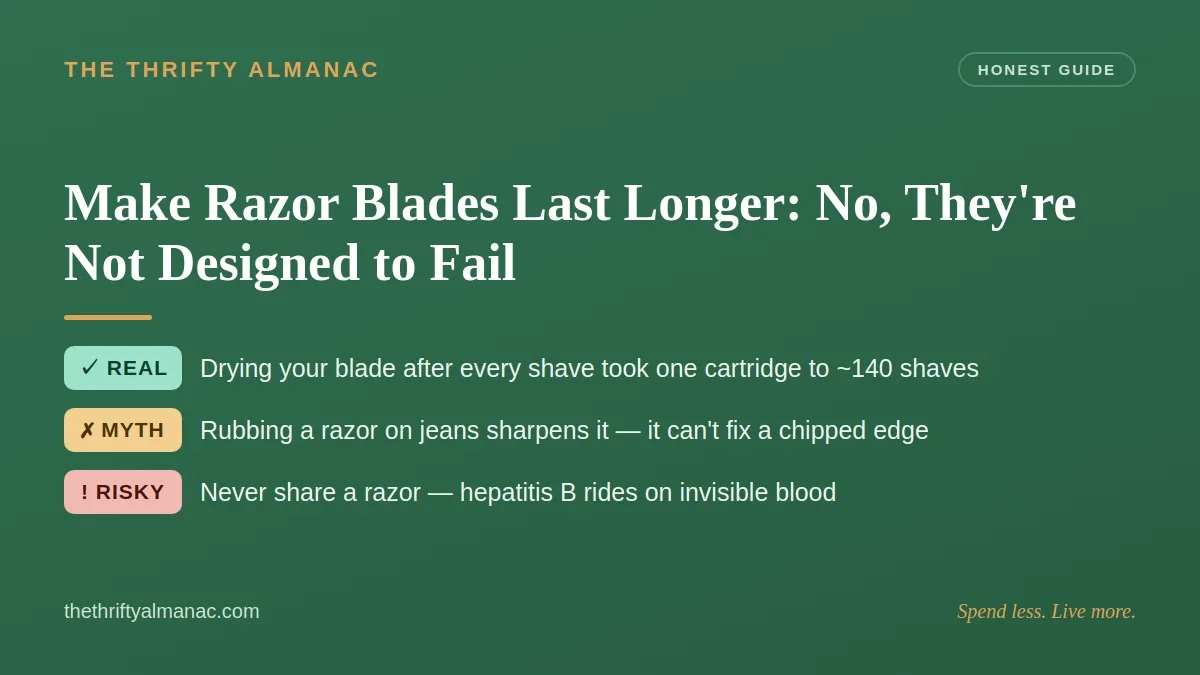
This is the same principle behind stopping rust cheaply anywhere else in the house: take away the standing water and you take away both the corrosion and the mineral crust. With a thorough after-shave routine, Verhoeven ran a single cartridge for many months — roughly 140 shaves — before pulling became a problem. The routine takes seconds:
- Rinse hot. A fast hot-water rinse flushes hair and cream from between the blades.
- Shake. A few firm flicks of the wrist to throw off most of the water.
- Blot, don't wipe. Tamp both sides against a dry towel, pressing straight down rather than dragging along the edge.
- Clear the gaps. Blow off any water still trapped between the blades.
- Store it dry. Park the razor outside the shower where air can reach it — it's the hours of sitting wet that do the damage.
Dermatologists arrive at the same habit from a different direction: the American Academy of Dermatology recommends storing your razor in a dry area so it dries completely between shaves, to keep bacteria from growing on it. When metallurgy and dermatology agree, that's as settled as frugal advice gets.
Two honest footnotes. The payoff depends on your water: the crust is mineral scale, so hard-water homes gain the most, soft-water homes less. You'll also see advice to coat the edge in mineral or camellia oil — plausible, but the solid evidence supports drying, not oiling; treat oil as an optional experiment. The ceiling is real, too: drying does nothing for mechanical chips, so the edge still ages. Just far slower.

Stropping on denim or your arm: what it really does
The other famous hack: drag the razor backward along your jeans or forearm to "sharpen" it. Scanning-electron-microscope work at Science of Sharp shows that stropping refines an edge that's already keen — a few strokes remove a tiny sliver of metal, smooth the apex, and add a slight convexity. What it cannot do is restore a truly dull or chipped edge; that damage requires regrinding the bevel, which no pair of jeans will ever do.
Cartridge razors — what most people use — barely benefit at all. The edge sits boxed in between a guard bar and a lubricating strip, so denim can hardly reach the apex; any improvement you feel is likely the fabric wiping off oxidation and deposits, which your towel already does for free. Stropping rates "real but narrow" for straight razors, "maybe" for double-edge blades, and a shrug for cartridges — and once chips have formed, no amount of denim helps. That blade is done. File this one next to homemade laundry detergent: a frugal legend that runs on how it feels rather than what it does.

How long can a blade really last — and what you save
Two anchor points. The AAD advises replacing a blade after 5 to 7 shaves to minimize irritation — a fair baseline for a razor that lives wet in the shower. The well-dried ceiling is Verhoeven's roughly 140 shaves on one cartridge. Land anywhere near that and you're buying a small fraction of the cartridges you used to.
Don't promise yourself the ceiling, though. Beard coarseness, water hardness, and pressure all move the number, and your skin gets the final vote. The math still works if drying merely doubles or triples your blade life. Concretely: a daily shaver on the AAD's six-shave schedule goes through about 60 cartridges a year — call it $240 at $4 a cartridge, a typical brand-name price. Stretch each blade to twelve shaves with the drying habit and the same year runs about $120. Run your own numbers: cartridges per year, times what each costs you, divided by whatever multiplier the habit delivers — the difference recurs every year. It's the maintenance-beats-replacement thinking that Depression-era households practiced by default, and one of the few viral frugal tips that holds up under a microscope.
When to stop stretching it: the safety line
A long-lived blade is a bonus, not a goal to chase past sense. Replace the blade the moment it tugs, catches, nicks you, or shows any discoloration along the edge. The AAD's guidance exists because dull blades cause real problems — nicks, razor burn, ingrown hairs — which is why it pairs the 5-to-7-shave rule with using a sharp blade, shaving with light strokes, and rinsing after each swipe. A blade that scrapes and bleeds you every morning isn't thrift; it's a skin problem on layaway.
And one line never worth crossing: never share a razor, no matter the savings. The CDC warns that hepatitis B can spread through shared razors via amounts of blood too small to see, and plainly advises against sharing them. Buy the second razor.
Common mistakes
- Storing the razor in the shower. Constant humidity plus mineral-loaded droplets is the exact recipe for scale and edge corrosion.
- Wiping the towel along the edge. Blot straight down instead — dragging fabric across the apex can damage the edge.
- Trusting your eyes. A blade can look flawless and still be dull; the damage is microscopic. Judge by tug, not by shine.
- Stropping a dead blade and blaming your technique. Once the edge is chipped, denim can't fix it. Replace it.
- Shaving through the tug to squeeze out one more week. Nicks, irritation, and ingrown hairs cost more than a cartridge.
- Sharing a razor with family or roommates. Bloodborne pathogens travel on blades. This is the one corner never to cut.
FAQ
Does storing the blade in oil or rubbing alcohol extend its life?
Oiling the edge to block moisture is plausible and widely repeated, but the documented evidence supports drying, not oiling — treat oil as an optional add-on after the towel step. Alcohol dips and freezer tricks have no authoritative support; skip them.
Can you actually sharpen a cartridge razor?
No. Stropping can maintain an edge that's still sharp, but on a cartridge the blades are boxed in by the guard and lube strip, so there's little to gain. Nothing short of regrinding — impossible on a cartridge — restores a chipped or truly dull edge.
How do I know it's time to replace the blade?
Let your skin decide: replace at the first tug, catch, nick, or any discoloration on the edge. The AAD's 5-to-7-shave guideline is the honest baseline for an untended razor; careful drying stretches that considerably, but comfort — not a shave count — is the signal that matters.
Is it hygienic to use the same blade for months?
It can be, if the blade is rinsed clean after every shave and stored where it dries completely — the AAD's own advice for preventing bacterial growth on razors. What's never hygienic is a blade that nicks skin, or one that anyone else has used.
The takeaway: Nobody rigged your razor — water did it, so rinse, blot, and store the blade dry, and replace it the moment it tugs. Spend less. Live more. — The Thrifty Almanac






0comments