

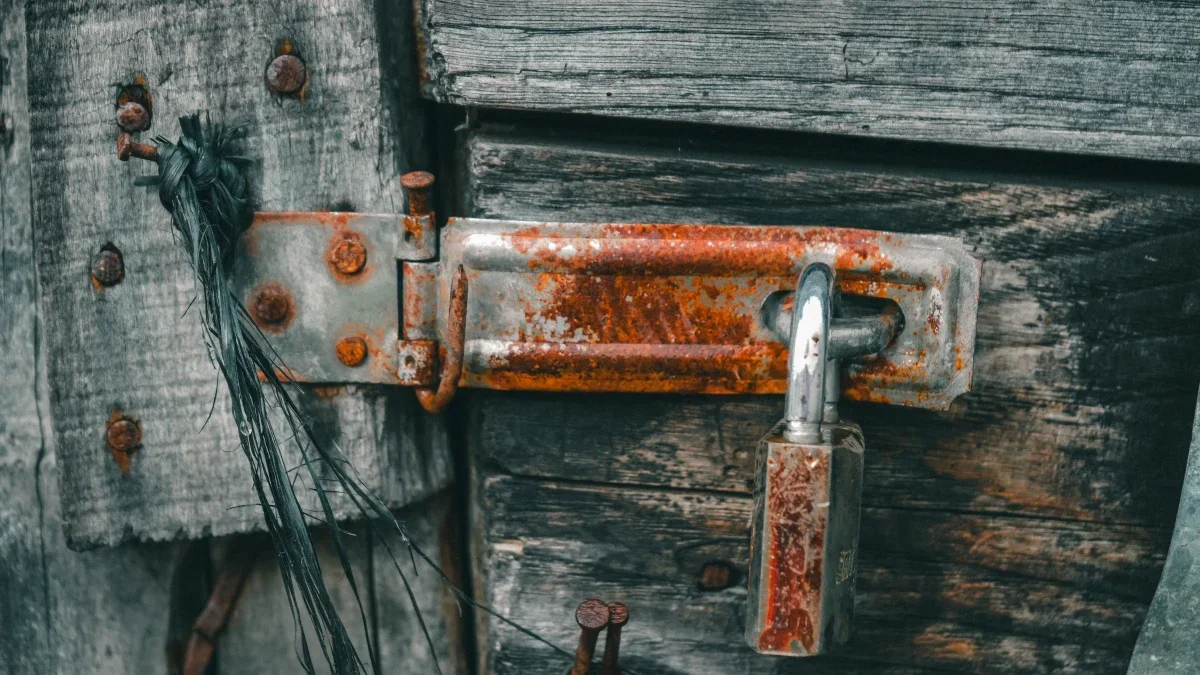
You wipe a dark liquid onto a rusty hinge, it turns black in a minute, and the video calls it done. That color change is real chemistry, but it is not the whole story — and the whole story is what saves you a second repair. Fixing rust with cheap household-grade acids is legitimate, well-documented work. The same slow oxidation that pits a hinge is what quietly dulls a razor, which is why drying the blade makes it last for months. The problem is that the how-to field is crowded with product demos that show the color change and stop, never explaining what actually happened, how long it lasts, or that the black coating is not a finished, weatherproof surface.
Here is the honest version those demos skip: rust work is three separate jobs, and confusing them is why people redo the same repair every spring. Once you can tell REMOVE from CONVERT from PROTECT, the cheap methods finally do what you wanted.
The three jobs people confuse: remove vs. convert vs. protect
Almost every rust question is really a question about which of three jobs you are doing. They use different chemistry, different products, and they solve different problems. The same three-way confusion trips people up with masonry too, where densifying, sealing, and waterproofing concrete get treated as one move when they are really three.
- REMOVE — strip existing rust off the metal. Acid dips (vinegar, some commercial removers) dissolve the rust away and leave bare steel behind.
- CONVERT — turn the rust that is there into a stable, insoluble barrier instead of removing it. This is what phosphoric- and tannic-acid "rust converters" do.
- PROTECT — seal the surface so oxygen and water cannot restart the reaction. Paint, primer, or oil. This is the step that buys you years.
Read that list once more, because the trap is right there: none of the three, on its own, is permanent. Remove and you have bare, reactive steel. Convert and you have stabilized rust that still needs sealing. The finish — the protect step — is what makes any of it last. Pick your path by what you are looking at: heavy loose rust means start with REMOVE; thin, stable surface rust means CONVERT; clean or freshly treated metal means PROTECT.
REMOVE: what vinegar and acid dips actually do (and their trap)
WHAT: Vinegar is dilute acetic acid, and an acid dip dissolves iron oxide — the rust — right off the surface. Soak a rusty bolt overnight and the crust softens and lifts. This genuinely works as a stripper.
HOW: The acid attacks the oxide and pulls iron into solution. According to the physics outreach team at the University of Illinois, "a first step in rusting involves some iron coming off the metal, going into solution," and "iron is more soluble in acidic solutions, like vinegar." So the acid does not politely stop at the rust — it keeps dissolving into the clean metal underneath too.
WHY this matters: That same solubility is the trap. The moment you lift the part out, you are holding bare, chemically reactive steel with no protective layer at all — and because iron dissolves so readily in acid, the surface is primed to flash-rust almost immediately in ordinary humid air.
LIMIT: This is the single biggest rust myth. Vinegar does not "stop" rust — it removes it and hands you a fresh problem. Bare steel after an acid strip has to be rinsed, dried, neutralized, and sealed within hours, or it rusts again, sometimes faster than before. Removal is a strip, never a protection step. If you are not ready to seal it the same day, do not strip it.
CONVERT: the real chemistry of phosphoric and tannic acid
WHAT: A rust converter does the opposite of a stripper. Instead of dissolving rust away, it chemically transforms the rust that is there into a stable, insoluble compound that stays put and slows further corrosion. Two cheap acids do this by two different routes.
Phosphoric acid: building an iron-phosphate barrier
HOW: Phosphate ions react with the iron to precipitate insoluble iron-phosphate compounds. Research published in the journal Materials describes the result as a passive film with a duplex layer — an inner layer of iron (hydro)oxides and an outer layer of iron phosphates, "mainly as FeHPO₄, Fe₃(PO₄)₂." That outer film is the barrier that hinders corrosion.
WHY it works: The phosphate layer forms because it is thermodynamically favored — the chemistry genuinely wants to go there. The same paper reports a free energy of formation around −2444.8 kJ/mol for Fe₃(PO₄)₂ and roughly −1664 kJ/mol for FePO₄. Those strongly negative numbers are why the phosphate barrier preferentially forms and stabilizes the surface instead of leaving it to keep corroding.
Tannic acid: locking rust into a chelate
HOW: Tannic acid takes a different path. It chelates — chemically grips — the iron to form iron tannate, which, per a corrosion-inhibition study also in Materials, "chelate[s] with iron ions to generate iron tannate covering the surface and transfer active corrosion products into a stable state" (PMC). This is a real, defined chemical bond, not a surface stain: separate analytical work confirms a 1:1 tannic-acid-to-Fe(III) coordination complex, written [(tannic acid)Fe]³⁺. The dark color you see is that chelate forming.
WHY it works: Locking loose, active rust into a stable, insoluble compound means it is no longer feeding the corrosion cycle. That is the credible mechanism the product demos skip — they show you the color and never tell you it is a genuine chemical conversion.
LIMIT: Converters only work on sound, thin rust. The acid has to make contact with a real, thin oxide layer to do its chemistry. Conservators at the University of Iowa describe the correct starting move: "carefully scrape away the flaking rust spots," then even out the surface before finishing. Heavy, flaky scale has to come off mechanically — scrape, wire-brush, or sand — before any converter goes on. Wipe a converter over thick loose scale and you are just coloring debris that will fall off and take your "fix" with it.
PROTECT: why a converter is not the finish line
WHAT: Here is the myth that sends people back to the same rusty hinge in a year: "the black coating means it's protected — you're done." It does not, and you are not. A converter stabilizes rust chemically, but it is preparation for a topcoat, not the topcoat itself.
HOW we know: Two independent lines of evidence say so. First, NASA's technical evaluation of rust converters describes them plainly as a treatment "for use on a rusted surface before the application of an organic coating (bituminous compounds, primer or topcoat)" — developed as an alternative to sandblasting the metal as prep for paint (NASA NTRS). Second, and more surprising: a converted layer can actually make the surface more water-attracting. In the Materials corrosion-inhibition study, the water contact angle of the rusted surface dropped to 41.6 degrees after tannic-acid treatment — lower contact angle means water spreads and clings more, not less — and the researchers had to add a separate hydrophobic layer to keep water out.
WHY it matters: A bare converter left in the weather is holding water against the metal it was supposed to save. That is exactly why "I treated it and it still rusted" happens. The chemistry did its job; the missing seal did not exist. Once you have removed or converted, you must protect — paint, primer, or a coat of oil rubbed in, the way the Iowa conservators finish their work. It is the same oil-and-seal logic that can keep a wood fence standing for decades — the finish, not the material, is what outlasts the weather.

LIMIT: Sealing is mandatory for longevity, and even a sealed job has limits. In salty or chloride-heavy environments — coastal air, road salt, de-icing spray — the phosphate and tannate barriers hold up far less well. This is a general home-and-workshop fix, not a marine or road-salt solution. Directionally, a converter plus a real topcoat lasts years; a bare converter lasts months. Treat those as the shape of the outcome, not a guaranteed calendar.
Putting it together: pick your path safely
The whole decision collapses to one card. Match your situation to a path, then always finish with the seal.
- Heavy, loose, flaking rust → REMOVE mechanically first (scrape, wire brush, sandpaper), or acid-strip — then immediately rinse, dry, neutralize, and seal.
- Thin, stable surface rust → CONVERT with a phosphoric- or tannic-acid converter on sound rust only → then seal with primer/paint or oil.
- Clean or freshly treated metal → PROTECT. Paint, primer, or an oil finish is what actually buys you the years.
The cheap "old-ways for pennies" framing is honest as far as the chemistry goes — phosphoric and tannic acids really are inexpensive and really do this work. If that honest, chemistry-first approach is what you are after, it runs through all of our budget-minded home fixes. The same lens is worth turning on the other garage-cupboard can people credit with powers it never claimed — what WD-40 actually does to bugs. What is dishonest is stopping at the color change. The value is not the product; it is knowing which of the three jobs you are doing and never skipping the seal.
A word on safety, because this is chemistry, not a craft project. Phosphoric and tannic acids are corrosive and irritant — wear gloves and eye protection, work with ventilation, and keep them off skin. Follow each product's label; a general explainer of documented chemistry is not a substitute for the manufacturer's directions. And keep the scope honest: chemical rust conversion is a cosmetic and surface-protection treatment. It is not a structural repair, and it does not belong on food-contact surfaces, potable-water parts, or any load-bearing, safety-critical metal. Rust on a car frame rail, a jack stand, or a deck bracket is a job for a professional, not a wipe-on converter. Knowing where that line sits is the same money-saving judgment behind the cheap plumbing repairs worth doing yourself.
Common mistakes recap
- Believing vinegar "stops" rust — it only removes it, and the bare steel flash-rusts unless sealed the same day.
- Confusing REMOVE with CONVERT — vinegar dissolves rust away; phosphoric acid turns it into a barrier. Opposite jobs.
- Treating the black converted layer as a finished coating — it is prep for paint, and can even attract water on its own.
- Wiping a converter over thick, flaky scale instead of mechanically cleaning down to sound rust first.
- Skipping gloves and eye protection with corrosive acids, or using conversion on structural or food-contact metal.
FAQ
Does vinegar stop rust for good?
No. Vinegar is a rust remover, not a rust stopper. The acid dissolves the oxide and keeps eating into the bare metal, which is more soluble in acid — so the steel you pull out flash-rusts fast unless you dry, neutralize, and seal it right away.
If I use a rust converter, do I still need to paint over it?
Yes. A converter stabilizes the rust chemically but is not a weatherproof finish — NASA's evaluation describes it as surface prep applied before a primer or topcoat, and tannic-acid layers can even become more water-attracting. Seal it with paint, primer, or oil, or it keeps corroding.
Are vinegar and phosphoric acid interchangeable?
No — they do opposite jobs. Vinegar (acetic acid) dissolves and removes rust, leaving bare steel. Phosphoric acid converts rust into an insoluble iron-phosphate barrier that stays on the surface and slows corrosion. Confusing "remove" with "convert" is the core mistake behind most failed rust repairs.
Will a converter fix thick, flaky rust?
Not on its own. You have to scrape, wire-brush, or sand off the loose scale first so the chemistry contacts sound, thin rust — the same first step conservators use. Heavy scale must come off mechanically before any converter goes on.
The takeaway: Rust is three jobs — remove, convert, protect — and the cheap acids only pay off when you know which one you're doing and always finish with a seal. Spend less. Live more. — The Thrifty Almanac




0comments