

You have seen the clip: a plastic bag over a leafy branch, a sheet of film stretched over a pit, or a little $12 gadget on a windowsill — and a narrator promising you can "pull gallons of clean water out of thin air" for almost nothing. It is the kind of hack that feels like a cheat code for survival. So here is the honest question almost nobody on screen actually answers: how much water does it really make in a night, and could a person live on it?
The short version is that "water from air" is real physics, not a scam. The dishonest part is the size of the promise. Put an actual liters-per-night number on it, then check that number against a humid backyard, a dew-prone valley, and a dry desert, and the trick shrinks fast. This is a "how much does it really make" explainer, not a survival or emergency-water guide. Treat it as a curiosity, not a plan. It is one more viral home hack held up to the numbers.
The $12 trick, on trial: how much water does "thin air" actually give you?
The viral version comes in three flavors: a bag tied over a living plant so its own moisture (transpiration) condenses inside, a plastic sheet over a pit that catches nighttime dew, and cheap "atmospheric water" gizmos that imply the same magic in a box. The pitch is always identical: nearly free water, straight from the sky, works anywhere. It is the same too-good-to-be-true framing behind a lot of old-fashioned tricks that rarely deliver.
What every clip leaves off is the one number that matters: yield per square meter, per night. They show a few glistening drops and let your imagination fill in a jug. Fill that blank with measured data and the story changes — because the trick behaves very differently in a muggy backyard than where you would actually be desperate for water.
WHAT you actually get: the liters-per-night number nobody puts on screen
WHAT: A passive dew collector — the sheet-over-a-pit style rig — is the fairest test case, because it just harvests moisture the night sky hands it. Researchers ran one square meter of collector for two years and weighed what it caught. On most nights, the yield landed between 0.05 and 0.25 mm of dew, climbing to a seasonal best of about 0.55 mm/night in the good months (field study, Int. J. Low-Carbon Tech.).

HOW to picture it: A millimeter of dew over a square meter is exactly one liter. So the everyday translation is:
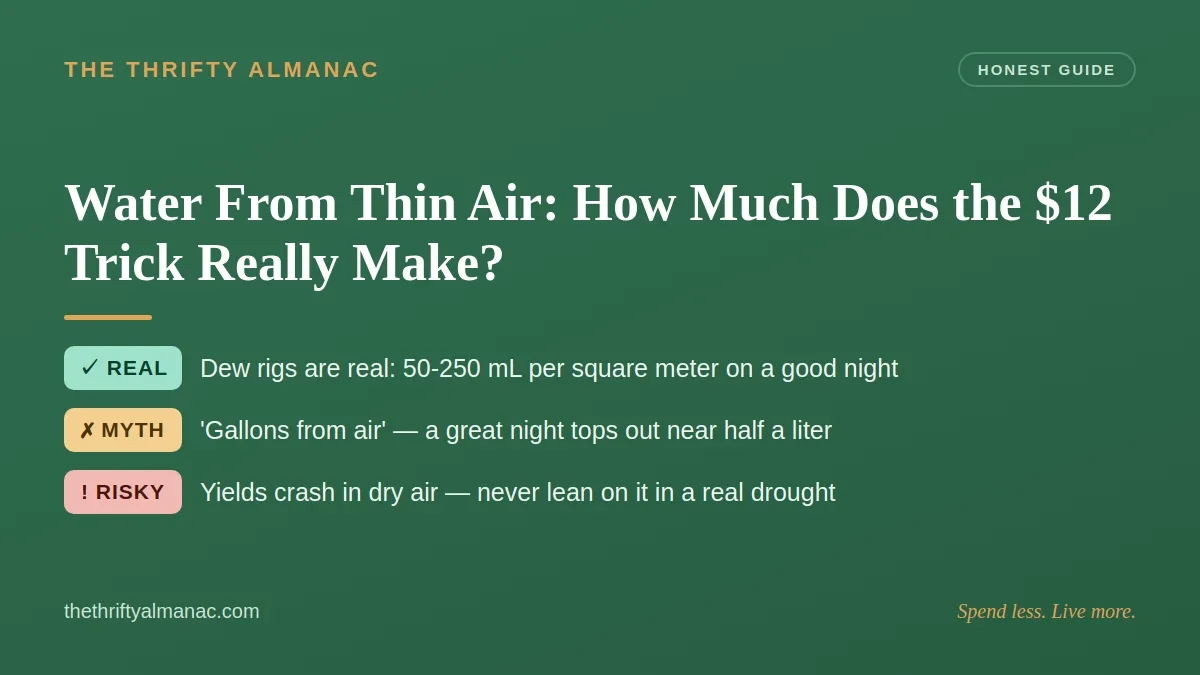
- A typical night: 0.05–0.25 mm equals roughly 50 to 250 mL per square meter — somewhere between a shot glass and a single mug of water.
- A great night: about 0.55 mm, or roughly 550 mL — a bit more than a standard water bottle, off a full square meter of gear.
WHY this is the honest headline: Even at the seasonal peak, one square meter produces about half a liter — not gallons. A person needs several liters of drinking water a day, so a good-night dew rig would have to cover many square meters, on a perfect night, just to match one day's needs. And most nights sit at the low end, not the peak.
LIMIT: These are measured, good-condition figures with clear skies and decent humidity. A cloudy, windy, or dry night can give you almost nothing. Do not read 0.55 mm as a nightly guarantee; read it as the ceiling on a favorable night in a favorable place.
HOW it works: why air is such a stingy water source
WHAT: The reason the number is so small is not bad engineering — it is the air itself. Air simply does not carry much water. Even warm air in the mid-80s°F (about 30°C) holds a maximum of only about 30 grams of water vapor per cubic meter, and cooler or drier air holds far less (NOAA / National Weather Service).
HOW to feel that: Thirty grams is about two tablespoons of water spread through a cube of air a yard on each side. To condense a single 250 mL cup, you would have to wring the moisture out of roughly eight cubic meters of already warm, already humid air — completely, which nothing does. A passive rig cannot move air at all; it just waits.
WHY dew forms at night: After dark, a surface facing a clear sky radiates heat upward and cools below the surrounding air. When it drops below the "dew point" — the temperature at which the air's vapor starts condensing — moisture beads out onto it. That is why dew rigs need clear skies (clouds bounce heat back down and stop the cooling) and collect almost nothing on a warm, overcast night.

LIMIT: The 30 g/m³ figure is a ceiling for warm air; the real capacity swings night to night with temperature and humidity. The mechanism is trustworthy, but the yield is at the mercy of the weather — which is exactly why you cannot bank on it.
WHY it collapses in the desert (and the energy math of doing it with a machine)
Here is where the survival framing gets it backwards. The pitch says "it's from the air, so it works anywhere, even the desert." The physics says the opposite: condensation gets worse as air dries, and nearly stops exactly where water is scarcest.
A NIST thermodynamicist said as much when reviewers examined a viral device called the WaterSeer, whose makers estimated 11 gallons a day from semi-arid air and up to 14 gallons a day in humid conditions. As Kenneth Kroenlein noted, "In most of the areas that are being underserved by water resources, the dew points are very, very low," and "it's very unlikely that you're going to be able to use condensation to pull water out of the air in dry places." In a field trial, a scaled-down version of that device produced only about 300 mL over three hours — nowhere near the gallons promised (Popular Science).
What about a powered machine? Active atmospheric water generators (AWGs) are just powered condensers — dehumidifiers, essentially — and they can make meaningful volumes. The passive, unplugged cousin of the same idea is the cheap salt trick for a damp room. But they run on electricity, and the energy cost climbs sharply as the air dries out. The minimum work to pull water from air follows W/M = Rv·T·ln(1/H), where H is relative humidity. That term is zero at 100% humidity (saturated air gives up its water for free) and rises steeply as humidity falls. At 50% relative humidity and 25°C, the theoretical floor is about 95 kJ per kilogram of water — around 38 liters per kWh in the ideal case (peer-reviewed analysis, Heliyon).
Real machines never touch that ceiling. The same analysis found even the most efficient Energy Star dehumidifier manages only about 2.35 liters per kWh, and tested AWG units delivered under 1.2 L/kWh — less than 5% of the theoretical best (Heliyon). So the "free water" framing is exactly that. They work, but you pay for every liter in electricity, and the drier the air, the higher the bill.
LIMIT: This is a description of how AWGs behave, not a recommendation or a build guide. If you are considering one, judge it as an appliance with a real running cost — especially in a dry climate, where it fights the hardest for the least. The same clear-eyed test — real help versus hype — applies to a DIY box-fan air cleaner.

LIMIT: real but tiny — and don't drink it raw
The fair verdict, holding both halves of the truth at once: passive "water from air" is genuine physics, not a hoax — and it produces far too little to live on, with the shortfall worst exactly where you would need it most. It follows the same real-but-oversold pattern as other old-house standbys, like the old masons' water-glass fix for concrete cracks. Mapped by climate:
- Humid backyard: a little. Tens of milliliters on a normal night, maybe half a liter per square meter on a great one.
- Dew-prone valley with clear skies: a bit more consistent, but still measured in cups, not gallons.
- Desert: almost nothing. Low dew points mean passive collection nearly stops, which is why the "works even in the desert" claim is backwards.
And a hard safety point, because this touches drinking water. Water condensed from air or scraped off a collecting surface is not automatically safe to drink. It can pick up dust, microbes, and whatever leached off the plastic or metal it ran across, so any collected water should be filtered and disinfected first — and it is worth knowing which homemade filters actually remove what. The plant-bag variant adds a hazard: if the plant is toxic or unknown, its transpired water can carry harmful compounds, so do not treat the bag-over-a-branch trick as a safe drinking method. And none of this is an emergency water source. For real preparedness, store clean water ahead of time and keep the means to filter and disinfect more.
Common mistakes recap
- Believing a passive rig makes gallons — the measured reality is tens of milliliters up to about half a liter per square meter on a good night.
- Assuming "from the air" means "works anywhere," when dry desert air is the worst case, not the best.
- Calling the trick a scam — it isn't; it is real physics, just badly oversold.
- Treating an AWG machine as free water — it is a powered dehumidifier with a real electricity bill that grows as the air dries.
- Drinking the condensate raw, or drinking plant-bag water from an unknown or toxic plant.
FAQ
Can I really get water from air with a $12 plastic trick?
Yes, a little. A one-square-meter dew collector realistically catches something between a shot glass and a mug on a typical night, and up to roughly half a liter on a great humid night (field study). The physics is real; the "gallons" part is the exaggeration.

Could I survive on water pulled from the air?
Not from a passive rig. A person needs several liters of drinking water a day, and a good-night collector gives only about half a liter per square meter. You would need a lot of gear, a lot of luck with the weather, and even then it would fail in the dry conditions where you would need it most.
Why does it barely work in the desert if there's "always some" moisture in the air?
Because condensation depends on the dew point, and desert dew points are very low. As a NIST scientist put it, "it's very unlikely that you're going to be able to use condensation to pull water out of the air in dry places" (Popular Science). Drier air holds less water and gives it up less easily.
Do the machines that "make water from air" actually work?
They do, but they are powered dehumidifiers, not magic. Even a top dehumidifier gets only about 2.35 liters per kWh of electricity, and real AWG units deliver less than that (Heliyon). The energy cost per liter rises as humidity drops, so they are least efficient in exactly the dry places where the pitch sounds most appealing.
The takeaway: "Water from thin air" is real physics but a tiny trickle — cups on a good humid night, almost nothing in the desert — so enjoy it as a science demo, never as your water plan. Spend less. Live more. — The Thrifty Almanac





0comments