

Somewhere in America right now, a bag of water is hanging over a back door, catching the light, doing absolutely nothing. Maybe there's a penny in it. Maybe a scrap of foil. The person who hung it swears it works — the flies do seem thinner this week — and their neighbor is about to hang one too. It's the most-shared fly remedy on the internet, and it's folklore.
The trouble with fly advice online isn't that it's all wrong. It's that the proven method and the pure superstition get filmed the same way, with the same confident voice, so you can't tell which is which until you've wasted a summer. The same fog settles over bigger fights — sorting out which bed bug remedies actually hold up means wading through the identical mix of solid method and confident nonsense. So here's the honest version: a receipts-first tier list of the old-fashioned tricks, ranked against what university entomology extension services actually document. This is for ordinary nuisance flies in the kitchen — not a heavy infestation or flies tied to a septic or dead-animal problem, which are jobs for a licensed pro.
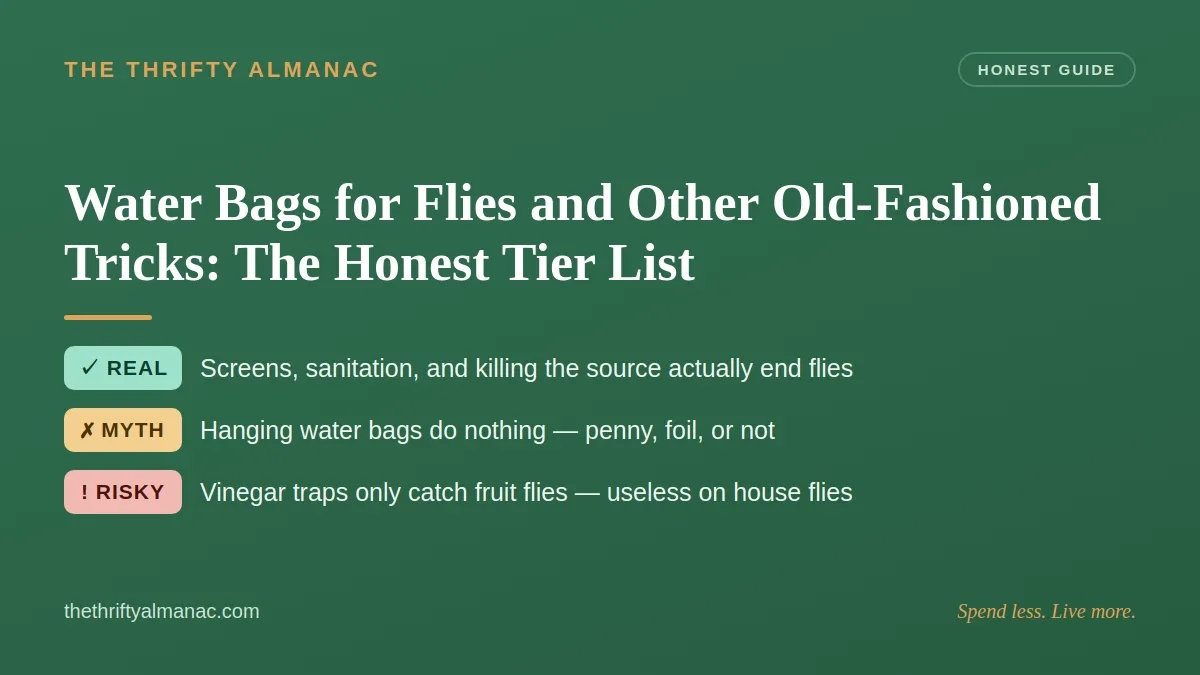
The honest tier list, in one glance
Before the explanations, here's where each remedy lands. The rest of the article shows the receipts.
- PROVEN: Exclusion (good screens, closed doors) + sanitation + finding and killing the breeding source.
- SITUATIONAL: The apple cider vinegar trap — real, but only for fruit flies, and only if you don't skip the dish soap.
- MILD / OVERHYPED: Herbs and essential oils — a flicker of evidence in a lab, not a fly-free kitchen.
- MYTH: The hanging water bag. It doesn't work.
Notice the pattern: the thing that actually works is the thing nobody makes a satisfying video about, and the thing everybody shares is the one at the bottom.
MYTH: the hanging water bag
WHAT it claims: A clear bag of water — sometimes with a penny, a marble, or foil — hung in a doorway supposedly scares flies off because they panic at their own giant, distorted reflection and won't fly under water.
WHY people believe it: This is a masterclass in observation bias. Fly numbers rise and fall on their own with the weather, the garbage schedule, and whatever's rotting in the yard. Hang a bag during any natural dip and your brain files it as cause and effect. Nobody remembers the weeks it did nothing.
What the evidence says: Extension entomologists put it plainly. Mississippi State University Extension lists the water-and-penny bag among the folk fixes and concludes, flatly, that "these homemade fixes just don't work". There's no credible mechanism behind it and no extension service that endorses it. A house fly's compound eyes don't process a water bag the way the folklore imagines.
LIMIT: If your bag "worked," you almost certainly did something else right at the same time — took out the trash, closed a window, cleared fallen fruit. Credit that, not the bag. Take the bag down; it's using up a doorway and a little of your dignity.

SITUATIONAL: the apple cider vinegar trap — and why yours failed
WHAT it is: A small bowl of apple cider vinegar with a few drops of dish soap, left near where the little flies gather. First, though, know your fly — it decides everything. Tiny, slow flies with reddish eyes hovering over the fruit bowl or drain are fruit flies, which breed indoors; the bigger, faster ones darting in from outside are house flies, and the house-fly guide is the right tool for those. This trap is for fruit flies.

HOW it works: The vinegar smells like fermenting fruit and draws the flies in. The soap is the part everyone forgets, and it's the whole trick — it breaks the surface tension so a landing fly sinks and drowns instead of skating across the top. Texas A&M AgriLife describes exactly this: "a plastic bowl containing an attractant, like apple cider vinegar, and a few drops of soap to drown flies."
WHY yours failed / LIMIT: Usually one of two reasons — you left out the soap (so flies drink and leave), or you aimed it at house flies, which it doesn't attract. And even done right, a trap is a helper, not a cure: Iowa State University Extension is clear that a trap is "only a temporary relief at best. Eradication will require eliminating the source." The full build-and-troubleshoot version lives in the fruit-fly trap guide.
MILD / OVERHYPED: herbs and essential oils
WHAT people claim: A pot of basil or mint on the windowsill keeps the kitchen fly-free.
What the evidence actually shows: There's a real signal here, but it's smaller than the claim. In a controlled laboratory study, plant essential oils — eucalyptus, fennel, and sage — did repel adult house flies, with measurable repellency in a lab assay. That's genuine. But read the fine print the researchers themselves wrote: the effect came from concentrated oils, measured over a short window in glass flasks, and the authors state outright that "further field validation... [is] needed".
WHY the potted plant disappoints, and a safety note: A living basil plant on the sill isn't releasing anything close to a concentrated oil at a repellent dose — which is exactly why so many people say "the herbs did nothing." No extension service points to a potted herb as fly control; they point to screens and sanitation. And caution earns its keep here: several common essential oils are toxic to cats and dogs, so don't diffuse or dose oils around pets on the strength of a fly claim. This is one entry on a longer list of natural repellents worth keeping or skipping.
PROVEN: the boring fix that actually works
The only tier that works is unglamorous, which is precisely why it never goes viral: good screens, plain sanitation, and finding the hidden breeding source. The one idea underneath all of it — the flies you see are only the symptom. UC IPM says it as directly as anyone: "Elimination of larval habitat is the preferred method of pest fly suppression," because insecticides "target adult flies, leaving immature developmental sites unchanged." Purdue Extension frames the front door just as plainly: tight-fitting window screens and closed doors keep them out in the first place.
That's a whole method, and it's covered step by step where it belongs — not buried under a myth-busting article. For the big flies at your windows, follow the house-fly guide; for the tiny ones at the drain and fruit bowl, the fruit-fly fix. Both come back to the same move: find the wet, rotting thing the flies breed in, and remove or clean it. It's the quiet backbone of nearly all effective do-it-yourself pest control.
Quick-reference summary table
| Remedy | Works on | Verdict | The honest reason |
|---|---|---|---|
| Hanging water bag (± penny) | Nothing | MYTH | Extension services confirm it just doesn't work; "success" is observation bias. |
| Apple cider vinegar + dish soap | Fruit flies only | SITUATIONAL | Real trap — but soap is mandatory, and it does nothing to house flies. |
| Herbs / essential oils | Unproven for home use | MILD | Lab repellency from concentrated oils; a potted plant isn't that. Some oils harm pets. |
| Screens + sanitation + source removal | All nuisance flies | PROVEN | The only approach extension entomologists actually endorse. |

FAQ
Does the water bag over the door really do anything?
No. Extension entomologists at Mississippi State list it among the folk remedies that simply don't work. If flies dropped off after you hung one, look for the real reason — a closed window, cleared trash, cooler weather.
My apple cider vinegar trap isn't catching anything. Why?
Two usual culprits: you left out the drop of dish soap (so flies float instead of drown), or you're targeting house flies, which the trap doesn't attract. It's built for fruit flies — confirm which fly you have first.
Will basil or mint on the counter keep flies away?
Not reliably. The only solid evidence is lab repellency from concentrated essential oils, and the researchers say real-world validation is still needed. A living plant isn't a proven barrier — and some oils are toxic to cats and dogs.
The takeaway: the hanging water bag is folklore and the vinegar trap only catches fruit flies — the flies that actually leave are the ones whose door you shut, whose garbage you sealed, and whose hidden breeding source you found and cleaned out. Spend less. Live more. — The Thrifty Almanac





0comments