

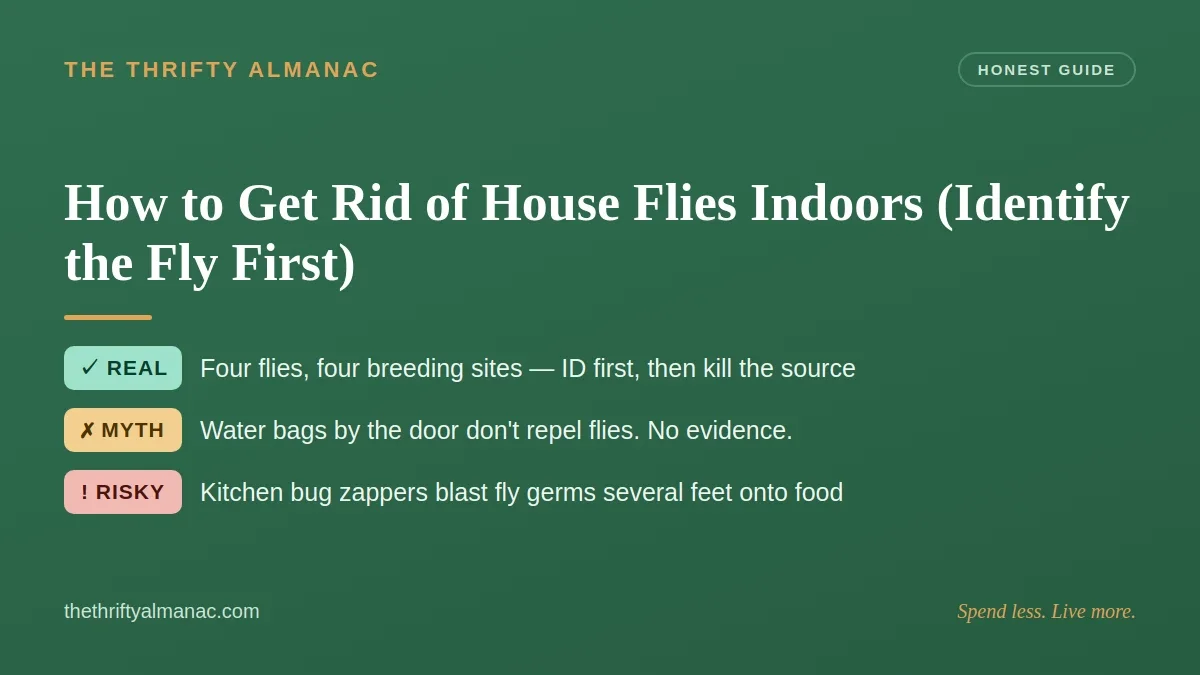
You have flies in the house, you searched for a fix, and the internet handed you a video titled something like "KILL Every Fly (Easy DIY)." One jar, one hack, problem solved. Except it usually isn't — because "house flies indoors" is rarely one insect. It's often four, and they breed in four completely different places.
A vinegar trap by the fruit bowl will never touch a drain-fly colony living in the slime under your sink. Sealing your attic does nothing for the gnats circling a forgotten potato. That's why the single most useful move costs nothing: figure out which fly you actually have before you buy anything. Here's the honest, extension-science version — what's real, what's a myth, and what's genuinely a bad idea near your food. Working from the pest, not the product, is exactly how doing your own pest control at home stays cheap and effective.
First, figure out which fly you actually have
Spend 30 seconds watching the fly before you spend a dime fighting it. Size, eye color, where it lands, and the time of year narrow it down quickly — and each answer points to a different breeding source, which is the thing you'll actually have to fix.

| The fly | What it looks like | Where it rests | Where it actually breeds |
|---|---|---|---|
| House fly | Medium, dull gray, sluggish | Walls, windowsills, near the trash and kitchen | Garbage, pet waste, decaying organic matter |
| Fruit / vinegar fly | Tiny, often red-eyed, about 1/4 inch, hovering | Over the fruit bowl, recycling, or a slow drain | Overripe produce, spills, wet drains, empty bottles and cans |
| Drain / moth fly | Tiny, fuzzy, moth-like wings, about 1/8 inch | Sitting still on bathroom or kitchen walls near drains | The slimy organic film coating a drain |
| Cluster fly | Noticeably larger than a house fly, dark gray, golden hairs, sluggish | Upstairs windows in fall and early spring | Outdoors — the larvae parasitize earthworms |
The tell that settles it is the breeding location, not the bug. If you can't confidently name the fly by sight, you'll confirm it in the next step when you go looking for the source — because that's where the fly leads you. One honest caveat: identifying by look and behavior is a "most likely," not a lab result. Fruit flies and the drain-loving humpbacked (phorid) flies can look alike, so let the source have the final say.
Step 2: Sanitation first — kill the source, not the adults
Before any trap, any spray, any gadget: find and remove the wet, rotting material the maggots are living in. This is not the boring throat-clearing before the "real" solution — extension entomologists are blunt that it is the solution. Purdue's guidance states plainly that insecticides alone cannot be expected to rid premises of flies, and UC IPM's rule is just as direct: when flies have access to garbage, baits alone will not control them.
The reason is speed. A house fly can go from egg to adult in as few as 7 to 10 days, so a source you don't remove simply refills faster than you can trap. And there's a health reason to care about house flies specifically: a systematic review linked at least 130 pathogens — from bacteria to viruses — to them, because they walk on waste and then on your counter. Here's the source hunt by species:
- House flies — take out the trash, keep bins tightly lidded, clean up pet waste, and clear any decaying plant or food matter. Then close the door they came in.
- Fruit flies — toss the overripe produce, wipe up juice and soda spills, rinse the recycling, and check for a forgotten onion or potato at the back of a bin.
- Drain flies — this one is physical. You have to scrub the organic film out of the drain with a stiff brush. UC IPM is explicit that the key is elimination of breeding sites, not pouring something down the hole.
The catch: source-hunting can take detective work. A hidden culprit — a drain in a rarely used guest bathroom, produce that rolled under the counter — keeps the problem alive even after the visible cleanup, which is why the flies "come back" for people who skipped this step.
What actually works indoors (the honest tier list)
Once the source is gone, a few tools genuinely help mop up the stragglers — at their real, modest power level, not the miracle level the ads promise. And a few popular "solutions" are worth none of your money. Here's the honest tier list.
| Verdict | Method | The honest read |
|---|---|---|
| REAL | Sticky fly paper or ribbons | Effective at eliminating a few flies in confined areas — a mop-up, not a whole-house cure |
| REAL | Cider-vinegar bait trap + a drop of dish soap | Genuinely works, but only for fruit flies, placed right at the infestation |
| REAL | Non-electrocuting UV light trap | Can work indoors where it isn't competing with daytime sunlight — so, away from windows |
| REAL | Screens and sealing gaps | The actual long-term fix for house flies and cluster flies getting in |
| MYTH | A water bag hung by the door | No evidence it repels flies |
| MYTH | Bleach or boiling water down the drain | Doesn't remove the film the larvae live in — short-term at best |
| DANGEROUS | A bug zapper near food prep | Explodes flies and flings germ-laden parts several feet |
Placement is what separates a tool that works from one that just hangs there. Put the bait trap right next to where the fruit flies are; a well-made cider-vinegar trap that actually catches them exploits their attraction to fermentation, which is exactly why it does nothing for a drain fly or a house fly. Put the fly paper where flies already rest. Keep the UV trap out of competing daylight. One limit to be honest about: there's no trustworthy percentage for how many flies sticky paper catches, so anyone quoting you a catch rate is guessing — treat it as "a few flies, small rooms" and no more.

The myths people waste money and effort on
Three of these come up again and again, and each one has a specific reason it fails.
The water bag by the door
Hanging a clear plastic bag of water to "confuse" flies is a classic, and University of Minnesota Extension lists it among natural remedies with no evidence that it repels house flies. If you're curious about why these old-fashioned fixes stick around, there's a separate breakdown of the water-bag trick and other folk remedies — plus a look at which natural repellents actually hold up to scrutiny.
The kitchen bug zapper
This one isn't just useless — it's the one to actively avoid near food. UC IPM warns to never use a bug zapper near food preparation areas, because the insect body often explodes on the wires and parts can be propelled over several feet. A Kansas State University lab study measured what that spray contains: electrocuting flies released roughly 1 in 10,000 of the bacteria and viruses on flies coated with microbes, and about 1 in 1,000,000 from flies that had eaten them, and the researchers concluded such traps could play a role in spreading infectious disease agents. Their advice was to keep electrocuting traps out of food-handling areas, hospitals, and daycare facilities. Fair limit: that study proved microbes get released in a lab; it did not document a home zapper making anyone sick. Treat it as a clear reason to keep the zapper away from the kitchen, not proof of food poisoning.
Bleach or boiling water down the drain
It feels decisive, but UC IPM calls it a common misconception: pouring boiling water or bleach doesn't remove the organic film in the drain and gives at best short-term control. The larvae live in that film, not in the standing water, so anything that doesn't physically scrub the film out is a temporary distraction. (And never mix bleach with other drain cleaners — the combination can release toxic fumes.)
When flies are a symptom of a bigger problem
Sometimes flies aren't a nuisance — they're a diagnosis of the building itself.
A cluster of big flies at your upstairs windows in fall or spring is almost never a hygiene problem. Cluster flies don't breed indoors at all; their larvae are parasitic on earthworms outside. Seeing them inside means adults crawled in to overwinter through gaps in your walls, attic, or around vents. The fix isn't spray — it's exclusion: screen the attic vents, add weather stripping, and caulk the gaps around siding, windows, and vents.

Drain flies that keep coming back after you've scrubbed every reachable drain point somewhere hidden. UC IPM notes that if you can't find the source in accessible drains, pipes in crawlspaces, wall voids, and beneath concrete slabs may need to be inspected for breaks or leaks. A persistent colony with no visible drain source can mean a cracked or leaking pipe soaking the material they breed in — a prompt to inspect (and possibly call a plumber), not proof of a break on its own.
Quick-reference: the right move for each fly
| Fly | Where it breeds | The one thing that fixes it | Don't bother with |
|---|---|---|---|
| House fly | Trash, pet waste, decaying matter | Remove the source + screen the openings | Kitchen bug zappers |
| Fruit fly | Overripe produce, spills, wet drains | Clean it up, then a cider-vinegar trap | Fogging sprays |
| Drain fly | Organic film inside drains | Physically scrub the film out | Bleach or boiling water |
| Cluster fly | Outdoors (earthworms); overwinters in walls | Seal and screen the building | Water bags |
Common mistakes
- Treating all four flies as one problem. A fruit-fly trap by the bowl does nothing for a drain-fly colony. Identify first.
- Buying a trap before removing the source. Extension science is clear that baits and sprays are temporary while the breeding material stays put.
- Pouring things down the drain instead of scrubbing it. The larvae live in the film, so you have to physically remove it.
- Running a bug zapper over the kitchen counter. It sprays fly fragments several feet — the last thing you want near food.
- Blaming your housekeeping for cluster flies. Those are a sealing problem, not a dirty-house problem.
FAQ
What's the fastest way to get rid of fruit flies?
Remove the fermenting food first — the overripe produce, the sticky recycling, the spill under the toaster — then set a cider-vinegar trap with a drop of dish soap right where they gather. The trap only mops up adults; without clearing the food, new ones keep hatching.
Why do I have flies when my house is clean?
Because the source is usually hidden or outdoors. Drain flies breed in a film you can't see without looking down the drain, and cluster flies don't come from your kitchen at all — they overwinter in wall and attic gaps. Clean counters won't stop either one.
Do ultrasonic or plug-in fly repellents work?
The verified extension and research sources here don't support electronic repellents or repellent essential-oil sprays for house flies. The tools with actual evidence behind them are unglamorous: sanitation, screens, sticky paper for a few strays, and a bait trap for fruit flies.
When should I call a professional?
Call a pest professional if flies keep returning after you've removed every source you can find, and call a plumber if drain flies persist after you've scrubbed all reachable drains — that can signal a cracked or leaking pipe in a wall void or under a slab that you can't reach yourself.
The takeaway: Name the fly, kill its breeding source, and most of the gadgets become unnecessary. Spend less. Live more. — The Thrifty Almanac






0comments