

You have seen it a hundred times: pour a mound of baking soda down the sink, chase it with vinegar, and watch the drain erupt in foam. The caption promises a clear pipe for pennies. Then you run the tap, the water still pools, and the clog has not moved an inch.
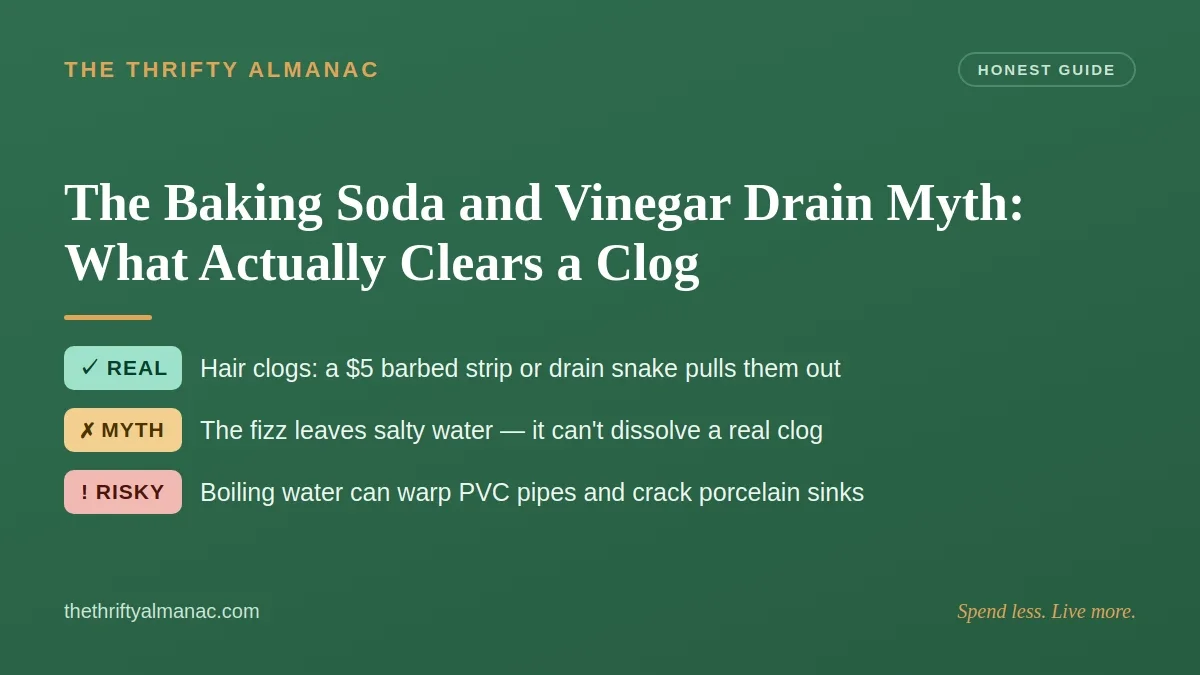
Here is the honest version the viral "unclog any drain instantly" videos skip: the baking-soda-and-vinegar volcano is chemistry-fair theater, not a drain opener. The foam is real, but it does almost nothing to a blockage. Clearing a drain is not hard once you stop hunting for one magic hack and match the fix to the kind of clog you have. This article does that, grounded in published chemistry and public-health guidance rather than "we poured it in and filmed it." It is the same real-versus-myth test worth running on any homemade cleaner you're tempted to trust.
What is actually happening in the reaction (and why the fizz is a dead end)
The scene is fun to watch because baking soda is a base, vinegar is an acid, and together they react in a hurry, throwing off a head of foam. For a science demonstration, that is the whole point. Inside a clogged pipe, it is the wrong show in the wrong place — and to see why, it helps to know what is in that foam once the bubbling stops.
When vinegar and baking soda meet, the atoms rearrange into three things. According to the American Chemical Society, baking soda (sodium bicarbonate) and vinegar (acetic acid) react to form sodium acetate, water, and carbon dioxide. That carbon dioxide gas is the fizz — the bubbles you see are simply CO2 escaping into the air.
Follow that to its conclusion. The gas leaves, and what stays behind is water plus a dilute salt, sodium acetate — the same harmless compound that gives salt-and-vinegar chips their tang, per the ACS. Salty water has no power to dissolve a wad of hair or a plug of grease. Once the fizz stops, the reaction is spent, and you are rinsing the clog with something barely different from tap water.
The most common misunderstanding online: people think the "reaction" keeps working on the clog. It does not. An acid-base reaction like this runs its course and is over — there is no lingering solvent doing quiet work down there, just water and a pinch of salt.
Why it fails on a real clog: wrong place, no force, self-canceling

- Wrong place. The reaction happens where the two ingredients meet — up in the open basin and the top of the drain — not far down at the blockage. By the time any liquid trickles to the clog, the fizzing is already finished.
- No force. A household drain is an open system, not a sealed bomb. The carbon dioxide has nowhere to push except straight up and out of the sink, the path of least resistance. It vents into the room, not down against the obstruction — so there is essentially no mechanical pressure at the clog, the opposite of what a "blast it loose" video implies.
- Self-canceling. The whole appeal is combining a base with an acid — but that is why nothing corrosive survives. Each neutralizes the other, so whatever cleaning muscle either had alone cancels out and leaves mild salt water.
None of this is dangerous — just ineffective. Baking soda and vinegar will not hurt your pipes; they will not clear them either. They do earn their keep on other chores, though; it's worth knowing which pantry staples genuinely clean and which are just theater.
How to actually clear it — match the fix to the clog
A drain gets blocked for different reasons, and each has its own honest fix. Figure out which of these three you have, and go straight to the right branch.
Branch 1: Hair and soap scum → mechanical removal
What it looks like: the classic slow bathroom sink, shower, or tub. That gray, ropey gunk is hair bound together with soap scum, usually snagged just below the stopper.
How to fix it: pull it out physically — this clog is a solid object, so the tool has to reach it and grab it.

- Start with the cheapest tool: a long, flexible barbed plastic strip (the kind with tiny hooks along the edge). Feed it past the stopper, twist, and pull the hair mat out. A straightened coat hanger with a hook bent into the end does the same job for free.
- For anything deeper, use a hand-crank drain snake (a drain auger), which reaches farther down the pipe and hooks or breaks up the clog.
Why this is the right call: the EPA advises, "Avoid chemical drain openers for a clogged drain. Instead, use boiling water or a drain snake." A snake physically removes the hair and solids — no chemistry, and nothing left in the pipe.
Branch 2: Congealed grease → heat plus a grease-cutting soap
What it looks like: a kitchen sink that drains slower and slower over weeks, often with no visible hair. Fats and oils that went down warm and liquid have cooled into a waxy lining in the pipe.
How to fix it: soften the grease with heat and break its grip with detergent. Squirt a generous amount of grease-cutting dish soap into the drain, then flush with a kettle of very hot water; the soap emulsifies the fat and the heat keeps it moving. The EPA names boiling water as a first-line approach for a clogged drain. For a stubborn, long-established grease plug, professional drain clearing beats dumping product after product.
Limit — read this before you reach for the kettle: boiling water is fine for metal pipes, but it can soften, warp, or loosen the joints in PVC and other plastic pipes, so use hot tap water instead if your lines are plastic. And never pour boiling water into a porcelain sink or toilet bowl — the sudden temperature change (thermal shock) can crack the porcelain.
Branch 3: Slow and recurring → this is a maintenance problem
What it looks like: you clear the drain, it works for a while, then it slows down again. The clog is not one event; it is a habit the drain has picked up.
How to fix it: keep grease and oil out of the drain in the first place. The EPA lists grease — including butter, wax, cheese, and heavy cream — along with cooking oils among the things you should never pour down the drain. Wipe greasy pans with a paper towel before washing, and pour used cooking fat into an old jar to harden and trash. A cheap mesh screen catches hair and food scraps before they become next month's clog. It is the least glamorous branch and the only one that stops the problem from coming back. If you want that habit spelled out, here is the simple monthly routine that keeps drains clear for about two dollars.
Why the pros skip the volcano — and skip the harsh chemicals too
When a fizzy hack fails, the instinct is to escalate to a strong chemical drain opener instead. The EPA points the other way — toward boiling water or a drain snake — precisely because harsh chemicals cause collateral damage. Poured down the drain, drain cleaners and other household chemicals can be harmful to the beneficial bacteria that break down waste in a septic system, and can be discharged into the groundwater and reach drinking water supplies.
What about the enzyme and bacteria "drain and septic" additives sold as maintenance? A septic system already holds "a significant presence of bacteria, enzymes, yeasts, fungi, and other microorganisms," which is why the EPA says these additives are "not recommended for domestic wastewater treatment." The microbes are already there. The real win is keeping grease, oils, and harsh chemicals out — not dosing the system with more of what it has. (That applies to normal domestic systems, not a specific setup's code or manufacturer rules.)
When to stop, and when to call a plumber
Being handy means knowing where handy ends. A few safety limits matter more than any hack.
- Never combine products. If someone has already poured a chemical drain cleaner in, do not add other products on top — some combinations release dangerous gases. And do not snake or plunge a drain full of caustic cleaner; trapped product can splash back onto skin and eyes.
- Snake gently. A drain auger can scratch finishes and, if forced, damage older or corroded pipes and traps. Feed it slowly and stop at hard resistance instead of cranking through it.
- Respect the porcelain and plastic caveats above before using boiling water.
- Call a licensed plumber when several fixtures drain slowly at once, when you smell sewage, or when drains gurgle — red flags for a main-line or septic problem, not a job for a hand tool.
One honest disclaimer: this article synthesizes published chemistry from the ACS and public-health guidance from the EPA. It is general information — not results tested in our own kitchen, and not a substitute for a licensed plumber or your septic manufacturer's instructions.
Common mistakes recap
- Expecting baking soda and vinegar to dissolve a clog — the fizz is spent CO2 and salt water, with no clog-dissolving power left.
- Believing the foam "blasts" the blockage out — a drain is an open system, so the gas vents up and out, not down at the clog.
- Using one hack for every clog instead of matching the fix to hair, grease, or maintenance.
- Escalating to harsh chemical drain openers, which the EPA advises against.
- Pouring boiling water into plastic pipes or a porcelain bowl.
FAQ
Does baking soda and vinegar ever do anything useful in a drain?
It can help freshen a smell and loosen very light greasy film, mostly thanks to the flushing and mild scrubbing. Vinegar does its best cleaning elsewhere anyway — steaming grime loose inside a microwave, for one. What it will not do is clear an actual blockage — for that you need to physically remove the clog or flush grease with heat and soap.
If the volcano is useless, why does it seem to work sometimes?
Usually the drain was only slightly slow, and the hot-water rinse people pour in afterward — not the fizz — moved a little grease along. The reaction gets credit the water earned. It will not harm your pipes either; the ingredients just neutralize into salt water, so you are mostly wasting pantry stock.
Should I buy an enzyme or bacteria additive instead?
For a normal domestic septic system, the EPA says those additives are "not recommended" because the system already has abundant natural bacteria and enzymes. Your money and effort go further keeping grease, oil, and harsh chemicals out of the drain in the first place.
The takeaway: the baking-soda volcano is science-fair theater that leaves only salt water behind, so skip the fizz and match the fix to the clog — pull hair out mechanically, cut grease with heat and soap, and prevent the rest by keeping oil out of the drain. Spend less. Live more. — The Thrifty Almanac






0comments