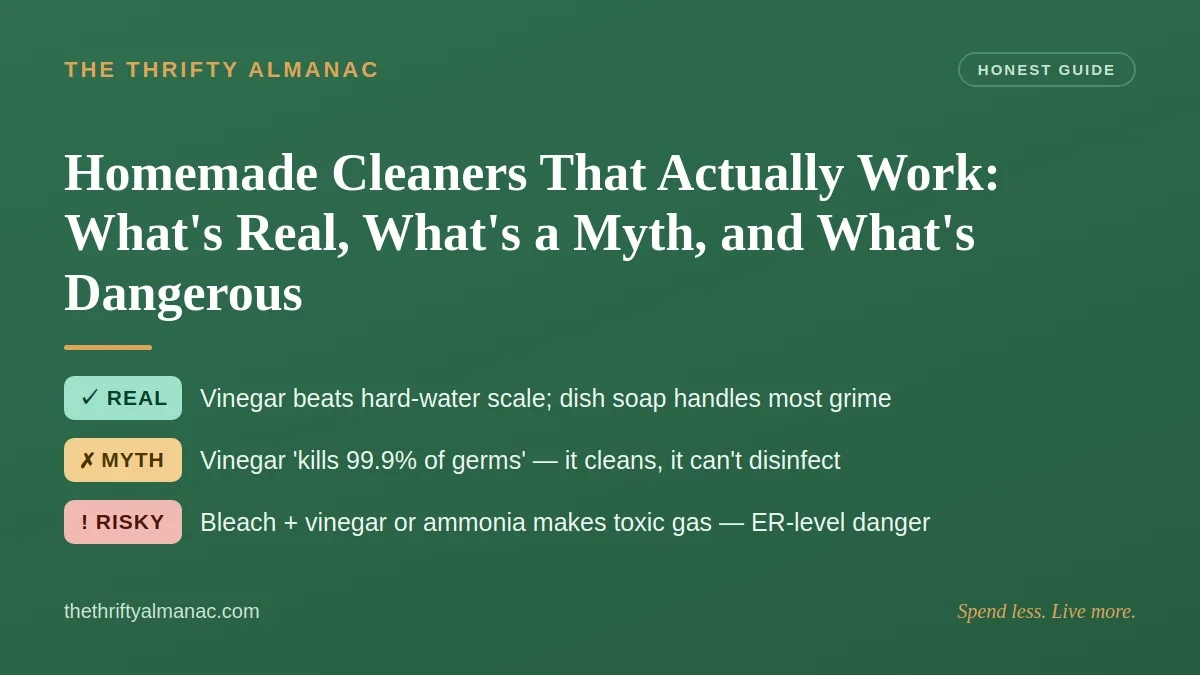
Homemade Cleaners That Actually Work: What's Real, What's a Myth, and What's Dangerous

You can clean most of your house with three cheap things from the pantry — vinegar, baking soda, and a squirt of dish soap. That part of the internet is right. What the recipe-list videos leave out is the part that actually matters: which of those mixes truly works, which one just fizzes for the camera, and which combinations can send you to the emergency room. Skip that sorting and you either waste your ingredients or, in the worst case, mix two bottles that should never meet.

So here is the honest tier-list — what works, what doesn't, and what's dangerous — built on one distinction most creators blur past. Get that one idea straight and every "does vinegar kill germs?" argument in the comments settles itself.

The one rule that makes DIY cleaning make sense: clean vs. disinfect

These two words get used as if they mean the same thing. They don't, and the difference is the whole ballgame. The EPA draws a firm line: "Cleaning removes dirt and organic matter from surfaces using soap or detergents," while "Disinfecting kills viruses and bacteria on surfaces using chemicals."

Here is why that matters for your homemade spray. Any product that legally claims to disinfect or kill germs has to be registered with the EPA and pass efficacy testing — the agency notes that disinfectants "are subject to more rigorous EPA testing requirements and must clear a higher bar for effectiveness." A jug of vinegar-water you mixed in your kitchen is not registered and has never been through that testing. It can clean beautifully. It cannot be relied on to disinfect.

So keep this at the front of your mind for the rest of this article: everything below is about cleaning. When you genuinely need to kill germs — after cutting raw chicken, while someone's sick, on high-touch surfaces during a stomach bug going around the house — reach for an EPA-registered disinfectant and follow its label. A homemade spray is the wrong tool for that job. (One common household bottle sits in a gray area here — see what hydrogen peroxide really can and can't do around the house.)

WORKS: the simple recipes that genuinely clean — and why

The good news is that the short list of DIY cleaners that actually perform is short, cheap, and easy to reason about once you know the mechanism behind each one. Nearly all of them are pantry staples that genuinely clean — the kind that quietly replace a shelf of store-bought sprays.

Vinegar-water for mineral buildup, hard-water spots, and soap scum

WHAT: equal parts white vinegar and water in a spray bottle, for the cloudy film on glass shower doors, the crust around faucets, and hard-water spots. (If the shower grout has gone black and speckled, that isn't soap scum — it's mold, and removing black mold for good takes a different fix.)

WHAT: equal parts white vinegar and water in a spray bottle, for the cloudy film on glass shower doors, the crust around faucets, and hard-water spots

HOW: spray, let it sit a minute or two so the acid has time to work, then wipe and rinse.

WHY it works: vinegar is a mild acid, and acid dissolves mineral deposits. UF/IFAS Extension puts it plainly — "Because vinegar is a mild acid, it will remove rust or lime deposits ..." That acid action, not any germ-killing power, is what cuts through hard-water scale and soap scum.

LIMIT: that same acid can damage surfaces. Keep vinegar off natural stone (marble, granite, limestone), unsealed grout, and waxed wood, and don't leave it sitting on certain metals — it can etch or corrode them. When in doubt, test a hidden corner first.

Baking soda as a scouring powder — and as a standalone deodorizer

WHAT: plain baking soda for two separate jobs — scrubbing a stuck-on mess, and pulling smells out of the air.

HOW: for scrubbing, UF/IFAS Extension says to "Sprinkle baking soda on a damp cloth (as you would for scouring), rinse with water, and polish to shine." For odors, "Sprinkle baking soda ... in odor-producing areas" — the fridge, a smelly trash can, carpet before vacuuming.

WHY it works: two different mechanisms. As a cleaner, baking soda is a gentle physical abrasive — its grit scours without scratching most surfaces. As a deodorizer, it neutralizes odors rather than masking them. Neither of those is germ-killing, and that's fine — smells and stuck-on grime are cleaning problems, not disinfecting ones.

LIMIT: it's an abrasive, so go easy on soft or shiny finishes where fine scratching would show, and always rinse it away rather than leaving a chalky residue.

Plain water plus a squirt of dish soap for everyday grime

WHAT: the most underrated cleaner in the house — warm water with a little dish detergent.

WHAT: the most underrated cleaner in the house — warm water with a little dish detergent.

HOW: a few drops in a bowl of warm water, a cloth, done. This handles the majority of daily kitchen and household messes.

WHY it works: soap and detergents are exactly what the EPA names as the tools of cleaning — they lift dirt and organic matter off a surface so you can wipe it away. Most "grime" is just that: dirt, grease, and food, not a colony of germs.

LIMIT: like the others, it cleans without disinfecting. For a surface that touched raw meat, follow the wash with an EPA-registered product per its label.

DOESN'T: two popular mixes that are mostly for show

This is the part the recipe-list videos never touch — flagging what DIY cleaning fails at. Two crowd favorites don't hold up.

Myth 1: "Vinegar disinfects — it kills 99.9% of germs"

This is the big one, and it collapses under the clean-vs-disinfect rule above. Vinegar is a cleaner, not a disinfectant. Only EPA-registered products that pass kill-testing are allowed to claim they disinfect, and no homemade vinegar spray is registered. Vinegar will lift dirt and dissolve mineral scum all day long — but relying on it to kill viruses and dangerous bacteria on your cutting board is trusting a claim that was never verified. For real germ-kill, use an EPA-registered disinfectant as directed on the label.

Myth 2: "Mix vinegar and baking soda for a super-cleaner"

That dramatic volcano fizz feels powerful, but chemically it's mostly self-defeating. Dr. Nathan Kilah, a chemistry lecturer at the University of Tasmania, explains that "Mixing vinegar and baking soda causes an immediate chemical reaction ... forms water, sodium acetate (a salt) and carbon dioxide" — and that "Sodium acetate is an even weaker base than baking soda, so it doesn't do much to clean." The two ingredients cancel each other out. You spend an acid and a base to produce a weaker cleaner than either one alone.

To be precise about it: this doesn't mean the puddle is literally just water. In a typical recipe you dump in far more baking soda than the vinegar can react with, so most of it stays unreacted. The point isn't that the result is inert — it's that combining them wastes both. Use them separately: baking soda to scour a surface, vinegar to dissolve lime and soap scum. If you want the fizz to loosen a slow drain, fine — but don't mistake that for a stronger all-purpose cleaner.

DANGEROUS: the combinations that can put you in the ER
DANGEROUS: the combinations that can put you in the ER
Read this first. Never mix bleach with vinegar or any acid — it makes toxic chlorine gas. Never mix bleach with ammonia — it makes toxic chloramine gases. Both send people to the hospital every year. If you mix cleaners and notice a sharp odor, leave for fresh air immediately, and call Poison Help at 1-800-222-1222 (or 911 if anyone has trouble breathing).

This is the safety spine of the whole article, so it gets its own section and its own warning above. "Combining cleaners makes them stronger" is one of the most dangerous ideas in home cleaning. What combining actually does is trigger reactions that release toxic gas.

Bleach + vinegar (or any acid) = chlorine gas

The CDC's report on the chemistry is blunt: "When sodium hypochlorite [bleach] and an acid are mixed, chlorine gas and water are released." Once you breathe it, the CDC's chlorine fact sheet explains that "When chlorine gas touches moist tissues (like the eyes, throat, and lungs) it creates an acid that can hurt these tissues." That same fact sheet gives the plain kitchen version of the warning: "Household chlorine bleach can release chlorine gas if it is mixed with certain other cleaning products. Do not mix household cleaners!"

Bleach + ammonia = chloramine gas

The same CDC report warns that "When bleach is mixed with ammonia-containing compounds, monochloramine (NH2Cl) ... and dichloramine (NHCl2) are formed, which may produce tearing, respiratory tract irritation, and nausea." The CDC's ammonia fact sheet backs this from the other side, noting ammonia "reacts with strong oxidizers, acids, halogens (including chlorine bleach)" and repeating the same rule: "Do not mix household cleaners!" Watch out here — many glass cleaners and some all-purpose sprays contain ammonia, so this isn't only about a labeled ammonia bottle.

UF/IFAS Extension sums up the whole rule in one sentence worth taping inside the cabinet: "NEVER mix bleach with ammonia, vinegar, rubbing alcohol, or other household cleaners; it can result in a chemical reaction that affects your lungs' ability to function." Add toilet-bowl cleaners and rust removers to that never-mix list — they're acids too.

Your at-a-glance cheat sheet: Works / Doesn't / Dangerous

✅ WORKS (and why)🚫 DOESN'T (and why)☠️ DANGEROUS — NEVER MIX
Vinegar + water — mild acid dissolves lime, hard-water spots, soap scum Vinegar "disinfects" — it cleans; it's not EPA-registered, so it can't be trusted to kill germs Bleach + vinegar / any acid → chlorine gas
Baking soda — gentle abrasive that scours; also neutralizes odors Vinegar + baking soda "super-mix" — they cancel into a weaker cleaner; use them separately Bleach + ammonia (incl. many glass cleaners) → chloramine gases
Dish soap + water — detergent lifts everyday dirt and grease Bleach + toilet-bowl cleaner / rust remover / rubbing alcohol → toxic fumes

Bottom line for the fridge: clean here with the pantry stuff; disinfect there with an EPA-registered product. If you ever smell something sharp after mixing, get to fresh air and call Poison Help at 1-800-222-1222.

Common mistakes recap

✅ WORKS (and why)🚫 DOESN'T (and why)☠️ DANGEROUS — NEVER MIX


Vinegar + water — mild acid dissolves lime, hard-water spots, soap scum
Vinegar "disin
✅ WORKS (and why)🚫 DOESN'T (and why)☠️ DANGEROUS — NEVER MIX Vinegar + water — mild acid dissolves lime, hard-water spots, soap scum Vinegar "disin
  • Trusting a vinegar spray to disinfect — it cleans, but it doesn't kill germs.
  • Combining vinegar and baking soda into one bottle and expecting a super-cleaner — you get a weaker one.
  • Using vinegar on marble, granite, unsealed grout, or waxed wood, where the acid etches.
  • Assuming "mixing makes it stronger" — with bleach it makes toxic gas.
  • Forgetting that many glass and all-purpose cleaners contain ammonia, so "don't mix with bleach" applies to them too.

FAQ

Does vinegar kill germs?

Not reliably. Vinegar is a cleaner — it removes dirt and dissolves mineral scum. To legally claim it disinfects, a product must be EPA-registered and pass kill-testing, and no homemade vinegar spray is. For true germ-kill, use an EPA-registered disinfectant per its label.

Is the vinegar-and-baking-soda fizz useless?

For all-purpose cleaning, mostly. The two react into water, carbon dioxide, and a weak salt, leaving a weaker cleaner than either alone. Use them separately. The fizz can help physically loosen gunk in a slow drain, but that's mechanical, not a chemistry upgrade.

Can I just use vinegar on everything?

No. Its acid can etch or corrode natural stone, unsealed grout, waxed wood, and some metals. It's great on glass and hard-water buildup, but test a hidden spot on anything delicate first.

What do I do if I accidentally mix bleach with something and smell fumes?

Leave the room for fresh air right away and don't go back to "clean it up." Call Poison Help at 1-800-222-1222, and call 911 if anyone is coughing hard or struggling to breathe. The CDC's rule is simple: do not mix household cleaners.

The takeaway: homemade cleaners genuinely work for cleaning — vinegar for mineral scum, baking soda to scour and deodorize, dish soap for everyday grime — but they don't disinfect, the vinegar-plus-baking-soda "super-mix" only cancels itself out, and bleach must never meet vinegar, ammonia, or any other cleaner. Spend less. Live more. — The Thrifty Almanac

Get the Free Home & Pest Almanac

Get weekly budget hacks and simple, chemical-free ways to keep your home pest-free—without paying for an expensive exterminator.

We respect your privacy.

💬

Comments

Share your thoughts on this post

Loading comments...