

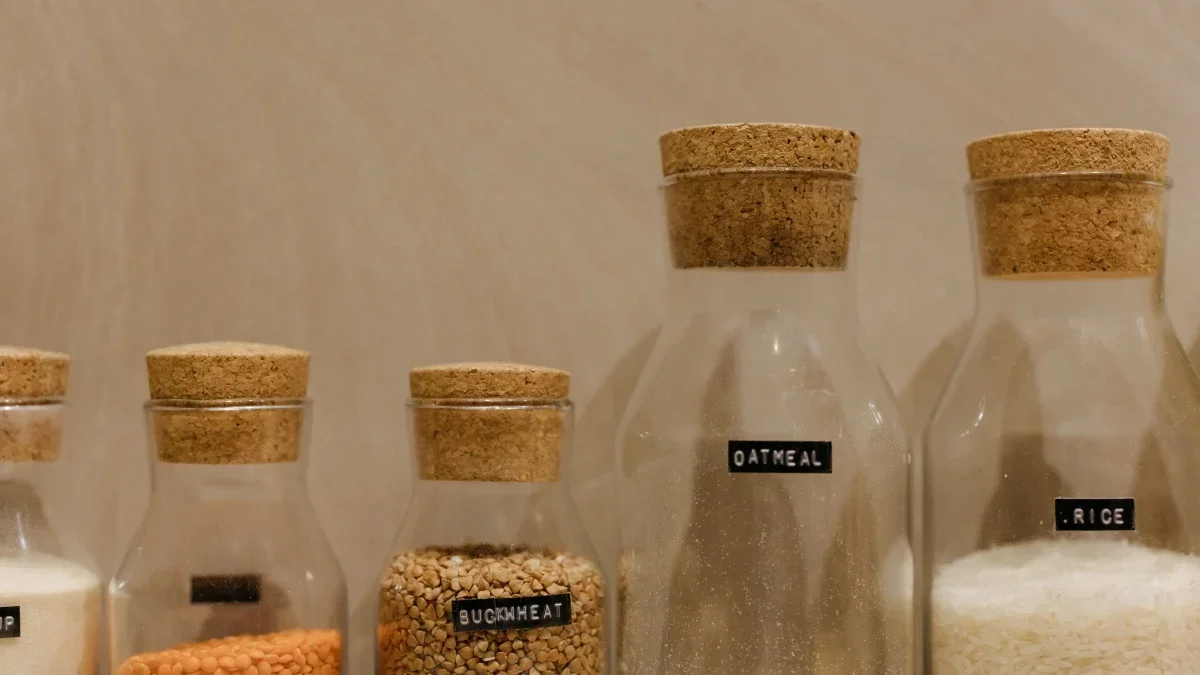
Open the cleaning aisle and you'll count a dozen bottles that each promise one job: glass, stainless, tubs, hardwood. Most of what's inside is water and fragrance. Meanwhile, the handful of things that handle most everyday grime already live under your sink: white vinegar, baking soda, a lemon, and a few microfiber cloths.
This isn't about being cheap for its own sake — it's about knowing what does the work so you buy less and scrub less. But two hard lines are chemistry, not opinion: vinegar cleans but does not disinfect, and you must never mix it with bleach. Get those right and the rest is picking the right staple.
The four staples that do most of the work
Almost everything here leans on one of these four, and knowing the mechanism tells you which to grab — and stops you buying a branded spray for every surface.
Distilled white vinegar
A mild acid. The FDA requires vinegar to contain at least 4% acetic acid, and household vinegar runs around 5% — that 5% is typical, not a legal requirement. The acidity dissolves mineral deposits: hard water is mostly dissolved calcium and magnesium, the same minerals that form chalky scale and combine with soap into soap scum. New Mexico State University's Extension service rates it a good all-purpose cleaner for hard-water deposits, rust, and tarnish — but notes the label can't call it a disinfectant, because it isn't EPA-registered.
Baking soda
A mild base and gentle abrasive: the fine grit scrubs without scratching most surfaces, and it's an alkali Extension services rate safe for glass, tile, and porcelain enamel. It also neutralizes some odors by real chemistry, not perfume — as a base it reacts with acidic smell molecules like butyric acid, turning them into odorless, non-volatile salts (McGill University's Office for Science and Society). The catch: it needs a large exposed surface area — a plate beats an open box — and not every odor is acidic, so it isn't a cure-all.
Lemon
Lemon juice is citric acid, so it does similar mineral-and-scum work to vinegar but smells brighter, and the peel oils cut grease. A spent lemon half is a tool, not trash.
Microfiber cloths
The quiet MVP. The split fibers physically lift dust, grease, and bacteria into the cloth instead of smearing them, so you often need far less cleaner — sometimes just water. In a study at UC Davis Medical Center, documented in the EPA's 2002 case study on hospital microfiber mopping, microfiber removed about 99% of bacteria using only water, versus roughly 30% for cotton-loop mops. That's a hospital floor study, not your countertop, so treat it as directional — and note it measures physical removal, not killing. Buy a stack in different colors so bathroom cloths never touch kitchen ones.
Cleaning hacks that save time and money
Each maps to a real action — dissolve, abrade, emulsify, or physically lift — which is why it can replace a specialty product.
- Descale a showerhead. Tie a vinegar-filled sandwich bag over the nozzle so it's submerged, and leave it at least an hour (overnight for heavy buildup). The acid dissolves the calcium-and-magnesium scale clogging the holes — no scrubbing. On a brass, gold, or nickel-coated finish, keep the soak brief, since prolonged acid can dull the coating.
- Deodorize with baking soda. Sprinkle it on a carpet, mattress, or a plate in the fridge (not left in the box), let it sit, then vacuum or swap it. As a base it neutralizes acidic odor molecules into odorless salts — but only with a broad, exposed surface, and only on acidic smells like pet and spill odors.
- Baking soda paste for the oven and tub. Just enough water to spread; it clings to vertical surfaces while the mild grit scrubs.
- Streak-free glass. Roughly one part vinegar to four parts water, sprayed lightly and wiped with a dry microfiber cloth; the acid cuts the mineral film and the cloth leaves no lint.
- Scummy shower door. Warm equal parts vinegar and dish soap, spray, dwell, then wipe — the acid breaks down the soap-plus-hard-water residue that's the top culprit on glass.
- Cutting board, stovetop, sink. Coarse salt and a cut lemon scour a wooden board; baking soda plus dish soap emulsifies stovetop grease; baking soda then a separate vinegar wipe renews a stainless sink — never in one bowl, where they cancel out.
The drain "hack," and its honest limit
Pour baking soda down the drain, follow with vinegar, cover while it foams, then flush with hot (not boiling, on PVC) water. The dramatic fizz is mostly carbon dioxide from an acid-base reaction that largely neutralizes both ingredients, leaving mostly water and a little sodium acetate. It nudges along light odor and gunk but will not dissolve a real clog — if water is standing, reach for a snake or a plumber. One habit ties it all together: spray, wait a minute, then wipe, so the cleaner does the work, not your arm.
Cleaning vs. disinfecting: what vinegar can't do
This distinction saves you money and false confidence. The EPA defines three things: cleaning removes dirt and does not kill germs; sanitizing kills bacteria (not viruses); and disinfecting kills both, using products held to a higher testing bar. Vinegar is a strong cleaner, not a registered disinfectant — and physical removal does more than people assume, since microfiber plus water lifts bacteria out rather than killing them. But when you truly need to disinfect — after raw meat, or during illness — use an EPA-registered product and its dwell time.
Specialty spray vs. cheap swap
This is about what does the work, not exact prices — the swap saves most where the bottle was mostly water.
| Specialty product | Cheap DIY swap | What does the work |
|---|---|---|
| Glass & window cleaner | Diluted vinegar + water, microfiber | Acid cuts mineral film; microfiber leaves no lint |
| Bathroom soap-scum spray | Warm vinegar + dish soap | Acid dissolves the calcium/soap residue |
| Soft-scrub cleanser | Baking soda paste | Mild abrasive scrubs without gouging |
| Stainless steel polish | Vinegar wipe + microfiber buff | Acid removes film; buffing restores shine |
| Air freshener / deodorizer | Baking soda sprinkle + lemon | Base neutralizes acidic odor molecules |
| Paper towels | Reusable microfiber set | Reused for many washes, not one wipe |
Swap one bottle as it runs out and you'll feel it in your cart — no big upfront change.
Surfaces where you should NOT use vinegar
Vinegar is an acid, and acid is wrong for certain materials. A few pennies saved isn't worth an etched countertop — matching cleaner to surface is the whole point of understanding pH. Skip vinegar on these:
- Natural stone (granite, marble, travertine, limestone). These are calcium-carbonate stones, and acid dissolves calcium carbonate directly — the same hydrogen-ion reaction USGS documents for carbonate-stone erosion. On a polished surface it leaves permanent, cloudy etch marks. Use a pH-neutral stone cleaner or mild dish soap and water.
- Cast iron pans. The seasoning is a hard layer of polymerized oil bonded to the iron; acids break it down, stripping the seasoning and inviting rust. Use hot water and a stiff brush, then re-oil.
- Unsealed wood, electronic screens, and rubber gaskets. Vinegar can strip wood finishes, degrade anti-glare screen coatings, and wear down washer and dishwasher seals over time. These are sensible-caution items rather than hard chemistry — spot-test first.
The one rule that isn't optional: never mix bleach and vinegar
Everything above is preference and thrift. This is not. Mixing chlorine bleach with vinegar — or any acid, or ammonia — especially with heat, can generate chlorine and chloramine gases that cause severe lung-tissue damage when inhaled, according to the CDC. This is a documented hazard, not a household superstition.
And most people don't know it. In a May 2020 CDC survey, only 35% of respondents knew bleach should not be mixed with vinegar (just 58% knew not to mix it with ammonia). If two in three people don't know the rule, assume the people in your home don't either — never combine cleaners unless the label explicitly says it's safe.
The payoff of DIY cleaning is a healthy home for less — and that math falls apart the moment it lands someone in the ER. Keep bleach and acid in separate jobs, and ventilate.
Common mistakes
- Mixing vinegar with bleach — the most dangerous error here, releasing toxic gas that damages the lungs (CDC). Never combine cleaners unless the label okays it.
- Expecting vinegar to disinfect — it cleans, but it's not a registered disinfectant. Use a registered product when you need to kill germs.
- Trusting the fizzing drain trick on a real clog — the foam mostly neutralizes into water and a little sodium acetate and won't clear standing water. Use a snake or call a plumber.
- Putting vinegar on stone or cast iron — acid etches calcium-carbonate stone and strips seasoning. Match the cleaner to the material.
- Wiping before the cleaner has worked — give it a minute to dwell instead of spraying and wiping at once.
FAQ
Does vinegar actually kill germs?
It removes grime and mineral film well, but it is not an EPA-registered disinfectant, which is why the label can't claim to kill germs. The EPA draws a hard line between cleaning (removing) and disinfecting (killing). For everyday grime, cleaning is enough; for true disinfecting, use a registered product.
How long does the vinegar smell last?
Not long — the sharp smell fades as it dries and the acetic acid evaporates, faster with airflow, so crack a window or run a fan. A few strips of citrus peel in the bottle soften it. (A rule of thumb, not a measured constant.)
How do I wash microfiber cloths so they keep working?
The big one: skip fabric softener and dryer sheets. They leave a coating that clogs the tiny voids in the fibers and blocks their pickup, killing the grab. Use just a little detergent, and wash new cloths separately the first time since colors can run. Cared for this way, a good microfiber cloth is built to be reused many times over.
Can I store a DIY vinegar spray?
Plain vinegar-and-water keeps for months, since vinegar is self-preserving. Add dish soap or citrus and you should use it within a few weeks. Never pre-mix and store baking soda with vinegar, though — they neutralize each other into mostly water within minutes.
The takeaway: A few pantry staples and a stack of microfiber handle nearly everything a cabinet of single-purpose sprays claims to — just remember vinegar cleans but doesn't disinfect, keep it off stone and cast iron, and never mix it with bleach. Spend less. Live more. — The Thrifty Almanac




0comments