

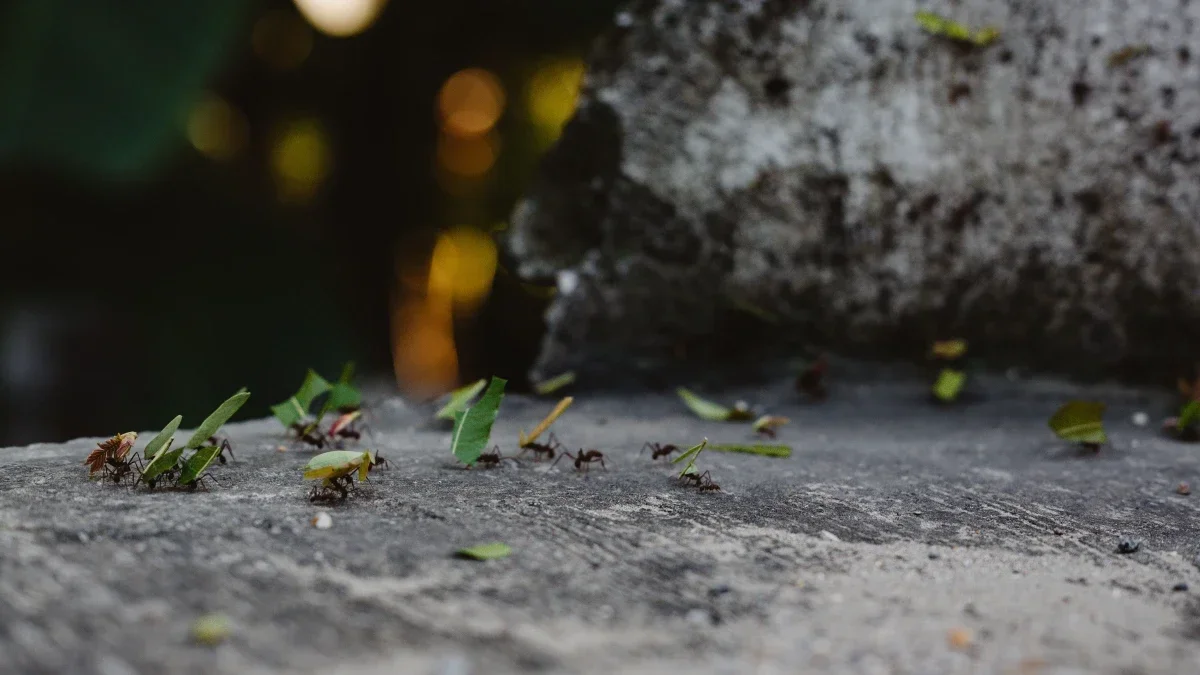
You wipe down the counter, and twenty minutes later a wobbly line of ants is marching toward a crumb you did not know was there. Here is the part most people miss: that single ant you spotted yesterday was not lost. It was a scout — it went home and told everybody, and what you see now is the crew walking a scent road it left behind.
An ant line is not really a bug problem. It is a logistics problem — a supply chain running back to a hidden queen — and you beat it by attacking the system in the right order, mostly with what is already under your sink.
First, understand what you are dealing with
The ants you see are a tiny fraction of the colony. The University of Minnesota Extension notes that straggling single ants are scouts, and that killing the foragers you see has little effect because only a small percentage of the colony is ever outside the nest at once (UMN Extension). UC IPM puts it bluntly: spraying around the foundation "won't provide permanent control, because it kills only foraging ants without killing the colony and the queens" (UC IPM). Seeing one ant means a colony has your address, and the nest and its egg-laying queen are usually out of reach — under a slab, in a wall, or in the yard. That is why the fix is bait the ants carry home, not spray aimed at the parade.
The right strategy, in the right order
Four steps, in sequence — skipping ahead is why most ant battles drag on. (1) Erase the trail so the next wave loses the map. (2) Cut off food and water so there is no reason to come back. (3) Set slow bait so workers carry it home to the queen. (4) Seal the entry points last, once the colony is down.
Step 1: Erase the scent trail with soapy water
What and how: Wipe every surface where ants have been walking with plain soapy water — a squirt of dish soap in warm water — hitting counters, baseboards, and the ground at entry points, and repeat whenever a fresh line shows up.
Why it works: UMN Extension reports that sponging or vacuuming ant trails with soapy water can be as effective as an insecticide spray for temporarily removing foragers, and that soapy water removes the ant's scent trail — especially when you clean thoroughly at entry points (UMN Extension).
Limit: It wipes the map but does nothing to the nest — a helper, not the cure. Diluted white vinegar is a fine alternative, but soapy water is the cleaner extension services single out — not vinegar.
Step 2: Close the buffet — remove food and water
To an ant, your kitchen is an all-you-can-eat buffet. Close it:
- Store sweets and pet food in closed containers — sugar, syrup, honey, cereal, kibble. Ants shrug off a loosely folded bag.
- Wipe up crumbs and grease daily, and rinse recyclables — a soda can with a leftover sip is a feast.
- Fix the drippy faucet and do not leave pet bowls out. In dry weather ants come indoors hunting water as much as food.
UC IPM calls eliminating food and water the first and most important step, and says to store attractive foods like sugar, syrup, honey, and pet food in closed containers and clean up grease and spills (UC IPM). This is what makes the bait work: if your counter offers a better meal, the ants ignore the bait.
Step 3: Set slow bait — and get the strength RIGHT
Why it works: The bait is a weak sugar solution laced with a little borate that workers carry home to the queen. UC IPM calls baits "a key tool for managing ants and the only type of insecticide recommended in most situations," and explains that workers carry small portions back to the nest where the bait is passed mouth to mouth to other workers, larvae, and queens — killing the entire colony (UC IPM). The catch: the toxicant must be slow, so a worker survives the walk home.
How (the corrected recipe): This is the number the internet gets wrong. UC IPM's research-backed range is only 0.5% to 1% boric acid or borax in a 10% to 25% sugar-water solution — a weak sweet liquid, not a paste (UC IPM). In kitchen terms that is roughly half a teaspoon of borax stirred into a cup of sugar water — far weaker than the "one part borax to three parts sugar" recipes online. Soak cotton balls in it, set them on an active trail, and never spray the ants feeding on it. Expect more ants at first — that means they are carrying it home.
Borax is not boric acid — and it matters here. Borax (sodium tetraborate) is, per the national extension service, "a naturally occurring alkaline compound that is a precursor in the manufacture of boric acid," and both are used as household insecticidal powders (Ask Extension). They are chemically distinct: the boric-acid powder in a store-bought roach product is far more concentrated than the laundry Borax box, so do not swap them spoon for spoon — keep whichever you use at the low end of the range.
Limit: Stronger is worse. UC IPM warns that once a borate bait climbs above 1% it becomes repellent and ants avoid it, so a heavy hand makes the bait less effective, not more (UC IPM). Those figures come from research on Argentine and home ants — treat the recipe as a starting point, not a guarantee for every species. And boron is toxic if swallowed; this is not "safe because it's natural." Keep bait out of reach, and with toddlers or pets in the house, skip the DIY cotton balls for a pre-made enclosed bait station.
Step 4: Seal the entry points — last
How: Once the trail has gone quiet for a few days, follow the old paths to the gaps — a hole around a pipe, a crack in the baseboard, a torn screen, worn weatherstripping. Caulk them, patch the screens, add a door sweep if you see daylight underneath, and outside, trim shrubs and branches touching the house.
Why it works and the limit: UC IPM recommends caulking cracks and openings that provide entry, and trimming branches so they do not touch structures — otherwise ants use them as bridges instead of climbing the trunk (UC IPM). Do it last: seal an active colony in and it chews a new path.
Which natural methods actually help (and which don't)
The bait is the fix; everything else is a helper or a folk remedy. Costs below are rough ballparks, not sourced figures.
| Method | Rough cost | How well it works | Notes |
|---|---|---|---|
| Borax / boric-acid sugar bait | A few dollars | High — reaches the colony | The real fix. Keep the strength low and away from kids and pets. |
| Soapy water (or vinegar) | Pennies | Erases trails, clears foragers | Removes the scent road; a helper, not a colony cure. |
| Diatomaceous earth | A few dollars a bag | Moderate — kills slowly, dry only | Food-grade only. Works dry; useless once wet. |
| Cinnamon, coffee grounds, essential oils | Varies | Weak, unproven | Folk deterrents. No extension source backs them; they never touch the nest. |
Diatomaceous earth is the folk favorite with real teeth. UMN Extension describes this fossilized-algae powder as a mild abrasive and desiccant that abrades the insect's cuticle and adsorbs its outer waxy layer, so insects that lose that wax in dry conditions die from water loss — but it works slowly and is useless when the air is moist, so reapply after rain, watering, or dew (UMN Extension).
When to call a pro (carpenter ants, fire ants, flying ants)
Most kitchen ant lines are a DIY job, but a few are not. With carpenter ants, the concern is your home's wood. Clemson Extension explains that they do not eat wood like termites; they tunnel into it to nest, are drawn to moist wood, and leave a telltale pile of coarse wood shavings with insect parts outside a hole (Clemson HGIC). Clemson warns their control "can be very difficult for an untrained person" and advises hiring a qualified pest control operator — DIY sugar bait will not fix wood damage. Call a pro too for fire ants, or any ants still marching after weeks of proper baiting.
Flying ants are reproductives — winged queens and males — that a mature colony sends out to start new colonies, so they signal an established nest (UMN Extension). They are often mistaken for termites, so use Clemson's quick ID: ants have elbowed antennae, a pinched waist, and front wings larger than the hind wings; termites have straight beadlike antennae, a broad waist, and four wings of equal size (Clemson HGIC).
Common mistakes that keep ants coming back
- Chasing the ants you see — you kill messengers while the queen keeps laying, and spray residue near the bait can repel ants from it.
- Mixing the bait too strong. Above 1% borate it turns repellent and works worse (UC IPM); keep it at the low 0.5%-to-1% end.
- Sealing cracks first — trap a hungry colony inside and it chews a new path. Bait first, seal last.
- Baiting a filthy counter that out-competes the bait.
- Giving up too soon, or leaving borax bait where kids or pets can reach it.
FAQ
How long until the ants are actually gone?
UC IPM says to expect 5 to 10 days to see fewer ants and several weeks or more for complete control (UC IPM). You will see a spike at the bait first, then a steady drop-off. Still seeing steady traffic after several weeks of clean counters and fresh bait? The nest may be out of reach — consider a pro.
Is borax the same as boric acid?
No. Borax is sodium tetraborate and, per the national extension service, a precursor in the manufacture of boric acid; both are used as household insecticidal powders, but they are chemically distinct (Ask Extension). A store-bought boric-acid product is far more concentrated than laundry Borax, so measure to the weak 0.5%-to-1% target either way.
Do natural methods work as well as store-bought sprays?
For the colony, slow bait often works better than a spray, because sprays kill only the foragers on contact and never reach the queen (UC IPM). Everything else is a helper; the bait does the heavy lifting.
The takeaway: do not chase the ants you see — wipe the trail with soapy water, starve them, set a deliberately weak borate sugar bait on their path so they poison their own nest, and seal the gaps last. Spend less. Live more. — The Thrifty Almanac




0comments