

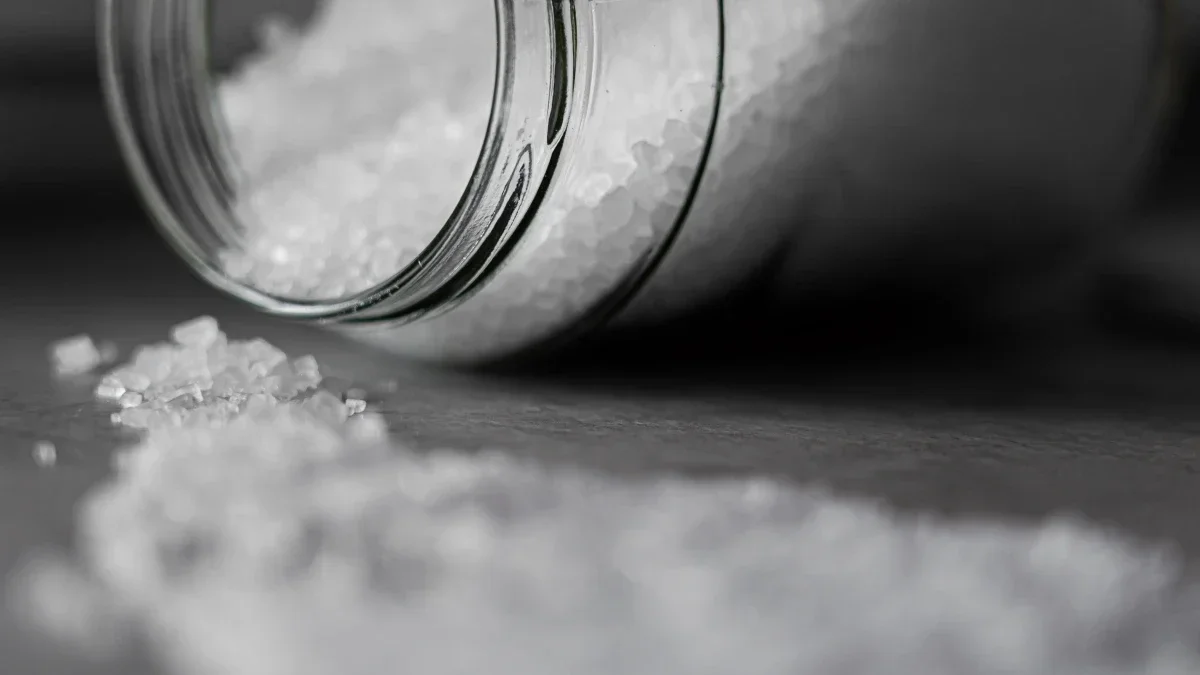
You have seen the clip: a bowl of salt in the corner of a musty closet, and a caption promising it will "suck the damp right out of the room." It is a tidy little miracle, and it is mostly wrong — on two counts. The salt in most of those videos (plain table or rock salt) barely touches the water in ordinary indoor air. And no open dish of anything permanently dries a room. The honest version is more useful than the myth, because it tells you which salt to buy, where it actually works, and where you are wasting your money.
The good news: there is a real, cheap, chemistry-backed version of this trick. It just runs on a different salt than the internet thinks, and it comes with hard limits worth knowing before you scoop anything into a tub.
WHAT: the $5 salt that dries air — and the one that doesn't
The setup. Two salts get called "the salt trick," and they behave nothing alike. One is sodium chloride (NaCl) — table salt, rock salt, the stuff on your fries. The other is calcium chloride (CaCl2) — the white pellets inside a DampRid-style tub, and the same stuff spread on winter roads. Buy calcium chloride in bulk and it is genuinely a few dollars a pound.
Here is the claim, stated honestly up front: calcium chloride keeps pulling water out of normal room air until it dissolves into a puddle. Table salt, in that same room, does almost nothing — not "a little less," close to nothing. They look similar in the bag, but only one is a real desiccant at the humidity your house actually sits at.
Why it matters: the difference is not marketing. It comes down to a single number called the deliquescence point, and it decides the winner before you even open the container. Flagging the boundary early: this is a tool for small, mostly-closed spaces — a closet, a safe, a storage bin — not a whole-house fix and definitely not a cure for a wet basement. Hold that thought; it is the whole back half of this article.
HOW: the deliquescence point — the one number that decides everything
What it is. Every hygroscopic salt has a humidity threshold, its deliquescence relative humidity (DRH). Above that threshold, the salt grabs water vapor from the air and starts dissolving into a brine. Below it, the salt just sits there, dry and useless. Think of it as the humidity level where the salt "wakes up."
The two thresholds. This is where the myth falls apart:
- Table/rock salt (NaCl): a saturated sodium chloride solution holds the air around it at roughly 75% relative humidity — the classic NIST reference measurements put it at about 74.9% near freezing, rising to about 75.6% around 30°C, and an independent peer-reviewed study pins it at 75.29% at 25°C. Below ~75% humidity, NaCl does not pull water from the air. It is essentially waiting for weather it will rarely see indoors.
- Calcium chloride (CaCl2): its threshold is far lower. Peer-reviewed work shows CaCl2 works its way through its hydrated forms and begins deliquescing from around 20% RH after that phase change — landing in the roughly 20–30% range at room conditions. Once the air is above that line, CaCl2 stays "thirsty."
Now put your room on the ruler. A normal indoor space runs somewhere around 40–60% relative humidity. That number sits comfortably above calcium chloride's ~20–30% line, so CaCl2 is switched on and actively pulling. But it sits well below table salt's ~75% line, so NaCl stays asleep. Same room, same air — one salt is working and the other is a paperweight. That is not opinion; it is where two thresholds fall relative to your thermostat's humidity.
This is exactly why every store-bought moisture absorber uses calcium chloride, not the table salt in your pantry. It is not a secret ingredient or a patent — it is the only common, cheap salt whose "wake-up" humidity is low enough to matter in a real room.
The limit on the number. DRH shifts a little with temperature and with which hydrated form the salt is in, so treat these as ranges, not razor-sharp lines. The takeaway does not change: ~75% for table salt is out of reach indoors; ~20–30% for calcium chloride is easily cleared.
WHY it keeps working: hygroscopic pull, brine, and a finite appetite
What you would actually see. Drop calcium chloride pellets in a small sealed container with a cheap hygrometer and watch over a few days. The pellets darken and clump, then collapse into a pool of liquid at the bottom of the tub — that puddle is brine, water the salt pulled out of the air, and the humidity reading in the box drops. Do the same with table salt and you get a bored hygrometer and dry crystals.
The mechanism. Calcium chloride is strongly hygroscopic: it absorbs water vapor directly from the atmosphere and dissolves into that liquid brine. Highway engineers rely on the exact same behavior. Federal road guidance describes chloride treatments that absorb small quantities of water from the atmosphere through suction forces to keep dirt roads damp and hold dust down — and federal gravel-road guidance lists calcium chloride as a leading water-absorbing dust suppressant for the same reason. A pound of pellets can hold a lot of water for a few dollars — far more than the table salt sitting in your pantry.
Here is the honest catch. That appetite is real, but it is finite. The salt fills up. Once those pellets have collapsed into saturated brine, they are done — deliquescence is a saturation process, not a magic dryer that runs forever. And in a big, leaky, open room, fresh humid air pours in faster than a small tub can drink it, so the reading barely budges no matter how thirsty the salt is. The pellets only visibly win where the air is trapped: a sealed bin, a closed closet, a shut cabinet. That is not a flaw in the trick. It is the trick's whole address.
LIMIT: where it works, where it fails, and how to stay safe
Where it genuinely helps. Small, mostly-enclosed spaces where trapped air can actually be dried out:
- Closets and single cabinets that smell musty
- Gun safes and document safes (rust and mildew live here)
- Storage bins, totes, and packed boxes in the garage
- RVs, boats, and campers closed up for the season
Where it fails — and where the myth does real harm. A tub of calcium chloride will not fix a wet basement, a leaking crawlspace, or a large open room. If liquid water is getting in, an absorber is nibbling at a symptom while the cause floods on. University Extension guidance is blunt about this: for basement moisture, you identify and correct the source of the water — grading the soil away from the house, fixing gutters and downspouts, sorting out drainage and vapor barriers. Dehumidifiers can help temporarily, but they are not a substitute for stopping water at its origin. The EPA gives the same order of operations for mold-prone damp: fix leaks and seepage first so water stops entering the house — not manage the humidity after the fact.
Safety — read this before you scoop.
- The brine is corrosive. That puddle of saturated chloride will pit and rust metal and can stain or damage finished surfaces. Keep the tub away from tools, electronics, metal fixtures, and anything nice, and never let it overflow.
- Keep it away from kids and pets. Calcium chloride is an irritant to skin and eyes, and the brine should never be swallowed. Handle dry pellets with care and store the container where small hands and curious pets cannot reach.
- It is not a mold cure. Lowering trapped humidity discourages mildew, but if there is an active leak or standing water, the mold risk stays until the source is fixed. That is a fix-the-house job, sometimes a call-a-pro job — not a job for a tub of salt.
The money math. Store-bought absorbers and DIY calcium chloride are the same active ingredient. Buying CaCl2 pellets in bulk and running them in a bin with a stick to hold the pellets above the collecting brine is cheaper per use than replacing branded tubs. But "cheaper" only counts if you use it where it works — a sealed space — and accept it is a consumable you empty and refill once it turns to brine. Marketing "up to X%" figures assume warm, very humid conditions; in a cool, moderately damp closet you will get less, and slower. Right tool, right place, honest expectations.
Common mistakes recap
- Using table or rock salt. Its ~75% wake-up humidity is out of reach in a normal room. Buy calcium chloride.
- Expecting it to be permanent. It saturates into brine and stops. Empty and refill — it is a consumable, not a one-time fix.
- Putting it in a big open room or a wet basement. Fresh humid air and active leaks will beat it every time. Seal the space or fix the water source.
- Judging it by a small catch. A little water in a leaky room means the room is losing, not the salt. Move it to a sealed bin and watch it work.
- Letting the corrosive brine touch metal, electronics, kids, or pets.
FAQ
Will a bowl of table salt dry out my damp room?
No. Sodium chloride only pulls water from air above about 75% relative humidity — its deliquescence point — and a normal room sits at 40–60%. It stays dry and does essentially nothing. Calcium chloride works because its threshold is far lower, starting around 20–30%.
How often do I have to replace it?
Until it saturates into brine — then it stops and needs emptying and refilling. There is no fixed lifespan; it depends on how humid the space is and how big it is. A damp, warm, sealed bin uses it up faster than a cool, mostly-dry closet.
My basement is still damp after using an absorber — why?
Because an absorber cannot out-drink an active water source. If liquid water is entering, the fix is the source: grading, gutters, drainage, vapor barriers. Extension and EPA guidance both put fixing the water entry ahead of managing humidity. If the damp is structural or persistent, that is a pro's call, not a tub-of-salt call.
Is it safe around my kids and pets?
Keep it out of reach. Calcium chloride is an irritant to skin and eyes, and the brine should never be swallowed. It also corrodes metal and can stain surfaces, so place it where it cannot be knocked over or reached.
The takeaway: the real "salt trick" is calcium chloride in a small sealed space — table salt does nothing indoors, no salt dries a room forever, and a genuinely wet basement needs the water source fixed, not a tub of pellets. Spend less. Live more. — The Thrifty Almanac





0comments