

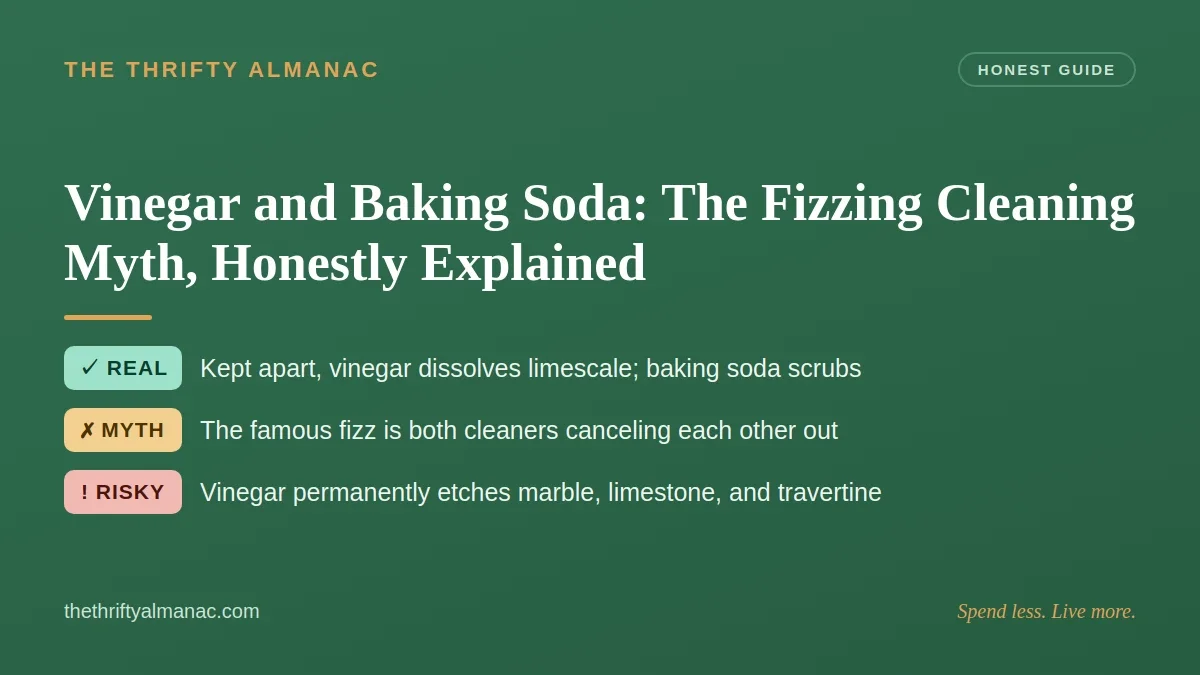
You pour the vinegar over the baking soda in the bottom of a grimy pan, it erupts into a hissing white foam, and for a second it really feels like the gunk does not stand a chance. That eruption is one of the most trusted images in home cleaning. It is also one of the most misread. Here is the honest version: that foam is not the sound of two cleaners teaming up. It is the sound of two good cleaners canceling each other out.
This is not a case of "the hack is fake." Vinegar and baking soda are both genuinely useful. Each earns a spot among the cheap pantry staples that actually clean. The problem is that combining them into that famous fizz is usually the one thing you should not do with them. Let's walk through what is really happening, what each ingredient does when you leave it alone, and the couple of surfaces where vinegar does slow, permanent damage that nobody warns you about.
The fizz everyone misreads
Watch the foam and your brain fills in a story: violent reaction, therefore powerful cleaning, therefore the dirt is getting destroyed. It is an easy leap to make, and the viral videos lean on it hard. But the eruption tells you almost nothing about grime. What it tells you is that an acid and a base just found each other and started trading places, and the bubbles are the exhaust from that trade — carbon dioxide gas leaving the party. Once the fizzing dies down, the reaction is essentially over, and so is most of the cleaning muscle of both ingredients.
WHAT is really happening in the foam
The chemistry here is the same lesson from a middle-school classroom, and it is worth a minute because it explains everything else. When an acid meets a base, they neutralize each other — the reaction of an acid and a base produces water and a salt, which chemists write as acid + base → water + salt.
Vinegar is the acid. Baking soda — sodium bicarbonate, or NaHCO3 — is the base. Put them together and they do exactly what opposites do: they shake hands and walk off, leaving behind water, a mild dissolved salt, and gas. That gas is the foam. As the same chemistry source explains, when the bicarbonate reacts with an acid it forms carbonic acid, which promptly falls apart into carbon dioxide gas and water. Those escaping CO2 bubbles are the whole show.

The foam is not the ingredients attacking grime. It is the two of them consuming each other. When it stops fizzing, the acid has spent its acidity and the baking soda has spent its base — you are left mostly with fizzy water and a little dissolved salt.
HOW each one cleans when you leave it alone
Here is the part the fizz distracts from. Separately, these two are excellent — but for completely different reasons, on different messes.
Baking soda: a gentle scrubber and odor absorber
WHAT: a mild abrasive. HOW: its cleaning power comes from being slightly gritty. Sprinkle it onto a damp sponge — barely wet — and the undissolved grains give you a soft scouring powder that lifts stuck-on dirt without scratching, and it cleans and deodorizes kitchen and bathroom surfaces as it goes. WHY it works: the grit does the physical work, so the trick is to keep it grainy. LIMIT: the moment you drown it in liquid, it dissolves — and Michigan State University Extension warns plainly that if you use too much water the baking soda loses its abrasive quality. A little water activates it; a lot of water disarms it.
Vinegar: an acid that dissolves mineral crust and grease
WHAT: a mild acid. HOW: acids dissolve things baking soda cannot touch. According to Utah State University Extension, because vinegar is acidic it can dissolve gummy buildup, eat away tarnish, and remove dirt, and vinegar (like lemon juice) will neutralize alkaline substances such as scale from hard water. WHY it works: the acidity is the active tool — it breaks down the chalky mineral deposits and hard-water film that build up around faucets, showerheads, and kettles. Left to work on its own it shines — steaming a bowl inside a microwave loosens dried-on splatter you can then wipe away. LIMIT: it is a solvent, not a scrubber. It has no grit, so it will not lift baked-on food the way baking soda does. And as you will see below, that same acidity is exactly what makes it dangerous on the wrong surface.
Notice the pattern: one works by being gritty, the other by being acidic. They are good at opposite jobs. That is the whole reason mixing them backfires.

WHY mixing them usually wastes both
Line the two up and the trap is obvious. The instant they touch, neutralization begins. The vinegar spends its acid attacking the baking soda instead of the mineral scale you wanted gone. The baking soda dissolves into the liquid, surrendering the grit that made it a scrubber. What you are left with in the pan is mostly fizzy water plus a mild dissolved salt — a puddle that is weaker at both jobs than either ingredient would have been on its own.
And "just use more of each" does not rescue it. More acid meeting more base only means the neutralization runs faster and more completely. You cannot out-muscle the chemistry; you can only feed it. The real fix is the opposite of mixing: use baking soda where you need gentle grit, use vinegar where you need to dissolve mineral crust, and keep them in separate corners.
Is there ever a reason to combine them? Mildly. Pouring baking soda then vinegar down a sluggish drain produces a burst of foam that can mechanically jostle loose hair and gunk, and the fizzing can be oddly satisfying. But be honest about what that is — the bubbles are physically nudging debris, not chemically dissolving a clog. It is a gentle mechanical assist, not proof that the mixture is a superior cleaner. For a real clog, it is usually not enough. For that, it helps to know what actually clears a stubborn clog.
LIMIT: the surfaces vinegar quietly ruins
This is the section that matters most, because it is where a "natural, harmless" reputation causes real damage. Vinegar is an acid, and acids do not care whether they are eating away limescale or your countertop.
Never use vinegar on marble, limestone, or travertine. These stones are calcium carbonate, and acid dissolves calcium carbonate — the U.S. Geological Survey writes the reaction as CaCO3 + 2H+ → Ca2+ + H2O + CO2 gas, the very same acid-eats-stone process that carves caves out of limestone. On a polished counter it shows up as dull, cloudy etch marks where the shine used to be, and once the surface is etched, it is etched for good. Iowa State University Extension is blunt about the safe alternative: only mild dish soap and warm water should be used to clean marble, because acidic cleaners can damage the stone. The same caution applies to other acid-sensitive finishes — natural stone tile and some grout sealers among them — so when in doubt, spot-test in a hidden corner and follow the manufacturer's guidance.

The mix you must never make
One safety line is non-negotiable, so read it twice.
Never mix vinegar — or any acid — with bleach. Doing so releases chlorine gas. The Alabama Department of Public Health warns that even the concentrations you would get from mixing common household products can cause minor to serious irritation and damage to the eyes, skin, and respiratory system.
The same rule covers a cousin combination: Utah State University Extension warns not to mix ammonia with a bleach product, as it can produce a harmful gas. If you ever mix cleaners by accident and smell a sharp, pool-like odor, leave the room, get fresh air, and do not go back in to "air it out" yourself. This is a call-someone situation, not a tough-it-out one.
Common mistakes recap
- Believing the foam is doing the cleaning. It is CO2 gas from the two ingredients neutralizing each other — the reaction is spent within seconds.
- Mixing them for a "stronger" cleaner. Neutralization leaves you weaker at both jobs, not stronger.
- Flooding baking soda with liquid. Too much water dissolves the grit that made it work — keep it barely damp.
- Reaching for vinegar on marble or other natural stone. The acid permanently etches calcium-carbonate surfaces. Use mild dish soap and warm water instead.
- Mixing vinegar with bleach. This releases chlorine gas — the one combination you must never make.
FAQ
So is the vinegar-and-baking-soda hack completely useless?
Not useless — just usually the wrong move as a mixture. Both are strong cleaners on their own. Combining them into foam neutralizes both. Use baking soda as a gentle scrub and vinegar as a mineral-dissolving rinse, on separate jobs.
What is left in the pan after it stops fizzing?
Mostly water plus a mild dissolved salt, with the carbon dioxide already gone as gas. That is why the leftover liquid does so little — the acid and base have already consumed each other.
Can I still use the fizz to unclog a slow drain?
You can try it for a sluggish (not fully blocked) drain — the bubbling can mechanically loosen some gunk. Just know it is a physical nudge, not a powerful chemical cleaner, and it often will not clear a real clog.
Which surfaces should I keep vinegar away from?
Marble, limestone, travertine, and other calcium-carbonate natural stone, where acid causes permanent etching. Be cautious with natural stone tile and some grout sealers too. On stone, mild dish soap and warm water is the safe standard.
The takeaway: the fizz you trust as proof is actually two good cleaners canceling each other out, so use baking soda and vinegar separately for the jobs each is built for — and never let vinegar near marble or bleach. That is the same clear-eyed habit behind every entry in our guide to home hacks worth trusting. Spend less. Live more. — The Thrifty Almanac






0comments