

Before you string up a clothesline, you need one number: what a single dryer load costs. Most articles either quote a savings figure with nothing behind it, or teach you to multiply nameplate wattage by an hour — which lands roughly 55% too high.
Here is the sourced version, plus the part most posts skip: line drying cannot save more than your dryer costs. That ceiling is lower than you have been told, and it swings fourfold by state.
What one dryer load actually costs
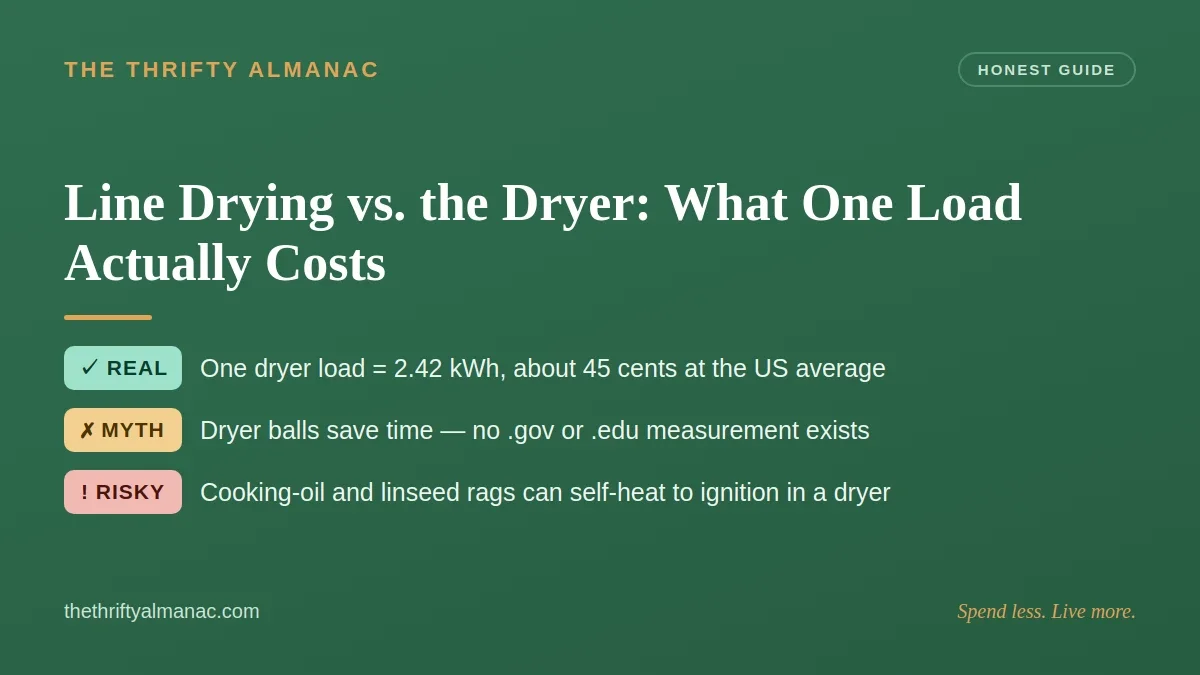
The Department of Energy's amended test procedure assumes 283 cycles a year, and a standard-size vented electric dryer at the federal minimum uses 684 kWh a year. Divide: 684 ÷ 283 = 2.42 kWh a load. The US average residential price was 18.44 cents per kWh in May 2026, so 2.42 × $0.1844 = about 45 cents a load, or roughly $126 a year.
Now the nameplate trap. A dryer's heating element draws around 5,000 to 5,500 watts. Multiply 5 kW by a 45-minute cycle and you get 3.75 kWh — more than half again the real figure. The element cycles on and off rather than running flat out.
EIA's 2020 survey corroborates it: 2.32 million Btu per household using one, about 680 kWh. That table also kills a repeated claim: the dryer is not your biggest annual load, sitting behind water heating at 9.23 MMBtu and refrigerators at 2.86. It owns the laundry room — about ten times the washer's 0.23 MMBtu — while sitting partway down any list of free habit changes that trim your power bill.
The limit: 2.42 kWh is a federal-standard baseline for a newer vented electric machine, not a measurement of yours. A neglected dryer uses more; a heat pump uses around 70% less. If your dryer burns gas, none of this arithmetic transfers.
Why your state changes the answer by four times
In May 2026, Idaho sat at 12.35 cents per kWh, Hawaii at 52.00, California at 33.25 and New York at 29.93. The same 2.42 kWh load:
| Where you live | Rate (c/kWh) | Per load | 300 loads a year |
|---|---|---|---|
| Idaho | 12.35 | $0.30 | about $90 |
| US average | 18.44 | $0.45 | about $134 |
| Hawaii | 52.00 | $1.26 | about $377 |
The formula is 2.42 × your own rate, taken off your bill. That is one month's data, rates move, and time-of-use pricing hides behind a flat average.
The honest ceiling on line drying
ENERGY STAR puts the average family at about 300 loads a year — roughly $134 of dryer electricity at the US average. Never run the dryer again and that is the entire prize.
Nobody does that. Line dry half your loads for half the year and you avoid 75 loads: about $33. In Idaho, $22. In Hawaii, $94 — where the math starts changing behavior. Two benefits go unpriced: less tumbling on your clothes, less waste heat indoors in summer. What line drying cannot do is transform the bill alone — much like unplugging idle electronics, a far smaller lever than the internet promises.

What genuinely shortens dry time, and what only claims to
Spin harder first. ENERGY STAR washers spin two to three times faster to extract more water, and less moisture means less time in the dryer. A high or extended spin is the cheapest minute you will ever save. The limit: no source puts a figure on how much.
Let the machine decide when it is done. Research by Ecos Consulting for NRDC, cited by ENERGY STAR, put the gap between a standard dryer and one that stops when clothes are genuinely dry at roughly 0.76 kWh per load — near a third of a load, spent tumbling laundry already dry. Use the moisture-sensor cycle, not timed dry. The limit: a modeled estimate, not a bench test.
Keep the air moving. Iowa State University Extension says lint in the trap, hose and ductwork causes reduced air flow and reduced drying efficiency, and a load that runs twice costs double.
Then the honest subtraction: wool and plastic dryer balls have no authoritative measurement behind them. Searching .gov, .edu extension and peer-reviewed sources turns up nothing — every figure traces to a manufacturer, a retailer blog or one uncontrolled personal test, and those claims contradict each other by roughly tenfold. They may help; nobody credible has shown how much. If softness rather than speed is the goal, see what actually fixes stiff, scratchy towels.
The dryer sheet myth
Dryer sheets are not free either. ENERGY STAR says sheets can leave a film on the filter that reduces air flow, and Iowa State Extension describes screens gone clouded and tacky from residue. Restricted airflow is what makes loads run long. The fix is free: clean the filter every load and scrub it monthly with a toothbrush.
Two limits: neither source puts a cost on the film, and the common claim that sheets foul the moisture sensor has no authoritative source behind it.
Where line drying stops paying
Your payoff depends on the days you can use the line. NOAA's relative humidity normals show how far apart regions sit:
| City | Afternoon RH | Morning RH |
|---|---|---|
| Las Vegas | 20% | 36% |
| Phoenix | 23% | 46% |
| Houston | 59% | 89% |
| New Orleans | 62% | 87% |
No source measures drying time against humidity, so take this as physics, not a cited finding: damp air accepts water slowly, and a Gulf Coast morning at 87% will not dry a towel like a Phoenix afternoon. Those are long-run normals, not a forecast.
The rules bite differently than expected. Florida's statute voids deed restrictions that prohibit clotheslines, and several other states have right-to-dry provisions, so "my HOA banned it" is often wrong. The catch is subsection (4), exempting patio railings in condominiums, cooperatives and apartments — so renters and condo dwellers are the ones genuinely stuck. Florida is the worked example, not a national rule; check your own state.
Drying indoors moves that water into your air. EPA says dryers must vent outdoors, an improperly vented one raises room humidity and may lead to mold growth, and that indoor humidity belongs below 60%, ideally 30 to 50%. A drying rack is not a broken vent, and no source has measured one causing mold — but it draws on the same moisture budget, so in a tight winter house, run a fan or crack a window.
Two things that must never go in a dryer
Two hazards, two mechanisms, and nearly every consumer article blends them into one.
Cloth carrying cooking oil, linseed oil or oil-based stain
Mississippi State University Extension lists carbon-based animal and vegetable oils — linseed, cooking oil, cottonseed, corn, soybean, lard, margarine — as able to undergo spontaneous combustion in contact with rags. NFPA gives the mechanism: those oils release heat as they dry, and if the heat is not released into the air it builds up — an average of 900 home fires a year start when oily rags catch fire. A warm drum packed with insulating fabric is that trap, and so is a hot pile fresh out of it. Kitchen towels, varnish rags, oily aprons: none go in the dryer. Dry them spread out or hung outdoors, never piled.
Anything soaked with gasoline or solvent
Mississippi State Extension is explicit that petroleum oils — motor oil, grease, diesel, gasoline — are not a concern for spontaneous combustion. The danger here is different and faster: flammable vapor reaching heat. NFPA says to remove the clothing, place it outside to dry, and launder it only once dry — and never to bring gasoline indoors, even in small amounts. No washer, no dryer, no open flame until it has dried outdoors. If someone feels dizzy or their skin is irritated, move them to fresh air and call Poison Help at 1-800-222-1222. If anything ignites, get everyone out and call 911.

A blocked vent costs money before it starts a fire
Restricted airflow fails on cost and safety at once. CPSC testing found dryers cycling on the high-limit thermostat with the vent 75 or 100 percent blocked, causing temperatures near the heater to increase significantly — and that lint can still build up and ignite on a hot surface even in a properly vented machine with a cleaned screen. A manufacturer told ENERGY STAR that reduced airflow may reduce overall energy efficiency by over 30%. That is an attributed claim, not an independent test, so it becomes no dollar figure here.
The scale, from NFPA's 2014–2018 data: an average of 13,820 home structure fires a year involving dryers, causing 7 deaths, 344 injuries and $233 million in damage. Failure to clean was behind 32%, and in 27% the first thing to ignite was dust, fiber or lint. Those counts cover only fires reported to fire departments.
Three signs of restriction: loads need a second cycle, the dryer top runs hot, the outdoor flap stays shut while it runs. USFA says never run a dryer without a lint filter and to check that the venting behind it is not damaged, crushed or restricted. If any apply, the inspection procedure lives in our piece on how much of the lint fire panic is real. A long or crushed run is worth a pro's eyes.
The tier list
| Verdict | Claim | Why |
|---|---|---|
| REAL | A load costs about 45 cents at the US average | 684 kWh ÷ 283 cycles × $0.1844 |
| REAL | Moisture sensing beats timed dry | Near 0.76 kWh a load |
| MYTH | Dryer balls save a known amount of time | No .gov, .edu or peer-reviewed measurement |
| MYTH | Line drying saves hundreds anywhere | Capped by dryer cost: $90 to $377 |
| DANGEROUS | Machine-drying cooking-oil or linseed rags | Those oils self-heat as they dry |
| DANGEROUS | Laundering gasoline-soaked clothing indoors | Flammable vapor near a heat source |
| DANGEROUS | Running a crushed or blocked vent | High-limit cycling, heater gets hotter |
Common mistakes
- Costing the load from the nameplate. Use 2.42 kWh, not 5 kW times cycle length, times your own rate.
- Buying dryer balls expecting a measured result. Spin speed and sensor drying are the sourced levers.
- Assuming gas dryers cost the same. None of this kWh math applies to them.
- Tossing kitchen or shop rags in with the towels. Cooking and drying oils self-heat; air-dry those outdoors.
FAQ
How do I work out my own cost per load?
Multiply 2.42 kWh by the price per kWh on your bill. At 18.44 cents that is 45 cents. On time-of-use, take the rate for the block you do laundry in.
Is line drying worth the effort?
At the US average and 300 loads a year the ceiling is $134; a part-time habit lands nearer $30 to $50, or several times that in a high-rate state.
Can my landlord or HOA stop me hanging laundry?
In Florida, such bans in deed restrictions are void by statute, and several other states have similar provisions — but it excludes patio railings in condos, co-ops and apartments, so renters often have no protection.
The takeaway: Price your own load at 2.42 kWh times your rate and you will know what line drying can and cannot do before buying a single clothespin. Spend less. Live more. — The Thrifty Almanac






0comments