

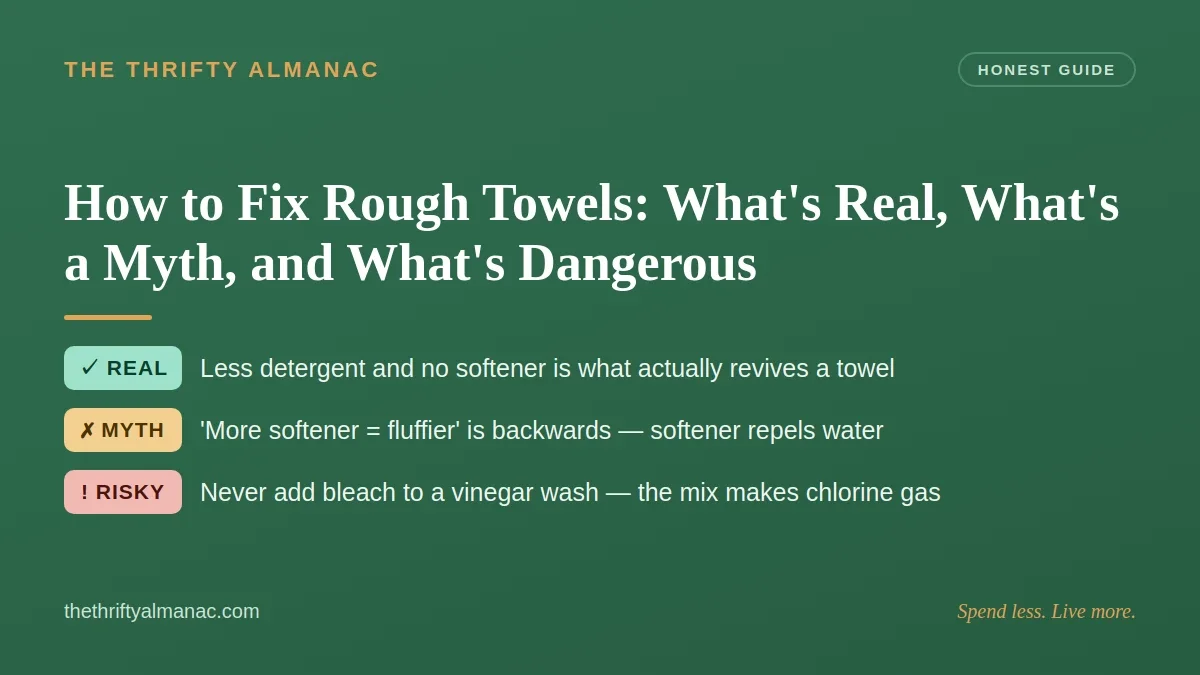
Your towels used to come out of the dryer soft and thirsty. Now they're stiff, they push water around instead of soaking it up, and they hold a sour smell. Before you toss the set and buy new, know this: worn-out fibers are rarely the problem — coated fibers are.
Rough towels are a buildup problem, and buildup gets fixed by doing less, not more. Adding another capful of fabric softener is the exact move that makes it worse. Here's the honest, evidence-ranked version — what revives a towel, what's folklore, and the two habits that can genuinely hurt you.
Why your towels turned stiff, thirsty, and a little funky
1. A water-repelling coating from softener and dryer sheets
Softeners and dryer sheets leave a thin film of cationic surfactants — quaternary ammonium compounds — that cling to fibers, feel slick, and, being hydrophobic, repel the very water a towel exists to drink. A fabric-softener manufacturer's own patent admits the actives "lower the water absorbency and wickability of the textile fabric" and calls that "troublesome in the use of 100% cotton items, such as towels," adding that high-performance fabrics often warn against softener entirely. It's a wax coat over a sponge.
2. Leftover detergent and hard-water minerals
Too much detergent doesn't rinse clean; the American Cleaning Institute notes that overdosing leaves residue that traps soil and odor. Hard water compounds it. Hardness is dissolved calcium and magnesium, which the U.S. Geological Survey grades as soft (0–60 mg/L), moderately hard (61–120), hard (121–180), and very hard (above 180) as calcium carbonate. Those minerals bind with detergent into an insoluble scum that stiffens fibers — the chalky film you scrub off a showerhead, now inside your towel. It's why the same routine is fine in soft-water Seattle and brutal across the hard-water Midwest and Southwest.
3. Dryer heat that cracks the cotton
Heat is the quiet third culprit. A USDA Southern Regional Research Center study found repeated high-temperature drying cracks cotton fibers and can reduce fabric strength by 25 percent or more, and that pulling laundry before it's bone-dry — trimming drying time 10 to 20 percent — avoids much of the damage. Treat the 25 percent as one study's result, not a universal constant — but high heat and over-drying clearly age cotton faster.
All three are additive — coating, residue, and scum accumulate over many washes. The good news: buildup is reversible, and the fix is subtraction. If you like pantry-staple cleaning, it helps to know which kitchen staples genuinely earn a spot in the laundry room. And before you try the classic fizz trick, see why combining vinegar and baking soda in one step mostly cancels both out — it matters for the strip-wash below.
The honest tier list: what actually fixes rough towels
Ranked by evidence strength, not by how satisfying a hack feels. For low-cost repairs across the rest of the house, lean on our broader playbook of household fixes.
| Move | What it does | Evidence | Verdict |
|---|---|---|---|
| S — Use less detergent; drop softener and dryer sheets | Removes the two coatings behind most stiffness and lost absorbency | Manufacturer patents + ACI dosing guidance | Do this first |
| A — Vinegar strip-wash, then a separate baking-soda cycle | Acetic acid dissolves alkaline and mineral residue; baking soda neutralizes acidic odor | Sound chemistry; no controlled .gov trial | Every 1–2 months |
| A — Dry on medium, pull promptly | Less fiber cracking from heat and over-drying | USDA over-drying study | Every load |
| B — Wool dryer balls instead of sheets | Separate laundry mechanically, leave no coating | Reasonable mechanism; speed claims are marketing | Fine swap, modest |
| C / Skip — More softener, scented boosters | Mask odor and add more coating | Contradicted by the absorbency evidence | Stop |
S-tier: subtract before you add
What: a small, correct dose of detergent and no softener or dryer sheets. How: measure to the load, not the full cap; high-efficiency (HE) machines need a low-suds dose to the line. Why: it removes the two coatings behind most stiffness, and the American Cleaning Institute frames softener's absorbency hit as dose-dependent. Limit: it's cumulative in reverse, so coated towels need several washes; it also pays to ask whether you're pouring far more detergent than you need.
A-tier: vinegar strip-wash, then a separate baking-soda cycle

What: once a month or two, run the towels through two detergent-free cycles — vinegar first, baking soda second. How: a hot cycle with about a cup of plain white vinegar (the 4–6% acetic-acid kind, not 20%-plus "horticultural" vinegar), then a second cycle with a half-cup of baking soda. Why: acetic acid dissolves alkaline detergent residue and calcium-carbonate scum; baking soda neutralizes the acidic compounds behind sour odor. Limit: keep them in separate cycles — mixed, acid and base cancel into salt, water, and fizz. It's chemistry-grounded, not lab-proven, and neat vinegar every load can wear rubber hoses and seals — every 1–2 months, not weekly.
A-tier: medium heat, out of the dryer promptly
What: drop from high to medium heat and pull towels a touch shy of dry. How: lower the setting, use the moisture sensor, or check a few minutes early. Why: the USDA work above ties most cotton damage to high heat and over-drying. Limit: aim for barely dry, not damp — wet towels in the basket breed the mildew smell below.
B-tier and below: wool balls yes, more softener no
Wool dryer balls are a fair swap for sheets — they separate laundry mechanically and leave no residue, so absorbency stays intact; just ignore the "dries 25% faster" and "softens" retailer claims, which are marketing, not testing. Skip outright: more softener and scented boosters, which mask odor and add the coating flattening your towels.
Myths that keep your towels rough
Myth: "More softener makes fluffier towels"
It does the opposite for the one job a towel has. That slick hand-feel is a hydrophobic coating, and the patent above admits it lowers absorbency and wickability — worst of all on 100% cotton. Fluffy-feeling and thirsty are not the same thing.
Myth: "Towels must be washed scalding hot every time"
For everyday soil, no. The federal ENERGY STAR program notes that water heating is about 90% of a washer's energy use, and switching from hot to warm can roughly halve a load's energy — most loads clean fine in warm or cold. The caveat runs both ways, though: a home "hot" cycle often isn't hot enough to disinfect. Healthcare hot-water washing uses at least 160°F (71°C), hotter than most home taps deliver. Don't assume warm sanitizes.
So match heat to the job: warm or cold for everyday soil, a home "hot" cycle for heavier soil, and a sanitize cycle or EPA-registered laundry sanitizer when something truly needs disinfecting — the move after an illness, not a hotter guess.
Danger zone: the laundry mistakes that can actually hurt you
Never mix bleach with vinegar or ammonia
This one is non-negotiable, since the routine uses vinegar: never add any chlorine-bleach product to a vinegar wash, and don't assume a "whitening" additive is bleach-free. Poison Control is blunt about the chemistry — "When an acid is mixed with a hypochlorite solution (such as bleach), chlorine gas is formed", and bleach mixed with ammonia produces chloramine gas instead. Both cause burning eyes, nose, and throat and coughing; heavier exposure brings lung damage, wheezing, and chest pain. If it happens, get to fresh air immediately and call Poison Control (1-800-222-1222).
The real dryer-fire hazard is lint, not softener

You'll read that softener residue on the lint screen causes dryer fires. The Consumer Product Safety Commission doesn't say that. Its guidance is that dryer fires start when lint builds up and blocks airflow, and its top prevention step is cleaning the lint screen every load and clearing the exhaust duct periodically. Clothes still damp after a normal cycle, or drying that runs long, can signal a blockage — don't just crank the heat. CPSC does not blame fabric softener for fires; dryer-sheet film can gradually reduce a screen's airflow, so occasionally washing the screen is sensible maintenance, not a proven fire fix. The load-bearing safety fact is lint and airflow.
A smell that keeps coming back is moisture, not fragrance
Baking soda absorbs odor but doesn't kill what's producing it. A sour or mildew smell that returns after every wash means bacteria or mold — usually from towels sitting damp too long or from trapped buildup. The durable fix is removing the buildup and drying fully — plus a sanitizing wash if needed — not more scent on top.
Your no-BS towel routine
Copy this onto the machine and adjust for your water and washer.
- Wash warm with a small, correct dose of detergent. No softener.
- Use wool dryer balls instead of dryer sheets.
- Dry on medium and pull the towels while barely damp.
- Every 1–2 months — or whenever towels feel waxy or smell off — run a vinegar strip-wash, then a separate baking-soda cycle.
- Hard water? Do the strip-wash more often; soft-water homes can stretch it out.
- Safety line: never add bleach to the vinegar wash.
Flex it to your setup: HE machines want low-suds dosing, and sensitive rubber seals mean occasional vinegar, not weekly.
Common mistakes
- Fighting stiff towels with more softener — that coating is the cause, not the cure.
- Overdosing detergent, assuming more suds means cleaner.
- Mixing vinegar and baking soda in one cycle, which cancels both.
- Drying on high heat and over-drying.
- Masking a mildew smell instead of drying fully and stripping the buildup.
FAQ
Will one dryer sheet ruin my towels?
No. The absorbency loss is cumulative and dose-dependent — repeated use progressively coats the fibers, not a single sheet. Stopping lets towels recover over several washes.
Can I put vinegar and baking soda in together to save a cycle?
No — as an acid and a base they neutralize each other into salt, water, and carbon dioxide (that fizz). Run them in separate cycles so each can work.
Does washing towels on hot actually sanitize them?
Not reliably. A normal home hot cycle usually doesn't reach true disinfection temperature; healthcare-grade washing runs far hotter than home taps. For illness or contamination, use a sanitize cycle or an EPA-registered laundry sanitizer.
How often should I do the vinegar strip-wash?
Every one to two months for most people, more often in hard-water areas. Not every load — undiluted vinegar can degrade rubber hoses and seals over time.
The takeaway: Rough towels are coated, not dead — subtract the softener and excess detergent, strip the buildup once in a while, and skip the high heat. Spend less. Live more. — The Thrifty Almanac






0comments