


It came out from behind the toilet near midnight, ran across the tile, and vanished under the baseboard before you could decide what it was. Too fast, too many legs, gone.
Here is what the pest-control ads leave out: the house centipede is usually not the problem. It is a readout. Penn State Extension says frequent sightings mean some prey arthropod is abundant and "may signify a greater problem than the presence of the centipedes." Kill it and the readout goes dark. The building stays as damp, and as buggy, as it was.
Is it a house centipede? A five-second ID
The panic buy happens before anyone identifies the animal, so start here. An adult has 15 pairs of legs — 30, not a hundred — on a dirty-yellow body one to one and a half inches long with three dark stripes. Banded legs are why it blurs when it moves. On adult females the last pair runs nearly twice the body length, so it reads far bigger than it is.
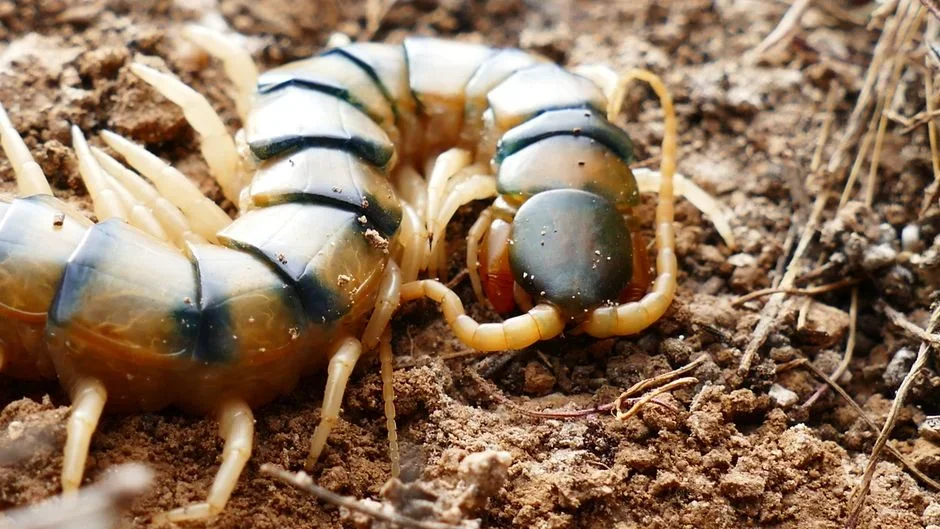
The tiebreaker is behavior. Centipedes carry one pair of legs per segment and, as UC IPM notes, unlike millipedes they never coil up when disturbed. Nudge it: if it curls into a spiral, you have a millipede.
| What you saw | House centipede | Millipede | Silverfish |
|---|---|---|---|
| Legs | Long, banded, one pair per segment | Short, two pairs per segment | Six short legs |
| When disturbed | Sprints away, never coils | Coils into a spiral | Wriggles like a tiny fish |
| Body | Flattened, striped | Round, hard, worm-like | Tapered, gray, three tail filaments |
What it is doing in your bathroom at midnight
Hunting. By day it hides beneath concrete slabs, inside cement block walls, in floor drains without water traps, and crawl spaces. At night it hunts the rest of your pest population. Penn State's prey list: silverfish, firebrats, carpet beetle larvae, cockroaches, spiders, and other small arthropods. UC IPM adds flies and calls it "actually beneficial," noting it damages neither plants nor household items. Michigan State agrees, calling it a beneficial organism.
That list is the story. If silverfish are showing up too, they are reporting the same humidity problem from the other side. Roaches deserve more urgency than either, since the allergy and asthma evidence around them is real. What no source supports is the flip side: nothing shows centipedes clearing an established infestation. Prey abundance drives predator abundance, not the reverse.
It is a symptom, not the disease
Two facts should change what you buy. Frequent sightings mean abundant prey, and the animals are produced inside your building. Penn State reports they do not survive winters outdoors in Pennsylvania but readily reproduce in heated structures, while Michigan State calls it the only centipede in Michigan capable of reproducing indoors, favoring damp basements and crawl spaces. Both are state-specific. A female may live several years and produce up to 150 young in that time — a lifetime total, not a clutch.
So read the room. Bathroom: UMN Extension finds them commonly around sinks, basins, and tubs — look for a supply-line drip, failed tub caulk, or a fan that does not vent outside. Basement: the slab-to-wall joint and hollow block walls. Floor drain: a dried-out trap is an open door. Crawl space: ground moisture, no vapor barrier.
Does it bite? The honest answer
Yes, and no, that is not cause for panic. Centipedes deliver venom through a pair of modified hollow front legs — only the first pair. Michigan State Extension records only a few reports of this animal biting people, usually after handling or a barefoot step, and says the bite can be as painful as a bee sting in some cases. The National Capital Poison Center calls centipedes under about three inches relatively harmless, with bee-sting symptoms: pain, redness, swelling.
The horror stories involve a different animal: tropical Scolopendra species running four inches to over a foot long, far more likely to sting painfully, with deaths rarely reported, outside the United States. Nothing in a North American bathroom is that creature.
If you are bitten, Poison Control advises washing with soap and water, an ice pack or warm-water immersion, an over-the-counter pain reliever, and a tetanus shot within the last 10 years, then seek care for infection or allergic symptoms. Poison Control answers at 1-800-222-1222. No US incidence data exists here, so "rare" is extension wording, not a measured rate.
The honest tier list
| Tier | The claim | Verdict |
|---|---|---|
| REAL | Frequent sightings mean prey is abundant inside | Stated outright by Penn State. |
| REAL | Drying hits the centipede and its food supply at once | Mechanism, not a measured kill rate. |
| REAL | They bite, rarely, at bee-sting level | Sourced to MSU and Poison Control. |
| MYTH | "They have a hundred legs" | Adults have 15 pairs, so 30. |
| MYTH | "Spray the baseboards and they're gone" | Wrong place, wrong order. |
| MYTH | "Let them live, they'll wipe out your roaches" | No support for predator control. |
| DANGEROUS | Set off a fogger and leave for the afternoon | Flammable, illness risk, no measured benefit. |
| DANGEROUS | Repeat broadcast spraying around kids and pets | Raises residue, misses the voids they live in. |
The myth: "spray the baseboards and they're gone"
UC IPM is blunt: although some pesticides are labeled for centipedes, "the use of such products is rarely justified" for centipede or millipede control. Be fair about that: extension sources have not banned insecticides. Penn State lists boric acid or diatomaceous earth dusts and synthetic pyrethroid sprays; Michigan State names cyfluthrin. The disagreement is about targeting and sequence.
Penn State's instruction is crack-and-crevice — sprays or dusts applied where centipedes are suspected, such as cracks and crevices in concrete slabs and block walls. A stripe along a baseboard touches neither the moisture nor the prey, so the vacancy refills. University of Kentucky Extension sets the hierarchy: sealing is the more permanent way to exclude pests, and insecticide supplements pest proofing rather than replacing it. Right chemistry, wrong place, wrong order — the rule behind our whole approach to handling pests yourself.
The genuinely bad idea: foggers

Because the propellants are flammable, EPA warns that improper use may cause a fire or explosion, and that failing to vacate or re-entering without airing out may result in illness. Labels require staying out for the time on the label, usually two to four hours, with children, pets, toys, and uncovered food removed first.
The efficacy data carries a caveat: it is cockroach research, not centipede research. No fogger trial has been run on house centipedes. In a North Carolina State study of 20 homes, published in BMC Public Health, bug bombs produced no declines from pre-intervention cockroach populations. Residue on horizontal kitchen surfaces ran 603 times higher than baseline, and when those surfaces were swabbed a month later, 34 percent still carried more residue than at baseline. Gel baits in the comparison homes eliminated the populations in two to four weeks.
Why it transfers: aerosol settles on open floors and counters. It never reaches inside block walls, under slabs, or into crawl spaces — where Penn State says centipedes spend the day.
The actual fix, in order: dry it, seal it, starve it

Step 1: Dry it
EPA guidance is to hold indoor relative humidity below 60 percent, ideally between 30 and 50 percent, and notes that low humidity may also discourage pests such as cockroaches and dust mites. That is general moisture guidance, not a centipede threshold — no study quantifies how much drying reduces centipede numbers. Penn State's first management line is still reduce the humidity by using dehumidifiers. Fix the leak first, run the dehumidifier second, refill dry drain traps third. If someone told you a bowl of rock salt will dry a basement, read that before buying a bag.
Step 2: Seal it
University of Kentucky Extension gives the spec that matters: gaps of 1/16 inch or less will permit entry of insects and spiders. Fit door sweeps or thresholds on every exterior door, paying particular attention to the bottom corners, and caulk where pipes and wires enter the foundation and siding — outdoor faucets, gas meters, dryer vents. Indoors, Penn State is specific: fill cracks in slabs and block walls, seal sump pump covers with screen and caulk, and screen basement floor drains.

Step 3: Starve it
Cut the prey and the predator has no reason to stay. Ohio State Extension notes silverfish prefer 75 to 95 percent relative humidity and recommends lowering the home's relative humidity with dehumidifiers and fans plus repairing leaking plumbing — Step 1 doing double duty. Use gel baits rather than sprays for roaches, and vacuum spider webs, emptying the canister outside.
Only then does chemistry make sense, and only into cracks and crevices — never as a band across an open floor where a crawling baby or a napping cat will meet it. Read the label, it is the law; keep children and pets off treated surfaces for the stated interval; never mix products. A structural moisture source, such as a failed foundation drain or standing water in a crawl space, is a call to a licensed contractor or pest professional.
What to do with the one in front of you right now
- Trap it under a cup, slide a card underneath, carry it outside. A vacuum works too. Do not handle it bare-handed or step on it barefoot — the two situations behind the few recorded bites.
- Note where you saw it and which water source is nearest.
- Within the week, check that room for silverfish or roaches — what you find decides which step to run first.
- Buy a cheap hygrometer before you buy any spray.
Common mistakes
- Treating the sighting, not the cause. Removing the animal changes nothing structural.
- Baseboard spraying as a standalone fix. Extension advice is crack-and-crevice, after moisture and exclusion.
- Reaching for a fogger. Flammable, requires full evacuation, and the closest field evidence shows no effect.
- Sealing before drying. A sealed damp basement is still damp, and they breed indoors.
- Leaving dusts where hands and paws reach. Even low-toxicity dusts belong inside cracks and voids.
- Believing either extreme about bites. Not "they can't bite," not a medical emergency.
FAQ
Does seeing one mean there are hundreds?
No source gives a sighting-to-population ratio, so anyone quoting one is guessing. Extension sources say frequent sightings indicate abundant prey. One sighting is a data point; three in a week is an investigation.
Are they dangerous to my dog or cat?
Penn State calls house centipedes harmless, and UC IPM notes they never damage plants or household items. No extension source tracks pet outcomes, so treat it as you would any biting insect: a pet that mouths one may get a defensive pinch, and swelling, drooling, or distress is a call to your veterinarian.
Should I just let them live?
In a basement or crawl space, plenty of people do — they eat the pests you actually mind. Do not expect them to solve an infestation, and frequent sightings mean the food supply needs fixing.
Will a dehumidifier alone get rid of them?
Drying removes what both the centipede and its prey need, which is why extension sources put it first. Nobody has measured a percentage reduction, so treat it as mechanism, not promise, and pair it with sealing.
The takeaway: Stop treating the centipede and start reading it — dry the space, seal the 1/16-inch gaps, cut the prey, and the predator has no reason to stay. Spend less. Live more. — The Thrifty Almanac






0comments