


The fan is running. The shower is over, the mirror is still a sheet of fog, and there is grey speckling on the ceiling above the shower head. So the fan works, and the fan is also losing.
Both are true, and the reason is the most useful fact here: the number on the box is not the number in your ceiling. A fan sold as 50 CFM is rated on a bench at 0.1 inches of water column of static pressure. Run it through a real duct at 0.25 in. w.c. and the DOE/CARB ventilation guide puts its output closer to 23-31 CFM. An 80 CFM fan lands around 48-57 CFM. Nothing is broken. It is under-delivering, and has been for years.
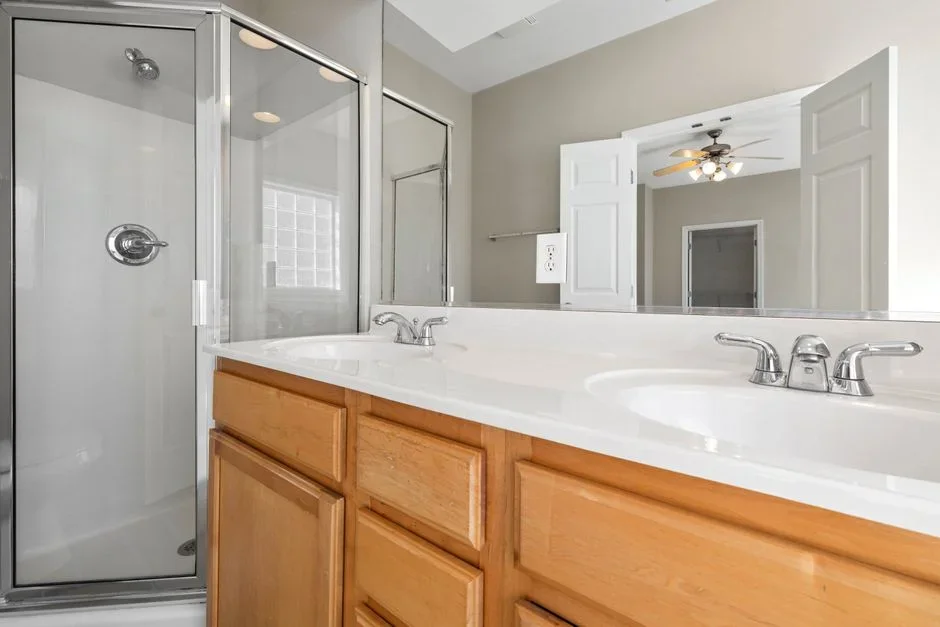
The mirror test that proves your fan is losing
A running motor proves the motor runs, not that air leaves the building. The clock is short: the EPA notes that if damp materials are dried within 24-48 hours, mold usually will not grow. A bathroom that holds fog long after the water stops misses that window twice a day.
Four things decide whether the moisture leaves: does the fan move air, is it sized for the room, does it run long enough, and does the duct end outside. Only the last costs money, and nobody checks it. If the ceiling is already growing something, handle the growth on the drywall first — this piece is about why it returns. If every room feels damp, the fan is a side issue next to the cheap whole-room damp fixes and what they actually accomplish.
The quick tissue check, and why it is not enough
Fan on, hold a single square of toilet tissue flat against the grille, let go. It sticks, flutters, or drops. No standards body publishes this test, so treat it as a rough go/no-go, nothing more.
A fan pulling 23-31 CFM against a 50 CFM label holds tissue happily. So does a fan whose duct dumps into your attic. The tissue proves only that the blade turns and the grille is clear. The honest tell is behavioral: if the room holds fog long after the shower, the fan has failed.

Sizing: the number is CFM, and it comes from your room
The Home Ventilating Institute's rule for a bathroom up to 100 square feet is 1 CFM per square foot, roughly eight air changes an hour. Above 100 square feet, HVI switches to adding by fixture: 50 CFM each for toilet, shower and bathtub, and 100 CFM for a jetted tub. That is HVI's method, not universal law.
The precise route is volume: length x width x height, then CFM = (8 x cubic feet) / 60. The DOE/CARB worked example uses an 8 by 12 by 8 foot bathroom: 768 cubic feet, calling for 102 CFM.
The code floor sits below the right answer. ASHRAE 62.2 sets bathroom local exhaust at 50 CFM intermittent or 20 CFM continuous, and HVI agrees continuous 20 CFM can stand in for an intermittent 50. A fan that meets the minimum can still be badly undersized for a large bathroom.
Noise is the spec people skip. HVI's quiet benchmark is 1.0 sones or less — about a refrigerator, against 3.0 for office noise. A loud fan gets switched off, and a fan switched off moves nothing.
Why a bigger fan usually does not fix it
The reflex is to buy a 110 CFM unit and bolt it to the old duct. That mostly buys noise, because the duct sets the ceiling, not the fan. The International Residential Code duct-length table (shown here as adopted in Washington State, Table M1504.2, rated at 0.25 in. w.c.) is blunt:
| Duct | 50 CFM | 80 CFM | 100 CFM | 125 CFM |
|---|---|---|---|---|
| 4-inch flex | 56 ft | 4 ft | Not allowed | Not allowed |
| 4-inch smooth-wall | 114 ft | 31 ft | 10 ft | Not allowed |
| 3-inch smooth-wall | 5 ft | Not allowed | Not allowed | Not allowed |
Read the 80 CFM column again: four feet of 4-inch flex. Footnote c says the figures assume no elbows, with fifteen feet of allowable length deducted per elbow. One bend and that fan is outside its own table. Code editions and local amendments vary; check what your jurisdiction adopted.
DOE/CARB caps a sensible master bathroom fan at 150 CFM. Straighten the run, swap flex for smooth-wall and delete elbows before buying a motor.
The "bigger fan backdrafts the house" story does not apply at this scale. The code trigger for makeup air is an exhaust system exceeding 400 CFM alongside a non-direct-vent fuel-burning appliance — a range-hood threshold. The real caution is narrower: DOE/CARB advises against whole-house exhaust-only ventilation in homes with atmospheric combustion appliances, including natural draft fireplaces. If your water heater or furnace draws on room air, have an HVAC contractor review it first.
Run it during the shower and after — but watch the mirror, not the clock
The free fix. HVI recommends leaving the fan on 20 minutes after use, with a timer for what people forget. DOE/CARB asks for delay-off switches of at least 10 minutes. NC State Extension says run it while bathing and after, calling a crank timer switch the easy method.
Treat 20 minutes as a rule of thumb, not physics — credible guidance starts at ten minutes and goes up. The better target is observable: a mirror that goes fully clear and stays clear. A large bathroom on a long duct needs longer. Swapping a wall switch for a timer is live electrical work; NC State's guidance assumes an electrician installs it.
A bathroom that stays damp between showers advertises it, most obviously through the insects that only show up in humid rooms.
The one that costs real money: where the duct actually ends
Take a flashlight into the attic, find the duct at the fan housing, and follow it until you see daylight at a wall cap or roof cap. That is the highest-value hour here — but attics deserve respect. Step only on joists or a board laid across them; ceiling drywall will not hold you. Use a properly footed ladder, wear gloves and a dust mask, and skip it in midsummer heat. If the insulation is loose grey-brown pebbles, it may be vermiculite that can contain asbestos — leave it alone and have it tested.
You may find a duct that stops short, lies on the attic floor, points at a soffit, or has slid off the housing. All of it is prohibited. IRC M1501.1 requires exhaust to discharge outdoors and states that air shall not be exhausted into an attic, soffit, ridge vent or crawl space; M1505.2 repeats it for bathrooms. The EPA agrees: vent bathrooms and kitchens to the outside, not into the attic.
The mechanism is simple and expensive. Warm wet air meets cold rafters, condenses, and soaks the wood from underneath, every shower, all winter. Find blackened sheathing or soft wood and stop: that is a remediation and roofing job, not a fan problem.
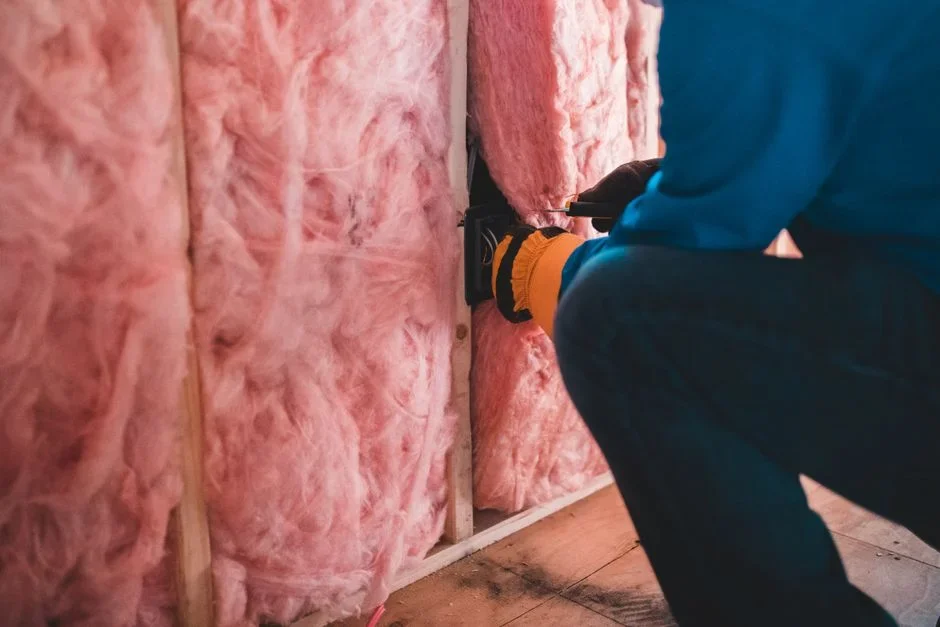
Redoing a termination means IRC M1504.3 clearances: not less than 3 feet from operable windows, doors and gravity intakes, and 10 feet from mechanical intakes. Insulate the duct where it crosses a cold attic. Cutting a roof penetration is flashing work — get help if that is new.
The window question, answered honestly
Most articles call the open window a myth. The code disagrees. IRC R303.3 requires bathrooms to have not less than 3 square feet of glazing, one-half openable, except where artificial light and a local exhaust system are provided. The window is the baseline; the fan is the exception for windowless rooms. The EPA lists both, telling readers to run the bathroom fan or open the window.
The limit is conditional: a window moves an unknown quantity of air on terms the weather sets. NC State Extension advises opening windows only when outdoor relative humidity is below 50%. On a dry spring morning it works. In an August heat wave you are importing moisture; in January nobody opens a bathroom window. A duct performs on schedule; a window performs when conditions allow.
Real, myth, dangerous
| Verdict | Claim | Why |
|---|---|---|
| REAL | Rated CFM is not delivered CFM | 50 on the box, roughly 23-31 in a duct |
| REAL | Run time beats raw power | Judged by a mirror that stays clear |
| REAL, with limits | An open window helps | Only below 50% outdoor humidity |
| MYTH | A bigger fan fixes fog | 4-inch flex caps at 4 ft for 80 CFM |
| MYTH | A bath fan backdrafts a house | The makeup-air trigger is 400 CFM |
| MYTH | The tissue test proves it works | An attic-dumping fan holds tissue fine |
| DANGEROUS | Venting into attic or soffit | Banned by code; rots sheathing |
| DANGEROUS | DIY timer wiring, roof penetrations | Live circuits and flashing: hire out |
What to check this weekend, in order
- Tissue check at the grille. Go/no-go only.
- Measure the room: 1 CFM per square foot under 100 sq ft, or (8 x cubic feet) / 60.
- Read the label on the fan housing and compare.
- Trace the duct: material, diameter, length, elbows. Check the table above.
- Go into the attic, safely, and follow the duct to daylight.
- Set the habit: fan on before the water, off when the mirror stays clear.
Scale helps. NC State Extension puts a 5-minute shower at about half a pint of water and a person breathing at roughly 3 pints a day. The EPA's target is indoor humidity below 60%, ideally 30 to 50%. A cheap hygrometer settles it.
Common mistakes
- Buying a higher-CFM fan and reusing the same flex duct with three elbows.
- Switching off the moment the shower ends, while the room is still saturated.
- Painting over or blocking the grille. DOE/CARB auditors documented fans still running, damper screwed shut, extracting nothing.
- Never looking at where the duct ends. It is the only failure here that rots your roof.
FAQ
Is my fan undersized, or just badly ducted?
Compare the label to the calculation. If it falls short of 1 CFM per square foot, it is undersized. If it matches and the mirror still fogs, suspect the duct: length, diameter, flex versus smooth-wall, elbows.
Can I vent the fan through the soffit?
No. IRC M1501.1 names the soffit alongside attics, ridge vents and crawl spaces as places air shall not be exhausted. A wall cap or roof cap is the compliant termination.
My bathroom has a window and no fan. Do I need to add one?
Legally, an openable window meeting R303.3 is the baseline, so a fan is an alternative, not an obligation. Practically, if the room stays fogged through winter, a ducted fan ventilates on your schedule, not the weather's.
The takeaway: Your fan probably works fine and still loses, because the duct it breathes through — not the motor — decides how much moisture actually leaves the house. Spend less. Live more. — The Thrifty Almanac






0comments