


You stepped outside on a warm afternoon and the sunny wall was moving — hundreds of insects packed onto the siding. Every instinct says grab a can and start spraying.
Hold off. The two insects that do this — boxelder bugs and multicolored Asian lady beetles — carry very different consequences for a house with a dog or an asthmatic in it. And the expensive mistake isn't spraying too little; it's spraying the wrong place at the wrong time, which hands you a second infestation worse than the first. ID first, vacuum second, sealing on the calendar third — the same order as our whole approach to household pests.
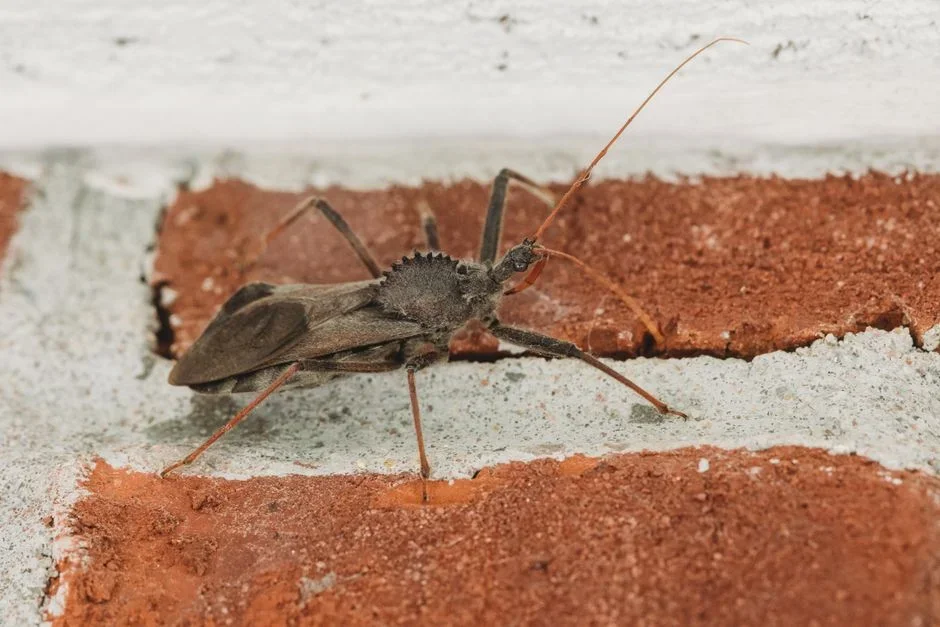
Boxelder bug or Asian lady beetle? Check the plate behind the head
Ignore color. Look at the pronotum — the small plate right behind the head.
| Check | Boxelder bug | Asian lady beetle |
|---|---|---|
| Size, shape | Flat-backed, elongated, about 1/2 inch long (roughly 12 mm) | Oval and domed, about 1/4 inch (around 7 mm) |
| Plate behind head | Three lengthwise red stripes | Whitish, carrying a small dark M or W mark |
| Color | Brownish-black, reddish-orange wing margins | Useless for ID: tan through orange to red, 18 spots, four, or none |
| Summer job | Seed-bearing female boxelder and silver maple | Eating aphids, hundreds a day |
| Behavior tell | Suns on south-facing walls | Hibernates in and around buildings, unlike natives |
The lady beetle's mark reads as an M or a W depending on viewing angle — promised an M, seeing a W, still the right insect. Boxelder nymphs look nothing like adults either: bright red, wingless, small. The limit: spot count is not an ID key.
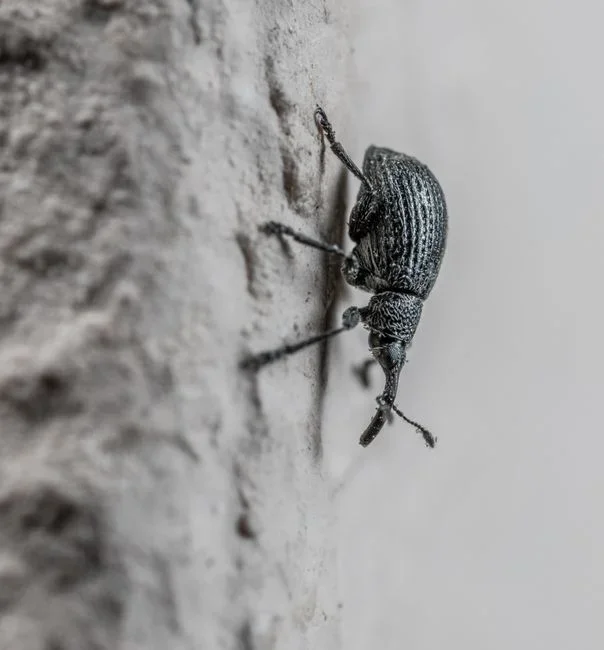
Neither one is eating your house, or breeding in it
This belief sells pest-control contracts, and it's wrong twice over. Ohio State says boxelder bugs do not damage buildings, clothing, food, or humans; Kentucky says lady beetles do not attack wood, food, or clothing.
Reproduction matters more, because it changes what February means. Penn State: overwintering insects like these do not reproduce within buildings, and Kentucky adds that beetles crawling out in late winter are the same individuals that entered the previous fall. Nothing hatches in your wall. Adults squeezed into a crevice last October, and warmth penetrating the walls in winter pushes them back out.
The limit — "harmless" is not "no consequences." Boxelder bugs stink when crushed and leave fecal stains on curtains and walls. Lady beetle hemolymph, released from the leg joints when they're disturbed, can permanently stain carpets, curtains, and walls — Michigan State calls it a yellowish fluid with a faint, foul odor. Real cost, just not a structural one.
Why they picked your wall
The driver is solar geometry, not housekeeping. Boxelder bugs gather in sunny spots on south sides of buildings; lady beetles pack onto sunnier southwest sides lit by afternoon sun. Kentucky found house color and construction matter less than surface contrast: dark shutters on light siding, light trim, downspouts. Walk all four sides during the afternoon flight window and mark where they vanish into the structure. That map is your sealing list.
The fix that creates a second infestation
Nobody tells you this before you buy the fogger. Once beetles reach wall voids and attics, Penn State says it is not advisable to use an insecticide against them; Kentucky calls killing them in wall cavities seldom effective; Ohio State says flatly, do not use any type of aerosol fogger or bug bomb. The reason is mechanical:
- You kill a mass of insects in a cavity you can't clean out.
- The pile becomes food — Ohio State notes scavengers including dermestid beetles feed on dead insects.
- Penn State's cluster-fly guidance says where that goes: carpet beetles then attack woolens and stored dry goods. Now the damage is real and it's in your closet — which is when people start tearing the bedroom apart hunting for bed bugs.
- Michigan State adds a second mechanism: dust from dead beetles in wall voids may trigger allergies or asthma.
Boxelder bugs are no better a target: Iowa State reports they're generally not killed by household aerosols.
The honest exception: this is wrong-place, wrong-time, not "spray never works." An exterior application before the beetles congregate is a tactic several extension services back, and Wisconsin allows treating clusters on siding with registered insecticides, insecticidal soap, or hot soapy water — no published dilution, so the label governs, including its directions on children, pets, and re-entry.
The lady beetle problems boxelder bugs don't have
Wisconsin says boxelder bugs will not bite humans or pets. Asian lady beetles differ on three fronts.
Bites. Penn State reports they occasionally bite, from slightly annoying to painful; Kentucky calls it a pinprick, seldom serious; Ohio State calls bites rare and unable to break skin, and Michigan State blames much of the stinging on leg spurs pricking skin. Poison Control notes they have no venom: wash skin with soap and water, rinse the mouth if fluid gets in it, and per Kentucky, don't rub your eyes after handling them.
Allergy. Documented, not speculative. In a four-year review of 1,400 skin prick tests at one northern West Virginia allergy practice, ladybug sensitization ran at 21% — near cat at 24% and cockroach at 27%, behind dust mite at 40% — with rhinoconjunctivitis at 8%, asthma 2%, urticaria 1%. Two allergens are characterized, Har a 1 and Har a 2, binding IgE in 65% and 75% of tested sera. Read those numbers carefully: an allergist's patients in a heavily infested region, not the general population — and one review found self-reported ladybug pests at home did not predict allergy. For a flare that tracks beetle season, Kentucky says see a physician.
Dogs. One peer-reviewed veterinary case describes 16 beetles embedded in a dog's hard palate, diagnosed as a chemical burn; Poison Control attributes it to irritant piperidine compounds. That's a single case, and Michigan State takes the opposite position — the beetles cause no harm to people and pets. Rare, documented, worth knowing if your dog mouths insects — a vet call, not a home fix. Poison Control takes worrying exposures at 1-800-222-1222.
What actually works once they're inside

Kentucky calls the vacuum the easiest way to remove beetles indoors, and warns a broom is likelier to cause staining. Three qualifiers make it work:
- Use a fan-bypass vacuum, like a shop vac. Ohio State says explicitly not to use a direct-fan vacuum, which pulls debris through the impeller.
- Direct-fan or bagless? Band a knee-high nylon stocking into the hose, trapping beetles before the fan.
- Discard the bag outside, right after. Ohio State conditions the method on discarding the bag; Penn State says remove it after each vacuuming. Their dust is an allergen source.
The limit: vacuuming is removal, not control. It does nothing about the population dormant in the wall, so expect repeats on warm days until spring.
The window that decides next fall
Watch the weather, not the calendar. Kentucky reports swarms fly to buildings September through November depending on locale, most Kentucky migration in October, flights heaviest on sunny days after a cool spell once temperatures return to at least the mid-60s. That rebound is your trigger.
The detail most articles blur: sealing and spraying run on different schedules. Kentucky puts the time to seal in late spring or summer, before the adults begin flying — months earlier than people expect. The exterior treatment is the late job: Ohio State places it in late September or early October, Penn State just prior to congregation, Michigan State when the first beetles appear. Miss it and there's no catching up: Kentucky notes barrier treatments in late winter or spring are ineffective, since the beetles got in the previous autumn. Dates shift earlier going north, later going south; the temperature cue is the rule.
Targets: cracks at windows, doors, soffits, fascia boards, utility pipes and wires; screening behind attic vents; tight door sweeps; screens at 16-mesh or smaller. The tolerance is tight — gaps of 1/8 inch or less let them in. Same gap-hunting job as shutting mice out of the house. No source quantifies how much sealing cuts indoor counts; extension services call it the most permanent fix.
The honest tier list
| Verdict | Tactic | Why it lands there |
|---|---|---|
| REAL | ID, then sealing before first arrivals | Named the most permanent control by every source |
| REAL | Fan-bypass vacuum, bag discarded outside | Removes what you see without crushing or staining |
| REAL, narrow | Exterior barrier treatment, late Sept to early Oct | Backed by three extension services — before congregation only |
| MYTH | "They're eating my house" / "breeding in the wall" | Adults only; no feeding or breeding indoors |
| MYTH | "Spray never works" | Outside and early works; inside and late fails |
| DANGEROUS | Foggers, bug bombs, insecticide into wall voids | Seldom effective, and the dead pile feeds carpet beetles |
Kentucky sets the honest ceiling: there is no quick fix, and vacuuming, pest-proofing and well-timed exterior treatment will not keep out every single beetle.
Common mistakes
- Identifying by color. Check the plate behind the head.
- Sweeping instead of vacuuming. A broom triggers the staining secretion.
- Leaving the bag in the vacuum. Odor plus allergenic dust, stored indoors.
- Treating wall voids after they're in. Buys you carpet beetles by spring.
- Waiting until fall to seal. You're locking them in behind the siding.
- Buying a ladybug house. Kentucky says they have no effect.
FAQ
Are these the same as the ladybugs that help my garden?
Same family, different behavior. Ohio State notes Asian lady beetles seek hibernation in and around buildings, while native species typically overwinter outdoors. A swarm on your siding in October is almost certainly the invader — though "typically" is a tendency, not an absolute.
Should I cut down the boxelder tree?
They feed on seed-bearing female boxelder and silver maple, not male trees. But no source supports removal as control, or says how far the bugs travel. Expensive gamble on an unverified premise.
Do vinegar, peppermint oil, or dryer sheets keep them out?
Nothing in the extension or poison-control literature tests or endorses them. The evidence points entirely at exclusion and removal.
When is it worth calling a professional?
When sealing is beyond reach — multi-story walls, extensive soffit and fascia gaps. Kentucky notes some householders find it more practical to hire a pest control firm or contractor.
The takeaway: The beetles at your window in February arrived last October, so the real fix isn't a spray can — it's a reminder on next spring's calendar. Spend less. Live more. — The Thrifty Almanac






0comments