

You cut the tree down yourself, and now there's a stubborn stump squatting in the yard. Every viral video promises the same thing: pour on some salt, drill a few holes, maybe light it up, and the stump "dissolves" on its own. Renting a grinder costs money, so the free trick is tempting.
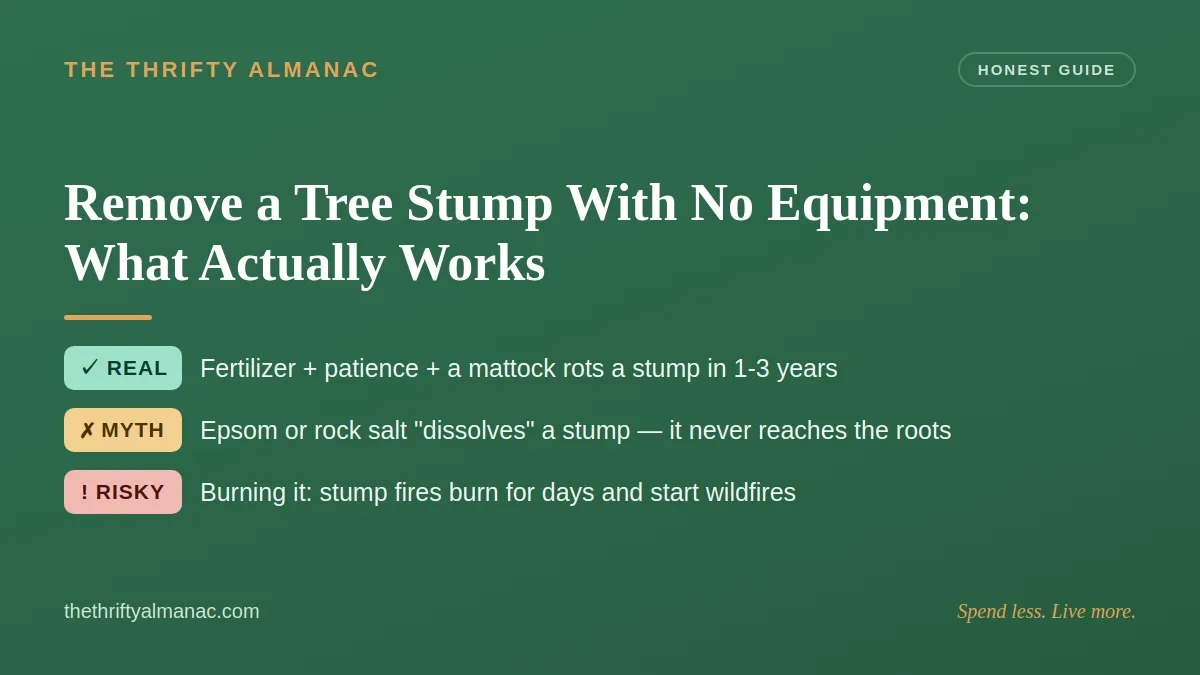
Here's the honest part nobody in those videos says out loud: there is no fast no-equipment method. Every genuine no-grinder route is either slow (we're talking months to years) or hard manual labor. Once you accept that, the choice gets simple. Below is the real tier-list, graded against university extension science, so you don't waste a season on a myth.
The honest bottom line: no fast no-equipment trick exists
A living stump doesn't want to rot on your timeline. The methods that actually work speed up decay a little or dig the thing out by hand. Nothing you pour on it makes wood vanish. Start with this table, then read the sections for the how and the why.
| Method | Verdict | Time | Effort / Cost | Main risk |
|---|---|---|---|---|
| Epsom or rock salt "dissolver" | MYTH | Never fully works | Cheap, low effort | Rock salt harms nearby soil & plants |
| Fertilizer + patience + mattock | REAL but slow | 1–3 years | Low cost, low effort | Very slow; keep pets/kids off treated holes |
| Enhanced natural decay | REAL (best value) | Fastest of the slow routes | Free, patient | Still measured in seasons, not days |
| Hand-dig & cut roots (small stumps) | REAL | Same day | Hard labor, cheap | Only for stumps under ~12 in |
| Burning it out | DANGEROUS | — | — | Fires burn for days; wildfire risk |
| Renting a grinder untrained | DANGEROUS-ish | Hours | Rental cost + real injury risk | Serious power tool; hire the pro instead |
MYTH: Epsom or rock salt "dissolves" a stump
This is the single most-shared bad tip in the niche, and it's worth correcting before you buy a single bag. There is no accessible peer-reviewed research supporting Epsom salt as a stump killer. Salt does not dissolve wood. At best, a concentrated dose slowly dries out any cells that are still alive.
And here's the mechanical catch: the salt solution likely never reaches the roots at all. Once you remove the leafy top of a tree, water and dissolved materials stop moving through the plant. So the "it travels down and kills the roots" story doesn't hold up.
The good news buried in that same extension answer: you may not need to kill the roots yourself. Without leaves to make food, the root system eventually dies on its own, and the dead roots rot over time. Your real job is just to cut back any sprouts that pop up. That's the same patience-first logic behind our take on what "permanent" weed control really means — starve the plant, don't chase a miracle pour.

One important distinction: Epsom salt (magnesium sulfate) is chemically milder to soil than the table or rock salt (sodium chloride) people also reach for. Rock salt is the one that does collateral damage. It causes acute damage — browning patches and dried-out buds — plus chronic harm to soil and surrounding roots that shows up later. If your stump sits near a lawn, a flower bed, or a tree you actually like, dumping rock salt can wreck all of it. Neither salt dissolves the stump; only one of them poisons your yard.
REAL but slow: feed the rot (fertilizer + patience + a mattock)
Here's the truth about "commercial stump remover." Those pricey jugs are just fertilizer — potassium or sodium nitrate — which means any high-nitrogen slow-release fertilizer does the same job for less money. There's no magic dissolver in the bottle. The nitrogen feeds the fungi that break wood down.
The method itself is well documented. Drill several one-inch-wide holes at least 10 inches deep, no more than 12 inches apart, then fill each with about 4 ounces of a nitrate-rich fertilizer. Keep the stump moist — and this is the part the marketing gets backward. Fungal rot needs moisture, not dryness. (The "salt dries the wood" idea is real, but it applies to prepping a stump for burning, not for rotting.)
Then you wait. With this acceleration, the softened stump can usually be broken apart with a sharp spade after one to three years; left completely alone, natural decay can take 10-plus years. South Dakota State frames the same chemical timeline as one to three years. When the wood finally goes punky, a mattock or a heavy axe pops it out in chunks. This is the honest manual route: cheap, low-effort, but patient. If you like getting decades out of your outdoor wood the slow, frugal way, it's the same mindset behind our old-school wood-fence longevity tricks.
REAL: let nature do it (or dig it out if it's small)
Two more low-cost routes deserve a spot. The first is enhanced natural decay, and it may surprise you: chemicals are not the speed champion. According to Illinois Extension, chemical treatment speeds decomposition by about 25%, while enhancing natural decay — more surface area, better soil aeration, moisture, and nitrogen — can accelerate it by up to 50%. Treat those percentages as directional guidance from a single extension post, not lab-precise constants, but the takeaway holds: cut the stump low, drill it up for surface area, keep it damp, feed nitrogen, and let the soil fungi work.
The second route is old-fashioned digging, and it genuinely works — but only on smaller stumps. Iowa State pegs the realistic limit at less than about 12 inches in diameter. You dig a trench one to two feet deep all the way around, then use a saw to sever every lateral root before levering the stump out. It's brutal on the back and it's the only same-day, zero-chemical option. Don't try it on a big stump; the roots will win. Choosing the right tool for the yard problem in front of you is the whole game — the same honest, size-first thinking we use in our tier-list for burrowing pests.
DANGEROUS: burning the stump
Burning is the trick most likely to hurt you or your neighborhood, so this is the correction that matters most. Iowa State flatly does not recommend burning: stump fires can burn for days and are difficult to control and extinguish. That's not a campfire you can stomp out and walk away from.
Two hard safety rules. First, never pour accelerant on it. State fire agencies are explicit: never use kerosene, gasoline, diesel fuel, or other flammable liquids to speed a burn — the flash-back can put you in the ER. Second, respect the wildfire risk. Escaped debris burns are the leading human cause of wildfire in Virginia; wind can carry embers well off your property and ignite dry vegetation, so never burn on a dry or windy day. Check your local burn regulations first, and if a stump fire ever gets away from you, call 911 — not the garden hose.
DANGEROUS-ish: renting a grinder without training
Grinding is honestly the fastest, easiest route. A machine chews the stump and large lateral roots down 8 to 12 inches, and the stump is gone within hours — Iowa State calls it the quickest, easiest, and safest way. Illinois notes grinders can take a stump anywhere from flush with the soil to over a foot deep.
The catch is the word "safest" — extension sources mean safest as the arborist's job, not a DIY rental. A stump grinder is a serious power tool that throws wood chips and rock at high speed. If you're set on grinding, the sane version is to hire it out. That's often the honest answer for a big stump you want gone this weekend.
Common mistakes
- Trusting salt to "dissolve" the stump. It doesn't reach the roots and it never dissolves wood; rock salt just damages the soil around it.
- Letting the fertilized stump dry out. Rot needs moisture. Drying is for burning — a different (and dangerous) method.
- Expecting a timeline in weeks. The real chemical/fertilizer route runs one to three years. Plan for it.
- Hand-digging a giant stump. Above roughly 12 inches diameter, the labor stops being worth it.
- Pouring gas on a burn. Flammable accelerants and days-long stump fires are how yards and hands get hurt.
FAQ
What's the absolute cheapest way to remove a stump myself?
Letting it rot. Cut it low, drill holes for surface area, keep it moist, add a high-nitrogen fertilizer, and wait. It costs a few dollars and a lot of patience — one to three years with help, longer without.
Does Epsom salt really kill a stump?
No university research supports it. At best it slowly dries out live cells, and it likely never reaches the roots because sap stops moving once the top is gone.
Do I even need a chemical to kill the roots?
Often no. With no leaves, the root system dies on its own and rots over time. Just keep cutting back any sprouts.
Is burning a stump ever a good DIY idea?
Extension services say no — stump fires burn for days and are hard to put out, and escaped burns are a top wildfire cause. Never use accelerants.
When should I just hire a pro?
When the stump is large, near structures, or you want it gone today. A professional grind clears it in hours, and it's the version extension sources call the safest. For more yard-and-home judgment calls like this, our home hacks guide lays out the honest options.
The takeaway: There's no magic pour and no fast no-equipment trick — pick patience and a mattock, a shovel for small stumps, or a hired grind, and skip the salt and the fire. Spend less. Live more. — The Thrifty Almanac




0comments