

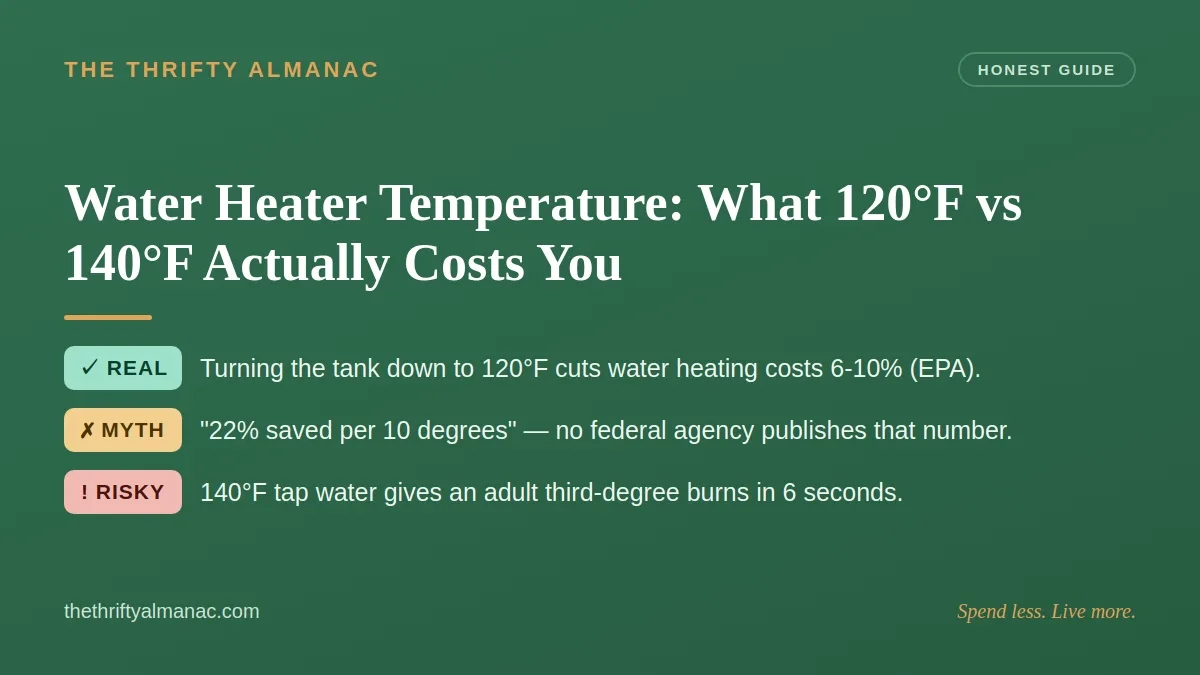
Your water heater thermostat is one of the few money-saving adjustments that takes ten seconds and costs nothing. It is also one where turning it the wrong way can put a family member in the emergency room — in two different ways, depending which way you turn it.
Two federal agencies look at the same appliance and give opposite advice, and neither is wrong. Here is what the dial is worth, what it costs, and how to decide for your household.
The short version: real, myth, and dangerous
| The move | Verdict | What an authority says |
|---|---|---|
| Turn the tank down to 120°F | REAL, modest | EPA: 6–10 percent off water heating — not per 10 degrees |
| Blanket the tank, swap the showerhead | REAL, faster payback | EPA: a year or less, and about four months |
| “22% saved by turning it down 10 degrees” | MYTH | No agency publishes it |
| “120°F is simply correct” | HALF THE PICTURE | CPSC says 120°F; OSHA and EPA say store at 140°F |
| Shutting the heater off while away | RISKY | EPA: disuse creates stagnant water |
| Testing the T&P relief valve yourself | DANGEROUS | PNNL: scale clogs T&P valves — call a pro |
What genuinely saves money on hot water
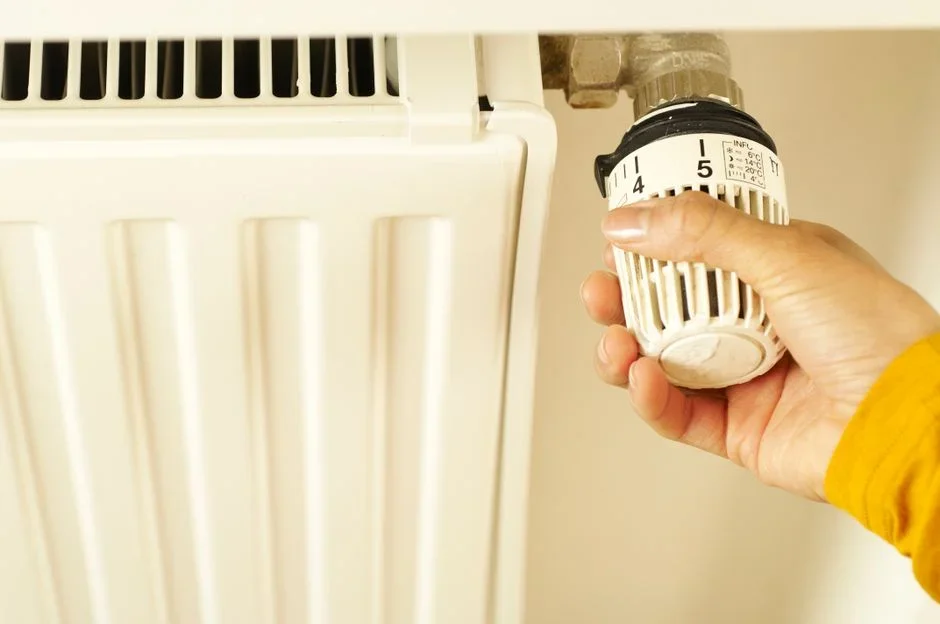
A storage tank spends its life reheating water nobody asked for, and the hotter you hold it, the more often the burner fires. For perspective: EIA put space heating and cooling at 52 percent of household energy use in 2020, with water heating bundled with lighting and refrigeration at another 25 percent. For bigger targets, our roundup of habit changes that cost nothing has more room. On hot water, four moves have a published figure behind them:
- A low-flow showerhead. EPA says they pay for themselves in only four months. A WaterSense model at 2.0 gallons per minute saves an average family 2,700 gallons and 330-plus kWh a year.
- Fix the hot-side drips. EPA puts household leaks at 9,400 gallons a year per average family, and a hot drip wastes the energy that heated it. Our guide to cheap parts that replace a service call covers which are genuinely DIY.
- An insulation blanket on an older uninsulated tank. EPA: pays back in a year or less, 25–40 percent less heat loss. Skip it on a modern insulated tank, and never cover controls, air intake, vent or relief valve.
- The dial. EPA: turning down to 120°F cuts water heating costs 6–10 percent. Read the next three sections first.
All national averages; savings depend on fuel, rate, tank age, household size and hardness. Anyone quoting a dollar figure has not seen your basement.
The viral numbers that don't survive a fact-check
“Save 22 percent by turning it down 10 degrees.” No federal agency publishes this. EPA's figure is 6–10 percent for the entire move down to 120°F. The viral version roughly doubles the real effect and pins it to a per-10-degree rule.
“3 to 5 percent for every 10 degrees.” Repeated everywhere, but it traces to a consumer web page rather than a study, and could not be verified against a working authoritative source. Not the same as false — it means nobody quoting it can show you where it came from, the same weakness behind other utility claims that fall apart under checking.
“A tank blanket pays for itself in a month.” EPA says a year or less. Still a good buy; the month version is fiction.
Safety side one: what hot tap water does to skin
The scald timings are why 120°F exists as a recommendation — exposures at which most adults suffer third-degree burns, per CPSC:
| Water temperature | Time to a third-degree burn (adults) |
|---|---|
| 150°F | 2 seconds |
| 140°F | 6 seconds |
| 130°F | 30 seconds |
| 120°F | 5 minutes |
A peer-reviewed burn review lines up closely: 5 seconds at 140°F and 5 minutes at 122°F. Note that last row: 120°F is lower risk, not zero risk. CPSC reports most scald injuries and deaths involve the elderly and children under five; that review explains why children fare worse — thinner dermis, more body surface exposed — and recommends adult-based standards be revised downward 3°C to 4°C for children.
CPSC's practical rule: use the lowest setting that satisfies your washer and dishwasher, and hand-test before bathing an infant. Its childproofing guidance also endorses anti-scald devices for faucets and shower heads.
Safety side two: the bacteria the savings posts skip
Legionella grows in lukewarm water. OSHA puts the range at 68° to 122°F, optimal between 95° and 115°F; EPA describes best growth between 80 and 120°F. Treat it as an approximate band, not a precise line — and notice the problem: a tank held at 120°F sits inside it.
So OSHA recommends storing at a minimum of 140°F and delivering at least 122°F to every outlet, and puts risk low when a heater runs at 140°F with 122°F at distant faucets. EPA agrees a thermostat at or above 140°F holds the system above the band — while noting in the same document that tap water may present a scalding risk above 117°F.
This is not a hospital-only problem. EPA's residential guidance names home water heaters and lists who is at higher risk: people 50 or older, smokers, people who are immunocompromised, and those with chronic lung disease, cancer, diabetes or kidney or liver failure. EPA also advises flushing your home's water after periods of disuse — the real argument against switching a tank off while you travel.
Two honest limits: none of this means a 120°F tank causes Legionnaires' disease, only that risk rises; and OSHA writes for workplaces, never addressing scald risk or mixing valves.
How to have both: the mixing valve
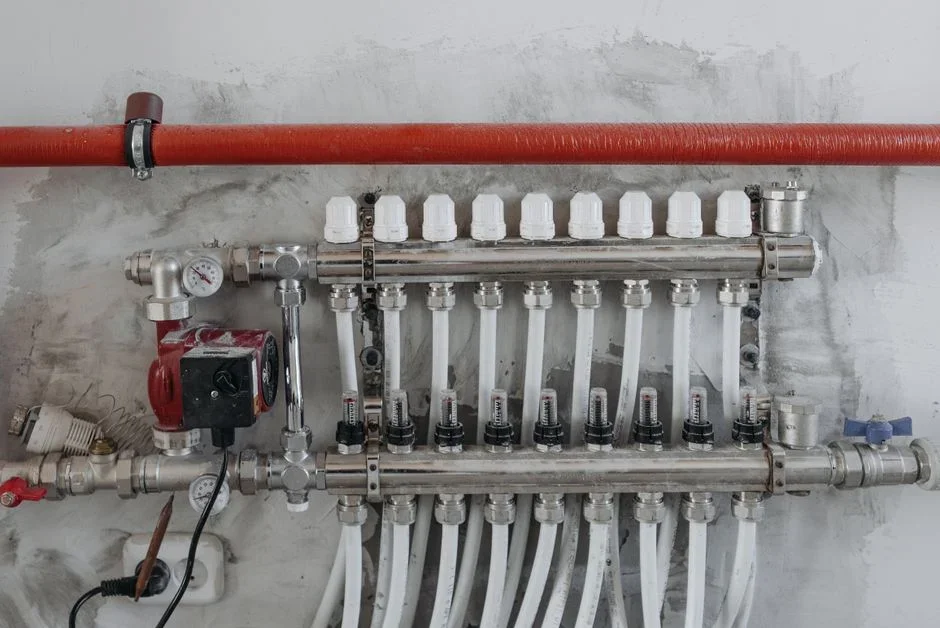
A thermostatic mixing valve blends hot and cold so the tank stores water hot while the tap delivers it safe. EPA describes these as devices that mix cold and hot water to consistent, safe temperatures to prevent scalding, placed as close to the outlets as possible. Store at 140°F for the bacteria question, deliver around 120°F for the burn question — that addresses both rather than splitting the difference.
EPA draws the DIY line itself: for mixing valves and for flushing a heater, follow the manufacturer's instructions or have a professional do the work. And if anyone in the house is immunocompromised, elderly or has chronic lung disease, EPA says a healthcare provider or public health professional can advise you. That is a doctor-and-plumber conversation, not a website one.
Sediment: the maintenance claim that holds up
PNNL, a Department of Energy national laboratory, found hard water dropped gas storage heater efficiency from 70.4 percent to 67.4 percent over the equivalent of two years. Real, and nowhere near “doubles your bill.” Scale insulates the burner from the water, building heat in the tank and its glass lining, which invites corrosion and failure. Electric heaters instead fail by burying and overheating the bottom element.
The finding that reframes the temperature debate: in water of 170 mg/L hardness, PNNL calculated 0.06 inches of lime scale accumulating in about 4 years at 140°F but almost 30 years at 120°F. Running hot carries a maintenance cost, and scale can clog pipes, the drain valve or the relief valve. Two limits: those figures come from accelerated lab testing extrapolated to realistic conditions, not ordinary homes; and on gas heaters, cleaning sediment did not restore full efficiency, because the burner surface cannot be fully cleaned. Flushing slows the loss; it does not undo it.

Flushing without hurting yourself or the tank
You are working with near-scalding water under pressure, so the order of PNNL's steps is the safety.
- Kill the heat first. Electric: pull the fuse or turn off the circuit. Gas: burner off or set to “pilot.” PNNL lists this as step one — draining with an element still energized destroys it.
- Shut the cold water supply at the top of the tank, then relieve pressure by opening several hot taps before touching the drain.
- Attach a hose to the drain valve, run it somewhere that can take near-boiling water safely, then open it.
- Refill before restoring heat. Close the drain, reopen the cold supply, and wait until the open hot taps run steady rather than sputtering — the tank is full. Only then restore power or gas.
How often? PNNL calls draining every 6 months conservative and probably not required in most locations — let hardness set the schedule, not the calendar. Call a plumber if the drain valve will not reseal, if the tank is old enough that thermal shock worries you, or if you see corrosion. And do not test, lift or open the temperature and pressure relief valve yourself; that is an inspection job for a pro.
Decide for your house
| Household | Setpoint | Mixing valve? | Who to call |
|---|---|---|---|
| Young children only | 120°F | Optional; anti-scald devices help | Nobody |
| Healthy adults | 120°F | No | Nobody |
| Older adults in the house | Both risks apply | Yes — cleanest answer | Plumber |
| Immunocompromised or chronic lung disease | Do not guess | Likely, with 140°F storage | Doctor, then plumber |
| Hard water, or away often | Lower storage slows scale; keep it running | Per rows above | Flush taps on return |
CPSC and OSHA/EPA genuinely differ, and no US authority settles it for a single-family home, so this is a framework, not a ruling. If a page hands you one number with total confidence, it is leaving out the other agency — the same caution behind our other household fixes worth doing.
Common mistakes
- Turning the dial down without knowing whether anyone in the house is higher-risk.
- Assuming 120°F is safe for a baby's bath — CPSC lists third-degree burns there after a five-minute exposure. Hand-test every time.
- Blanketing a modern tank, or covering controls, air intake, vent or relief valve on any tank.
- Draining before cutting power or gas and relieving pressure through open hot taps.
- Lifting the relief valve lever on an old tank to “check it.”
FAQ
So what temperature should I actually set?
Healthy adults and young children: CPSC's 120°F is defensible. If someone is older, immunocompromised or has chronic lung disease, the honest answer is 140°F storage plus a mixing valve — and a conversation with their doctor.
How do I check what my heater is actually set to?
Dial markings are not a measurement. CPSC's method: hold a candy or meat thermometer under the faucet first thing in the morning, or at least two hours after any hot water use, then adjust and check again.
Should I turn the heater off when I travel?
Leaving it running is the safer default. EPA's concern with disuse is stagnant water and the temperature and disinfectant changes that follow — which is why it advises flushing taps when you return.
The takeaway: The dial is a real but modest saver with a real safety cost on both sides, and the only setting that answers both risks at once is hot storage paired with a mixing valve. Spend less. Live more. — The Thrifty Almanac



0comments