

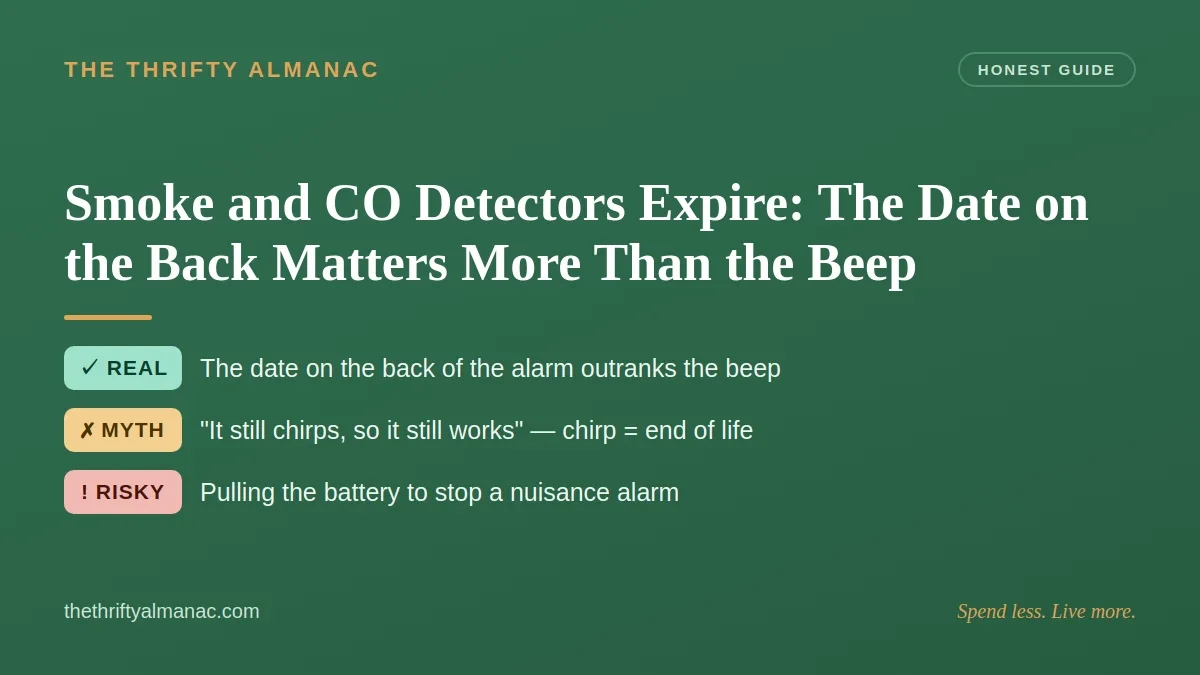
Take sixty seconds and flip over the smoke alarm nearest your bedroom. Twist it off the bracket and find the printed date. That's the manufacture date, and it decides whether the alarm still works — not the day you bought it.
Most of us have never looked. In CPSC's 2024 survey, as reported by NFPA, 99% of U.S. households have a smoke alarm — up from 88% in 1994 — but only 51% were accurate about their alarms' age. It also found 61% test less than monthly, 33% never at all.

The 10-year rule, and why a working beep doesn't buy you time
NFPA is blunt: "All smoke alarms must be replaced 10 years after its manufacturing date." USFA agrees — "Smoke alarms do not last forever." The clock starts at the factory stamp, so an alarm warehoused two years is already two years old.
Pressing the test button is a real check — NFPA asks you to test monthly. But it doesn't reset the clock. Sensing chambers collect dust and drift over a decade.
On carbon monoxide alarms the gap is explicit. CPSC: "Using a test button tests whether the circuitry is operating correctly, not the accuracy of the sensor." It proves the horn works, not that the sensor detects gas — so CPSC points to the replacement age in the product literature.
Still test monthly — just stop reading it as proof of youth. An indicator that lights up feels like proof of capability, the same reasoning that makes people overestimate what a budget battery station can actually run.
The chirp a new battery won't fix
Two chirps, two meanings — confusing them keeps expired alarms up for years. NFPA: "A single chirp every 30 or 60 seconds means the battery is low." But "Chirping that continues after the battery has been replaced means the alarm is at the end of its life."
NFPA's troubleshooting guidance adds two cases: past 10 years from the manufacture date, chirping means end of life; under 10 years, if new batteries still chirp, "replace the alarm anyway." Sealed units aren't re-batteried — the whole alarm goes.
| Sound | Meaning | What you do |
|---|---|---|
| One chirp every 30–60 seconds | Low battery | Replace the battery (unless sealed) |
| Chirping after a fresh battery | End of life | Replace the entire alarm |
| Three beeps, pause, repeat | Smoke — fire | Get out, call 911 outside |
| Four beeps, pause, repeat | Carbon monoxide | Fresh air outdoors, call 911 |
| Trouble signal that won't stop | Fault | Check batteries; if it persists, call the fire department |
Memorize the four-beep pattern: NFPA notes "4 beeps followed by a pause repeatedly" means carbon monoxide. A combination unit looks identical from below, so sound is the tell.
Ionization vs photoelectric: which fires your alarm notices first
NFPA puts the split simply: "Ionization alarms are more responsive to flaming fires, and photoelectric alarms are more responsive to smoldering fires."
NIST explains why: ionization alarms are quicker on "small black soot particles from flaming fires," while photoelectric detectors are more sensitive to particles "larger in size and white or light-colored, and thus more reflective" — a smoldering couch cushion.

Don't pick a winner. USFA recommends both types, or dual-sensor units, since nobody can predict what kind of fire starts. NFPA adds that photoelectric alarms suit kitchens and bathrooms, triggering fewer nuisance alarms. The limit: neither type is a safe default alone, and nothing here says one is being retired.
Which is on your ceiling? The 2024 survey found 42% ionization, 29% photoelectric, 6% both, 23% no idea. The type sits on the same label as the date.
Where alarms belong (the hallway-only house is the gap)
The most common setup in America is one hallway alarm. That isn't coverage — it's a single point of failure with a closed bedroom door between it and a sleeper. NFPA calls for alarms "inside and outside every bedroom and sleeping area," on every level including the basement, on the ceiling or high on a wall. You may have "as little as 2 minutes to escape safely."
The two types follow different rules. The basement is the clearest split: smoke alarms belong there, CO alarms generally don't.
| Location | Smoke alarm | CO alarm |
|---|---|---|
| Inside every bedroom | Yes (NFPA) | Near or inside each sleeping area (EPA) |
| Hallway outside sleeping areas | Yes (NFPA) | Yes (CPSC, EPA) |
| Every level | Yes, basement included (NFPA) | Not attics or basements unless someone sleeps there (CPSC) |
| Kitchen | No — 10 ft from the stove (NFPA) | 15 ft from fuel-burning appliances (EPA) |
| Bathroom | No — 36 in. from the door (NFPA) | Not applicable |
| Attached garage | Follow the manual | Inside the home near the garage door, and rooms above it (EPA) |
The 15-foot figure is EPA's: a central spot on every livable level "at least 15 feet away from any fuel-burning appliance," plus near sleeping areas and near the door to an attached garage — the point people get backwards. EPA puts a CO alarm there on purpose. Its limit: many local fire departments publish shorter clearances, and NFPA defers to the manufacturer. CPSC adds: don't let furniture or draperies cover an alarm, and interconnected units are best.
Requirements come from state and local codes that vary widely — treat this as best practice, then check yours.
CO alarms wear out sooner, and the sources disagree
Your CO alarm doesn't get the same decade. How much less depends on who you ask.
- CDC: "Replace your CO detector following the manufacturer's instructions or every 5 years."
- USFA's home checklist sets thresholds side by side: smoke alarms "less than 10 years old," CO alarms "less than 7 years old."
- CPSC and NFPA defer to the manufacturer's stated replacement age.
So: a 5-to-7-year range, manual as tiebreaker. Find the replacement age on the unit and put that year on your calendar. CPSC also recommends replacing batteries annually, testing monthly, and choosing a CO alarm meeting the UL 2034 standard.
Ownership lags: only 55% of households in that survey had a CO alarm, and 26% knew "nothing at all" about them. CDC reports "More than 400 Americans die from unintentional CO poisoning not linked to fires," plus 100,000 emergency visits and 14,000 hospitalized yearly.
Risk climbs whenever people improvise heat or power. CPSC is explicit: never leave a car running in an attached garage "even with the garage door open," and never run a generator "in or near an enclosed space." That's the hazard inside idling a vehicle to keep the lights on, and why lighting a room with oil lamps needs ventilation and a working CO alarm. CDC says generators go outdoors "more than 20 feet from windows, doors, and vents."
The two things that get people killed
1. Pulling the battery to shut it up
USFA is direct: "If a smoke alarm sounds while you're cooking or taking a shower with lots of steam, do not remove the battery." Open a window, press the hush button, wave a towel. If one alarm goes off constantly, relocate it — don't silence it.
People develop the habit for a reason. NFPA's 2023 incident data counted 82,245 CO incidents needing a fire department response — plus 79,051 alarm malfunctions and 79,286 activations where no CO was found. Nuisance events roughly match real ones, teaching people to distrust the noise. And it matters: NFPA reports "roughly three out of five fire deaths happen in homes with either no smoke alarms or no working smoke alarms."

Nuisance alarms usually have a physical cause worth fixing — the same logic as lint packing itself into a dryer duct, where the repair is the vent, not the alarm.
2. Staying inside to figure it out
If a CO alarm sounds there is one instruction. NFPA: "immediately move to a fresh air location outdoors," account for everyone, and "call for help from a fresh air location." Not: open windows and see if the headache fades. Not: hunt for the source. Out, then call from outside.
NFPA separates the trouble signal from the alarm — if it sounds, check for a low battery; if it persists, call the fire department — ask their non-emergency line in advance which number to use.
Why so rigid: CPSC warns that occupants and physicians "can mistake mild to moderate CO poisoning symptoms for the flu, which sometimes results in tragic deaths." CPSC puts no symptoms for most people at 1 to 70 ppm, noticeable symptoms above 70 ppm, and unconsciousness and death possible "above 150 to 200 ppm." Those numbers explain why you leave — they are not a checklist for grading yourself indoors.
A 15-minute audit
- Flip every alarm; note its date and type (ionization, photoelectric, dual, or combination).
- Add 10 years to each smoke alarm date — that's the replace-by year.
- For each CO alarm, find the replacement age in the manual (expect 5 to 7 years).
- Map coverage against the placement table. Note every bedroom lacking an alarm inside it.
- Set two reminders: a monthly test, and each unit's replace-by year.
The audit is free, turning replacement from a surprise into a line item you can shop on your own timeline. It never justifies skipping a bedroom or stretching a unit past its date.
Common mistakes
- Counting from the purchase date. The 10 years runs from the manufacture stamp.
- Treating a passed test as an inspection. On CO alarms, the button skips the sensor.
- Feeding a chirping alarm more batteries. Chirping on a fresh battery means finished.
- Relying on the hallway alarm. A closed bedroom door blocks it from the sleeper.
- Defaulting a CO alarm to the basement or attic. CPSC says no unless someone sleeps there.
- Moving a CO alarm away from the garage door. Backwards — EPA wants one near it.
- Investigating a CO alarm from inside. Out first, call from outside.
FAQ
Where exactly is the date printed?
On the back or side of the housing, on the same label as the model number and sensor type — you'll have to twist the alarm off its bracket. No date at all means replacement is the safe assumption.
My alarm is hardwired. Does the 10-year rule still apply?
NFPA's rule covers all smoke alarms: 10 years after the manufacturing date. Being wired in grants no extra life. If you're not comfortable with household wiring, kill the breaker or call an electrician.
Does a combination smoke/CO unit cover everything?
They're legitimate, but identical to a plain smoke alarm from below — learn the patterns: three beeps for smoke, four for CO. The two types also carry different placement rules and replacement ages, so a combo unit's date follows whichever component expires first.
The takeaway: Flip your alarms over tonight, read the manufacture dates, and put the replace-by years on your calendar — the cheapest safety upgrade in your house, because it costs nothing at all. Spend less. Live more. — The Thrifty Almanac





0comments