

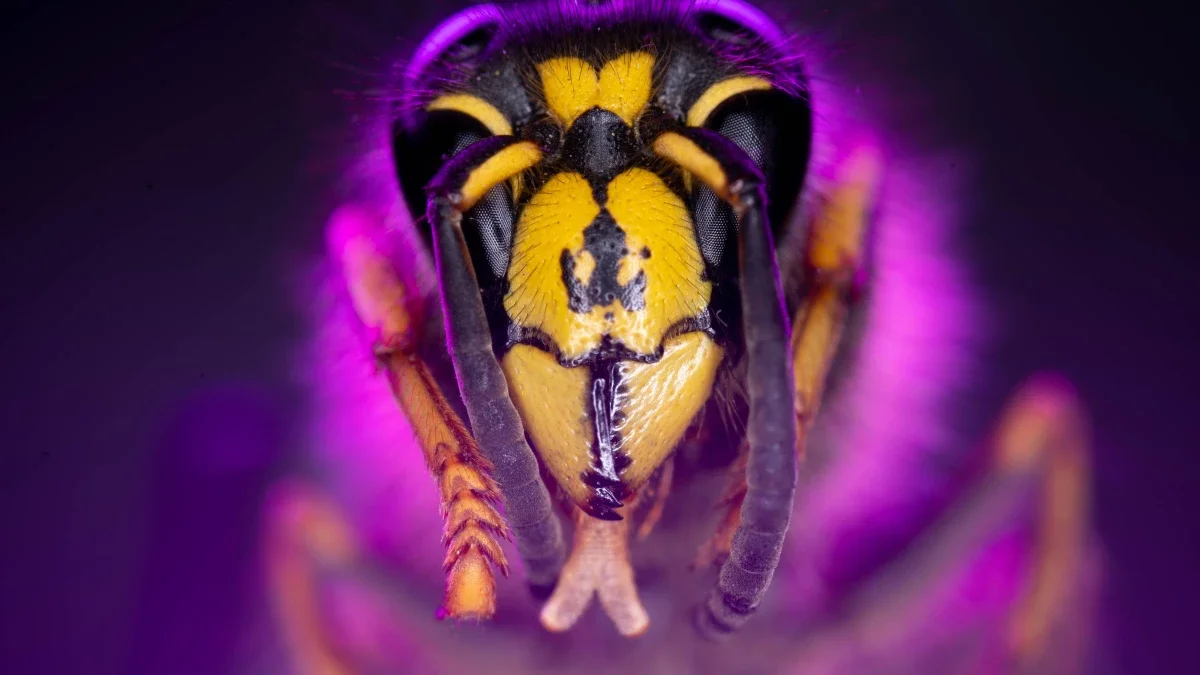
There's a gray, papery ball the size of a fist wedged in the arborvitae by the driveway, and at the same barbecue a striped insect keeps landing on the rim of your soda can. Every neighbor has an opinion, and every opinion ends the same way: kill it. It's easy to feel like those are one problem with one answer.
They're usually not. The honest version the "just kill it" advice skips is that "striped and flying near me" covers at least five very different insects — and the one dive-bombing your drink is almost never the one living in that nest. Some of them you genuinely want gone. At least two of them are pollinators that a lot of people are actively trying to protect. Telling them apart takes about ten seconds once you know what to actually look at, and getting it right changes whether you reach for a trap, a phone number, or nothing at all.
Look at texture first, then the waist
WHAT: Color is the trap. Half of these insects are yellow and black, so "yellow and black" tells you almost nothing. Two features do the heavy lifting: how hairy the body looks, and how pinched the waist is.
HOW: Bees are fuzzy. Wasps and hornets are sleek and hard-shelled, with a sharply narrow "waist" between the thorax and abdomen. University of California's IPM program puts the honey-bee tell plainly: "Honey bees are less brightly striped than yellowjackets and have more hair". That hair isn't decoration — it's how bees carry pollen, which is also the clue to why they matter. A wasp, by contrast, looks polished and slightly menacing because it is smooth. Paper wasps take the pinched waist to an extreme; UC IPM describes them as having "long slender waists" and dangling legs that trail behind them in flight.
WHY: If it's fuzzy and unhurried, you're probably looking at a bee, and the answer is almost certainly "leave it alone." If it's sleek, fast, and comes to a point at the middle, you're in wasp-or-hornet territory, and the next question is which — because that decides how careful you need to be.
Paper wasps: the open-cell umbrella under the eave

WHAT: Paper wasps are the slim, long-legged wasps that build the nest everyone pictures — a single gray honeycomb hanging like an upside-down umbrella from a porch eave, a mailbox, or a deck rail. The giveaway is the nest itself: the cells are open and exposed, with no paper envelope around them. UC IPM notes paper wasps "build paper nests with many open cells under eaves". If you can see the individual six-sided cells, it's a paper wasp.
WHY: Temperament is where paper wasps get a partial pass. They are far calmer than their reputation. UC IPM says flatly that "Paper wasps are much less defensive and rarely sting humans", and Penn State Extension echoes it: "Paper wasps are not defensive unless their nest is threatened".
LIMIT: "Unless their nest is threatened" is the whole catch. A nest tucked over a doorway you use twenty times a day, or right where you swing a rake, is a problem worth handling — not because the wasp is a menace, but because you keep walking into its front yard. A nest in the far corner of the garage that nobody bothers can often just finish its season and die off in fall. If it does need to go, the calm-but-armed math is covered in our safe nest-removal walkthrough.
Yellowjackets: the one that actually ruins the picnic
WHAT: This is the insect on your soda can. Yellowjackets are shorter and stockier than paper wasps, with bold, jagged black-and-yellow banding — UC IPM measures them at "1⁄2 to 1 inch long with jagged bright yellow and black stripes". The bigger tell is where they live: not a tidy umbrella under the eave, but hidden. UC IPM says they "nest in holes in the ground, inside wall cavities, or in hanging nests totally enclosed in gray paper with a single entrance". Penn State adds that the common ground-nesters, genus Vespula, "typically make their nests underground" — which is exactly why people mow straight over one without knowing it's there.
WHY: Behavior is what sets yellowjackets apart from every other insect on this list. They are the scavengers. UC IPM notes that "In fall, foraging yellowjackets are primarily scavengers" — which is the technical reason they crowd your meat, your fruit, and your sugary drinks in late summer and early fall, when their colony is largest and natural food is scarce. Penn State is blunt about the defense, too: "Some species of yellowjackets aggressively defend their nests by inflicting repeated stings". Note "repeated" — unlike a honey bee, one yellowjacket can sting you again and again.
LIMIT: Because they defend hard and hide their nest, an underground yellowjacket colony is the one situation where blindly poking around is genuinely risky. For the foragers at the table, a baited trap set away from where you're sitting does more than swatting ever will — the logic and the build are in our soda-bottle trap guide, which also flags the point where it's smarter to call a pro than to dig.
Hornets: the big paper football in the tree

WHAT: In most of the U.S., "hornet" in the backyard means the bald-faced hornet — which, despite the name, is technically a large relative of the yellowjacket, not a true hornet. It's the striking black-and-white insect, noticeably bigger than a yellowjacket, and it builds the nest people mistake for something out of a horror movie: a large, gray, football- or teardrop-shaped paper envelope hanging from a tree branch or the side of a house. Penn State explains the name comes from the face: "Their common name comes from their striking white face".
WHY: The reputation outruns the reality when you're not near the nest. Penn State notes "Bald-faced hornets are docile when encountered away from the nest" — a lone one foraging on a flower is not looking for a fight. The nest is a different story: it's a well-defended fortress, often high up and large, and it is not a beginner removal job. You may also run into the European hornet in parts of the eastern U.S. — a genuinely large brown-and-yellow hornet that nests in hollow trees and wall voids and is sometimes drawn to lights at night. Either way, a big enclosed aerial or in-wall hornet nest is a "hire it out" situation, which is exactly what our nest-removal guide and the broader DIY pest-control hub spell out.
Why bees get a pass — and who to call instead
WHAT: Honey bees and bumble bees are the fuzzy ones, and they are on a completely different side of the ledger. Honey bees are golden-brown and hairy rather than sharply striped; bumble bees are the big, round, heavily furred ones that look almost cartoonish. Penn State notes honey bees "are cavity nesters and reproduce by swarming", so a honey-bee colony usually turns up inside a wall void, a chimney, or a hollow tree — not a hanging paper nest.
WHY: This is the "pass." Bees are pollinators, and they sting far less readily. Penn State points out that honey bees "typically only sting to protect their nests or their lives, and each individual bee can only sting once" — the barbed stinger tears loose and the bee dies, so it has every reason not to. Bumble bees earn their keep the same way; Penn State calls them "important pollinators of flowering plants" that "can perform 'buzz pollination', which is important for tomatoes, blueberries, and other plants".
LIMIT: If you've correctly identified a honey-bee swarm or colony, do not spray it and do not trap it. Many local beekeepers will collect a swarm for free or a small fee and relocate it, and killing them off is both wasteful and, in some places, discouraged or restricted. When in doubt about a fuzzy insect near your house, the right move is a call to a local beekeeper or your county extension office — not a can of anything.
| Insect | Body & texture | Color | Nest | Temperament |
|---|---|---|---|---|
| Paper wasp | Slim, very pinched waist, long dangling legs | Brown to reddish or black with yellow | Open honeycomb "umbrella" under eaves | Calm; stings mainly if nest is threatened |
| Yellowjacket | Short, stocky, sleek | Jagged bright yellow & black | In the ground, wall cavities, or enclosed gray paper | Aggressive near nest; scavenges food in fall; stings repeatedly |
| Bald-faced hornet | Large, sleek | Black with a white face | Large enclosed gray paper "football" in trees/on walls | Docile away from nest; fierce at the nest |
| Honey bee | Fuzzy, slender | Golden-brown, softly striped | Cavities (walls, chimneys, hollow trees) | Rarely stings; dies after one sting; pollinator |
| Bumble bee | Large, round, very furry | Black with yellow (sometimes orange) bands | Underground cavities, old rodent burrows | Gentle; pollinator |
When a sting stops being a nuisance

This isn't medical advice — it's a summary of public health guidance so you know where the line is. For most people a single sting is a local reaction: sharp pain, redness, swelling that stays near the sting site. That's miserable but not dangerous, and it usually calms down on its own with a cold compress.
LIMIT: A small number of people react to the venom itself, and that reaction can move fast and become life-threatening. MedlinePlus, the National Institutes of Health's consumer health service, lists serious-reaction signs including "Difficulty breathing" and "Swelling in the throat, lips, tongue, and mouth", along with hives spreading over the body, a racing heart, dizziness, or collapse. If you see any of those, treat it as an emergency: call 911, and if the person has a prescribed epinephrine autoinjector, it should be used right away. MedlinePlus advises that people with a known sting allergy "should always carry an insect sting kit and know how to use it" containing epinephrine, and to "Call poison control or a hospital emergency room if the person who is stung has an allergy to the insect or was stung inside the mouth or throat". A sting inside the mouth or throat is a call-for-help situation even in someone with no known allergy, because swelling there can block the airway. If you're unsure, err toward calling — reactions can escalate within minutes.
The honest bottom line
Don't sort these insects by color, and don't sort them by fear. Sort them by texture and by where they built their home. Fuzzy and living in a wall cavity? Almost certainly a bee doing unpaid work for your garden — call a beekeeper, not an exterminator. Sleek, on your food, and vanishing into a hole in the lawn? That's a yellowjacket, the one insect here that earns its bad reputation. A neat open honeycomb under the eave is a paper wasp that will mostly ignore you, and a big gray paper football in a tree is a hornet nest best left to a pro. The ten seconds you spend looking closely is the difference between solving a real problem and killing a pollinator by mistake — and, in the worst case, between shrugging off a sting and recognizing the one that needs a 911 call.



0comments