

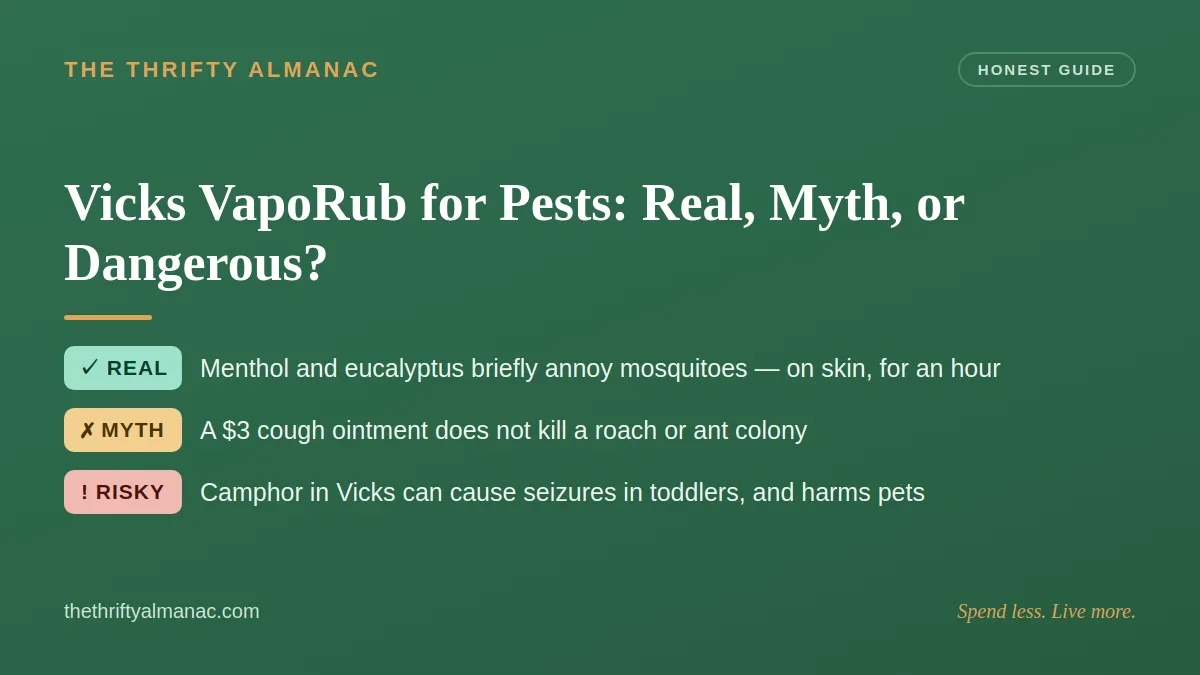
You've seen the videos: "20 Vicks hacks that kill roaches, ants, and wasps," or a jar of blue ointment with a caption swearing exterminators hate this $3 trick. It's a tidy story — a cheap thing in your medicine cabinet quietly solving a pest problem. The trouble is that most of it isn't true, and one part of it is genuinely risky.
Here's the honest verdict up front, the way we like to sort these things: one small grain of truth, one big myth, and one real danger. Let's give each its due.

The one-line verdict
| Claim | Verdict | Why |
|---|---|---|
| Some of these smells bother mosquitoes | REAL-ish | Menthol and eucalyptus-type oils do repel mosquitoes short-term — on skin, for about an hour |
| A jar of Vicks kills or controls a roach/ant infestation | MYTH | It's a cough drug, not an EPA-registered pesticide, with zero efficacy data as one |
| It's harmless even if it doesn't work | DANGEROUS | The camphor in it is toxic if swallowed by kids or absorbed by pets |
REAL-ish: yes, some of these smells genuinely bother mosquitoes
Being fair about the true part is what makes the rest of this credible. Menthol and eucalyptus oil are aromatic plant compounds, and lab research on plant essential oils shows they really can repel mosquitoes — briefly. The catch is right there in the chemistry: these oils are highly volatile, so a review of plant-based repellents found the raw essential oil is repellent for only about one hour before it evaporates and leaves you exposed.
The plant route isn't a dead end, though. Refined into a low-volatility extract called PMD (para-menthane-3,8-diol, from lemon eucalyptus), the same botanical family becomes something serious — one study cited in that review showed 100% protection for 11 to 12 hours. That's why oil of lemon eucalyptus made it onto the CDC's recommended list while a jar of Vicks did not.
Draw the line carefully here. This is skin repellency, against mosquitoes, for a short window — and the strong data belongs to refined PMD, a different species processed into a registered product, not to the 1.2% eucalyptus oil sitting in an ointment. If you're curious how far the scent-repellent idea actually stretches, we dug into what the evidence says about scented bug repellents separately. The short version: a smell some bugs briefly dislike is not a treatment.
What Vicks VapoRub actually is (and isn't)
Read the label and the myth starts to wobble. Vicks VapoRub is an FDA-regulated over-the-counter drug. Its active ingredients are camphor 4.7%, eucalyptus oil 1.2%, and menthol 2.6%, carried in a petroleum-jelly base with cedarleaf oil, nutmeg oil, thymol, and turpentine oil. Its only approved uses are suppressing coughs and easing minor muscle aches. Nothing about pests.
That matters because of how repellents and insecticides are regulated. To claim a product repels or controls pests, it generally has to be registered with the EPA — and NPIC, the EPA-supported pesticide information center, points out that registered products must undergo testing to show they work before making that claim. The EPA's list of registered skin-applied repellent ingredients runs through DEET (500+ products), picaridin (~40), IR3535 (~45), oil of lemon eucalyptus and PMD (6 each), and a few others. Vicks appears on none of them, because it was never submitted or tested as a pesticide.
As for the petroleum base itself — it's superb at holding menthol vapor against your chest and does nothing to a hidden colony. That's a mechanism argument, not a tested finding, but it lines up with the citable fact: no registration, no efficacy data.
MYTH, busted: it does not kill or control a roach or ant infestation

Here's the core of it. There is no study — none — testing Vicks VapoRub as an insecticide, and no EPA registration behind the "kills roaches, ants, and wasps" claim. So we can't say it was "proven not to work"; we can say something more damning, which is that there's simply no evidence it does anything to an infestation, and good reason to expect it won't.
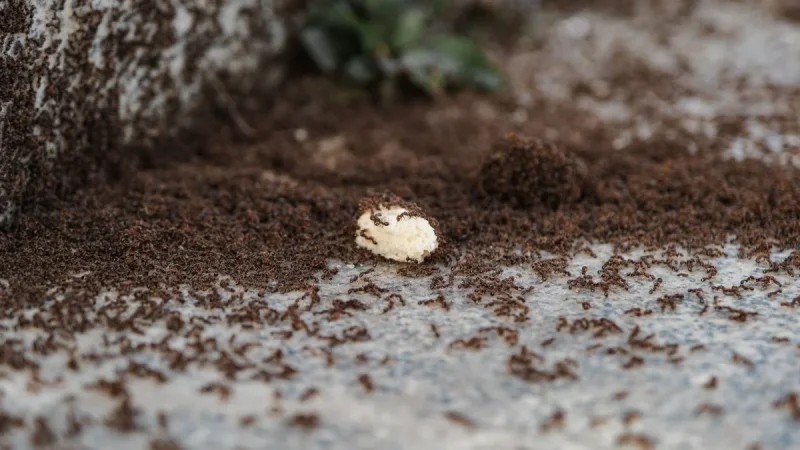
The mosquito grain of truth doesn't transfer. That data measured short-term biting protection on human skin. A roach or ant problem is a colony problem — the ones you see are a fraction of the ones you don't. NPIC's point about unregistered "natural" products is that they haven't been verified to control pests at all; the agency notes there are no EPA-registered repellents built on garlic, rosemary, lemongrass, thyme, or geraniol oils either. Smearing ointment around your baseboards might briefly annoy an insect that walks past. It is a sticky mess, not a treatment, and it never touches the nest. It's the same wishful thinking behind the peppermint-oil-repels-mice trick — a strong smell we assume must be doing more than it is.
DANGEROUS: the camphor problem for kids and pets

This is the part the "harmless if it doesn't work" framing gets wrong. Camphor — that 4.7% — is genuinely toxic when swallowed. A pediatric safety review notes an ingested dose of about 1,000 mg can be fatal to a small (10 kg) child, and that U.S. poison-control guidance refers any child who ingests more than 30 mg/kg to the emergency department. This isn't theoretical: a published case report describes a two-year-old who had seizures within an hour of a camphor dose.
The regulatory record backs this up. The FDA caps camphor in OTC products at 11% and, in 2006, warned about a camphor-containing vapor patch that was recalled after accidental ingestions caused seizures. The Vicks label itself says "Children under 2 years: do not use," and to contact a Poison Control Center right away if it's swallowed. Now picture the hack's advice — smear it along baseboards, under the sink, behind the toilet — which is exactly where a crawling toddler's hands go.
Pets make it worse. Camphor is readily absorbed across the skin and should never be applied to dogs or cats; Pet Poison Helpline names Vicks VapoRub specifically, with signs ranging from skin irritation and vomiting to seizures in larger amounts. A dog that licks a treated baseboard is doing precisely the wrong thing.
Safety note: if a child or pet swallows camphor, call Poison Control (1-800-222-1222) or your vet immediately — don't wait for symptoms.
What actually works — cheap, proven, and safer

For mosquitoes, reach for an EPA-registered skin repellent — DEET, picaridin, or oil of lemon eucalyptus/PMD are all on the registered list and the CDC recommends them. One caveat: the CDC says products with OLE or PMD should not be used on children under 3, while DEET and picaridin have no such age floor — so the "natural" pick isn't automatically the kid-safe one.
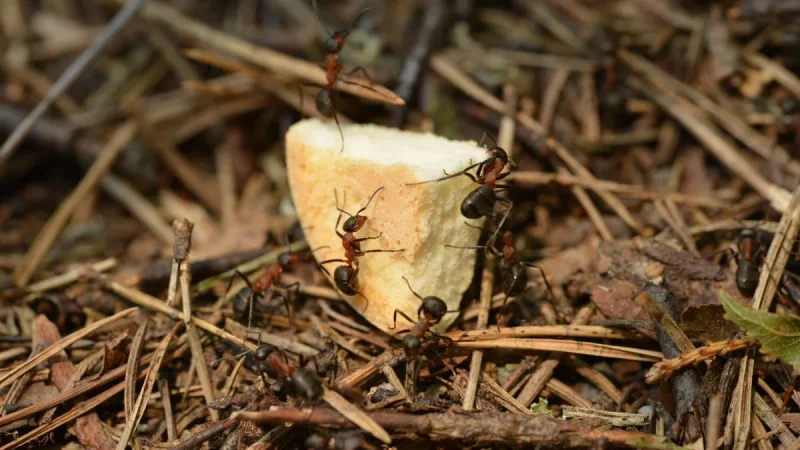
For roaches and ants, boric acid is the honest hero. For ants, UC IPM recommends a homemade bait of just 0.5–1% boric acid in sugar water; foragers carry it back to the nest, and you'll see fewer ants in 5 to 10 days. Counterintuitively, going stronger backfires — at higher concentrations the foragers die before they can carry the bait home to the colony, so a weaker bait actually does more damage. For roaches, Penn State extension lists boric acid dust as one component of an integrated pest management program. The whole point of a bait over a spray is that it works slowly by design — the roach carries it back to the harborage before it dies — which is exactly why smearing something on a surface never reaches the nest. If you want the full method, our guide to using boric acid on roaches and ants walks through placement and timing. The broader do-it-yourself pest control playbook covers the sanitation that makes any bait work.
Boric acid isn't zero-risk — Penn State notes it's a hazard to children, so keep baits out of reach and away from food. But used correctly, it's proven and it's cheap, which is more than the jar can claim.
Common mistakes
- Treating a smell like a treatment. Even if a bug dislikes menthol, brief avoidance isn't colony control.
- Assuming "OTC drug" means "safe to spread around the house." The camphor that's fine on an adult's chest is a poisoning risk at a toddler's or pet's level.
- Going stronger with boric acid. For ants, a higher concentration kills foragers before they can carry the bait home — weaker works better.
- Expecting a one-day miracle. Real baits take days to work; wiping them up too soon just interrupts the spread.
- Picking OLE for a toddler. The "natural" repellent has its own under-3 age limit that DEET and picaridin don't.
FAQ
Does Vicks VapoRub kill cockroaches or ants?
There's no evidence it does. It's an FDA cough-and-muscle ointment, not an EPA-registered pesticide, and it's never been tested as one. A strong smell might briefly bother an insect, but nothing about it reaches or controls a colony.
Will rubbing Vicks on my skin keep mosquitoes away?
Maybe for a short while — plant oils like the eucalyptus and menthol in it can repel mosquitoes for roughly an hour before evaporating. An EPA-registered repellent lasts far longer and is what the CDC actually recommends.
Is it dangerous to use Vicks around kids or pets?
It can be. The camphor is toxic if swallowed — poison-control guidance sends kids who ingest more than 30 mg/kg to the ER — and it's absorbed through pets' skin. Smearing it on surfaces kids and animals touch is the risky part.
What's the cheapest thing that actually works on ants?
A boric-acid sugar bait at 0.5–1% boric acid, per UC IPM. It reaches the nest through foraging ants, costs a few dollars, and shows results in 5 to 10 days — just keep it away from children and pets. If you'd rather avoid pesticides entirely, some non-chemical tactics do hold up, but scent hacks aren't among them.
Why do so many videos swear by the "$3 jar" trick?
Because it's a satisfying story, not because it's tested. "Exterminators hate this" is marketing framing with no data behind it. The registered repellents and boric-acid baits aren't as clickable, but they're what the research supports.
The takeaway: Vicks is a cough ointment with a real camphor hazard — skip it for pests and spend your few dollars on an EPA-registered repellent or a boric-acid bait instead. Spend less. Live more. — The Thrifty Almanac



0comments