

You bought the yellow box, sprinkled a good visible line of powder along the baseboard, and a week later the roaches are strolling right over it like it's a welcome mat. It's easy to conclude the stuff is weak. It isn't. Boric acid is one of the oldest, cheapest, best-documented insecticides on the shelf — the failure is almost never the powder. It's how it went down.
Here's the honest version the endless "sprinkle this and they're gone" videos skip: boric acid and its cousins are slow, patient, colony-level tools that only work when applied thin, placed right, and left alone for days. Dump too much, confuse the wrong chemical, or make the bait too strong, and you get the opposite of what you paid for. Let's sort what's real from what's a myth — and where the genuine dangers are.
Why your boric acid isn't working (the thin-film rule)
WHAT: The single most common DIY roach failure is a thick, visible pile of powder. That mound of white dust you can see from across the room is exactly what a roach walks around.
HOW: You want a film so thin it's barely visible — a light haze puffed into cracks, crevices, wall voids, and the hidden spaces under and behind the fridge, stove, and dishwasher. A cheap bulb duster or a squeeze bottle lets you lay down a whisper of powder rather than a drift. If you can see a clear white line, you've used far too much.
WHY: Boric acid doesn't work by contact-poisoning on the surface. According to UC IPM, "because it has a positive electrostatic charge, the dust clings to the body of a cockroach as it walks through a treated area, and the cockroach ingests small amounts when it grooms itself." It's a stomach poison — the roach has to swallow it. A barely-there film clings to the legs and body; a caked pile does not. The same source is blunt about it: "Thin films of dust are more effective than thick layers, which may cake and clump together." A thick deposit simply repels.
LIMIT: This only works dry. UC IPM notes that "if a deposit gets wet and then dries and cakes, it loses its electrostatic charge and will not be picked up readily by cockroaches." Keep the powder out of open floor where kids and pets travel — the target is hidden voids, not the middle of the kitchen.
Borax is NOT boric acid — and it matters
WHAT: Half the home recipes online quietly swap the two words as if they're the same jar. They aren't, and the mix-up ruins results and adds risk.
HOW to keep them straight:
- Borax is the crude mineral (sodium tetraborate) — the laundry booster in the big box on the detergent aisle.
- Boric acid is the refined form sold specifically as a pesticide dust or bait, usually near-pure.
WHY it matters: The two are related borate compounds, but their safety profiles diverge sharply. Per the National Pesticide Information Center, borax "is corrosive, as such it is highly toxic to the eye," and "dermal exposure to borax has resulted in redness or inflammation of the skin" — whereas boric acid "is low in ocular toxicity" and isn't considered a dermal irritant. The published pesticide guidance, ratios, and label directions are written for boric acid specifically. Reach for the laundry borax instead and you're improvising with a more irritating chemical the instructions were never written for.
LIMIT: Use an EPA-registered boric acid product and follow its label. That label isn't a suggestion — the placement and dosage directions on it are legally binding and override any general how-to, including this one.
Why the ants keep coming back (kill the queen, not the worker)
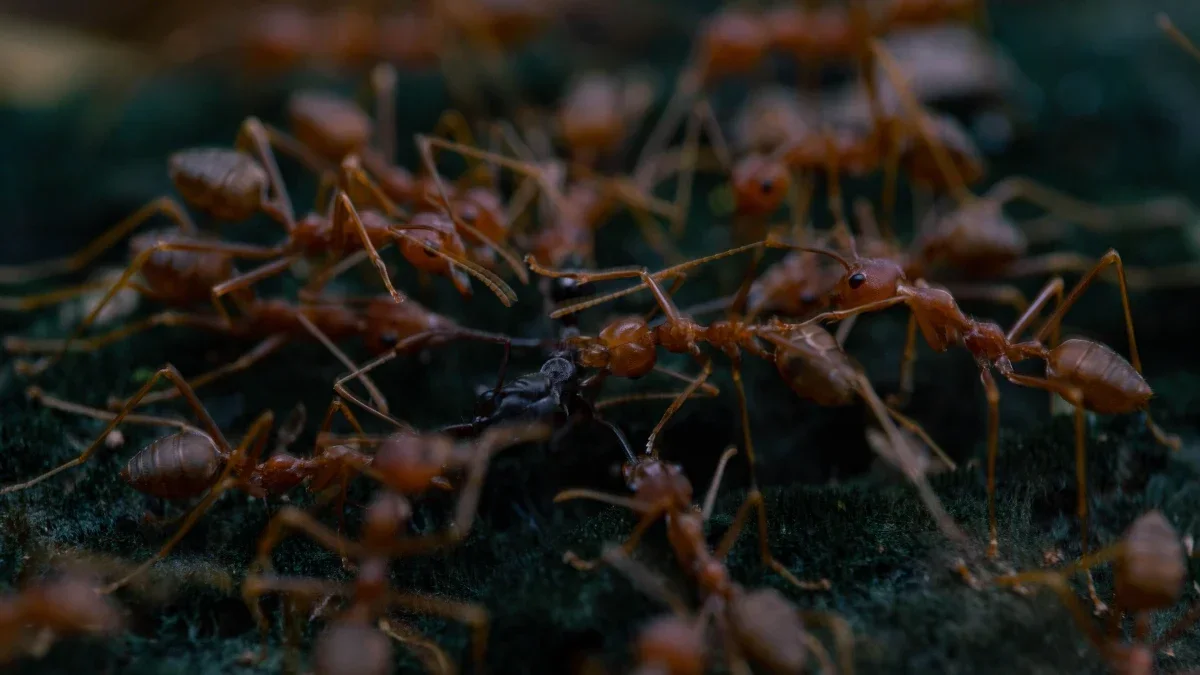
WHAT: You set out a borate ant bait, the ants swarm it for a day, you feel victorious — and three days later there are more than before. This is the most misunderstood part of the whole subject, and the fix is counterintuitive.
HOW: The mechanism is a relay. A worker ant finds the bait, drinks it, and carries it home to share with the colony — including the queen. If the poison is weak enough to be slow, that relay completes and the whole nest gets dosed. UC IPM gives the target strength for a homemade sugar-water bait: a "0.5 to 1.0% concentration in a sugar-water solution." That is a tiny amount of boric acid in a lot of sweet water — deliberately underpowered, offered in a refillable station tucked along the ant trail.
WHY weaker wins: Here's the myth that costs people whole summers — "stronger bait kills faster." With borate baits, stronger is worse. UC IPM explains that prepackaged stations often "contain 5.4% borate," and while those "can be effective at killing foragers in the home," they "are less effective at managing major infestations, because foragers are killed before they can bring the bait back to the colony." The forager dies on your counter, the queen never gets a taste, and the nest simply sends more workers. A low 0.5–1% dose keeps the messenger alive long enough to poison the source.
LIMIT: This is slow by design. Expect several days to a week before the trail visibly thins, and resist every urge to "boost" the recipe. Making it stronger is the exact move that breaks it.
Diatomaceous earth: powerful, but only when dry
WHAT: Diatomaceous earth (DE) is the other pantry-hero powder, and it earns its reputation — but it fails quietly in the one condition people most often ignore.
HOW: Apply a light dusting — again, thin, not piled — into dry cracks, crevices, and voids where insects travel. Use a food-grade product and follow the label. Keep it strictly in dry zones.
WHY it works: DE is a physical desiccant, not a stomach poison. As UC IPM describes, these absorptive powders "destroy insects by removing the protective, waxy outer body layer, causing the ant to dry out, or desiccate." Because it kills by abrasion rather than chemistry, it doesn't degrade — the same source notes these dusts "don't lose their effectiveness over time, as long as they remain dry." That last clause is the whole game.
LIMIT: The moment DE gets damp, it stops working. Under a leaky sink, in a wet basement, or after a mop-down, it's inert and must be reapplied once things dry out. Treating it as a set-and-forget powder for any location is the myth that leaves people wondering why the humid corner never cleared.
Timeline, safety, and what to expect
WHAT: These methods are cheap because they're patient. Setting honest expectations is what keeps you from "fixing" a working treatment into a broken one.
HOW the timeline runs:
- Boric acid roach dust: UC IPM is direct — it "has fairly slow activity, and it may be 7 days or more before it has a significant effect on a cockroach population." That's the intended pace, not a sign it failed.
- Borate ant bait: several days to a week as the colony feeds itself the poison.
WHY patience is the active ingredient: Both work at the colony level. A fast knockdown kills a few visible bugs and warns the rest; slow poison travels home. Re-dosing on day two doesn't speed anything up — it just adds mess and risk.
LIMIT — this is the part that's genuinely serious: Boric acid and borax carry real pediatric and pet risk. The NPIC notes that "many boric acid products require that they be applied in places out of children's reach," because young children "may crawl or play on the floor and put their hands or other items in their mouths." This is not a theoretical caution — NPIC documents real harm, including that "seizures and death have been reported more often in infants exposed long-term to boric acid than adults," and, historically, "in the 1960's, several infant deaths were reported after improperly labeled boric acid disinfectants were accidentally used in infant formulas." Apply into cracks, voids, and the spaces behind and under appliances — never open floors a baby or dog can reach. Keep every treatment out of reach of children and pets, and if a child or pet ingests any, contact Poison Control (1-800-222-1222) or your veterinarian right away.
Common mistakes recap
- Laying down a thick, visible line of boric acid. It cakes and repels — you want a barely-visible film.
- Putting powder on open floors. Wrong for effectiveness and dangerous around kids and pets. Treat cracks and hidden voids.
- Grabbing laundry borax instead of boric acid. More irritating, and not what the guidance was written for.
- Making the ant bait "extra strong." A 5.4% station kills foragers before they can dose the queen; 0.5–1% is what clears the colony.
- Using boric acid or DE in damp spots. Wet powder is dead powder. Keep it dry or reapply.
- Re-dosing on day two out of impatience. Give boric acid 7+ days and bait a week before you judge it.
FAQ
Can I just use Borax from the laundry aisle?
It's not the same product. Borax is the crude, more irritating mineral; boric acid is the refined pesticide form the guidance and labels are written for. NPIC notes borax is corrosive to the eye and can inflame skin, while boric acid is far milder on both. Buy an EPA-registered boric acid product and follow its label.
Why do the ants disappear for a day, then come back worse?
Your bait is probably too strong. A concentrated bait kills the worker on your counter before it can carry poison home, so the queen survives and sends reinforcements. A weak 0.5–1% sugar-water bait keeps the forager alive long enough to feed the colony — that's the version that actually wipes out the nest.
Is boric acid safe around my kids and dog?
Only if it's placed out of reach. NPIC documents serious harm — including infant seizures and deaths — from improper exposure, and recommends applying it where children can't get to it. Keep it in cracks, voids, and behind appliances, never on open floor, and keep the container sealed and away from little hands and curious pets.
How long before I see results?
Slower than a spray, on purpose. UC IPM says boric acid may take 7 days or more to significantly cut a roach population, and borate ant bait takes several days to a week. If it looks like nothing's happening on day three, that's normal — don't re-dose or crank up the strength.
The takeaway: Cheap boric acid and DE beat expensive sprays only when you go thin, keep it dry, place it out of reach, use a weak bait so the workers dose the queen, and wait a full week before judging. Spend less. Live more. — The Thrifty Almanac





0comments