

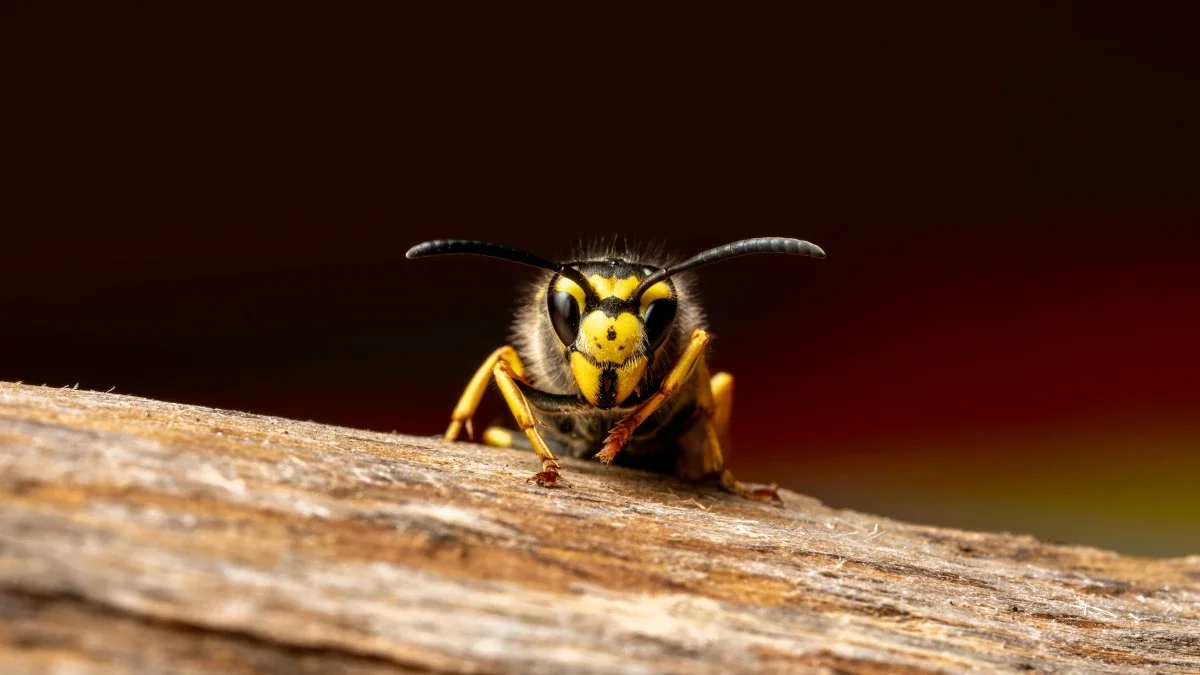
Every spring, a single wasp starts drifting slow loops around your porch ceiling, dipping into the corner where the soffit meets the wall, backing out, trying the next gap over. It looks like nothing — one bug, no nest, no problem. So you wave it off and go back inside.
Here's the honest version the "wait and see" approach skips: that lone wasp is almost certainly a mated queen who spent the winter tucked behind your siding, and she is house-hunting. If she finds a gap she likes, by August that same spot holds a nest with dozens of workers who are far more defensive than she was alone. Stopping wasps from nesting on your house is real, it works, and it is almost entirely a spring job — closing doors before anyone moves in, not blasting a colony after it's established.
The whole game is timing, and the window is spring
WHAT: Social wasps like paper wasps and yellowjackets don't keep a colony running year-round. The old nest dies off in fall, and only newly mated queens survive winter in a sheltered spot. According to the University of California Statewide IPM Program, UC IPM puts it plainly: "Typically, previously mated, overwintering yellowjacket and paper wasp queens begin their nests in spring when the weather becomes warm."
WHY it matters: A queen starting fresh is one insect building a nest the size of a walnut. She has no workers to defend her, and if you disrupt her she often just leaves. UC IPM notes that "early in the season, simply knocking down newly started paper wasp nests will cause the founding female to go elsewhere to start again or to join a neighboring nest as a worker." That same nest in midsummer is a defended structure with a stinging workforce. Every week you wait, the job gets harder and the risk goes up.
Seal the gaps before a queen claims them

HOW: The single most effective prevention step is physical exclusion — closing the openings wasps use to reach sheltered nesting cavities. Penn State Extension's guidance on the European paper wasp is direct: "Limit suitable nest sites by repairing holes in walls, caulk cracks in soffits and eaves, and screen vents and louvers."
WHY: These wasps aren't picky, but they do want a protected pocket. Penn State lists their favorite hideouts as "under and within the eaves of structures, in attics and wall voids, and other enclosed areas" — and, oddly enough, "exterior lighting fixtures, parking meters, animal skulls, bird boxes, and infrequently used equipment like gas grills, motor homes, and boats." A dime-sized gap where a soffit panel has pulled loose is an open invitation into a warm, dry wall void. Close it in early spring and the queen has nothing to work with.
| Where a queen scouts | Why it appeals | How to close it |
|---|---|---|
| Soffit and eave cracks | Leads to a dry, hidden wall or attic void | Caulk or exterior-grade sealant; refit loose panels |
| Attic gable vents, louvers | Big sheltered cavity, easy entry | Fine metal insect screen behind the vent |
| Holes in siding or trim | Direct route into wall voids | Patch and seal with caulk or putty |
| Unused grills, mailboxes, playsets | Enclosed, undisturbed, weatherproof | Open and check early season; keep lids/covers shut |
| Open eaves, porch ceilings | Overhead shelter for an exposed paper nest | Can't seal — inspect often and remove nests small |
LIMIT: Sealing stops wasps from getting into voids, but open paper wasps will still try to hang an exposed umbrella-shaped nest right on a porch ceiling or under an open eave. UC IPM confirms they "hang their paper nests in protected areas, such as under eaves, in attics, or under tree branches or vines." You can't caulk a ceiling — those spots are why the early-season walkaround below still matters.
Take down last year's nests — even though wasps won't reuse them
WHAT: Paper wasps and yellowjackets generally build a brand-new nest each year and abandon the old one. So the gray papery nest still stuck under your eave from last summer is dead — no one's coming back to it.
WHY remove it anyway: Two honest reasons. First, a proven-good location tends to attract a new queen the following spring — if the spot worked once, it reads as prime real estate again. Second, Penn State notes those fertilized overwintering queens sometimes shelter "occasionally in the cells of abandoned wasp nests," so an old nest can literally be housing next year's founder. Clearing old nests in late winter or very early spring — before anyone's active — removes both the landmark and a potential winter bunk.
HOW: On a cold morning when wasps are sluggish or gone, knock down and dispose of old nests, then close any gap they were guarding. If a nest is already active, that's a different job with real sting risk — see our guide on removing a wasp nest the safe way before you touch it.
Cut the food and water that draw scavengers

HOW: Yellowjackets in particular turn into aggressive scavengers by late summer, hunting protein and sugar around patios and trash. UC IPM is blunt about the fix: "Usually, scavenging wasps won't become a problem if there is no food around to attract them." Practical steps that follow from that:
- Garbage: "Keep garbage in sealed cans and empty regularly," per UC IPM. Loose or open trash is a wasp buffet.
- Drinks and food outdoors: Cover sodas, juice, and sweet drinks — a wasp crawling into an open can is how a lot of mouth stings happen. Clean up spills and fallen fruit.
- Pet food and water: Don't leave it sitting out; standing water and pet bowls give wasps a reason to linger near the house.
WHY: Food control won't stop a spring queen from nesting — she's after shelter, not your soda. But it dramatically cuts the summer traffic that makes wasps notice your yard, camp near the house, and pick your eaves for next year. If wandering scavengers are your main problem, a simple soda-bottle wasp trap can pull foragers away from where people sit.
Walk the perimeter every couple of weeks in early season
HOW: From the first warm stretch through early summer, do a slow lap of the house every week or two and look specifically at the sheltered overhead spots: porch and patio ceilings, the undersides of eaves and gutters, deck rails, door and window frames, the inside of the mailbox, gas-grill lids, and any playset or storage box that's been sitting closed. You're hunting for the tiny starter nest — a small cluster of open, downward-facing paper cells, often no bigger than a bottle cap, with one wasp on it.
WHY: This is the highest-payoff five minutes in wasp prevention. A nest you catch at bottle-cap size is a single queen you can knock down on a cool morning with almost no risk. Miss it for a month and it's a defended colony. Checking mailboxes and grills matters more than people expect, because Penn State specifically lists infrequently used enclosed equipment among prime nest sites.
About those fake "decoy" nests — the honest limit

LIMIT: You've probably seen brown paper "decoy nests" sold on the promise that wasps are territorial and won't nest near an existing colony. It's a tidy story, and it might feel like cheap insurance. But be honest about the evidence: the university extension sources that carefully lay out wasp biology and prevention — sealing gaps, removing old nests, controlling food, catching starter nests early — do not endorse decoy nests as a proven method. The territorial premise is thin, since paper wasp queens routinely nest close to one another, and there's no solid published data showing a paper bag reliably keeps them away.
If you want to hang one, it won't hurt anything. Just don't let it replace the steps that are actually backed up. A decoy on the porch is not a substitute for a bead of caulk in the soffit.
If you or someone gets stung
Prevention isn't perfect, so know the difference between a normal sting and an emergency. This isn't medical advice — it's a plain summary of public health guidance, and it doesn't replace a doctor or 911.
A normal reaction is local: pain, redness, and swelling right around the sting. For the stinger itself, MedlinePlus advises you "carefully scrape the back of a knife or other thin, blunt, straight-edged object (like a credit card) across the stinger" rather than using tweezers, which can squeeze more venom in. (Note that wasps often don't leave a stinger behind the way honeybees do.)
Call 911 immediately if you see signs of a whole-body allergic reaction. Per MedlinePlus, danger signs include "Swelling in the throat, lips, tongue, and mouth," "Difficulty breathing," and "Hives" spreading beyond the sting site — along with dizziness, a racing heart, or collapse. These can escalate fast. If the person has an epinephrine auto-injector prescribed for insect stings, MedlinePlus says the medicine "you should take right away." Being stung inside the mouth or throat is also a reason to seek emergency help even without a known allergy. When in doubt, call 911 or Poison Help at 1-800-222-1222.
The honest bottom line
Stopping wasps from nesting on your house is a spring project disguised as a summer problem. The moves that actually work are unglamorous: seal the cracks in your soffits, eaves, and vents so queens can't reach wall voids; take down last year's nests before anyone's awake; keep garbage and food covered so scavengers lose interest; and walk the perimeter every couple of weeks in early season to catch starter nests while they're bottle-cap sized and defenseless. Skip the decoy-nest gimmick — the evidence isn't there. And if a nest is already big and active, don't turn prevention into a sting hazard; read up on safe DIY pest control and know when the smart, cheap move is calling a pro.





0comments