

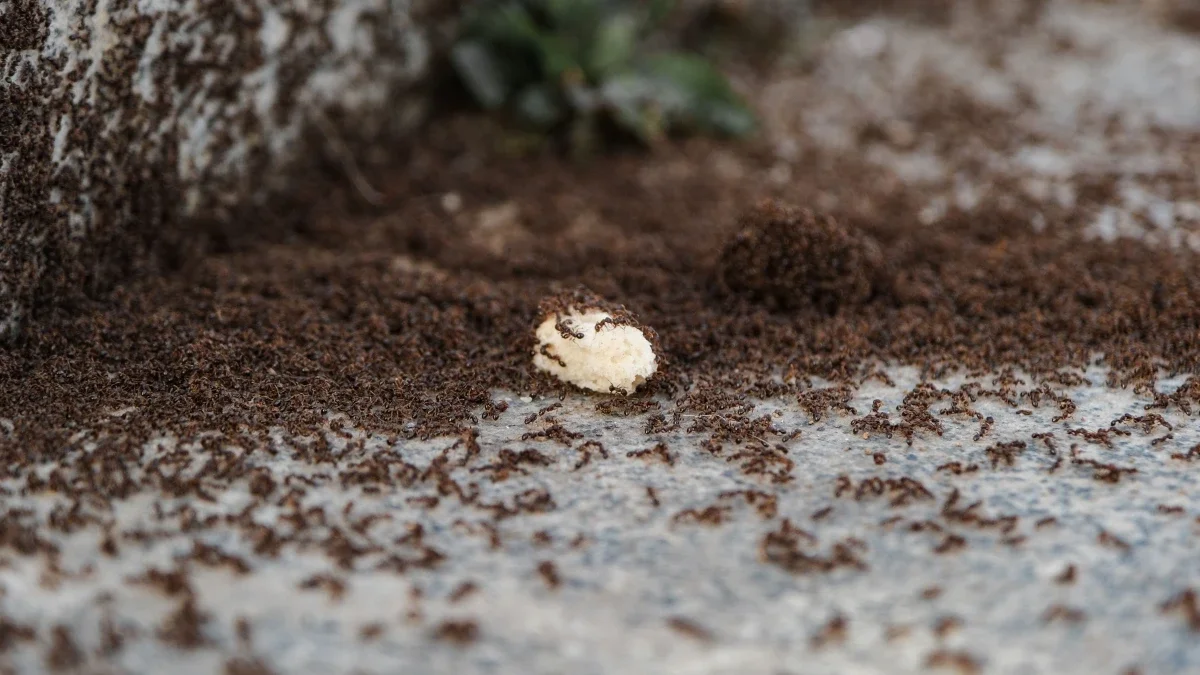
You find a fresh ant hill in the lawn, grab whatever spray is under the sink, and soak the mound. The surface erupts, then goes still. Victory. A week later the hill is back — a foot to the left, and sometimes it has brought friends. Do this three or four times and it's easy to decide the ants are simply unkillable, or that the yard is cursed.
They aren't, and it isn't. The failure is almost never the product. It's the target. You treated what you could see — the trail, the swarming surface — and left untouched the only thing that matters: the queen, sitting in a chamber below the mound, laying eggs the whole time you were spraying. Here's the honest version that the "blast the hill on sight" advice skips: a visible ant hill is the chimney of a much bigger structure, and until the queen is dead, the colony just rebuilds the chimney.
Why the queen is the entire game
WHY: An ant colony is not the ants you see walking around. The foragers on the surface are a small, disposable fraction — sterile workers whose whole job is to bring food home. Kill every one of them and the nest simply sends out more. University of California's IPM program is blunt about what a contact spray actually accomplishes: "Insecticide sprays kill only the foraging ants; more ants will emerge from their nests."
That single sentence explains the "it came back worse" cycle. The queen — often multiple queens in some species — keeps producing replacements underground, untouched by anything you sprayed on the grass. This is the same reason baiting beats spraying indoors, and we've walked through that logic in why ants keep coming back. Outdoors, at a mound, the principle is identical but the stakes are clearer: the nest is right there, and everything depends on whether your treatment actually reaches the bottom of it.
Two honest ways to reach the nest

For an outdoor mound, you realistically have two tools that get past the foragers and down to the queen. They work in opposite ways, and picking the wrong one for your situation is how people waste a summer.
| Bait | Mound drench | |
|---|---|---|
| How it kills the queen | Workers carry poisoned food down to her | Liquid soaks down and reaches her directly |
| Speed | Slow — weeks to months | Fast — often within hours |
| Main failure mode | Ants aren't foraging, so they ignore it | Liquid doesn't reach the queen; she survives and rebuilds |
| Best when | Many scattered mounds; you can wait | One or two problem mounds you need gone now |
| Labor | Low — scatter and leave it | Higher — mix and pour each mound |
Bait: slow, patient, and it goes exactly where you can't
HOW: Bait is food carrying a slow-acting poison. The genius is that you don't have to find the queen — the ants deliver the dose for you. UC IPM describes the mechanism plainly: "Foraging ants collect and carry the insecticide and spread it throughout the entire colony during food sharing, thereby poisoning ants underground and queens in their nest." That is the whole point: it reaches the underground ants and the queens, not just the ones on top.
WHY it must be slow: A bait that killed on contact would drop the worker before she got home, and the colony would never get the dose. Slowness is a feature, not a defect. It's also why bait tests your patience — UC IPM notes that "control with insecticide baits may take more than one week," and for a large mound it can run considerably longer.
LIMIT: Bait only works if the ants are actually out hunting for food. Drop it during the wrong conditions and it just sits there. Place it where they travel — UC IPM's guidance is to "place bait near ant nests and trails, at the basal stem or trunk of infested plants, and along foundations outside walls where ants have been observed inside." If you'd rather build a low-toxicity plan around baiting from the start, we lay one out in getting rid of ants naturally, and the boric-acid bait ratios in the boric acid guide apply to ants too.
Mound drench: fast, direct, and unforgiving if you miss

HOW: A drench is a large volume of diluted liquid insecticide poured directly onto and into the mound, so it saturates the tunnels and reaches the queen chamber. When it lands right, it's dramatic. Texas A&M's fire ant program notes that "liquid drenches generally eliminate mounds within a few hours." That's the appeal — no waiting, no wondering.
LIMIT: Speed is also the trap. A drench only works if the liquid physically reaches the queen. If you use too little volume, if the soil is baked hard and sheds the water, or if the queen's chamber sits deeper or off to the side of where you poured, she survives — and a surviving queen means the mound simply reappears days later, exactly the outcome that made you think ants are invincible in the first place. Drenching is a precision act pretending to be a brute-force one. Use enough liquid to soak the mound thoroughly, treat on a cool morning when ants are near the top, and don't disturb the mound first (kicking it just tells the colony to relocate the queen).
Fire ants are a different problem — treat them as one
If the mound is a red imported fire ant nest, the calculus changes, because these stings are a genuine health issue, not just a nuisance. Texas A&M describes the sting this way: "Symptoms of a fire ant sting include burning, itching and a white pustule that forms in a day or two." For most people that's painful but minor. For some it is not — and this is where you stop being casual.
Texas A&M's guidance on a severe reaction is direct: "If a sting leads to chest pains, nausea, severe sweating, loss of breath, serious swelling or slurred speech, the person should be taken to an emergency medical facility immediately." If you or a family member has had any reaction beyond ordinary local swelling, take it seriously — the same source advises that "some people become sensitive to fire ant stings and should seek the advice of an allergist." A severe allergic reaction after a sting is a medical emergency, not a pest-control question — call 911 or get to an ER, and talk to a doctor about whether you should carry an epinephrine auto-injector.
HOW to treat fire ant mounds: Texas A&M's recommended approach — the "Texas two-step" — combines both tools instead of choosing one. Step one is broadcasting bait across the whole yard; step two is treating the stubborn individual mounds directly. It's built for infested yards, which the program defines as "fully infested areas (five or more mounds for each quarter-acre of yard)." The broadcast bait quietly knocks down the colonies you never noticed; the mound treatment handles the ones next to the patio you can't ignore. Bait timing matters — apply it "when worker ants are actively looking for food, usually in late afternoon or in the evening" — and don't expect overnight results, since "baits are slow-acting and require weeks to months to achieve 80% to 90% control."
So which one do you use?

Match the tool to your situation rather than your impatience. Reach for bait when you have several mounds scattered across the yard, when the mounds are away from high-traffic areas, or when you simply want the lowest-effort, lowest-toxicity route and can wait a few weeks. Reach for a mound drench when a single nest sits somewhere you cannot tolerate — next to the front step, a kids' play area, a garden bed you're working in — and you need it gone quickly, accepting that you must soak it thoroughly to actually get the queen. For fire ants across a whole yard, do both, in that order: broadcast bait first, then spot-treat the mounds that stay. And if you want the broader framework these decisions fit into, our DIY pest control guide ties baiting-versus-spraying together across pests.
The honest bottom line
A yard ant hill lies to you: it shows you a swarm of workers and hides the one ant that actually matters. Spraying the surface treats the lie. Both real options — bait and drench — succeed or fail on the same test: did the treatment reach the queen? Bait reaches her slowly by hitching a ride with the workers and asks you to be patient. A drench reaches her fast by force and asks you to be thorough. Pick based on how many mounds you have and how long you can wait — not on how satisfying it feels to watch the surface go quiet. If the nest is fire ants and anyone in the household reacts badly to stings, keep the pesticide question and the medical question separate: treat the mound by the book, and treat a severe reaction as the emergency it is. If you suspect the structure of your home is involved, or you're dealing with an allergy history, that's the point to bring in a professional rather than another can of spray.






0comments