

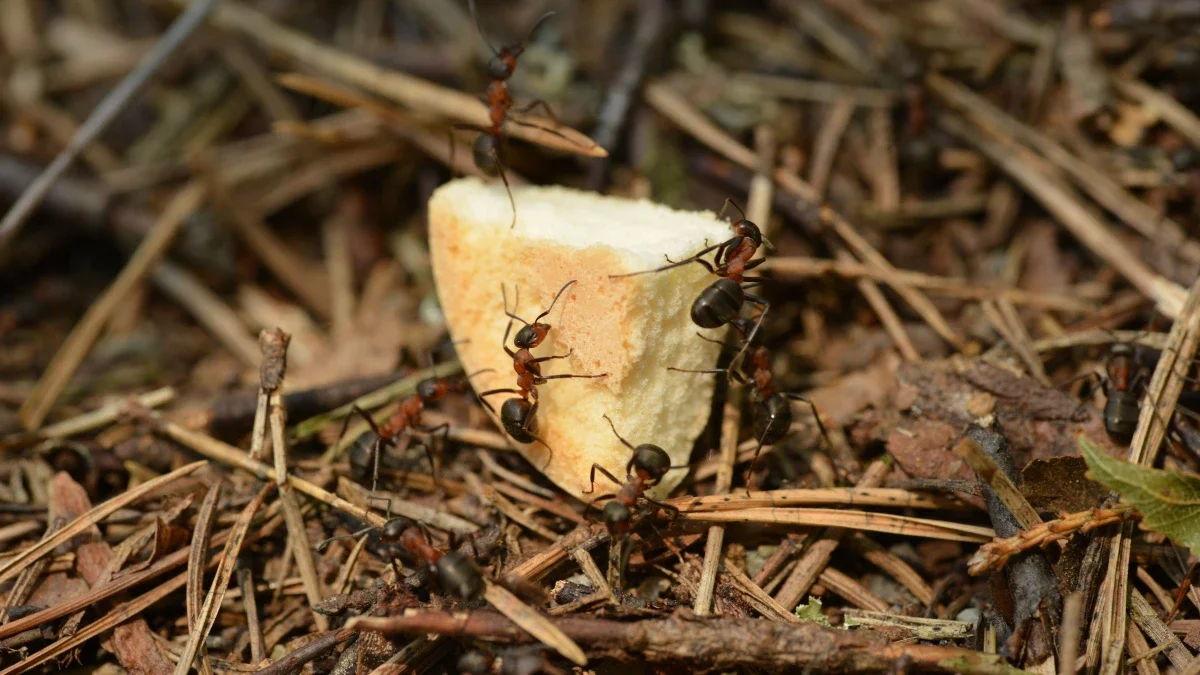
A thin line of tiny brown ants is crossing the counter toward a sticky spot by the toaster. You grab the can labeled "ant killer," follow the trail, and give it a good spray. By morning the line is gone and you feel like you handled it. A week later they're back, two counters over, and now there seem to be two trails instead of one. It's easy to blame the spray, or decide these ants are just unbeatable.
Here's the honest version the "just kill them" advice skips: the single step that decides whether anything works is the one nobody does first, which is figuring out which ant you actually have. Most of the ants that show up in American kitchens are the same short list of species, and for most of them the fix is identical. But two of them multiply their nests when you hit them with a repellent spray, and one of them isn't a kitchen pest at all, it's a wood pest that can quietly matter to your house. Five minutes with a bright light, a magnifier, and one crushed ant sorts out which situation you're in.
The five ants in most American kitchens
WHAT: Entomologists sort ants partly by counting the tiny bumps, called nodes, on the narrow "waist" (the petiole) between the ant's midsection and its rear. UC IPM's identification guidance tells you to "count the number of nodes (projections) on the petiole; there are one, two, or apparently none." You don't have to become an expert at this, but combined with size, color, and where the nest is, it separates nearly every common house ant.
Here is the field-guide version, drawn from University of California and Penn State extension descriptions.
| Ant | Worker size | Color | Waist nodes | Where it nests / tell |
|---|---|---|---|---|
| Odorous house ant ("sugar ant") | ~1/8 inch | Dark brown to shiny black | One (hidden) | Rotten smell when crushed |
| Argentine ant | ~1/8 inch | Dull brown, no shine | One | Long steady trails; huge outdoor colonies |
| Pavement ant | ~3/16 inch | Dark brown to black | Two | Sand piles at sidewalk cracks and foundations |
| Pharaoh ant | ~1/16 inch | Yellow, honey, to orange | Two | Tiny and pale; nests deep in wall/cabinet voids |
| Carpenter ant | 1/4 to 1/2 inch | Black (some red and black) | One | Big; smooth galleries in wood, coarse sawdust |
Start with two questions before you reach for the magnifier: how big is it, and where is the nest. Size alone splits the group in half. Anything a quarter-inch or bigger is almost certainly a carpenter ant, a completely different problem from the rest. Everything else on this list is small, and for the small ones, the treatment is broadly the same, so getting the exact species perfect matters less than knowing it's not the two exceptions.
Odorous house ants, the "sugar ant" that fails the smell test

WHAT: "Sugar ant" isn't a real species, it's a catch-all for the small dark ants that raid sweets. In most of the country, the one you're looking at is the odorous house ant. Penn State Extension puts workers at "1/16 to 1/8 inch (2.4-3.3 mm) long," with a body that "is uniform in color from brown to black."
HOW to confirm: Crush one and smell it. This is the give-away no other kitchen ant shares. As Penn State's Odorous House Ant factsheet states, "a distinctive characteristic of this species is the rotten odor when crushed." People describe that smell as rotten coconut, blue cheese, or cleaning solvent, the nickname "coconut ant" comes from it. If you crush a small dark ant and get a sharp, unpleasant, chemical-sweet whiff, you've identified it.
WHY it matters: Odorous house ants have many queens and satellite nests, which is exactly why spraying the visible trail feels like a win and then fails, you killed the foragers, not the queens. The fix is slow-acting bait the workers carry home. For the bait ratios that work on ants, our boric acid bait guide covers the sugar-water-and-borax mix, and our full natural ant plan walks through placement.
Pavement ants, the sand piles give them away
WHAT: Pavement ants run slightly larger than sugar ants, roughly 3/16 inch, dark brown to black, with two nodes on the waist and, under magnification, fine parallel grooves on the head and midsection. Most people never see those grooves; they see the nest instead.
HOW to confirm: Look at the ground. Pavement ants nest under slabs, driveways, and foundations, and they push the excavated dirt up through cracks, leaving little volcano-shaped piles of sand along sidewalk seams and expansion joints. If you're finding small mounds of fine grit at the edges of concrete and a trail leading inside from there, that's the pavement ant's signature. Indoors they follow the same sweet-and-greasy foods the sugar ants do.
WHY it matters: Good news, it doesn't change much. Pavement ants respond to the same baiting approach as odorous house ants. The reason to identify them is mostly to reassure yourself the sand piles aren't termites or something structural, they're just spoil from digging under your slab.
Carpenter ants, the only ID that changes the whole plan

WHAT: This is the one where getting the name right actually changes what you do. Carpenter ants are big, Penn State lists workers at "1/4 to 1/2 inch in length," dark, shiny brown to black. If an ant in your house is noticeably large compared to the sugar-ant trail, stop and look harder.
HOW to confirm: Carpenter ants tunnel into wood, but a crucial detail sets them apart from termites. Per Penn State's Carpenter Ants factsheet, "because carpenter ants do not consume the wood as food, excavated particles are dumped outside the nest." That debris looks like a small pile of coarse sawdust, often mixed with insect parts. And "unlike termites, the tunnels or galleries of carpenter ants are smooth-sided and contain no soil particles or fecal pellets." So: big black ants, plus piles of clean sawdust (called frass) near a window frame, sill, or damp wood, points to carpenter ants. Seeing winged ants emerge indoors usually means an established nest is inside.
WHY it matters, and the LIMIT: Carpenter ants don't eat your house, but they hollow galleries in it, and over years, in wet or already-damaged wood, that can weaken framing. This is where a blog should stop guessing. If you find smooth galleries in structural wood, or recurring piles of frass and large ants deep inside the home, treat it as a possible structural issue and book a professional pest inspection. Telling carpenter ant damage from termite damage, and judging whether load-bearing wood is compromised, is an inspector's job, not something to decide from photos online. It also usually means finding and treating a hidden nest rather than dabbing bait on a countertop.
Pharaoh and Argentine ants, the two you should not spray
WHAT: Two small ants on this list punish you for reaching for the can. Pharaoh ants are the tiniest, about 1/16 inch and pale yellow to honey-orange, nesting deep inside wall voids, cabinets, and behind baseboards. Argentine ants are dull brown, around 1/8 inch, and famous for endless single-file trails fed by enormous multi-queen colonies outdoors.
WHY it matters: Both species carry many queens and readily fragment. Hit a colony with a repellent spray and, instead of dying, it can split, with queens and workers scattering to start several new nests, so a one-room problem becomes a whole-house problem. Pharaoh ants are the textbook case; the standard advice is to bait them and specifically not to spray. Even for ordinary ants, spraying the trail rarely reaches the nest. Penn State's IPM guidance is blunt about why surface sprays disappoint: an application indoors "may kill some ants, but the nest will just send in more, especially if food is still available and access is allowed," and it tells homeowners to "avoid sprays, bombs/foggers, and liquid concentrates."
HOW to handle them: Bait, and be patient. UC IPM's home ant guidance is unusually direct: "baits are a key tool for managing ants and the only type of insecticide recommended in most situations." Set the bait on the trail, resist wiping the trail away (the ants are your delivery system), and give it a week or more. This is the same reasoning behind why ants keep coming back after every spray, you keep killing the messengers and leaving the queens.
The honest bottom line

You don't need to key out an ant to genus. You need to answer three questions. Is it big (quarter-inch or more) with sawdust nearby? Then it may be carpenter ants and a possible structural concern, so identify carefully and get an inspection if wood is involved. Is it tiny and pale yellow, or a relentless brown trail? Then it's likely pharaoh or Argentine, so bait and never spray. Is it a small dark ant that smells rotten when crushed, or one leaving sand piles at the sidewalk? Then it's an odorous house or pavement ant, and the same slow bait handles both.
Every one of those answers except carpenter ants ends in the same place: bait, not spray, and don't wipe out the trail you're trying to feed. Naming the ant first is what keeps you from spending a summer reloading the same can. For the full workflow, from finding trails to choosing baits, start with our DIY pest control guide. And if you suspect the large ones are in structural wood, or you're not sure whether it's ants or termites, that's the moment to call a licensed inspector rather than settle it yourself.



0comments