

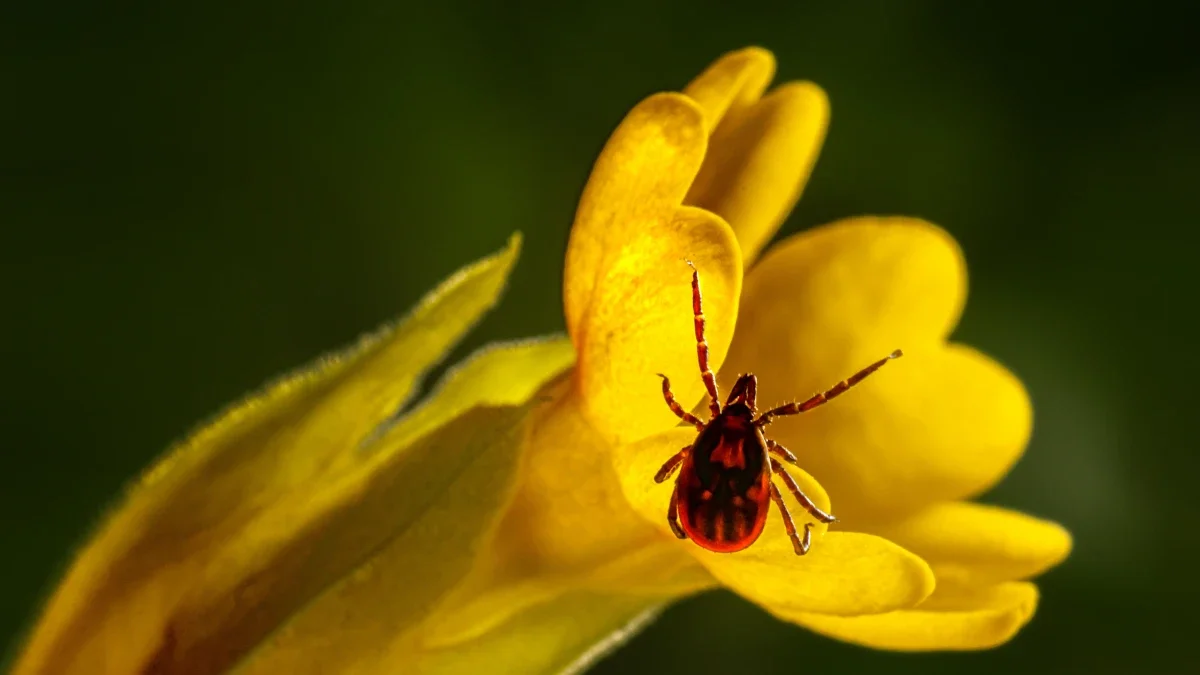
You find a dark speck stuck to the back of your knee, and it won't brush off. Your brain offers two fast answers at once: the alarming one (spider, bed bug, some disease waiting to happen) and the convenient one (probably just a scab). Both guesses can be wrong in ways that matter, because the thing pinned to your skin might be a tick, and a tick is not the creature most people picture.
Here's the honest version the panic skips. A tick isn't an insect at all, and most of what makes one identifiable is stuff you can check in about ten seconds with your naked eye or a phone-camera zoom. Count the legs. Size it against a seed. Look for a hard shield or a single pale dot. University entomologists have already done the tedious sorting; you just need to know what they're looking at.
Count the Legs First: A Tick Is an Arachnid, Not a Bug
WHAT. The single most useful identification move happens before you ever name the species. West Virginia University Extension files ticks in the right family plainly: "Ticks are a parasitic group of arthropods more closely related to spiders, mites and scorpions than to insects." An adult or nymph tick carries eight legs, no antennae, no wings, and one teardrop-shaped body fused into a single piece. That is the anatomy of a spider cousin, not a beetle or an ant.
Leg count also tells you which life stage you're looking at. Penn State Extension breaks it down: "Larvae will be the only life stage with six legs," while "nymphs and adults will have eight legs." A six-legged "seed tick" fresh from the egg is easy to mistake for a fleck of dirt, and the eight-legged nymphs and adults are the ones that bite people most. If your mystery speck has six legs plus a pair of antennae poking off the front, it's an insect (an ant, a young bed bug, a beetle) and not a tick. And if it has a clearly two-part body with long, jointed legs and scurries when you nudge it, that's a spider, which squats and runs where a tick clamps down and stays.
Size Is the Detail Everyone Gets Wrong

WHAT. People expect a tick to be big enough to see coming. Most aren't. Penn State's rule of thumb is the one to memorize: "Nymphs are typically the size of a poppy seed, while adults are about the size of a sesame seed." A poppy-seed-sized nymph is the reason so many bites go unnoticed. It's smaller than the print on this page and the same brownish color as a freckle, a fleck of dried mud, or a skin tag.
Then the picture changes completely once a tick feeds. Ticks take blood slowly, over a span of days, and you almost never feel it happen. WVU Extension explains the sleight of hand: "it injects small amounts of saliva with anesthetic properties at the site of attachment." As it drinks, the abdomen swells into a smooth gray or tan balloon. An "engorged" tick can reach the size of a raisin and look nothing like the flat speck that first latched on, which is exactly why the same animal can read as three different creatures depending on whether it has eaten.
The Three Ticks Most Americans Actually Meet
HOW. Hundreds of tick species exist, but in the United States three account for most human bites, and each carries a tell you can see. The markings sit on the scutum, the hard shield right behind the head.
| Tick | What to look for | Where it's common | Commonly linked disease |
|---|---|---|---|
| Blacklegged / deer tick (Ixodes scapularis) | WVU: "chocolate brown... with adult females having an orange to red back surrounding the scutum"; nymphs poppy-seed tiny | Eastern and upper-midwestern U.S. | Lyme disease |
| American dog tick (Dermacentor variabilis) | WVU: "brown to reddish-brown with cream or grayish colored markings on the scutum"; larger-bodied | Mostly east of the Rocky Mountains | Rocky Mountain spotted fever |
| Lone star tick (Amblyomma americanum) | WVU: "reddish-brown to tan... a single white spot on the scutum" on females | South, East, and Midwest | Ehrlichiosis; linked to alpha-gal (red-meat) allergy |
One caution on the lone star's famous dot: WVU ties that single white spot specifically to "adult females." Males and nymphs lack it, so a spotless tick is not automatically "not a lone star." Color is a soft clue too, since it shifts as a tick engorges. Treat these as a starting sort, not a courtroom verdict.
Tick or Bed Bug? The Mix-Up That Trips People Up

HOW. A flat, brown, seed-sized body sends plenty of people straight to "bed bug," and the resemblance is real. The EPA's own description of an adult bed bug lands close: "about the size of an apple seed" and "long and brown, with a flat, oval-shaped body." After a meal a bed bug turns "balloon-like, reddish-brown, and more elongated," which isn't far from an engorged tick.
The differences are decisive once you know them. A bed bug is a "true bug," an insect with six legs and antennae. A tick is an arachnid with eight legs and none. A bed bug crawls quickly across a surface and hides in mattress seams, box springs, and headboards; it does not burrow into you. A tick does the reverse: it cements its mouthparts into skin and stays anchored for days. So if the thing you found is firmly attached to your body or your dog and won't simply walk off, the odds tilt hard toward tick. A creature that leaves a tidy row of itchy welts on your torso overnight but is never caught on your skin points back toward bed bug.
Why the ID Matters, and When to Stop Guessing
WHY. Getting the identity right isn't trivia. The species and the length of attachment shape the health risk, which is why entomologists care whether that speck is a deer tick or a dog tick. Because the bite is engineered to be painless, a tick can ride along for a day or more before you spot it, and that quiet stretch is when the chance of passing a pathogen climbs.
HOW to remove one. WVU Extension's instruction is blunt and worth following to the letter: "remove it using thin-tipped tweezers or forceps. Grasp the tick as close to skin as possible and pull the tick upward with steady even pressure." The aim is to lift it out with the mouthparts intact. Skip the folk fixes, the ones that tell you to smother it in petroleum jelly, touch it with a hot match, or drown it in nail polish. Health guidance is to pull the tick, not to provoke it into salivating more. Keeping ticks out of the yard in the first place is a longer game, and it has its own playbook in our guide to killing ticks in your yard.
LIMIT. Nymphs are genuinely hard to tell apart by species with the naked eye, and a half-fed tick hides its markings under a swollen body. When it matters, drop the tick into a sealed bag or press it onto a strip of tape and hold onto it, because many state health labs and university extension offices will identify it for you. Then watch both the bite site and yourself over the following days and weeks: an expanding or bull's-eye rash, fever, aches, or unusual fatigue are reasons to call a doctor, and a pet that turns lethargic, feverish, or lame deserves a vet's call. This isn't medical or veterinary advice; it's a nudge to loop in a professional rather than diagnose from a phone photo. For the broader approach to handling household pests without panic, start with our DIY pest control guide.
The Bottom Line

Identifying a tick comes down to four quick reads. Count the legs: eight and no antennae means arachnid, not insect. Size it against a poppy or sesame seed, and remember an engorged one balloons to raisin size. Check the scutum for a shield pattern or a lone white dot. And notice whether it's attached, because a body that burrows in and holds on is a tick, not a bed bug hiding in your sheets. Get those four right and you'll know what you're dealing with before you touch it. When the answer stays fuzzy, save the specimen and let a doctor, vet, or extension lab make the call. This isn't medical advice, but telling an arachnid from an apple-seed-sized insect is the part you can absolutely handle yourself.





0comments