

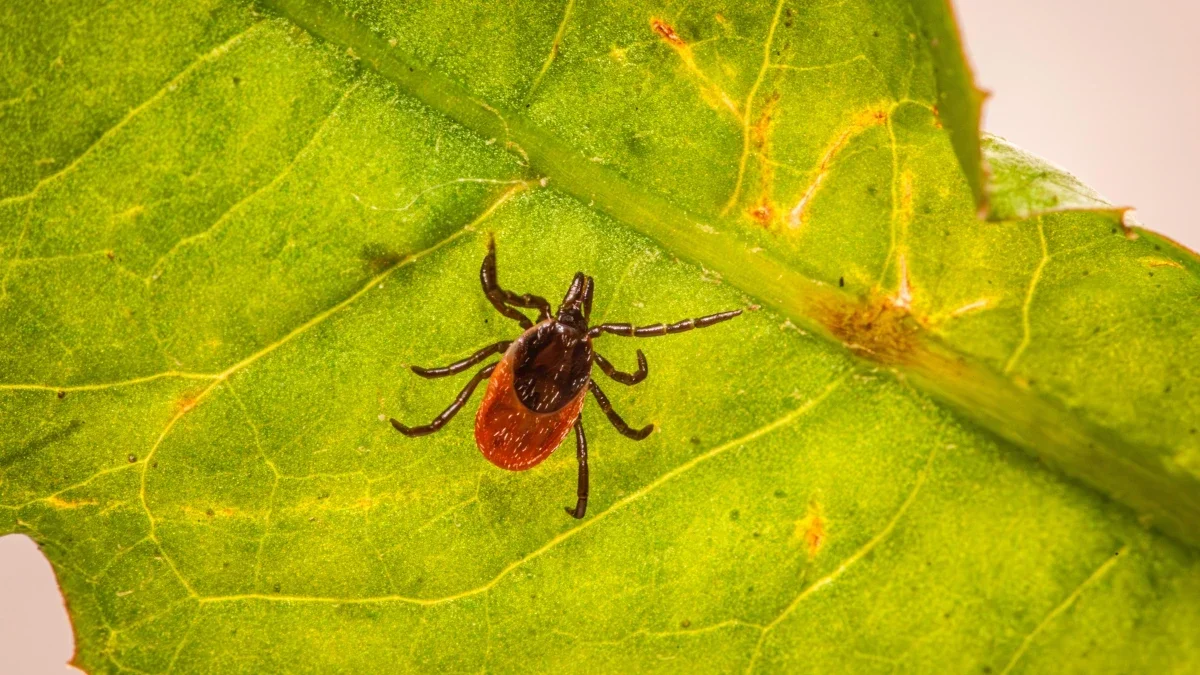
Here is what the "one miracle spray" videos never tell you: a tick cannot jump, cannot fly, and cannot drop out of a tree onto your head. It climbs a grass blade and waits, front legs out, for something warm to brush past — a behavior called questing that happens along the damp, brushy line where lawn meets woods, according to tick-behavior research.
So skip the trending fixes: the homemade cedar-oil spray and the hydrogen-peroxide trick lead with the weakest method and never touch the two places ticks actually live — the edge, and the mice. What follows is a four-layer system, ranked cheapest and most effective first. It runs on the same cheapest-first logic as our wider DIY pest-control playbook.
Where ticks actually come from (and why the viral videos are wrong)
A tick's whole life is a fight against drying out. It needs the air around it near 80 to 82 percent humidity; drop below that for even a few hours and its questing falls off and it dies. That weakness is why ticks huddle in shady leaf litter and the brushy edge, and why your open, sunny lawn is a desert they avoid. That same shady edge strip is where chigger larvae wait for a passing ankle, so one afternoon of raking and cutting back pays off against both.
That kills the most stubborn myth in these videos: ticks are not spread across your open lawn, so mowing shorter is largely busywork. Recent research finds no meaningful difference in tick density by grass-cutting height — they live at the edge and in the litter, and that thin border strip is where the free work below goes.
One more correction: many of these viral tick videos are fronted by an "Amish elder" or "natural expert" persona that commenters widely flag as staged, AI-generated content. Trust the named science — CDC, university tick labs, peer-reviewed studies — not the storyteller.
Layer 1 — Dry out the edge for free (the CDC edge barrier)
WHAT: the free Saturday job that does roughly half the work — drying out the brushy border ticks live in.
HOW:

- Rake the leaf litter off the line where your lawn meets woods, and cut back the overhanging brush so sun and wind reach the strip.
- Lay a 3-foot-wide barrier of dry wood chips or gravel along that edge; free chips are usually a call to a local tree service away.
- Move the woodpile and bird feeder away from where kids play — they're mouse magnets, and mice bring ticks (and a cleared, tidy edge helps keep snakes out of the yard too, since they shelter in the same brush and hunt those same rodents). It pays to spot a mouse problem early.
WHY it works: three feet of dry, sunny chips is a strip of desert ticks won't cross — it drops the air below the roughly 80 percent humidity they need, and the CDC recommends exactly this barrier to stop ticks migrating in from the woods.
LIMIT: clearing the edge thins ticks, it does not erase them. A deer wandering through at dawn can drop a few more, and the damp shade creeps back every season — so the strip needs upkeep, which is what Layer 2 is for.
Layer 2 — the cheap tick tube that hits the mice (the real science)
WHAT: a cardboard tube stuffed with permethrin-treated cotton. Mice carry the cotton home to line their nests, and the treatment kills the ticks riding on them — the one backyard method with real peer-reviewed numbers.
HOW:
- Buy tick tubes, or make your own from a toilet-paper roll and permethrin-treated cotton balls. If you go the DIY route, see the cat warning in Layer 3: keep cats well away while you soak and dry the cotton, since wet permethrin is acutely toxic to cats.
- Place them where mice run: along stone walls, under the deck, and by the woodpile.
- Set them out in late spring and again in late summer, when young ticks feed on mice.
- Refresh the cotton about once a month.
WHY it works: this flips the deer-fence obsession on its head. The great majority of Lyme-infected nymphs get their first infecting blood meal from white-footed mice and other small rodents, not deer — so hit the mice and you choke the next generation. Field trials measured a roughly 53 percent drop in questing nymphs and a 66 percent drop in Lyme-infected nymphs; a five-year study of homemade tubes found about the same, 54 and 66 percent.
LIMIT: tubes tilt the odds hard in your favor, but they aren't a cure. They only work when placed while young ticks are on the mice, the cotton must be refreshed about every month, and results swing year to year with your mouse numbers and yard size. Fewer mice means fewer ticks — just know that peppermint oil won't drive them out. A DIY batch runs only a few dollars — but price your own cardboard, cotton, and permethrin first, since the cost moves with them.
Layer 3 — spraying the right way, and the warning that can save your cat

WHAT: a targeted late-spring spray of only the shady edge that knocks local ticks down. But the compound that works, permethrin, is acutely toxic to cats.
HOW:
- Treat only the thin border band where ticks live, not the open lawn, and keep cats indoors until the ground is fully dry.
- Never put a dog's permethrin flea product on a cat, and don't let a cat curl against a freshly treated dog. If fleas are the real worry, there's a cat-safe way to clear yard fleas.
- When unsure, hire a licensed pest professional instead of guessing.
WHY it works — and why cats: a cat's liver lacks the enzyme dogs and people use to break permethrin down, so it builds up in the nervous system and causes tremors, seizures, death. The dose gap is enormous — dog flea products can run 45 to 60 percent permethrin, while a cat-safe product is under 0.1 percent. But it's wet permethrin plus a cat that's the danger — a dried barrier spray and treated clothing are safe around cats once fully dry.
LIMIT: don't rely on spraying alone — the CDC is explicit that a spray is one layer, not the answer. And the biggest correction of all: the viral cedar-oil and hydrogen-peroxide sprays do almost nothing outdoors. Cedar and essential oils kill and repel ticks at high rates in a sealed lab dish, but on real grass they fade within about a day and never reach the nymphs in the damp litter. The hydrogen-peroxide trick is worse — it only affects a tick it directly soaks, breaks down into water and oxygen within minutes, and scorches your plants.
Layer 4 — protect the people and pets walking through it
WHAT: no yard ever hits zero ticks, so the last layer protects bodies: permethrin-treated clothing plus a daily tick check. That same treated clothing shrugs off the other warm-season yard biter, too — though for mosquitoes the real fight is at the water, not in the gadget aisle, where most traps and baits are a waste.
HOW:
- Spray 0.5 percent permethrin on shoes, socks, and pant cuffs — on the fabric, dried before wearing, not on skin.
- After time outside, check the warm hidden spots — behind the knees, waistband, hairline, armpits, ears — and the dog's ears, toes, and collar line.
- If you find one attached, grab it with fine-tipped tweezers right where it meets the skin and pull straight up, slow and steady.
WHY it works: permethrin-treated clothing has been measured by CDC and military researchers to cut tick bites by more than 90 percent, and a DIY treatment lasts through several washings. And a blacklegged tick usually stays attached about 36 to 48 hours before it can transmit Lyme, so one pulled within a day rarely makes anyone sick.
LIMIT: this layer is pure habit, and habit is the part people quit. One firm correction on removal: do not burn an attached tick, smother it in nail polish or Vaseline, or twist it — the CDC warns that all of those make it release more saliva into you. Fine-tipped tweezers, straight up, is the only safe way.

The old guinea-fowl trick (honest about what it does)
WHAT: a small flock of guinea fowl and hens scratching the brushy edge — a living version of Layer 1, and how farm families kept dooryards clear long before tick tubes. HOW: let a few birds work the border strip, turning leaf litter and eating what crawls.
LIMIT: extension sources say a foraging flock only makes a dent in ticks, not a clean sweep — and it will happily eat your garden seedlings too.
The order that actually wins (and why ticks matter more than ever)
Do the layers in order, cheapest first — no fog truck, no bottle of peroxide:
| Layer | Move | Rough cost | The mechanism it targets |
|---|---|---|---|
| 1 | Dry the 3-foot edge barrier | Free | Ticks die below ~80% humidity |
| 2 | Tick tubes at the mouse runs | A few dollars | Mice, not deer, infect most nymphs |
| 3 | Careful edge spray (cat-safe) | Low | Kills local questing ticks at the source |
| 4 | Treated clothing + daily check | Low | 36–48h attachment needed to transmit Lyme |
Why bother with all four? Because this is no longer a small worry. Reported Lyme cases have more than doubled in 15 years — about 62,551 reported in 2022 — and the CDC estimates roughly 476,000 Americans are treated for Lyme each year. (Part of that recent jump came from a change in the surveillance definition, so it's "more than doubled," not the "tripled" the videos claim.) And a single lone star tick bite can trigger alpha-gal syndrome, a red-meat allergy that lasts years: the CDC identified roughly 110,000 suspected cases from 2010 to 2022, with estimates that up to 450,000 may be affected, and many of those reactions can be severe or life-threatening.
Common mistakes recap
- Leading with the viral cedar-oil or hydrogen-peroxide spray — they fade or break down in minutes and never reach the leaf litter.
- Mowing the open lawn shorter to beat ticks — they can't jump or fly and don't live there; the brushy edge does the work.
- Fencing out deer but ignoring the mice — mice, not deer, infect most nymphs.
- Putting a dog's permethrin product on a cat — it can kill the cat.
- Burning, smothering, or twisting an attached tick — use fine-tipped tweezers straight up instead.
FAQ

Does the homemade cedar-oil spray really get rid of ticks?
Not on a real yard. Cedar and essential oils kill ticks at high rates in a sealed lab dish, but outdoors they scatter and fade within about a day and never reach nymphs in the damp litter. Put the effort into the free edge barrier and tick tubes instead.
Are tick tubes really worth it?
They're the one backyard method with peer-reviewed numbers — field trials cut questing nymphs by about 53 percent and infected nymphs by 66 percent. Set them out in late spring and late summer, refresh the cotton monthly, and expect results to vary.
Is permethrin safe around my pets?
Safe around dogs, and around cats once it's fully dry. The danger is wet permethrin plus a cat, whose liver can't break it down. Never use dog products on a cat, keep cats off treated ground until dry, and when in doubt call a pro.
How fast do I need to remove a tick?
Sooner is safer. A blacklegged tick usually needs 36 to 48 hours attached to pass on Lyme, so a daily check and quick tweezers-straight-up removal cut your risk sharply. It also helps to work out which tick you are looking at, because the species that carries Lyme is far smaller than most people picture.
The takeaway: dry the brushy edge for free, hit the mice with a cheap tick tube, spray only the edge with cat-safe care, and make the nightly tick check as automatic as locking the door — a layered system beats ticks cheaply, no miracle bottle required. Spend less. Live more. — The Thrifty Almanac






0comments