

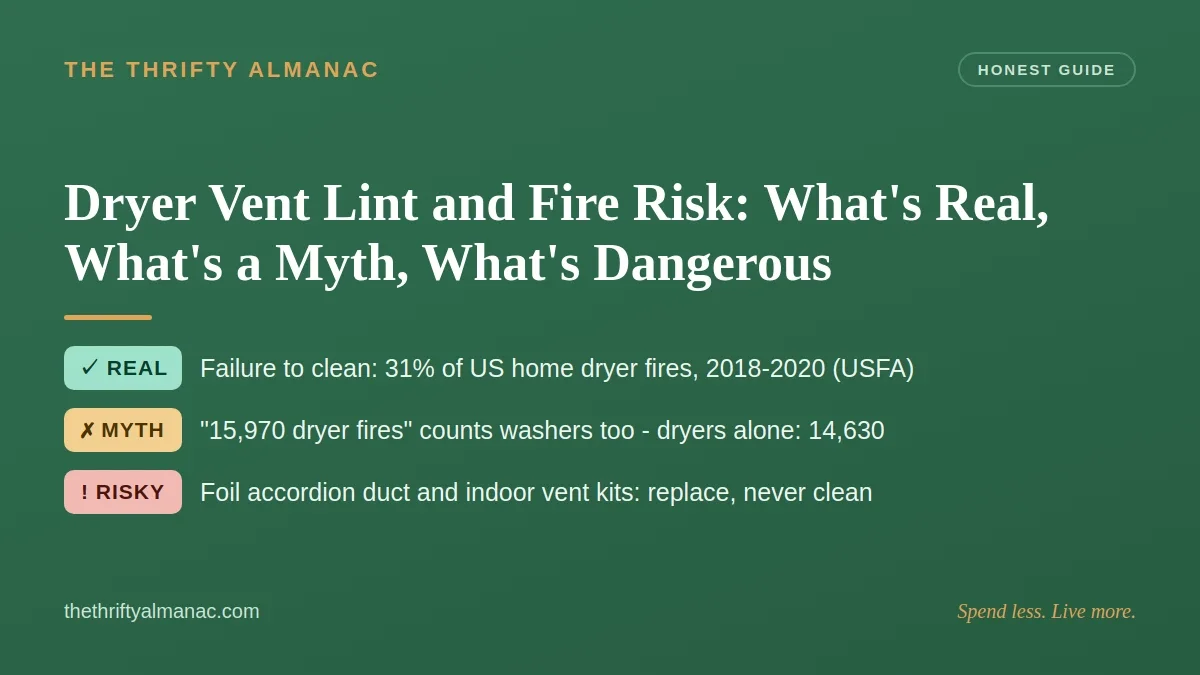
Your dryer used to finish a load in one cycle. Now it takes two, and the clothes come out warm and damp. Take that seriously — federal fire investigators and the company that built your machine agree on what it usually means.
The fire risk is documented and the fix is mostly free — but vent-cleaning ads quote the wrong numbers, and some money-saving dryer advice makes a home less safe.
The honest version of the dryer fire statistic
Almost every dryer-vent ad quotes 15,970 fires a year. That number exists, but it isn't dryers. NFPA's Home Fires Involving Clothes Dryers and Washing Machines (March 2017, data 2010–2014) counts 15,970 home fires involving dryers or washing machines combined. Dryers alone: 14,630 fires, 9 deaths, 420 injuries, $222 million. The "13 deaths and $238 million" everyone repeats is also the combined total.
The cause everyone cites is right, but the percentage depends on the report, and the three aren't interchangeable.
| Report | Scope & data years | Fires per year | Failure to clean |
|---|---|---|---|
| USFA appliance safety page (NFIRS) | Homes, 2018–2020 | not published | 31% |
| NFPA (March 2017) | Homes, 2010–2014 | 14,630 dryer fires | 33% |
| USFA Topical Fire Report v13i7 (Aug 2012) | Residential buildings, 2008–2010 | about 2,900 | 34% |
| CPSC staff estimate (2011 report) | Residential structures, 2003–2005 | about 6,900 | not reported |
One detail explains most of the confusion: in that same NFPA report, the table combining dryers and washers puts failure to clean at 31% — the identical figure USFA publishes for a different period. Same number, different scope. The dryer-only row is 33%.
And the part nobody selling appointments prints: per incident, dryer fires are less severe than the average home fire. USFA recorded 1.8 deaths per 1,000 dryer fires versus 5.5, and $9,610 in loss per fire versus $15,940. Common and preventable, not apocalyptic.
The tier list at a glance
| Verdict | The claim | The honest read |
|---|---|---|
| REAL | Not cleaning is the leading cause | Three federal reports agree |
| REAL | Damp clothes mean a blocked vent | Often the only symptom you get |
| REAL | Softener films the lint screen | Whirlpool and GE confirm it |
| MYTH | "15,970 dryer fires a year" | Includes washers; dryers alone, 14,630 |
| MYTH | Ducts last years between cleanings | NFPA says annually |
| DANGEROUS | Foil or plastic accordion duct | Replace it, don't just clean it |
| DANGEROUS | Indoor lint-trap venting kits | On a gas dryer, never |
| DANGEROUS | Machine-drying oily rags | A cool-down standard exists for this |
Real: the three things that actually move the risk
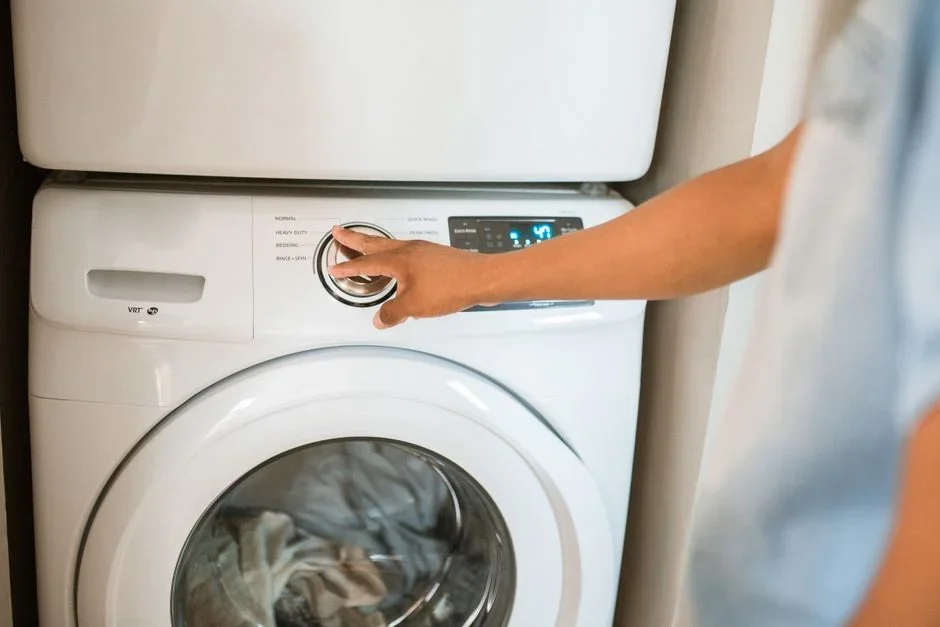
S-tier — clean the lint screen every load. USFA's flyer is blunt: "Do not use the dryer without a lint filter. Clean the lint filter before and after each cycle." Ten seconds, aimed at the leading cause.
A-tier — clean the duct once a year. NFPA's wording is "Clean lint out of the vent pipe once a year" — the pipe, not just the screen. Stack it with the no-cost habits that trim a power bill.
A-tier — metal duct, shortest run possible (below).
The finding that reframes the category: CPSC engineers determined lint may still accumulate inside a dryer even with properly vented ducting and routine screen cleaning, and that it ignites on contact with a hot surface such as the heating element. The screen is necessary, not sufficient — which fits USFA ranking dust, fiber and lint (27.6%) the top item first ignited.
Unplug an electric dryer before pulling it out to look behind it. Don't drag a gas dryer around — flexing the connector is how leaks start, and NFPA says a professional should confirm the gas line and connection are intact and free of leaks.
Real: the 60-second airflow test you can run tonight
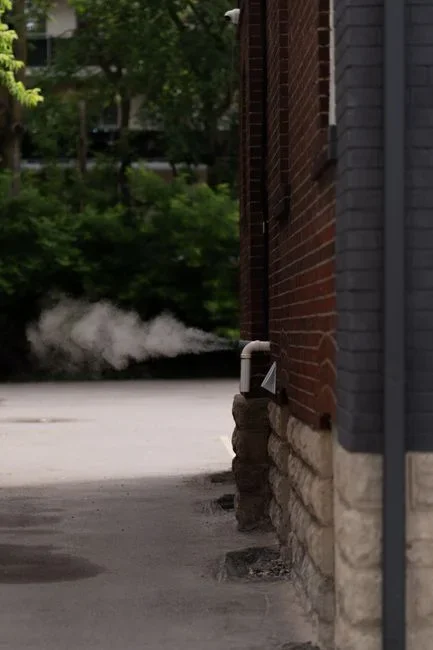
Step 1 — go outside while the dryer runs. Per CPSC: check the outside vent while the dryer operates to be sure exhaust air is escaping; if it is not, the vent or duct may be blocked. USFA adds that the outdoor covering should open when the dryer runs.
Step 2 — time a normal load and write the number down. Both CPSC and NFPA name the same tell: damp clothes at the end of a typical cycle, or drying that takes longer than normal, may mean the screen or duct is blocked.
Why dampness is the diagnostic: CPSC testing found dryers cycled on the high-limit thermostat when the exhaust vent was 75 or 100 percent blocked, driving temperatures near the heater up significantly — and in that mode, damp clothes "may be the only indication to the user that the dryer is not operating efficiently." Fire risk and wasted electricity share one symptom. If long cycles also leave laundry stiff, the real reasons towels go rough apply too.
Myth: dryer sheets and softener "protect" your machine
Half true, and the true half works against you. Whirlpool says detergent and fabric softener residue can build up on the lint screen, causing longer drying times or making the dryer stop before the load is dry. GE says the same: softener "can coat the small openings and allows less lint to pass through."
The harm stops at airflow and drying time; claims about wrecked drums, sensors or heating elements appear in no manufacturer or agency guidance. Neither does the viral "pour water on the screen and see if it beads" test — we looked for a source and found none. The real instruction: scrub it with a nylon brush, hot water and liquid detergent every six months, then dry it thoroughly before reinstalling — the principle behind our household maintenance playbook.
Myth: "the vent only needs doing every few years"
NFPA and CPSC both put the duct on an annual cadence, with volume driving the interval. CPSC's surveyed households dried roughly six loads a week, and every load pushes moisture through that pipe — a full load can hold as much as one and a half gallons of water.
Baseline once a year, more often above six loads a week or with a long elbow-heavy duct — and let the airflow test be the trigger. Dryer fires peak in January, at 10.6% of the year's total.
Dangerous: flexible plastic and foil accordion duct

CPSC tells owners to replace plastic or foil accordion-type ducting with rigid or corrugated semi-rigid metal duct, which provides maximum airflow. NFPA agrees: only rigid or flexible metal venting should be used, because plastic or foil duct more easily traps lint and is more susceptible to kinks or crushing.
The install rules come from adopted mechanical code. Section 504.4, as California publishes it, requires rigid metallic duct, termination outside the building with a backdraft damper, and no screen at that termination. It also bars assembling ducts "with screws or other fastening means that extend into the duct and that are capable of catching lint," and puts joints male-end downstream so lint can't snag. Length and elbow limits vary by jurisdiction — check your local code and the installation manual.
Dangerous: venting the dryer indoors with a lint-trap kit
No agency reviews these kits; this is reasoning from requirements. A load can carry up to a gallon and a half of water — an indoor kit releases it into the house. EPA tells homeowners to vent clothes dryers outdoors, keep humidity at 30 to 50 percent, and treat wet surfaces as a breeding ground for molds, mildews, bacteria and insects. On an electric dryer, you're buying mold to recover a little heat.
On a gas dryer, never. EPA lists gas clothes dryers among combustion appliances that produce carbon monoxide, nitrogen dioxide, particles and sulfur dioxide, depending on how the appliance is installed, maintained and vented. Keep a working CO alarm near sleeping areas; if it sounds, get everyone outside first and call 911 from there.
Dangerous: oil-soaked laundry and unattended loads

Kitchen rags, garage cloths, stain-remover towels, massage-oil sheets. CPSC and NFPA agree on clothes soiled with volatile chemicals — gasoline, cooking oils, cleaning agents, finishing oils and stains: wash more than once, hang to dry if you can, and if you machine-dry, use the lowest heat and a cool-down cycle. Then get the load out, not into a basket.
NFPA documents a "Mandatory Cool Down" standard, approved through UL and the Canadian Standards Association with a March 2019 effective date, intended to reduce the likelihood of spontaneous ignition fires, that holds the end-of-cycle chime until the load cools.
On unattended loads, NFPA's advice is not to leave a dryer running if you leave the home. The popular "never run it overnight" line is an inference, not a statistic — USFA data shows dryer fires are lowest between 3 and 6 a.m. (0.9–1.1% per hour) and peak between 1 and 2 p.m. (6.7%) — that's when dryers run.
Brush kit, or is your duct run the real problem?
A brush kit and an hour solve it when the run is short and straight, the flap opens, and cycle times drop back to normal afterward. A kit costs a fraction of a service call — vague on purpose: no government or university source publishes retail pricing.
It won't fix a structural problem: a long elbow-heavy run, a duct crushed flat behind the machine, a bad termination, or cycle times that stay long after a clean. A run that fails your local code is a professional job — the DIY-versus-pro line we draw with cheap plumbing fixes that beat a call-out. And per CPSC, cabinet lint builds up regardless, so a service clean is its own line item.
Common mistakes
- Quoting "15,970 dryer fires" — that includes washers. Dryers alone: 14,630 a year.
- Blending the 31%, 33% and 34% failure-to-clean figures. Three reports, three periods.
- Assuming the screen covers it — lint builds inside the cabinet anyway.
- Joining duct with screws that poke inside; each one catches lint.
- Dragging a gas dryer out and stressing the gas connector.
- Piling hot, freshly dried oily rags in a basket and walking away.
FAQ
How often should I really clean the duct?
Once a year is the NFPA baseline, more often if you dry well above six loads a week or have a long, elbow-heavy run. Let the flap check decide, not the calendar.
Is a gas dryer more dangerous than an electric one?
Not on the fire numbers. NFPA reports electric line voltage in 64% of washer and dryer fires and natural gas in 18%, but cautions this doesn't imply greater risk, since electric dryers outnumbered gas roughly 3.9 to 1. The gas-specific hazard is combustion byproducts, not fire.
Will a blocked vent show up on my power bill?
You'll notice longer cycles first. Nobody authoritative publishes how many extra minutes or dollars a blocked vent costs, so any precise annual figure is invented. Time a load, clean the duct, time it again, and do the math at your own kWh rate. For a baseline to compare against, here is what a single dryer cycle costs next to the clothesline.
The takeaway: Clean the screen every load, brush the duct once a year, swap foil for metal, and let damp clothes be your early warning. Spend less. Live more. — The Thrifty Almanac






0comments