

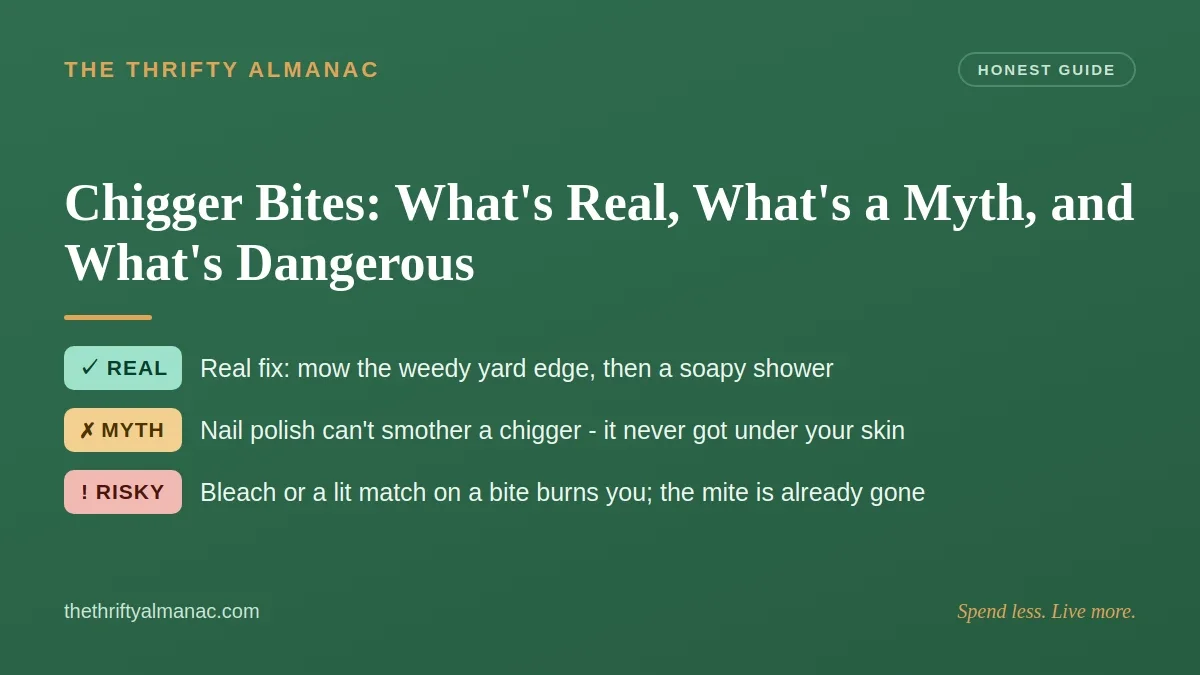
You clear the weedy strip where your lawn meets the fence line and feel nothing. That night a band of red welts rises exactly where your sock elastic sat. By morning someone has told you to paint each bump with nail polish, to smother the bug under your skin.
Don't. That advice rests on folklore four extension services and the CDC all contradict, and the real fix is cheap and dull.
The nail polish thing does not work, and here is why
University of Illinois Extension states the myth and answers it in one word. Their version: a chigger burrows into your skin, so you have to suffocate it with nail polish, bleach, alcohol, turpentine or fire — "FALSE!"
Chiggers do not tunnel in and do not drink blood. Texas A&M AgriLife Extension: chiggers do not burrow into a host's skin or suck blood. Ohio State University Extension calls the burrowing story a myth outright. Oklahoma State Extension draws the conclusion: these are non-burrowing mites, so avoid substances you think will suffocate them, because they are not there by the time the bite itches.
Nail polish seals skin over an empty spot — useless. Bleach, turpentine, alcohol on broken skin and anything involving a flame are worse: they hurt you.
What a chigger actually is: a larval mite the size of a period
Chiggers are not insects. They are the six-legged larval stage of mites in the family Trombiculidae, which Texas A&M measures at 0.15 to 0.3 mm — about 1/100 of an inch. Roughly the period ending this sentence, which is why nobody sees one on an ankle.
Only larvae feed on people; the one that bit you matures into a soil-dwelling adult that never bothers a human again. So there is no infestation in your skin, bed or carpet — only a patch of ground outside where larvae wait. That patch is what you act on — the logic behind our homeowner's playbook for handling pests without a contract: fix conditions, not symptoms.
The straw, not the burrow
The larva grips the skin surface with jaw-like mouthparts and injects saliva whose enzymes liquefy the top layer of skin cells. Your immune system reacts, and between its secretions and your tissue response a hardened tube forms. Ohio State describes a stylostome, a tube-like channel or straw, from which the larva sucks the digested skin slurry. A peer-reviewed review agrees the stylostome functions as a straw. CDC researchers in Emerging Infectious Diseases confirm larvae do not burrow, but attach to hairless areas and secrete enzymes that liquify epidermal cells, with the reaction coming from sensitization to the saliva.
So the hard welt is a feeding tube plus your own inflammation, not a bug tucked inside — which is why it outlasts the mite.

Why you do not feel it until hours later
Texas A&M reports itching usually begins 3 to 6 hours after a bite and peaks at 24 to 48 hours, and Ohio State notes the reaction can last two weeks or more.
Meanwhile the mite is leaving: StatPearls says larvae dislodge easily by scratching and rarely stay attached to humans more than 48 hours, though one can sometimes still be seen on the bump. Attachment runs longer on animals — CDC reports feeding of 2 to 10 days depending on host — so no single number fits. Honest version: usually gone before you notice, sometimes still hanging on, dislodged by scratching either way. Suffocating it accomplishes nothing.
Sock lines, waistbands, bra straps: the map of a chigger evening
Larvae board at the ankle and climb until clothing stops them; StatPearls notes they migrate to protected areas of thin skin and accumulate along the borders of tightly fitting clothing. Texas A&M lists the usual addresses — sock lines, the waist and near the groin. That argues against burrowing by itself: something that tunnels in where it lands has no reason to hunt for a bra strap. Loose clothing is no shield: protection comes from tight weave, tucking in, and treated fabric.
They live at the edge of your yard, not the middle
Ohio State places egg-laying in humid soils of grassy fields, scrubby weedy areas and lawns, especially transitional zones from fields to paths, peaking in Ohio June through August. Oklahoma State adds shaded areas, leaf litter, rotten logs and stumps. Season is regional: Texas A&M reports activity from late spring to fall, with up to four generations a year in southern Texas.
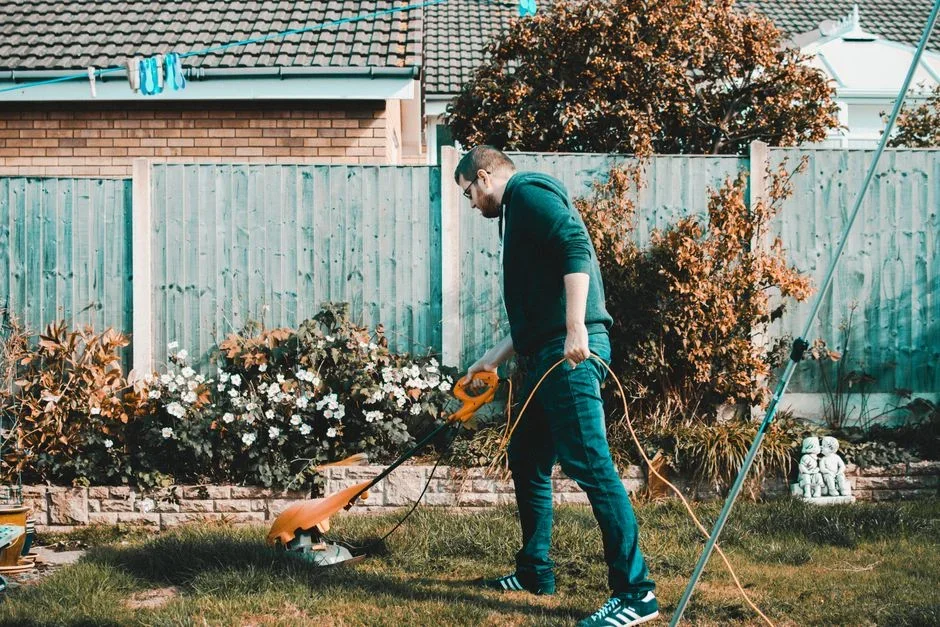
Mowing works, but not because the blade kills anything: short grass raises soil temperature and lowers humidity enough to make lawns less hospitable. Walk your property line for where mown turf meets brush — the same seam that makes a yard friendly to ticks. No source gives a mow height or how far chiggers travel inward, so keep it directional: cut it, clear it, keep play areas away.
What actually prevents chigger bites, ranked
| Verdict | Measure | How to do it | Evidence — and where it stops |
|---|---|---|---|
| REAL | Mow and clear the brushy edge | Cut grass short; trim weeds, brush and leaf litter at the lawn's edge. | Short grass raises soil temperature and lowers humidity. Free, and treats the source. No sourced mow height. |
| REAL | Permethrin on clothing only | Treat pants, socks and shoes per label, outdoors; dry fully first. | CDC: at 0.5%, treated clothing repels and kills ticks, chiggers and mosquitoes. The only hard percentages come from one 1990 trial abroad. |
| REAL | EPA-registered skin repellent | Cover ankles, lower legs and waistline; reapply per label. | Registered actives include DEET, picaridin, IR3535, oil of lemon eucalyptus; Oklahoma State suggests 20% or higher. EPA's repellent finder filters only mosquitoes and ticks — not chiggers. |
| REAL | Tuck in, then shower promptly | Tightly woven pants tucked into socks; bathe as soon as you come in. | Clemson: a thick lather, rinsed and repeated, kills most chiggers on you; a hot, soapy shower helps remove them. No removal percentage exists. |
| MYTH | Nail polish or petroleum jelly to smother it | — | Nothing is embedded to smother. The welt is a reaction, not an occupant. |
| MYTH | Spraying the whole lawn | — | Most extension entomologists advise against it; Texas A&M is the exception. Details below. |
| DANGEROUS | Bleach, turpentine, alcohol or a flame on a bite | Don't. | A chemical or thermal burn on skin you already scratched open, for no benefit. |
| DANGEROUS | Permethrin on skin — or a cat on damp treated clothing | Fabric only, dried before wear; keep cats off. | CDC: never apply permethrin to skin. NPIC: cats break permethrin down slowly; accidental exposure to concentrated 45–65% products can cause tremors, seizures and death. |
That trial ran in northern Queensland, Australia, in November 1990 against Eutrombicula hirsti; permethrin-treated uniforms delivered 96.4% and 83.2% protection depending on treatment rate. Different species, different continent, decades ago: directional evidence, not a US figure.
That shortlist is the same one that surfaces when you compare repellent ingredients ranked by the evidence behind them, so one bottle covers both jobs. Read the label, and follow its age guidance for children.
If cats share your house, handle permethrin as you would when treating a yard where pets roam: spray outdoors, dry out of reach, never let a cat nap on damp treated fabric.

Treating the bites: calming your immune system, not killing a bug
Texas A&M's list is unglamorous: oral antihistamines, anti-itch creams with camphor and menthol, calamine or pramoxine, and hydrocortisone ointments, plus antiseptic ointment on broken skin. StatPearls agrees management is symptom control with oral antihistamines or topical corticosteroid creams. Notice what is missing from both: anything that kills anything. This is general information from public health and extension sources, not medical advice — if bites spread, weep or look infected, or you are treating a small child, ask a clinician.
The real risk is the scratching
In the US, chiggers are low risk for transmitting pathogens, and the review notes scrub typhus has not been reported in the US. The documented complication is self-inflicted: Clemson warns scratching can leave mouthparts at the feeding site and cause secondary infections needing topical antibiotics, and Ohio State says infected scratches should be attended to by a medical provider.
In proportion: a 2023 CDC study found Orientia in chiggers at 5 of 10 North Carolina sites and told local clinicians to stay alert. That is bacterial DNA in field-collected mites, no confirmed US human cases, and the authors' own call for further study — a signal researchers track, not a backyard threat.
And the folk remedies: bleach, turpentine or a flame on scratched skin risks a chemical or thermal burn, far worse than an itch. If a household chemical is swallowed or splashed, call Poison Control at 1-800-222-1222.
Skip the yard-wide spray
Ohio State: insecticide is not generally recommended, with hot-spot treatment giving only short-term knockdown while mowing and brush control do the durable work. Clemson: yard treatments are usually not practical or recommended. The review explains why — large areas would have to be sprayed numerous times.
Texas A&M is the honest exception, listing residual sprays — bifenthrin, cyfluthrin, esfenvalerate, permethrin — as able to help suppress chigger numbers through a hose-end applicator. That is a real disagreement between extension services, and flattening it would be dishonest. The middle path: mow, clear the brushy border, and treat only the hot spots along the edge. No source gives a dollar figure, so judge a quote by the repeat applications it assumes.

Common mistakes
- Treating the welt as an infestation. You are calming a reaction, not evicting a tenant.
- Blaming the wrong outing. Itching starts hours later, so the patio dinner takes the blame for the weeding.
- Putting permethrin on skin. Clothing and gear only — and keep cats off damp treated fabric.
- Spraying the whole lawn. Larvae concentrate at the weedy edge, where a mower beats a sprayer.
- Scratching until it bleeds. That turns an itchy nuisance into an infection.
FAQ
Do chiggers lay eggs under your skin?
No. They do not burrow, feed on blood, or reproduce on you. The larva feeds at the surface and drops off; adults live in soil.
Should I dig the chigger out with a needle?
No. Nothing is embedded to remove, and breaking the skin invites the one real complication — infection from your own scratching.
How long do chigger bites last?
Itching peaks in the first day or two, and Ohio State notes the reaction can run two weeks or more. Bites that spread or ooze need a clinician.
Can chiggers infest my house or bed?
They are not household pests. Larvae ride indoors on clothing, so wash what you wore, but they do not establish in carpets or bedding as fleas do.
The takeaway: Chiggers never got under your skin, so stop trying to smother them — mow the brushy edge, treat clothing instead of skin, shower promptly, and calm the itch as the allergic reaction it is. Spend less. Live more. — The Thrifty Almanac






0comments