

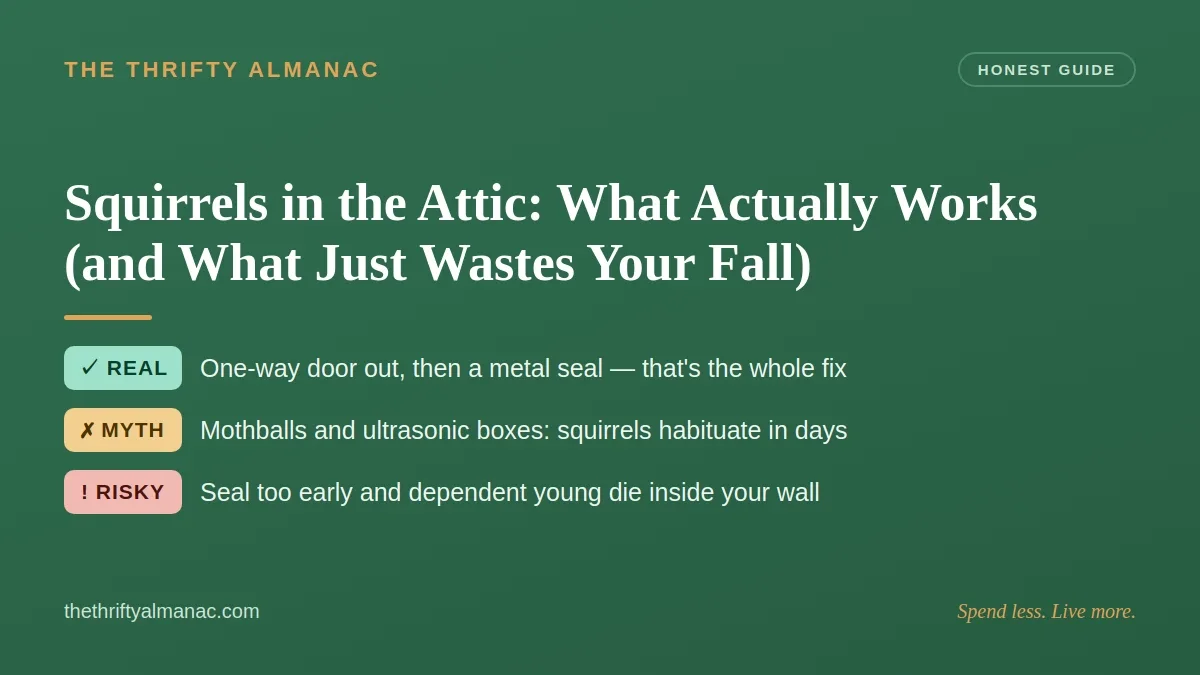
Something is running laps across your ceiling just after sunrise, and by lunchtime you're being sold an ultrasonic box. Skip it. An attic squirrel problem has one durable fix, and it has nothing to do with smells or sound.
The job has an order: confirm it's squirrels, find every hole, be sure no dependent young are inside, let the adults leave through a one-way door, then close up with metal. Shortcuts all fail the same way — the animal gets used to them, and the hole is still there. This is the attic chapter of our wider approach to handling pests yourself.
The short version: what actually clears an attic
| Method | Verdict | Source |
|---|---|---|
| One-way door, then a metal seal | S-tier — the only thing that empties an attic | They leave, can't re-enter (Alabama Extension) |
| Trimming limbs off the roof | A-tier prevention | 6 to 8 feet from buildings (ICWDM) |
| Live trapping | B-tier, legally loaded | Game species in most states; permit may be required (ICWDM) |
| Mothballs, ammonia, ultrasonics, sprays | F-tier | Squirrels habituate within days (UC IPM) |
The one non-negotiable: never close the last hole until you know nothing is left inside. Break it and you'll be chasing a smell through drywall for weeks. If you've already worked the drugstore aisle, our piece on why scent repellents keep failing on rodents explains the same habituation problem.
Is it actually squirrels? Daytime noise is a clue, not proof
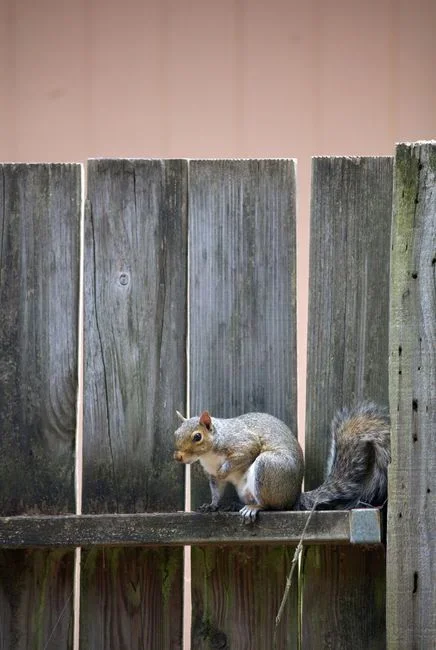
Tree squirrels are daytime animals. Penn State puts it flatly: flying squirrels are the only squirrels active at night. UC IPM adds they're most active in early morning and late afternoon — hence the complaint that it wakes the house at dawn. Noise starting only after dark points elsewhere: mice, rats, bats or flying squirrels. Scratching in a wall at night is a different job at a different mesh size, so start with the first signs of a mouse problem.
Then stop trusting your ears. ICWDM warns that noises in wildlife damage settings are not a very accurate way to determine the species. Alabama Extension lists the physical giveaways: rustling, grinding as squirrels gnaw wiring and rafters, remnants of pecans and nuts. ICWDM adds the nest — leafy debris piled in a soffit, and trash-bag-sized piles of pine cones in attics or gutters.
Why fall is when they move in — and why that season traps you
MSU Extension tells homeowners to check garages, attics, sheds and basements for creatures storing food or preparing a warm, dry nest for winter. But fall is also when a late-summer litter can still be dependent. Alabama Extension puts breeding at February/March and July/August, with young not leaving the nest for 10 to 12 weeks — pushing a July litter into late autumn. Penn State's calendar differs: gray squirrels there breed mid-December or early January and again in June. UC IPM reports one or two litters a year of three to five young.
Those aren't contradictions, just species and regional differences — which is why no article can give you a safe national date, this one included. Ask your state extension or wildlife agency. And from the yard you cannot tell whether nursing young are up there: the honest case for a licensed operator, which your county Extension office can name.
Step 1: Find every hole, not the obvious one
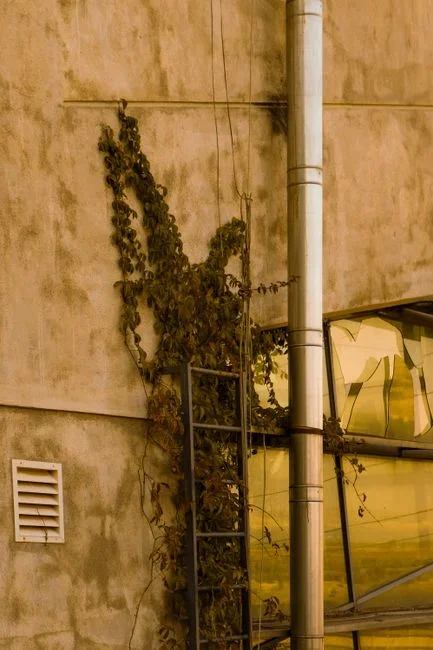
A one-way door works only if exactly one exit is left open — miss a second hole and the squirrels use it while your door does nothing. ICWDM's method: walk outside and imagine the route the animal used. Are trees or utility lines near the roof? Work the roof edge, where Alabama Extension puts loose siding and holes in eaves, soffits and ridge vents; UC IPM adds broken vent screens; MSU Extension names torn gable-end vent screens and fascia boards popping loose at the corners. Inside, kill the lights and look for daylight. Photograph and number every opening — and if one sits where a properly footed ladder won't reach, hand that part to someone equipped for roof-height work.
Step 2: The one-way door
Seal every opening but one with metal. On the last, mount a one-way door or exclusion funnel so squirrels leave and cannot return. ICWDM gets specific: spring-loaded doors plus a metal apron around the hole, 1 foot square minimum, to reduce chew-ins — and warns freezing rain can freeze the door shut or open, which matters on a late-autumn install.
How long do you leave it up? No agency or university source names a number of days, so ignore the tidy figures on removal-company blogs. UC IPM gives a test instead of a timer: be sure no animal is inside before closing entry routes, and to check, plug the entrance with a loose wad of newspaper — any still inside will remove the plug to get out.
The limit on that test: it detects only animals that can walk out. A nursing litter cannot push a paper plug aside, so undisturbed paper is not proof the attic is empty during breeding season. That is exactly where most households should stop and call a licensed operator.
Step 3: Seal with metal — foam and wood get chewed through
This is where most DIY attempts fail: the hole gets foamed, looks repaired, reopens within weeks. ICWDM is blunt — foam that expands reduces heat loss but will not prevent rodent entry.
| Where | Spec | Source |
|---|---|---|
| Any chewed opening | Heavy 1/2-inch wire mesh or aluminum flashing | Penn State, ICWDM |
| Squirrel entrances | Sheet metal or 1/4-inch hardware cloth | UC IPM |
| Vent grills | 18-gauge 1/2-inch galvanized expanded metal, or 16-gauge 1/2-inch galvanized wire cloth — never chicken wire | UC IPM |
| Anything over 1/4 inch | Seal it — the rodent-exclusion threshold | UC IPM |
Fair attribution: the 1/4-inch threshold, vent gauges and chicken-wire warning come from rat and house-mouse guidance, not squirrel research — but squirrels chew harder, so treat those numbers as a floor. Same logic as our cheap kit for sealing rodents out. Foam is fine as filler behind mesh; never as the barrier.
While the attic is open, Alabama Extension says to pick up food particles and feces, replace damaged wiring, remove soiled insulation, and sanitize with an antimicrobial cleaner. It specifies no protective equipment and none will be invented here; if a nest has sat for months, cleanup is another job for the operator.
Step 4: Cut the runway
Sealing without removing access resets the clock. ICWDM says trim limbs and trees 6 to 8 feet from buildings to stop squirrels jumping onto roofs. Alabama Extension sets it at at least 8 feet from buildings and feeders, and explains why: squirrels jump up to 4 feet vertically and twice that horizontally. Pull down vines. For a tree you can't cut back, ICWDM describes a 2-foot metal collar 6 feet off the ground.
The myths: mothballs, ammonia, ultrasonics, peppermint oil
Ultrasonic repellers. ICWDM quotes Howard and Marsh on ultrasound and rodents: a rodent control program with ultrasonics was just as successful if the units were not turned on. UC IPM gives the mechanism — rodents quickly become accustomed to repeated sounds, making high-frequency devices ineffective.
Mothballs. The accurate answer is worse than "does nothing." ICWDM says naphthalene may temporarily discourage squirrels from entering attics, but doesn't recommend it in occupied buildings because it can cause severe distress to people. The EPA goes further: illegal naphthalene mothballs can be mistaken for candy by young children, and recent studies link naphthalene to illnesses including nasal cancer. Temporary at best, hazardous to your household, hole still open.
Ammonia rags and scent sprays. No agency or university source tests ammonia against squirrels, so nobody can honestly quote a study. UC IPM's general finding covers it: rodents have an initial aversion to some odors and tastes, but no repellents solve the problem for more than a very short time.
Peppermint oil. Scope is the correction. Peppermint oil, garlic and capsaicin appear in extension literature as ingredients applied to birdseed and feeders — protecting a food source, not evicting an animal from a structure. The repellents Penn State credits are contact products: Ro-pel, containing denatonium saccharide, and sticky polybutene against climbing.
The dangerous parts: wiring, and the law
Chewed wiring is not a wait-and-see problem. Penn State states squirrels chew the insulation around wires, and that bare wires may cause a fire; Alabama Extension calls exposed wiring a potential fire hazard. The CPSC explains why your breaker panel won't save you: arcing and sparking in home wiring can cause fires, and typical fuses and circuit breakers do not respond to early arcing — by the time one opens a circuit, a fire may already have begun. Arc fault circuit interrupters address that, and CPSC is explicit that a qualified electrician must install them — do not attempt the work yourself. So the action item is an inspection, with AFCIs as a question for the electrician. No fire statistics here: the percentages repeated online have no traceable government source.
Trapping is a legal question first. Fox and gray squirrels are game species in most states — a different legal category from "pest," which is why a permit enters the picture at all, and why what you've read about mice tells you nothing here.
| State | What the agency says |
|---|---|
| New York | Illegal to move an animal off your property; gray, black and fox squirrels need a DEC permit, red and flying squirrels don't (NY DEC) |
| Missouri | May trap most damage-causing wildlife without a permit, on your own property — but relocation is discouraged: it spreads disease and the animal may starve (Missouri MDC) |
| California | Releasing any tree squirrel elsewhere is illegal without a CDFW permit (UC IPM) |
| Alabama | No relocation across a county line or major river drainage (Alabama Extension) |
Those four show how much rules vary — call your own state agency first. Alabama Extension's rule of thumb: most states prevent releasing a live squirrel elsewhere, and most require traps be checked every 24 hours.
Common mistakes
- Sealing the hole first. The fastest route to a dead animal inside your wall.
- Assuming the month makes it safe. Breeding calendars differ by species and region.
- Finding one hole and stopping. A one-way door is decorative if hole two is open.
- Foam or chicken wire as the repair. Neither excludes anything.
- Trapping before reading your state's rules, or skipping the electrician after finding gnawed wire.
FAQ
How do I know the squirrels are actually out?
UC IPM's test is a loose wad of newspaper plugged into the entrance — anything still inside pushes it out to leave. Undisturbed paper after several dry days is a good sign. It won't detect nursing young, and no verified source gives a fixed number of days, so uncertainty here is the cue to call a professional.
Can I trap them and drive them to the woods?
Often not legally. New York bars moving an animal off your property, California requires a CDFW permit to release a tree squirrel elsewhere, and Alabama bars relocation across county lines. Even Missouri, which allows permit-free trapping, discourages relocation on disease and survival grounds.
What about flying squirrels?
If the noise is strictly nocturnal they belong on your list — Penn State notes they're the only squirrels active at night. Exclusion works the same, but the law can differ: New York allows taking red and flying squirrels without the permit other species require.
Do I have to hire someone?
Not always. Inspection, metal sealing and branch trimming are ordinary homeowner work. Hand it over when you can't rule out dependent young, when openings need roof-height access, when wiring has been gnawed, or when your state's rules are unclear. Alabama Extension points homeowners to a licensed nuisance wildlife control operator through the county Extension office.
The takeaway: A one-way door plus a metal seal is the whole answer, and the only way to ruin it is closing the hole before you're certain nothing is left inside. Spend less. Live more. — The Thrifty Almanac



0comments