

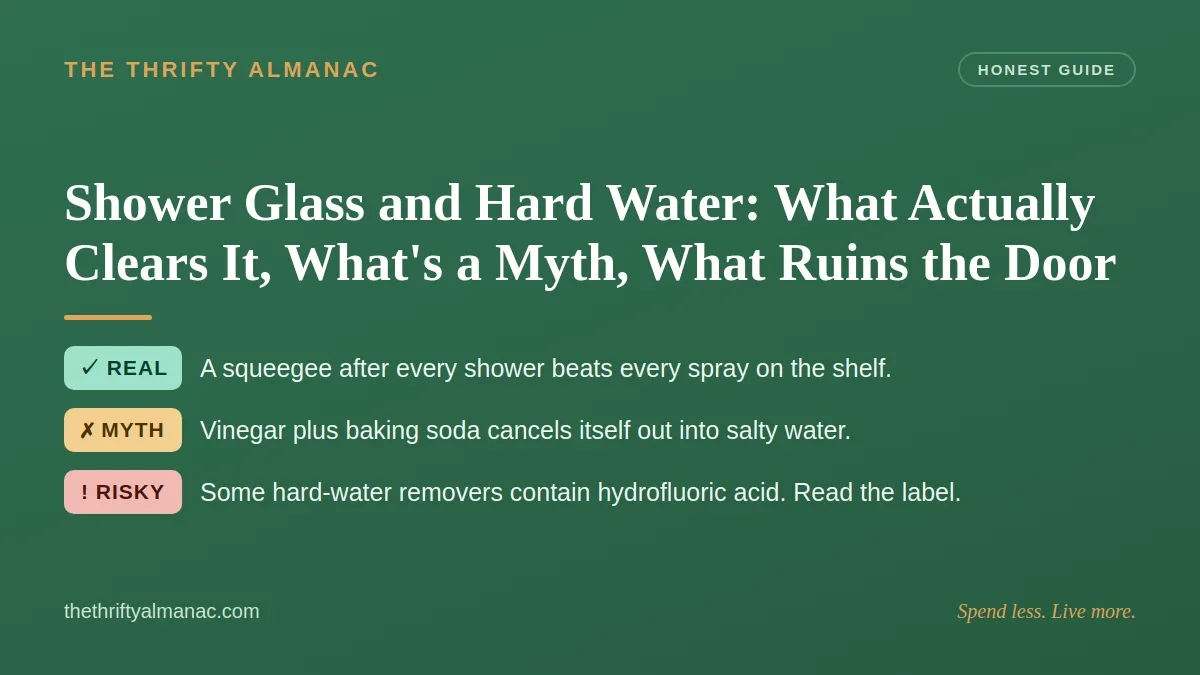
There are two different stains on your shower door right now, and they are not the same chemistry. One is mineral. One is a soap-and-body-oil film. A single all-purpose spray handles one of them at best — which is why you can scrub until your shoulder aches and the glass still looks foggy.
So diagnose before you buy anything, treat in the right order, and know which popular fixes are harmless, which are useless, and which one can permanently wreck a door your budget would rather you kept.
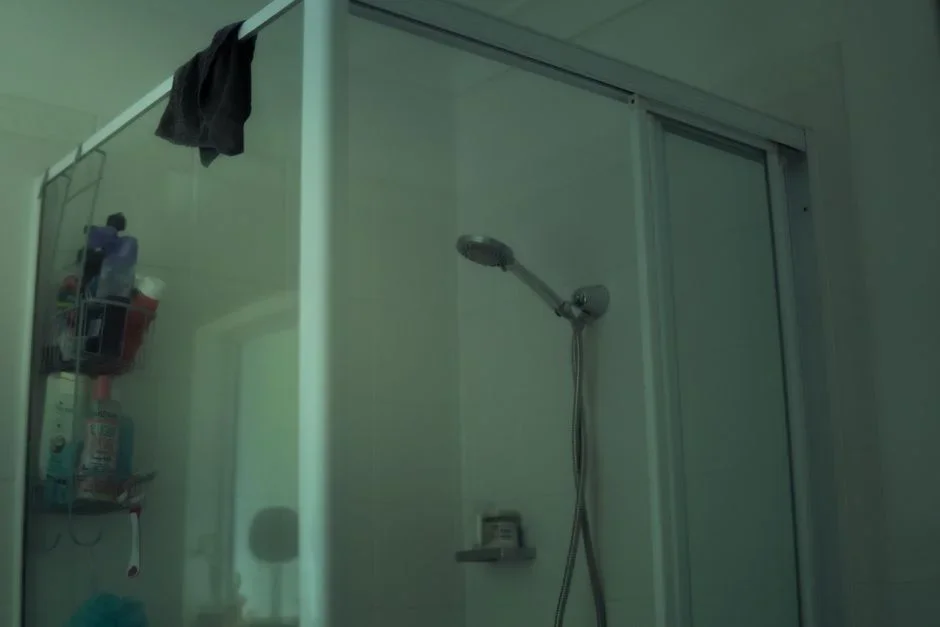
Your shower door has two stains, not one
Hard water spots are mineral. They dry on as chalky white specks or a gritty haze, and you can feel the roughness with a fingernail. Soap scum is a slick, dull film — it smears rather than flakes, and it feels faintly greasy.
Two quick checks, no products required. Dab a little white vinegar on one spot: if it softens or loosens, you're looking at mineral deposit, because acids neutralize alkaline substances such as hard water scale, per Utah State University Extension. Then rub a drop of dish detergent on a different spot: if it goes slippery and lifts, that patch is soap film, since detergents are what cut grease.
| What you see and feel | What it is | What removes it |
|---|---|---|
| Chalky white specks, gritty under a fingernail | Hard water mineral scale | A mild acid (white vinegar, citric acid) |
| Dull, slick, smeary haze | Soap scum | Detergent / surfactant |
| Both at once — cloudy and rough | Layered film (most showers) | Detergent first, then acid |
Most doors are the third row. That's the real reason "I sprayed vinegar and nothing happened" is such a common complaint — the acid never reached the minerals because a greasy film was in the way. Sorting stains before reaching for a bottle is the same habit that makes a few cheap pantry staples outperform a shelf of specialty sprays, and it works on tile and fixtures too.
The mineral haze is your water, not your effort
Hard water is simply water carrying a lot of dissolved calcium and magnesium. When it evaporates off the glass, the water leaves and the minerals stay. The USGS classifies hardness in milligrams per liter as calcium carbonate: 0–60 is soft, 61–120 moderately hard, 121–180 hard, and above 180 very hard.
The glass industry puts a number on how much that matters. Professional window cleaners who rinse with pure water and let it air-dry need total dissolved solids of 20 parts per million or less to avoid spotting, and the NGA/IWCA cleaning guidance states plainly that tap water is not acceptable for it. Your shower sprays tap water on glass several times a day.
To learn your own hardness, read your utility's annual water quality report or test a well. National hardness maps are built on 1975 monitoring data and read regionally, not house by house.
Soap scum starts on your skin
Soap scum isn't just body grease. In hard water, soap reacts with the dissolved minerals: EPA's WaterSense program notes that hard water reacts with soap to form a sticky coating on skin and reduces soap's ability to lather, so a bath or shower gets less productive. Less lather means people use more soap, which makes more scum.
That points at a fix no cleaning spray can match: change what you wash with. Detergents are synthetic and, unlike soap, are designed specifically not to react with hard water minerals to form soap scum, according to USU Extension. Swapping bar soap for a detergent-based body wash cuts the film off at the source. No one has published how much less scum that yields, so treat it as a mechanism, not a promise.
Before any chemical: is your glass coated?
Plenty of shower doors ship with a factory water-repellent or low-maintenance coating, and coated glass has its own rules — the NGA guidance says specific procedures must be followed and the manufacturer's instructions consulted. Wreck the coating and you can't put it back.
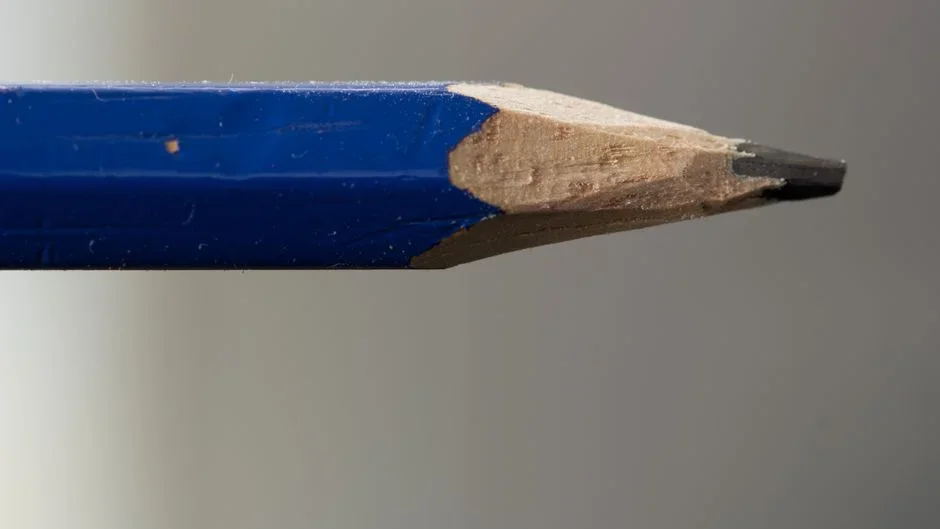
The industry's own field test takes five seconds: touch the point of a pencil to the glass. If the reflected pencil point meets the real one with no gap, the coating is exposed on that side. Then test-clean one small area, stop, and examine it carefully — the same guidance warns that light scratches may be invisible under a gray sky and obvious when the sun hits at an angle, so check in daylight before you do the whole door.
The right order: detergent, then acid, then dry
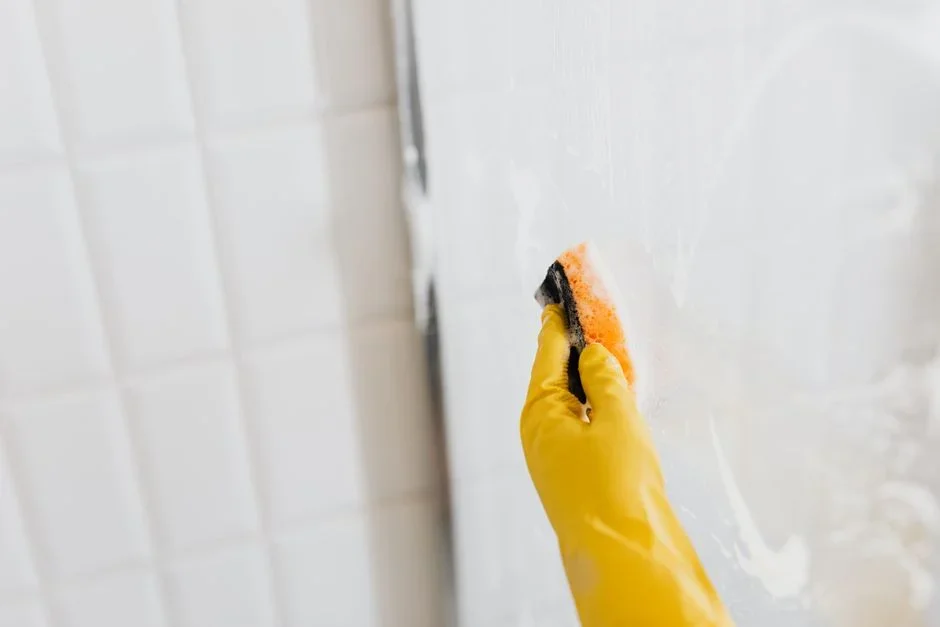
Wet the glass with clean water and a mild, non-abrasive cleaner first — a squirt of dish detergent qualifies — and work the soap film off. Only then apply your mild acid to whatever mineral haze remains. On a vertical door, a common trick is laying acid-dampened paper towels flat against the glass so the liquid doesn't run straight to the floor. Rinse fully, then squeegee.
Two honest limits. No government or university source publishes a tested dwell time or dilution for vinegar on shower glass, so any "soak 20 minutes" figure online is somebody's habit, not a validated protocol. And the NGA is blunt that glass cleaning solutions should not include acids, naming muriatic (hydrochloric) and hydrofluoric — that warning is aimed at strong mineral acids, but it's exactly why the coating check and the spot test come first.
Buying instead of mixing? Look for the EPA Safer Choice label. EPA reviews every ingredient regardless of its percentage against criteria including carcinogenicity and aquatic toxicity, and certified products still have to pass performance standards. If you'd rather mix your own, know which DIY combinations are safe and which ones you must never put in the same bottle.
The cheapest fix is 30 seconds and no chemical at all
Squeegee the glass after every shower. This isn't folk wisdom — pulling all the cleaning solution off the surface immediately is a required step in the professional glass cleaning procedure, and the guidance's "do not" list includes allowing water or cleaning residue to remain on the glass, and allowing dirt and residue to sit for an extended period.
Pull top to bottom, wipe the frame and bottom track with a microfiber cloth, and run the fan. You get a second payoff: EPA advises drying wet areas within 24–48 hours to prevent mold growth, recommends running the bathroom fan or opening a window while showering, and suggests keeping indoor humidity below 60 percent, ideally 30 to 50. Drying the door is also the front half of keeping bathroom mold from coming back after you clean it.
The limit: a squeegee stops new deposits. It won't dissolve the crust already welded on. Do one proper cleaning, then squeegee to keep it.
The honest tier list
| Verdict | Method | Why |
|---|---|---|
| REAL | Squeegee and dry after every shower | Removing all water and residue immediately is standard glass industry practice |
| REAL | Detergent for film, mild acid for scale, in that order | Detergents cut grease; acids neutralize alkaline scale (USU Extension) |
| REAL | Switching bar soap to a detergent body wash | Detergents are built not to react with hard water minerals |
| MYTH | Fizzing vinegar and baking soda together | Vinegar neutralizes alkaline scale; baking soda neutralizes acids. Together they cancel out |
| MYTH | Toothpaste "polishes" glass clear | Toothpaste is built around abrasives — the exact thing the glass rules forbid |
| DANGEROUS | Scouring powder, steel wool, razor blades | Abrasives are banned for maintenance cleaning; blades must never touch coated glass |
| DANGEROUS | "Hard water remover" with hydrofluoric or hydrochloric acid | Named by the glass industry as harmful and common in restoration products |
| DANGEROUS | Mixing bleach with any acidic cleaner or ammonia | Releases chlorine or chloramine gas |
On toothpaste specifically: dental research lists hydrated silica, calcium carbonate and alumina among standard toothpaste abrasives, with relative dentin abrasivity around 70 in common products. That figure describes teeth, not glass — but "contains grit" is enough to disqualify it, because the first rule of routine glass care is no abrasive materials. The fizzing myth gets a fuller breakdown of what that bubbling reaction actually leaves behind, and the same logic explains why grout responds to a completely different approach than glass.
The mixing mistake that ends in a 911 call
Bathrooms are where people layer three bottles onto one surface. Don't. Sodium hypochlorite bleach can liberate dangerous amounts of chlorine or chloramine gas when mixed with acids or ammonia, according to ATSDR, which also notes children are more vulnerable because of smaller airways.
This is documented, not hypothetical. In a CDC case published in MMWR, a woman filled a sink with a 10% bleach solution, vinegar and hot water to wash produce, smelled chlorine, developed difficulty breathing and wheezing, and called 911. The same report counted 45,550 poison center calls about cleaners and disinfectants in January–March 2020, a 20.4% rise over 2019. CDC cautions that voluntary call data underestimates true cases, so read it as scale, not proof.
An earlier CDC investigation in California traced five chlorine gas episodes affecting at least 14 people to staff mixing bleach with a 4% phosphoric acid cleaner. Toilet bowl cleaners, rust removers and lime-scale products are frequently acidic, so combining any of them with bleach is the same reaction. Don't count on your nose as the alarm: EPA notes mild irritation at 1 to 3 ppm of chlorine, with pulmonary edema at 46 to 60 ppm. Read the label, never mix products, ventilate, and wear eye protection. If someone is exposed, get to fresh air and call Poison Control at 1-800-222-1222 — or 911 if they are struggling to breathe.
When the glass is beyond cleaning
Be realistic about the ending. Glass can be permanently damaged if it's cleaned infrequently or improperly, per the NGA guidance. Once a surface can't be restored by routine methods, the remaining options are aggressive ones — razor blades, chemical cleaning, mechanical polishing — and that guidance warns any non-routine cleaning carries a risk of irreparable damage. That's a call for a professional, not a Saturday afternoon with a polishing kit. Note too that these standards were written for architectural glass and professional crews; your enclosure may add a manufacturer coating with stricter rules.
If your water is the root cause, treating the water is the durable fix — with tradeoffs. EPA says softeners are not necessary in all homes and should only be considered in areas of substantial hardness or where recommended by appliance manufacturers, local health and safety codes, or water utilities, and that some jurisdictions limit their use. If you do buy, the NSF/ANSI 44 voluntary efficiency rating requires 5.0 gallons of water or less per 1,000 grains of hardness removed, and demand-initiated regeneration beats a fixed schedule. The cost side: regeneration can use 25 gallons of water or more per day, up to 10,000 gallons a year, plus sodium and chloride discharged into your wastewater. Check local rules before you install.
Common mistakes
- Attacking mineral scale with acid while a soap film is still covering it. Detergent first.
- Cleaning the whole door before spot-testing a hidden corner and inspecting it in daylight.
- Skipping the pencil-point check and stripping a factory coating you didn't know was there.
- Reaching for scouring powder, steel wool or a razor blade — abrasives and blades are exactly what the glass industry rules out.
- Buying a "hard water remover" without reading the ingredients for hydrofluoric or hydrochloric acid.
- Letting water air-dry on the glass and then blaming the cleaner.
- Spraying a second product on top of the first, especially anything containing bleach.
FAQ
Is vinegar safe on shower glass?
Mild household acids act on mineral scale, which is the mechanism you want. But no agency or university publishes a tested concentration and dwell time for shower glass, and the glass industry advises against acidic cleaning solutions in general. Check for a coating, spot-test a hidden corner, inspect in daylight, and rinse thoroughly.
Can I just use one all-purpose spray?
Only if your door has one type of stain. Mineral scale needs an acid and soap film needs a detergent, and most shower doors carry both layered together. That's the usual reason a single product seems to stop working halfway.
Do I need a water softener to fix this?
Probably not just for a shower door. EPA treats softeners as an option for areas of substantial hardness or where a utility, appliance maker or local code recommends one, and some places restrict them. Read your utility's water quality report before spending anything.
My glass looks cloudy even when it's clean. Is it ruined?
It may be. Glass can be permanently damaged by improper or infrequent cleaning, and restoration methods carry a real risk of irreparable damage. Get an opinion from a professional glass cleaner rather than experimenting with a polishing compound.
The takeaway: Diagnose the stain, treat it in the right order, and then let a 30-second squeegee do the work every bottle on the shelf is failing at. Spend less. Live more. — The Thrifty Almanac






0comments