

You've seen the video: someone flips a coffee mug over, drags a dull kitchen knife across the rough ring on the bottom a few times, and slices a tomato paper-thin. "Sharpen your knives without spending a dime." It's the kind of frugal hack we love here — so does it hold up?
Short answer: the trick is real, but the claim around it is oversold. That gritty ring on the base of a mug can refresh a dulled edge in an emergency. What it can't do is truly sharpen. Understanding the difference is the whole game, and it's what keeps you from wrecking a good knife.
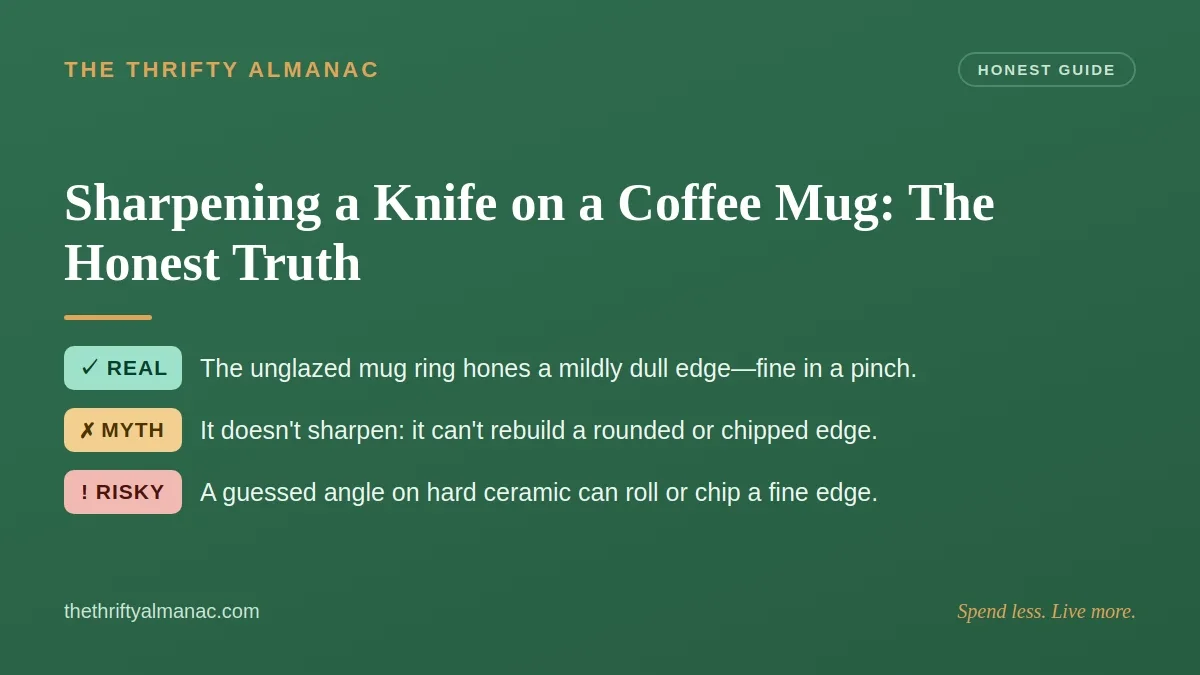
The verdict up front: real trick, oversold claim
The most reputable kitchen source to actually put this trick through its paces, America's Test Kitchen, is careful about how it frames the mug: the unglazed ceramic "has a bit of grit to it, so it works as a honing rod, straightening the edge." Not sharpening. Honing. And their own caveat is blunt: the trick "isn't ideal for your really good knives" and is best saved for an emergency at Aunt Margie's house.
The honest tier-list
- REAL: A mug's bare ceramic ring can realign and lightly abrade a mildly dulled edge, giving you a quick working edge when nothing else is around.
- MYTH: It "sharpens" a truly dull knife. It doesn't. It can't rebuild a rounded-off or chipped edge the way a stone does — at best it fakes "sharp" for a little while.
- DANGEROUS/COSTLY: You're holding a blade at a guessed angle against a hard, uneven abrasive. That can roll or chip a fine edge, scuff the mug, and lull you into trusting a knife that still slips.
Verdict badge: Fine in a pinch, wrong as a habit.
Honing vs. sharpening vs. stropping — the distinction that explains everything
Once you get these three straight, the mug makes total sense. They are not the same job.
Sharpening removes a small amount of metal to grind a fresh bevel — a brand-new cutting edge. The proof it worked is a burr, which we'll get to. Honing doesn't create a new edge and removes little or no metal; it just realigns the microscopic edge that rolls and bends over as you cut. As the knife-makers at Shun put it, honing "realigns" the edge while sharpening "restores a knife's edge by removing a small amount of metal." Stropping — the leather-strap step — doesn't sharpen either; it removes the leftover burr and polishes the edge you already made.
Plain-English version: sharpening cuts a new edge, honing straightens the one you've got, stropping gives it a final polish. The frequency tells the story too — Shun suggests honing roughly once a week and sharpening about once a year for a home cook. The mug lives firmly in that first, frequent, straighten-what's-there category. It's a honing tool wearing a sharpening costume.
Why the mug's unglazed ring can do anything at all
This is the half of the story that keeps the trick from being total nonsense. Look at the bottom of a ceramic mug and you'll usually find a ring of bare, rough ceramic — the "foot" where the mug sat in the kiln, left unglazed so it wouldn't fuse to the shelf. That exposed fired ceramic is hard. Really hard.
An abrasive only bites a blade if it's harder than the blade, and ceramic clears that bar easily — it's about four times harder than most knife steels. That's the exact same principle behind a ceramic honing rod, where "the rod material has to be harder than the steel used in the blade." If you drag an edge across the ring and see a faint black smear, that's steel actually coming off — so the mug is a touch more aggressive than a smooth honing rod, sitting somewhere between a hone and a coarse stone.
But note what that same source says about rods in general: neither a steel nor a ceramic rod "will sharpen your knife." They keep an edge aligned so you sharpen less often. The mug inherits that limit.
Where the myth breaks down
The viral framing says the mug "sharpens a dull knife like a whetstone." Three things make that false.
1. The grit is uneven and uncontrolled. A real whetstone is graded to a consistent grit. A mug's ring is whatever texture the kiln left — coarse in spots, glassy in others. It abrades unpredictably, so it can't produce the clean, consistent apex a stone does.
2. You're guessing the angle. Edge geometry is precise work. Western and German knives are typically ground to about 20 degrees, and Japanese knives to a finer angle, around 17 degrees. Freehanding a blade over a mug, you're eyeballing that angle stroke to stroke. Hold it too steep and you scrub off the fine edge; too shallow and the thin edge you leave behind chips or rolls in use.
3. It realigns more than it rebuilds. On a knife that's only mildly dull — edge slightly rolled — straightening it can genuinely bring back some bite. On a truly dull knife, where the apex is rounded off or nicked, there's no aligned edge left to straighten. Light, uneven abrasion can't grind the missing bevel back. You get a knife that feels sharper for a few minutes, not one that is sharp.
The tell that a real edge exists is a burr — a tiny wire of metal that forms along the edge when you sharpen on a stone. When you can feel that burr running the entire length of the blade, you've created a new edge. A mug can't reliably raise a burr like that, which is the clearest sign it's honing, not sharpening.
The real risks: guessed angle, chipping, and the dull-knife trap
The downside isn't dramatic, but it's real, so let's be honest about it. Dragging a fine edge at a freehand angle across a hard ceramic ring can roll or chip that edge, and it can scuff a glaze line or scratch the mug. To be straight with you: there's no lab documenting blade chips caused specifically by the mug trick — those cautions are reasoned from the sourced facts about wrong-angle edges chipping, not measured findings. But the physics points one way, and it's why the pros wave you off using it on knives you care about.
The sneakier hazard is the false sense of security. A knife that's been half-fixed still slips — and here's the part people get backwards: a dull knife is more dangerous than a sharp one. As NC State Cooperative Extension puts it, "a dull knife is more dangerous than a sharp one because it requires more force to cut making it more likely to slip off in the wrong direction and cut the user." A mug-refreshed edge that only fakes sharpness leaves you leaning on the blade, which is exactly the setup for a slip. If the cut is deep or won't stop bleeding, that's an urgent-care or ER visit, not a butterfly-bandage moment.
What a cheap whetstone or pull-through does better
Here's the honest upgrade path — the "so what should I actually buy" — for when you want a lasting edge instead of a 10-minute rescue.
| Tool | What it really does | Best for | The catch |
|---|---|---|---|
| Coffee mug ring | Honing/light abrasion, uneven grit, guessed angle | One-time emergency, camping, a rental kitchen | Can't rebuild a real edge; risks rolling a fine one |
| Ceramic honing rod | Realigns the edge between sharpenings, removes little metal | Weekly upkeep on knives you keep sharp | Won't restore a genuinely dull knife |
| Entry whetstone | You control angle, pressure, and metal removal; raises a true burr | Actually sharpening — the durable answer | Small learning curve; takes a few minutes |
| Pull-through sharpener | Tungsten-carbide "V" scrapes both sides fast | Speed when you don't care about the edge's life | Ignores the knife's angle; leaves a weak, jagged edge |
An inexpensive whetstone is the real winner because it hands you control — you set the angle, you feel for that burr along the whole blade, and you know you've cut a fresh edge. A pull-through is the opposite bargain: it uses two tungsten-carbide blades set in a fixed V that tear metal off both sides. It makes a knife feel sharp almost instantly, but it ignores your knife's actual angle and leaves a rough, micro-toothed edge that dulls fast. Fine for a beater knife; rough on a good one. A ceramic rod, meanwhile, is your best friend for the weekly maintenance that keeps you off the stone longer. If you like squeezing full life out of every blade, the same mindset behind making razor blades last longer applies here — maintenance beats replacement.
When the mug trick is genuinely fine — and how to do it least badly
Credit where it's due: sometimes the mug is exactly the right tool. You're camping. You're in a vacation rental with one sad knife and no sharpener. A guest is arriving and your only blade won't cut a bagel. In those spots, the mug earns its keep.
The least-bad method, mirroring America's Test Kitchen:
- Flip a sturdy mug over on a stable, non-slip surface and find the rough, unglazed ring.
- Set the blade against the ring at roughly 15 to 20 degrees — think a matchbook's thickness under the spine.
- Draw the edge across the ceramic with light pressure, heel to tip, keeping your fingers well clear of the path of the blade.
- Do a few strokes per side, alternating, and stop as soon as the edge starts to bite a sheet of paper.
- Then get it properly sharpened when you're home. This is a rescue, not a routine.
That last line is the whole point. Treat it as a temporary fix and you'll never resent it. Treat it as your maintenance system and you'll slowly grind your knives into sadness.
Common mistakes
- Calling it "sharpening." It's emergency honing. Expecting a whetstone result sets you up to over-scrub and damage the edge.
- Leaning on the blade. Heavy pressure over hard, uneven ceramic is how you roll or chip a fine edge. Light strokes only.
- Using it on your good knives. The source that tested it says plainly it "isn't ideal for your really good knives." Save those for a stone.
- Trusting a half-fixed edge. A knife that still slips is the real danger. If it doesn't cut cleanly, respect it like the dull tool it still is.
- Skipping the follow-up. The mug buys you time, not a maintained edge. Book the real sharpening.
FAQ
Does the coffee mug trick actually work?
Yes, as emergency honing. The unglazed ceramic ring is harder than your steel, so it can realign and lightly abrade a dulled edge. It won't rebuild a truly dull or chipped edge, and it's not a substitute for a stone.
Will it damage my knife or my mug?
It can. Freehanding a fine edge over a hard ceramic ring risks rolling or chipping the edge, and it may scratch the mug. That's reasoned caution, not lab-proven — but it's why the trick is for cheap or emergency knives, not treasured ones.
What's the cheapest way to keep knives truly sharp?
An inexpensive whetstone plus a honing rod. The stone lets you cut a real edge and feel the burr; the rod keeps that edge aligned between sharpenings. It's the same DIY-versus-pro math as our $15 fixes that replace a pricey call-out — a little skill saves the service fee.
Can I use the bottom of a plate or a ceramic tile instead?
Same principle — any bare, unglazed, harder-than-steel ceramic can hone in a pinch. The limits are identical: uneven grit, guessed angle, and no true new edge.
How do I stop my knives from rusting after all this?
Dry them immediately and store them off wet surfaces. If rust has already started, our guide to stopping rust cheaply covers remove-versus-convert-versus-protect for kitchen steel.
The takeaway: The mug is a real emergency hone but a fake sharpener — use it once in a pinch, then let a cheap whetstone do the actual job. Spend less. Live more. — The Thrifty Almanac




0comments