

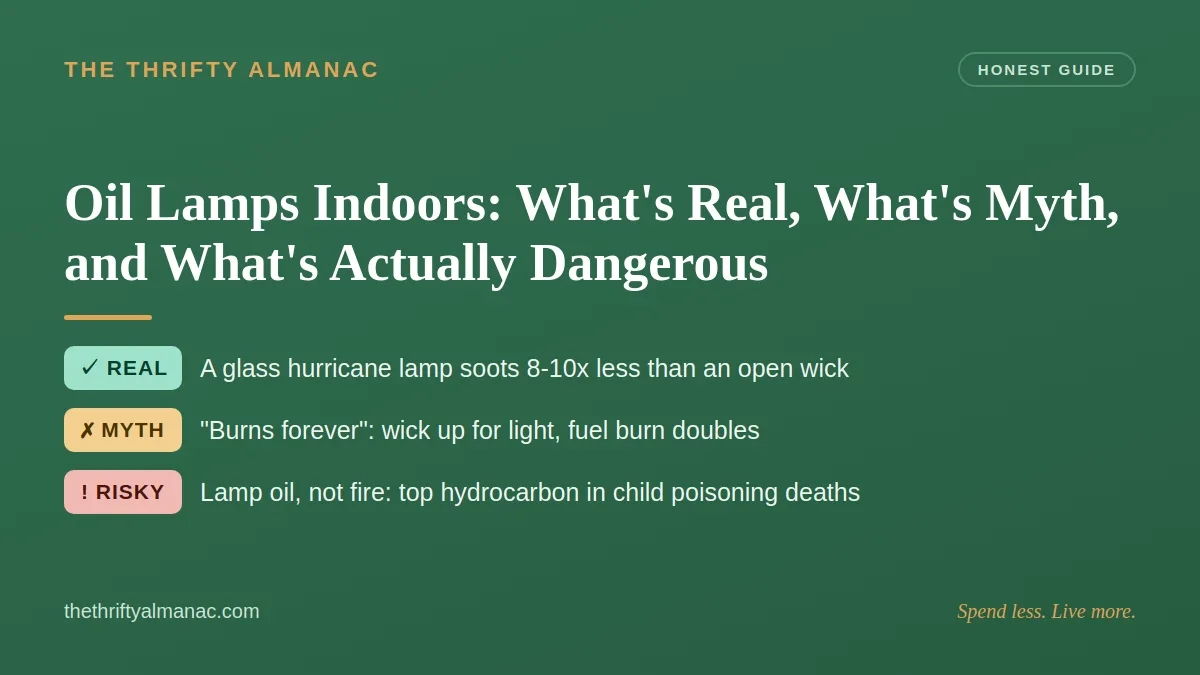
The power goes out, your phone is nearly dead, and someone says the answer is an oil lamp — no batteries, no charging, burns all night. It is a genuine light source, and the one every federal safety agency puts dead last.
Here is the honest ranking: what a lamp does well, which two viral promises fall apart under measurement, and the hazard with the worst record in US poison-center data — which is not the flame.
The claim going around: the light that never needs a battery
No charge cycle, no dead cells, fuel that keeps for years. Nothing in that pitch is a lie; the problem is rank order, and agencies are unanimous. CPSC tells households to use flashlights or battery-operated candles instead of open flame. CDC says to use battery-powered flashlights and lanterns rather than candles or gas lanterns. EPA warns that candles emit combustion products. FEMA's prep list names flashlights and battery-backup CO alarms; open flame is not on it.
Utah's state preparedness office names oil lamps directly: battery-operated flashlights and lamps are the safest, because the fire hazard and breathable toxins keep candles and oil lamps off the top spot. A real backup at the wrong rank — the rest of our household fixes worth doing get sorted the same way.
REAL: it works when nothing else does, and the design details are measurable
A lamp has no charge state to forget. The gap between a good lamp and a bad one is not folklore either: researchers in Environmental Science & Technology compared designs directly. A glass-shrouded hurricane lamp emitted 9 ± 1 grams of black carbon per kilogram of fuel versus 76 ± 15 g/kg for an open simple wick lamp, with CO of 3 ± 1 g/kg against 16 ± 1 g/kg — eight to ten times less soot. The chimney and wick discipline do that work, not the label on the bottle. Utah's guidance matches: purest lamp oil without color or perfume, rated indoor-safe, loose wick fibers trimmed before filling, and after lighting roll the wick down to expose about a quarter inch.
The limit: those factors came from a test bench and from homes burning kerosene for hours nightly. They show how designs compare, not what your living room holds after one evening — nobody has published that figure for a paraffin lamp in an American house.
MYTH 1: "It burns forever"
In the same study, a simple wick lamp used roughly 6 grams of fuel per hour on a low wick and about 12 g/hour turned up. Turning it up for light you can read by doubles the burn rate and raises black carbon 38 percent and CO about 30 percent.
The tradeoff is structural. The glow is the soot: researchers call black carbon inside the flame the agent of illumination, so a light-making flame runs incomplete combustion by design. Push it for brightness and the chimney films over, giving back less light.
The limit: no authoritative source publishes a lumen figure or cost per hour for a head-to-head against an LED lantern, so we will not invent one. Peer review does call fuel-based lighting costly and low-quality across 135 reports in 33 countries. Treat a lamp as navigation light, not task light.
MYTH 2: "It'll take the chill off the room"
No agency lists a lamp as a heat source, and the absence is the point. CDC's outage heating list is blankets and sleeping bags, a code-compliant fireplace, and space or kerosene heaters checked as legal locally — plus a flat rule to never use a gas range or oven to heat a home.
Keep two appliances separate. A kerosene heater is a rated heating appliance with its own fuel rule — CPSC says water-clear 1-K grade and never gasoline. A kerosene lamp is a light. Blurring them talks people into burning a flame all night in a closed bedroom — the same error behind the flowerpot heater takedown, which fire services also warn against.
The limit: no agency publishes a heat output for a lamp, so this rests on what the official lists recommend and what they leave out, not on a measured figure.
The real danger, and it isn't the flame: kids reach the oil
To a toddler, colored lamp oil looks like a beverage and clear lamp oil looks like water. Most lamp oil is paraffin: swallowed, it is poorly absorbed from the gut but easily aspirated into the lungs, causing severe breathing difficulty and pneumonia — and symptoms can be delayed.
US poison-center data from 2000 through 2021 make it concrete: lamp oils were the leading hydrocarbon category for ingestion-related death among people under 20 — 12 of 34 deaths, with the highest serious-outcome share of any hydrocarbon at 29.6 percent, the highest admission share at 32.0 percent, and odds of death 4.32 times those of other hydrocarbons, across 32,054 pediatric ingestions, 30,490 in children under 6. The authors' prevention line is not subtle: do not use high-risk products such as oil lamps in homes where young children live or visit.
The rule: store fuel in its original container, high, locked, out of sight, and keep a lit lamp where no toddler or cat can tip it. If you suspect a child swallowed any, contact Poison Control at webPOISONCONTROL or 1-800-222-1222 right away — do not induce vomiting and do not wait and see. None of this is medical advice.
Carbon monoxide, fine particles, and why "crack a window" isn't the answer
CO has no color and no smell, and CDC names lanterns outright: it forms any time you burn fuel in cars, small engines, stoves, lanterns, grills, fireplaces, gas ranges, or furnaces. More than 400 Americans die each year from unintentional non-fire CO poisoning, matching the NCHS count of about 430 a year for 1999–2010.
Particles matter too. In lab tests, 7–9 percent of the kerosene burned in a simple wick lamp became particulate, all of it under 2.5 micrometers. EPA notes particles under 10 micrometers reach deep into the lungs and some into the bloodstream, linked to premature death in people with heart or lung disease and to aggravated asthma. A Clean Air Journal review adds that portable lamps sit close to people for hours, so more of what they emit gets inhaled: women in semi-rural Mozambique who lit with kerosene averaged 81 percent higher personal black-carbon exposure than women with electricity. Those homes burned lamps nightly — proof the emissions are inhalable, not a forecast for your table.
Ventilation is a supplement, not the fix. EPA calls it a temporary measure for short periods of expected high CO. The bluntest phrasing comes from CPSC on generators — opening doors or windows will not prevent lethal CO buildup. The same logic sinks most blackout improvisations, including running the house off a car engine. The required layer is a CO alarm on every level and outside sleeping areas, tested monthly. If one sounds, get everyone outside and call 911 — do not go back in to investigate.
Fuel and fire rules that are boring and non-negotiable
- Manufacturer-specified, indoor-rated fuel only. CPSC's line for kerosene appliances is 1-K grade, never gasoline. Improper or contaminated fuel drives most of the flare-ups behind an estimated 2,300 residential kerosene-heater fires and about 90 deaths a year. Diesel and cooking oil carry no federal ruling: burn what the lamp maker specifies.
- Never fill a lit lamp. Utah is explicit: never fill the lamp with oil when it is lit; keep the reservoir three-quarters full, use a funnel, wipe spills at once.
- Wick low, glass clean. Roll a lamp wick down to about a quarter inch once lit. Kerosene-heater guidance makes the same point from the other side: a wick set below the manufacturer's mark worsens the pollutants that build up in a closed room. Different appliance, same principle.
- Clearance and supervision. A state fire marshal: keep flame at least 12 inches from anything that can burn, use tip-resistant holders, never leave it unattended, out before bed.
- Never in a tent, camper, or vehicle you sleep in. CPSC says people die every year from CO poisoning caused by portable heaters, lanterns, or stoves used inside tents, campers, and vehicles.
- Check local code. CDC says to ask your fire department whether a kerosene heater is even legal locally; many leases ban open flame outright.
The verdict: your outage lighting order of operations
| Tier | What it is | Honest read |
|---|---|---|
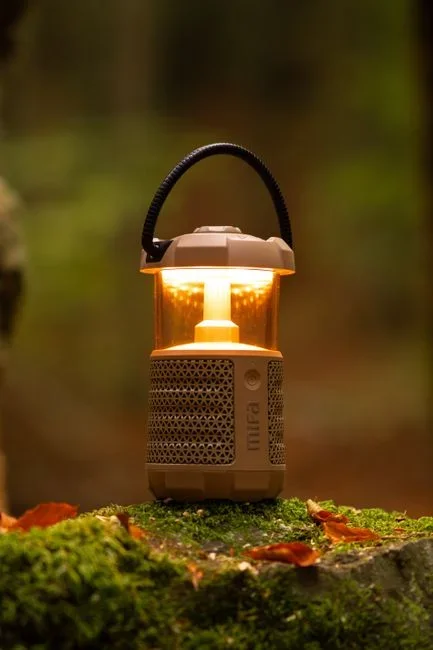
| Tier 1 — REAL | Rechargeable LED lantern, headlamp, power bank | First at every agency; no fumes |
| Tier 2 — REAL | Battery flashlights, spare cells, flameless candles | CPSC's substitute for burning candles |
| Tier 3 — LAST RESORT | Hurricane lamp, glass chimney, low wick | Works with no grid; needs a CO alarm |
| MYTH | Lamp as room heat, or "it burns forever" | On no heat list; brightness doubles fuel burn |
| DANGEROUS | Oil in a child's reach; flame lit overnight or in a tent | Top hydrocarbon in child ingestion deaths |
Three conditions move a lamp from acceptable to unacceptable: young children live in or visit the home, you plan to sleep with it lit, or there is no working CO alarm. EPA points to the fix that removes the tradeoff — battery generators and solar power stations produce no toxic fumes and can be used indoors. Just be realistic about what a small one runs, as our budget battery box breakdown shows.
Common mistakes
- Treating the lamp as Plan A instead of the layer beneath LED light.
- Rolling the wick up for brightness, then wondering why the chimney blackens.
- Storing lamp oil in a juice bottle or where a child can see it.
- Believing an open window substitutes for a CO alarm.
- Letting a lamp burn while everyone sleeps, or lighting one in a tent.
FAQ
Is paraffin lamp oil safer than kerosene indoors?
Cleaner-burning claims trace to lamp design and wick height, not the bottle: the 8–10x drop in black carbon came from the shrouded hurricane lamp versus an open wick. Fuel type does nothing about the ingestion hazard.
Can I leave an oil lamp burning overnight?
No. Fire services say to extinguish open flame before bed, and CO has no smell — sleeping is when it kills. Use a low-output LED instead.
Do I need a CO alarm for just one small lamp?
Yes. Agencies recommend alarms on every level and outside sleeping areas whatever you burn — there is no way to sense CO without one. If it sounds, get outside and call 911.
What if my child swallowed lamp oil but seems fine?
Call anyway. Aspiration symptoms can be delayed, which is why this category has the highest admission rate of any hydrocarbon. Reach Poison Control at webPOISONCONTROL or 1-800-222-1222.
The takeaway: Keep an oil lamp if you want a grid-proof backup, but rank it third, lock the fuel away from children, and never let it burn where someone is sleeping. Spend less. Live more. — The Thrifty Almanac



0comments