

You have poured baking soda down it. Then vinegar, then a lemon, then ice — and by Thursday the sink smells like a warm trash can again. You did not pick the wrong thing to pour. Pouring is the wrong verb.
It smells because grease and food film sits where water barely reaches, and every manufacturer's cure is the same: cut the power and scrub it off.
Your disposal doesn't smell because of your drain
Whirlpool's service documentation is blunt: a disposer odor usually signals grease and food buildup from insufficient water flow during and after use, and it names built-up film under the splash guard flaps as a frequent odor source (Whirlpool). That deposit sits above the waterline, on rubber, where nothing you pour ever scours it.
The film also feeds the gnats circling your sink, so if you are fighting an insect problem that never quite ends, scrubbing the guard removes the breeding surface. Pantry staples still have their place in a frugal cleaning routine — for the jobs they suit.
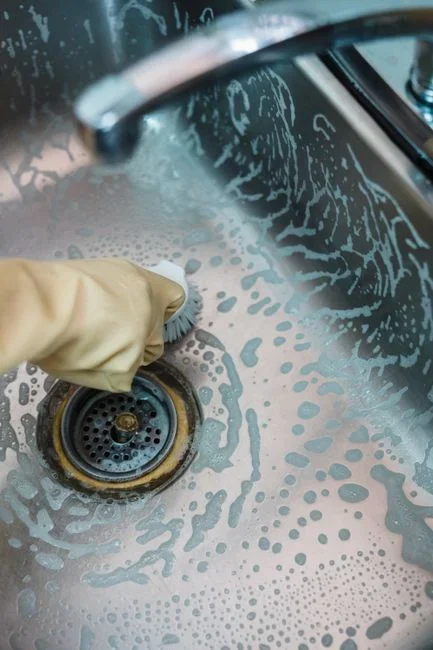
The fix nobody does: pull the splash guard and scrub it
Moen's first step is not optional: unplug the disposal, or if hardwired, kill power at the electrical box. Then pull the splash guard out, scrub its underside with baking soda and warm water, rinse, and re-install (Moen). The baking soda is an abrasive here, not a reagent you pour and wait on.
Not every guard lifts out. For fixed ones, InSinkErator says to turn the unit off, disconnect the power supply, then reach through the sink opening and clean the underside of the baffle and the upper lip of the grind chamber with a scouring pad (InSinkErator).
The safety rule that outranks all of it: all three manufacturers say never put a hand into the disposal — use tongs or needle-nose pliers. And a wall switch is not a disconnect; a housemate can flip it back on. ESFI says to cut power at the breaker in the main service panel, and never attempt a project beyond your skill level (ESFI).
Afterward, run cold water at least 15 seconds after grinding is complete (Whirlpool) — a habit that folds into a low-cost monthly drain routine.
There are no blades in there, and that changes everything
A disposal does not chop. InSinkErator explains that impellers — also called lugs — on a spinning plate use centrifugal force to drive food waste against a stationary grind ring, which breaks it into very fine particles (InSinkErator). Its FAQ says it flatly: the units don't have blades or knives (FAQ).
Nothing can sharpen blades that do not exist, which retires the eggshell myth. What cleans a disposal is friction against a surface — which is why the fix above is a scrubber, not a bottle.
The honest tier list: real, myth, dangerous
| Practice | Verdict | What it does |
|---|---|---|
| Hand-scrubbing guard and chamber lip | REAL | The only step that removes grease |
| Cold water during, 15 seconds after | REAL | Keeps fats solid so they leave |
| Ice cubes with citrus | REAL (limited) | Freshening; no cleaning claim |
| Baking soda plus vinegar | MYTH | Gas that escapes, then salt water |
| Eggshells to sharpen blades | MYTH | No blades; a septic issue instead |
| Hot water while grinding | MYTH | A prohibited input, not a cleaner |
| Chemical drain cleaner | DANGEROUS | Caustic injury is irreversible |
| Reaching in, power connected | DANGEROUS | Universal manufacturer ban |
| Fats, oils, grease | DANGEROUS | The one absolute never |
REAL — and what each is honestly worth
InSinkErator says to run the disposer with a moderate flow of cold water, avoid hot water when grinding, and never pour grease or fat into it (InSinkErator). Ice with citrus is manufacturer-endorsed — but read the verb: InSinkErator says it freshens the unit, Whirlpool suggests citrus peelings for scent. Neither claims it removes buildup. Only the hand scrub does.
MYTH — three things that do nothing here
Baking soda and vinegar. An Ohio State analysis lists the products: carbon dioxide gas, water, and sodium acetate, which stays in solution. Fully reacting one teaspoon of baking soda (5 cm³) takes about 110 cm³ of vinegar and yields roughly 2.1 liters of CO₂ (Ohio State). The gas leaves; what remains is salt water, none of it a degreaser — the same reason it doesn't clear a clogged drain either. Research on kitchen drain biofilms found their persistence demonstrates the general ineffectiveness of chemical control agents (ASM), though that study covers pipework, not splash guards. The tell: all three manufacturers pair baking soda with scrubbing. None prescribes vinegar.
Eggshells sharpen the blades. No blades. And egg shells sit on InSinkErator's list of items even the entry-level Badger Series grinds (InSinkErator), so they are not hurting the motor. Penn State Extension lists eggshells among organic waste that prematurely fills a septic tank — a downstream cost, not a mechanical one.
Hot water melts the grease away. InSinkErator says to avoid hot water when grinding, permitting it only between grinding periods, and its foodservice safety instructions list extremely hot water among prohibited items. Separately, EPA describes grease as problematic because it solidifies and blocks flow (EPA). Warm grease that moves hardens somewhere less convenient — reasoning from two facts, not a finding either states.
DANGEROUS — the three that can cost you
Chemical drain cleaner. InSinkErator's operating instructions name drain cleaner on the do-not-put-in list (InSinkErator), and EPA tells homeowners to avoid chemical drain openers, using boiling water or a drain snake instead (EPA). Poison Control classifies caustics as very strong acids at pH 2 or below or strong alkalis at pH 12 or above, names household drain cleaner among them, and warns they damage instantly and that injury cannot be reversed, only treated (Poison Control). It then pools in a chamber you will later reach into. On skin or eye contact, rinse immediately and call Poison Control at 1-800-222-1222.
Reaching in with power connected. Whirlpool says to always disconnect power before working on the disposer, and never to put a hand inside the chamber (Whirlpool).
Fats, oils and grease. The one item in emphatic capitals on InSinkErator's compatibility page. EPA's pretreatment fact sheet quotes its Report to Congress: grease from restaurants, homes and industrial sources is the most common cause of reported blockages, at 47 percent (EPA) — homes named alongside restaurants.
It's jammed: the hex key and the red button, in order
A hum means the motor has power but the assembly cannot turn — a jam. Silence means the overload protector tripped, or the breaker is off.
- Switch the unit off and cut power at the breaker. Bail out standing water if the sink is full.
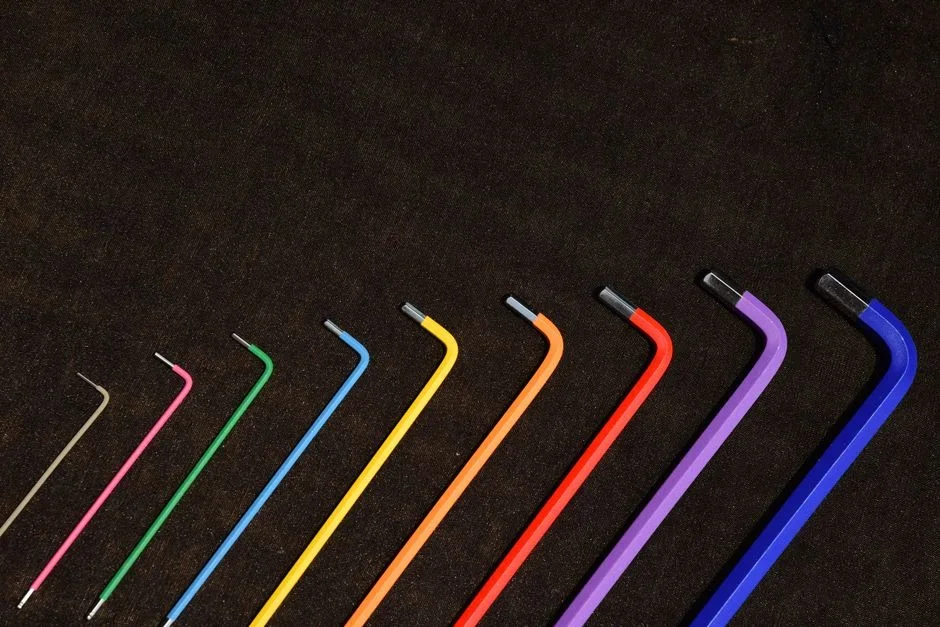
- Insert the wrenchette into the center hole on the bottom of the disposer and work it back and forth until it turns one full revolution. If yours is missing, InSinkErator specifies a standard 1/4-inch Allen wrench (InSinkErator); Whirlpool says to use the size specified for your model.
- Remove the object with tongs or pliers — never a hand.
- Press the reset: a small square red button under the unit, which drops about a quarter inch (5 mm) when the overload protector trips. If it will not stay in, wait ten minutes.
- Restore power, run cold water, switch it on (Whirlpool). If it trips again, stop and call a professional.
What to put down it: the machine rule vs. the pipe rule
Almost every list online insists coffee grounds, pasta and potato peels will destroy your disposal. The manufacturer's documentation says otherwise.
| Item | Can the machine grind it? | Do your pipes want it? |
|---|---|---|
| Coffee grounds | Yes — entry-level Badger list | No — EPA warns against them |
| Egg shells | Yes — same list | No — Penn State: fills the tank |
| Pasta and rice | Yes — same list | Marginal; starch adds load |
| Potato peels | Listed, but see below | No — starch-paste seize-up |
| Celery, banana peels, corn cobs | Advanced Series only | Fibrous; confirm your model |
| Fats, oils, grease | Not applicable | Absolute never |
Grindability comes from InSinkErator's compatibility page; the right column from EPA and Penn State. The potato exception is real: Iowa State's AnswerLine describes the peels' high starch content creating a thick, glue-like paste in water that seizes the disposal up (Iowa State) — a clog story, not a broken-machine one. Even that page calls the mechanism "blades."
Your disposal grinds more than the internet claims; your plumbing pays for it. If a slow sink becomes a real backup, weigh a cheap tool against a service call.
If you're on septic, the rules get stricter
EPA notes that food waste is only slowly digested by septic-tank bacteria and accumulates as scum and sludge, so a disposal means pumping more often, and that septic additives containing bacteria or chemicals are not recommended for domestic wastewater treatment (EPA). Penn State Extension advises composting scraps instead, lists drain cleaners among chemicals that may harm the bacteria, and puts pumping at every 2 to 3 years, sooner for small tanks or large households (Penn State).
What this guide can't tell you
No source quantifies how much of the smell is guard versus chamber versus trap, so the scrub is the highest-yield step, not a guaranteed cure. Hex sizes and reset behavior vary by model, so your manual outranks this article. If the unit leaks, trips the breaker repeatedly, or still smells after a power-off scrub, that is a plumber's call; wiring is an electrician's. If the odor returns within days, the film is rebuilding faster than cleaning can keep up: a usage problem.
Common mistakes
- Treating the wall switch as a power disconnect instead of using the breaker.
- Pouring baking soda and vinegar in and expecting degreasing.
- Feeding in eggshells to sharpen parts that do not exist.
- Shutting off the moment the noise stops instead of running cold water 15 seconds longer.
- Using chemical drain cleaner in a chamber you will later reach into.
- Retrieving objects by hand instead of with tongs or pliers.
FAQ
How often should I scrub the splash guard?
No manufacturer publishes an interval, so treat monthly as a routine, not a sourced recommendation. If the odor returns sooner, the cause is what goes down the sink.
Is it safe to reach in if the power is off?
Manufacturers say not to reach in at all — use tongs or pliers. Cleaning the baffle underside with a scouring pad, power off at the breaker, is the one exception they describe.
Do disposal cleaner pods beat scrubbing?
No manufacturer prescribes one in place of physical cleaning, and drain-biofilm research points to chemical agents being generally ineffective against mature films.
My disposal hums but won't turn. Is it broken?
Usually jammed, not dead. Cut power at the breaker, work the hex socket underneath until it turns fully, remove the cause with pliers, then reset and test.
The takeaway: The smell is a grease film on the splash guard, and nothing you pour in will remove what a scrubber and a switched-off breaker will. Spend less. Live more. — The Thrifty Almanac




0comments