

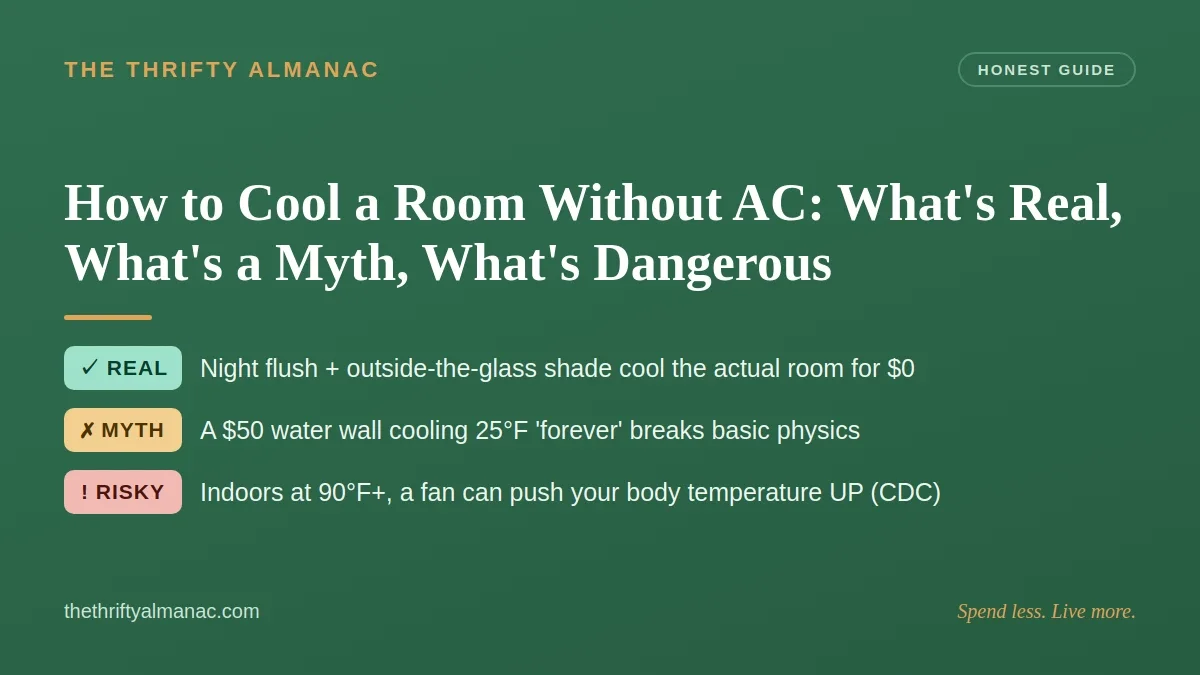
Every June the same videos resurface: a $50 "water wall" that supposedly cools a room 25°F forever, a bucket-and-fan rig that drops "any room" 15 degrees with zero power, a guy who cools his whole house for $5 a summer. Meanwhile your bedroom is sweltering at 10 p.m. and you'd like an answer that isn't a thumbnail.
So we pulled the public record and ranked every no-AC method by what it actually does to room temperature, what it costs, and where it stops working. The viral claims get their trial below.
How We Ranked These (No, We Didn't Buy a $50 Water Wall)
No garage testing here. We checked the receipts: every method below was held up against CDC, ready.gov, DOE's Building America research, and ENERGY STAR on four questions: does it cool the room or just your skin, what it costs, which climates it works in, and whether it can hurt you.
S-Tier: Block the Sun Before It Gets Inside
Heat you never let in is heat you never have to fight. DOE research calls shading windows one of the most impactful measures against heat gain, and says where to start: unshaded east- and west-facing windows collect as much as two times more solar heat per square foot than south-facing ones. The other rule: shade from the outside. DOE's guidance ranks exterior options — landscaping, shutters, screens — ahead of interior blinds, because it's easier to block heat from entering a house than to remove it once it's there. A curtain fights heat that's already in the room.
Your budget ladder: free is closing drapes and adding window reflectors that bounce heat back outside — both straight off ready.gov's heat checklist. Cheap is exterior shade screens on the east and west windows. The bigger spend is awnings or shutters — exactly how old houses stayed livable without AC.
The limit: shading stops new heat; it doesn't remove heat already indoors. Pair it with the next method.
S-Tier: Night Flush — the Free Cooling Cycle Your House Already Has
This is the only free method that lowers the actual room temperature. DOE's Building Science Education Center lays out the mechanics: night flushing uses cool nighttime air to pull heat out of a home and everything in it — walls, floors, furniture. Cross-ventilation moves that air through windows on opposite sides of the house, and the stack effect helps: cool air enters low, warms, rises, and exits upstairs — a big part of why your upstairs turns into an oven by dinnertime.
The routine: once outdoor air is cooler than indoors, open windows on at least two sides — low on the cool side, high on the warm side. A window fan blowing out on the sheltered side speeds the exchange; DOE notes fans can draw in cool outside air and distribute it. Off-season, that same box fan does double duty as a cheap DIY air purifier once you tape a furnace filter to the back. At sunrise, close every window and drop every shade — and sealing drafty windows and doors keeps the cool you banked from leaking back out.

The limit: it needs cool nights. Building America's design criteria say night flushing works best where lows drop below about 67°F and day-night swings top 25°F. If your summer nights stay warm and sticky, this has little to give you.
A-Tier: Fans — Cheap, Effective, and Everyone Uses Them Wrong
Here's the correction every viral video dodges: fans don't cool rooms. ENERGY STAR says it in six words — "ceiling fans cool people, not rooms" — and adds that a fan in an unoccupied room should be off. Moving air makes you feel roughly 2°F to 5°F cooler than the thermometer reads, per DOE research. The room doesn't change; you do.
Three setups that earn the A:
- Ceiling fan, right direction: counterclockwise in summer, pushing air down onto you.
- Fan plus AC: DOE research shows a running ceiling fan lets you raise the thermostat as much as 4°F with no noticeable comfort loss.
- Box fan blowing out: when indoors is hotter than outdoors, exhaust air out a window instead of stirring it.
The limit: a fan in an empty room is pure waste — its motor even adds a little heat. Past a certain indoor temperature, fans stop being safe — see the Danger Zone below.
A-Tier (Dry Climates Only): Evaporative Cooling — the Humidity Fine Print
Evaporative ("swamp") cooling is real — the kernel of truth inside most bucket-cooler videos — but the fine print matters. DOE guidance says it suits climates where design wet-bulb temperatures are 70°F or lower: hot-dry regions like Arizona, New Mexico, Nevada, the high plains. There, a proper unit uses about one-fourth as much energy as central AC. Trade-offs: it raises indoor humidity as it cools, and it drinks — roughly 2,980 gallons a year in Santa Fe to 7,261 in Albuquerque.
The limit: the wetter your air, the less cooling you get. In sticky summers — the Southeast, the humid Midwest — a swamp cooler just makes the room clammier, and if that room already feels damp, it's worth checking whether salt really dries a damp room before spending on a fix. We won't promise a degree drop for a DIY version — no federal or extension source backs one.
B-Tier: Whole-House Fan — Big Results, Real Installation
A whole-house fan is night flushing with a motor: it pulls cool evening air in through open windows and shoves hot air into a vented attic. It's the closest thing to AC that isn't — B-tier only because it's a real installation project. DOE sizing calls for 12 to 23 air changes per hour and at least 1 square foot of net-free attic vent area per 750 CFM. It's not the small powered attic fan — ready.gov lists those for clearing hot attic air, not your living space. Operating rules: run it only when it's cooler outside than inside, open windows first, never run it with the AC.
The limits are safety-grade. DOE says homes with combustion appliances that draw room air, or standing pilot lights, are not recommended candidates — the fan can backdraft exhaust gases into the house. Running one when it's hotter or more humid outside invites moisture and mold. Have a pro check the gas situation before you cut a hole in the ceiling.
Myth Tier: The Viral Claims, Fact-Checked

"This $50 water wall cools the room 25°F — forever"
Water is thermal mass: it absorbs heat until it matches the room, then stops. Nothing absorbs heat "forever" — that's conservation of energy. To reuse thermal mass you must dump its heat overnight, which is just night flushing with extra steps; DOE adds that only the first 1 to 2 inches below the surface contributes meaningfully. Verdict: BUSTED.
"Cool any room 15°F — free, no power, 3-minute setup"
This splices two real things into one false one: wind chill on your skin (a 2°F–5°F feeling, not a room change) and evaporative cooling (real, but only in dry air, and never "no power"). Verdict: BUSTED — two kernels of truth, dishonestly combined.
"I cool my whole house for $5 a summer"
Strip the branding and the working part is night flush plus daytime shading — genuinely close to free. The "$5" is a marketing number nobody audits. Verdict: KERNEL OF TRUTH — skip the course, open the windows.
"A fan over a cooler of ice replaces an air conditioner"
As illustrative physics, not a test: melting ice absorbs a fixed, modest amount of heat — a small fraction of what even the smallest window AC removes hour after hour. The breeze feels cool at arm's reach; the room stays hot. It's the same energy arithmetic that sinks the candle-and-flowerpot heater in winter. Verdict: BUSTED as an AC replacement.
Danger Zone: When a Fan Makes Heat MORE Dangerous
Here's the line many articles get wrong. The CDC says to use fans only when indoor temperatures are below 90°F — the indoor reading, not the forecast. Above 90°F inside, blowing hot air across your body can raise your body temperature while you feel like you're coping. Ready.gov is blunter: don't rely on a fan as your primary cooling device — it creates a false sense of comfort but does not prevent heat illness.
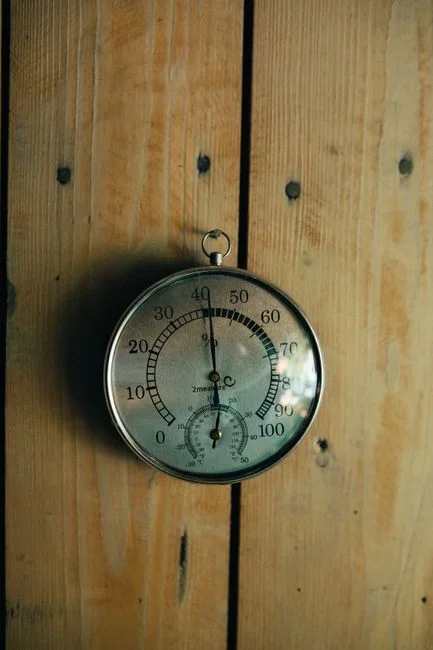
Put a thermometer in the room. At 90°F or higher, the hacks are over: get to air conditioning, or dial 2-1-1 to find a cooling center — a library or mall works too. Check on elderly neighbors, kids, and pets. Below 90°F indoors, fans are still safe and useful — a threshold, not a ban.
Your Cooling Game Plan Tonight (by Climate)
| Method | Tier | What it really does | Watch out for |
|---|---|---|---|
| Exterior window shading | REAL (S) | Blocks heat before it enters; E/W windows first | Doesn't remove heat already inside |
| Night flush + cross-ventilation | REAL (S) | Actually lowers room temperature, free | Needs cool nights (lows under ~67°F) |
| Fans, used right | REAL (A) | You feel 2°F–5°F cooler; room unchanged | Off in empty rooms; unsafe above 90°F indoors |
| Evaporative cooling | REAL (A, dry only) | Real cooling at ~1/4 the energy of AC | Useless-to-harmful in humid air |
| Whole-house fan | REAL (B) | Motorized night flush, near-AC results | Backdraft risk with gas appliances; humid-air mold |
| $50 water wall, "15°F free," ice-chest AC | MYTH | Skin-deep effects sold as room cooling | Wasted money, delayed real fixes |
| Fan as your only defense at 90°F+ indoors | DANGEROUS | Can raise body temperature | Go to AC or call 2-1-1 |
Dry-summer climate: tonight, run the night flush; this weekend, shade the east and west windows; long-term, price an evaporative cooler or whole-house fan. Humid-summer climate: tonight, shades down and ceiling fan counterclockwise; this weekend, exterior shading plus an evening box-fan exhaust; long-term, AC used smart — a fan and a 4°F higher thermostat setting — beats every gadget here.
Common mistakes
- Shading south windows first — east and west take up to twice the solar heat per square foot.
- Leaving windows open all day after a night flush — seal the house at sunrise.
- Running fans in empty rooms. Fans cool people, not rooms.
- Buying a swamp cooler in a humid state — you'll get clamminess, not cooling.
- Trusting a fan during a heat emergency. At 90°F indoors, it can work against your body.
FAQ
Does a bowl of ice in front of a fan do anything?
A cooler breeze near the fan is real, but the ice holds far too little cooling capacity to change the room's temperature. It's a personal comfort trick, not room cooling.
Can I run a whole-house fan if I have a gas water heater?
Be careful. DOE says homes with combustion appliances that draw room air or have standing pilots are not recommended for whole-house fans because of backdraft risk. Have an HVAC pro evaluate first.
Is it safe to sleep with a fan on during a heat wave?
Check the room thermometer, not the weather app. Below 90°F indoors, a fan is fine and helpful. At or above 90°F indoors, the CDC says it can raise your body temperature — find AC or call 2-1-1 for a cooling center.
The takeaway: Shade the sun out, flush the night in, point fans at people below 90°F indoors — and let the $50 miracle walls stay in the comments. Spend less. Live more. — The Thrifty Almanac






0comments