

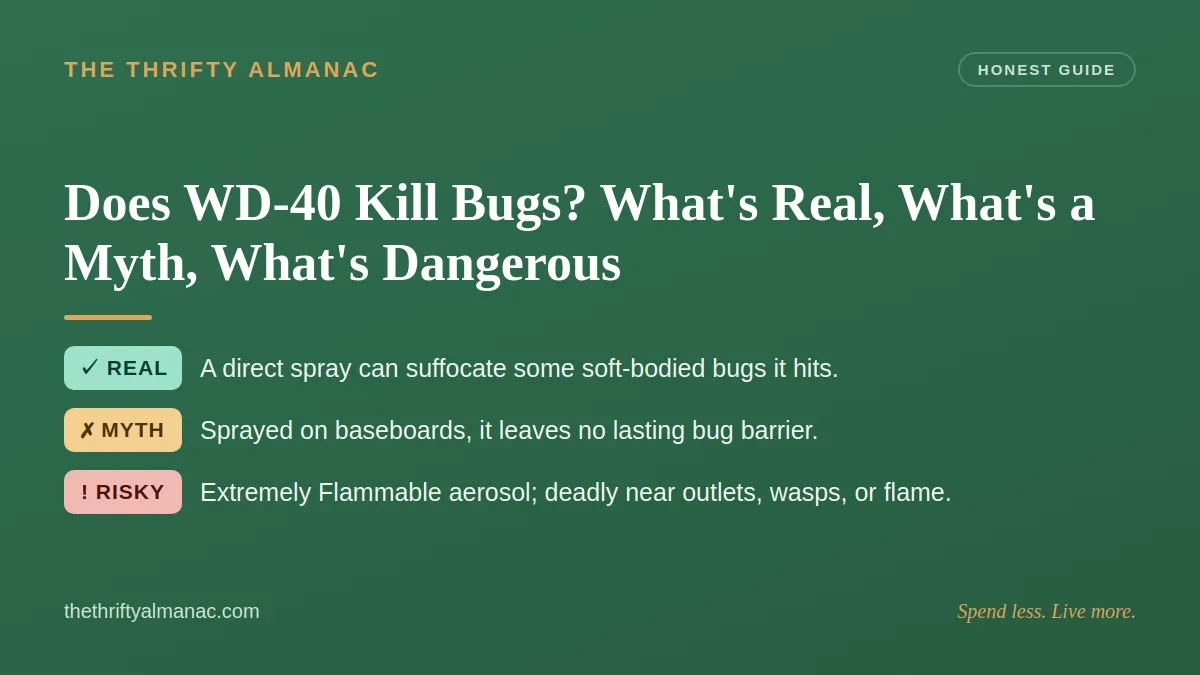
You have probably seen the clip: someone points a can of WD-40 at a roach, gives it a blast, and the bug curls up and dies. It looks convincing, and now half the internet swears WD-40 is a secret exterminator you can spray around windows, doors, and wasp nests to keep pests out for good.
Here is the honest version. A direct spray really can kill some bugs on contact, for a reason worth understanding. But that same physics is exactly why it fails as pest control, and the safety warnings on WD-40's own paperwork make the popular hacks a genuinely bad idea. So let's sort it the way we sort everything: what's REAL, what's a MYTH, and what's flat-out DANGEROUS.

REAL-ish: A Direct Spray Can Knock Down Some Insects
Here's the grain of truth. WD-40 is mostly oil and solvent. Its own Safety Data Sheet lists the can as roughly half aliphatic hydrocarbon, under 35% petroleum base oil, under 25% more hydrocarbon, and a little carbon-dioxide propellant. In plain terms, it sprays an oily film.
Oils and soaps kill insects by a physical route, not a chemical poison. Clemson's Home & Garden Information Center explains that soaps and oils "kill by suffocation," disrupt the insect's cell membranes, and strip the protective waxes on its body so it dries out. The bugs most affected are "small, soft-bodied insects such as aphids, mealybugs, thrips, scale crawlers, and spider mites," per the same Clemson factsheet. Coat a soft-bodied bug in oil and you plug the pores it breathes through. That is why the videos look real.
The limit: No extension service or peer-reviewed study has ever measured WD-40's specific kill rate, which species it drops, or how fast. The "it can suffocate some bugs it hits" claim is an inference from WD-40's oil content plus the well-documented oil mechanism above. It is not a tested insecticide, and it is not a reliable killer of roaches, ants, or wasps. It kills what the wet spray directly touches, nothing more.
MYTH: It's a Pest Solution, a Lasting Barrier, or a Safe Bug Spray
This is where the internet goes off the rails. Three beliefs, all wrong.
Myth 1: WD-40 is a pesticide
It isn't, legally or by design. The EPA defines a pesticide as "any substance or mixture of substances intended for preventing, destroying, repelling, or mitigating any pest," and any such product "must be registered by the EPA before it can be legally sold or distributed." WD-40 carries no such registration. On its own SDS the company lists the product use as "Lubricant, Penetrant, Drives Out Moisture, Removes and Protects Surfaces From Corrosion" with "Restrictions on Use: None identified." No pesticide label means no tested, legal use pattern for bugs and no efficacy or safety data behind that use at all.
Myth 2: Sprayed around doors and windows, it forms a bug barrier
This is the most repeated hack and the easiest to bust. Oil and soap films have "no residual effectiveness because soap dries or is washed away," and "the soap solution must wet the insect during application." Once that greasy film dries, it does nothing to the next ant that walks across it. There is no lingering repellent barrier. You are left with an oily smear on your baseboards and trim that still lets bugs stroll right through.
Myth 3: It's a safe home bug spray
Wrong on the safety axis, not just efficacy. WD-40 is classified Aspiration Toxicity Category 1, carrying the warning "May be fatal if swallowed and enters airways," and the first-aid line "DO NOT induce vomiting." It is also rated for nervous-system effects and warns "May cause drowsiness or dizziness," with the direction to "avoid breathing vapors or mists" and "use only outdoors or in a well-ventilated area." An oily, may-be-fatal-if-swallowed aerosol is the last thing you want fogged across kitchen counters, food surfaces, or anywhere a toddler or pet might touch.
To be precise: "not EPA-registered" means untested for bug use, not automatically proven useless on contact. The point is that nobody has verified it works, and its maker never intended it to.
DANGEROUS: Flammable, and Bad News Near Wasps, Outlets, and Stoves
This is the section that matters most, because the popular hacks put the can exactly where its own label says never to point it.
WD-40's SDS classifies it as "Flammable Aerosol Category 1" with the signal word DANGER and the statement "Extremely Flammable Aerosol." The manufacturer's own hosted copy carries the identical classification, so this is the company talking, not a critic.
Two warnings on that sheet should stop the hacks cold:
- Electricity can rupture the can. The handling section says to "unplug electrical tools, motors, and appliances before spraying or bringing the can near any source of electricity," because "electricity can burn a hole in the can and cause contents to burst into flames." Now picture someone spraying a wasp on an outdoor outlet, a porch light, or a bug zapper.
- The vapor cloud can flash back. The fire section warns that "vapors are heavier than air and may travel along surfaces to remote ignition sources and flash back." A stove pilot light or a nearby spark can ignite a cloud you sprayed several feet away.
The label spells out the rest: "Keep away from heat, sparks, open flames, hot surfaces. No smoking," and "Do not spray on an open flame or other ignition source." Spraying a flammable aerosol at a wasp nest under an eave, near a grill, or over a kitchen burner checks every box the manufacturer tells you to avoid.
A note on the numbers: you may see people cite a "flash point" for WD-40. Its exact formula is a trade secret, and the only temperature figure worth trusting from the sheet is the storage ceiling: do not store above 122°F (50°C). The load-bearing fact is simpler, the GHS class itself: Extremely Flammable Aerosol, DANGER.
What to Do Instead: IPM, Baits, and Cheaper Fixes
Killing one bug you can see never solves an infestation, because the ones you can't see keep breeding. The approach that actually works is integrated pest management, which UC IPM describes as leading with prevention, inspection, and non-chemical tools before any pesticide is considered.
For roaches and ants specifically, skip the sprays. Penn State Extension's roach guidance is blunt: "Avoid using foggers and sprays. You can't control where the chemicals go, and the risk of exposure is high." Its recommended method is gel bait placed in cracks and crevices, paired with sanitation: food in sealed containers, no crumbs or standing pet food, and cracks sealed with caulk or copper mesh. Bait works precisely where a spray fails, because insects carry it back to the nest instead of you killing one straggler.
If you want the budget-safe routes we already cover, start with the natural pest repellents that actually work, learn why ants keep coming back so the baiting sticks, and for a kitchen roach problem read our walkthrough on how to get rid of roaches with boric acid. All of them cost less than a can of WD-40 and none of them ask you to fog a flammable oil across your counters.
Quick-Reference Verdict Table
| Verdict | Claim | The honest reality |
|---|---|---|
| REAL-ish | A direct spray kills some bugs on contact | Oils suffocate soft-bodied insects they wet (Clemson). Kills only what it hits, no infestation cure. |
| MYTH | Sprayed on trim, it repels bugs long-term | Oil films have "no residual effectiveness" once dry. No lasting barrier. |
| MYTH | It's a real, safe pesticide | Not EPA-registered; labeled a lubricant with no pest use. Untested for bugs. |
| DANGEROUS | Fine to spray near wasps, outlets, stoves | "Extremely Flammable Aerosol, DANGER." Vapors flash back; electricity can rupture the can. |
| DANGEROUS | Safe around kitchens, kids, and pets | Aspiration Category 1: "May be fatal if swallowed." Do not fog on food surfaces. |
Common mistakes
- Treating one dead bug as a solution. Contact kill is not pest control. The colony or population survives.
- Spraying baseboards for a "barrier." The film dries and does nothing. You get grease, not protection.
- Aiming at wasps near outlets, zappers, or lights. The exact ignition scenario the SDS warns against.
- Using it indoors near the stove. Heavier-than-air vapors can travel to a pilot light and flash back.
- Fogging it in the kitchen. An aspiration-toxic, oily aerosol has no business on food or counters.
FAQ
Does WD-40 actually kill wasps and hornets?
A direct hit can knock some down by coating them, but it is not designed or tested for it, and spraying a flammable aerosol at a nest near any outlet, light, or flame is a serious fire risk. For a stinging-insect nest, follow a proper safe wasp-nest removal method, use a product labeled for wasps, or call a pro if the nest is large or hard to reach.
Can I spray WD-40 around windows and doors to keep bugs out?
No. Once the oily film dries it has no residual effect, so it does not repel anything. Seal the gaps with caulk instead, and bait for the pest you actually have.
Is WD-40 safe to use indoors for pests?
It is not recommended. The label directs "use only outdoors or in a well-ventilated area," warns "avoid breathing vapors or mists," and flags the product as may be fatal if swallowed. Keep it off food surfaces and away from kids and pets.
What should I use instead?
Lead with prevention and sanitation per UC IPM, then gel baits over sprays for roaches and ants as Penn State Extension recommends. Our guides on repellents that work and boric acid for roaches cover the cheap, safe routes.
If someone swallows WD-40 or it gets in the eyes, what do I do?
Per the SDS, do not induce vomiting and call a Poison Center or physician immediately; in the U.S. that's Poison Control at 1-800-222-1222. Flush eyes with water and get medical attention if irritation persists.
The takeaway: WD-40 can suffocate a bug it directly soaks, but it is no pest solution and it's an Extremely Flammable aerosol you should never fog near flame, outlets, or food. Spend less. Live more. — The Thrifty Almanac



0comments