

My grandmother kept a bottle of peppermint oil above her stove. When a mouse got into her pantry one winter, she soaked a few cotton balls and told me mice "can't stand the stuff." She wasn't wrong — but she refreshed that peppermint constantly, and it only did anything because she'd already stuffed the gap under the pantry door with steel wool.
That's the honest heart of natural pest control. A few remedies genuinely help, but they're helpers, not miracles, and the skill is knowing where each one stops working. So this is a plain sort by evidence: what has research behind it, what has thin or lab-only support, and what is simply a dud.
The one rule: repellents are the second layer, prevention is the first
Repellents nudge pests away; prevention keeps them out. A natural repellent is the second lock on the door, never the first — and the CDC's rodent playbook is exclusion and sanitation, not scents.
Mice can slip through a hole about the width of a pencil — roughly 1/4 inch, or 6 mm, per the CDC. The fix is mechanical: fill small holes with steel wool held in place with caulk or spray foam, and patch larger openings with metal, hardware cloth, or cement (CDC). Then take away food and water — sealed dry goods, wiped counters, closed trash, no leaks under the sink. Skip that groundwork and no repellent below will hold; the buffet stays open. That exclusion-and-sanitation work is the backbone of any do-it-yourself pest-control plan.
The remedies with real mechanical evidence — use these, within their limits
These three earn their keep because their effect is physical, not a smell a bug gets used to — but each has a narrow lane, and none empties a nest. A scent a bug ignores after a day is exactly the trap behind the Vicks-VapoRub-for-pests claim.
Diatomaceous earth — for crawling insects
What it is and how to use it: a fine powder of fossilized algae, sold in a "food grade" form for the home. Lay down a thin, barely-visible film — not a heap — along baseboards and under appliances; a thick pile just gets walked around. Wear a dust mask and keep kids and pets clear while it's airborne.

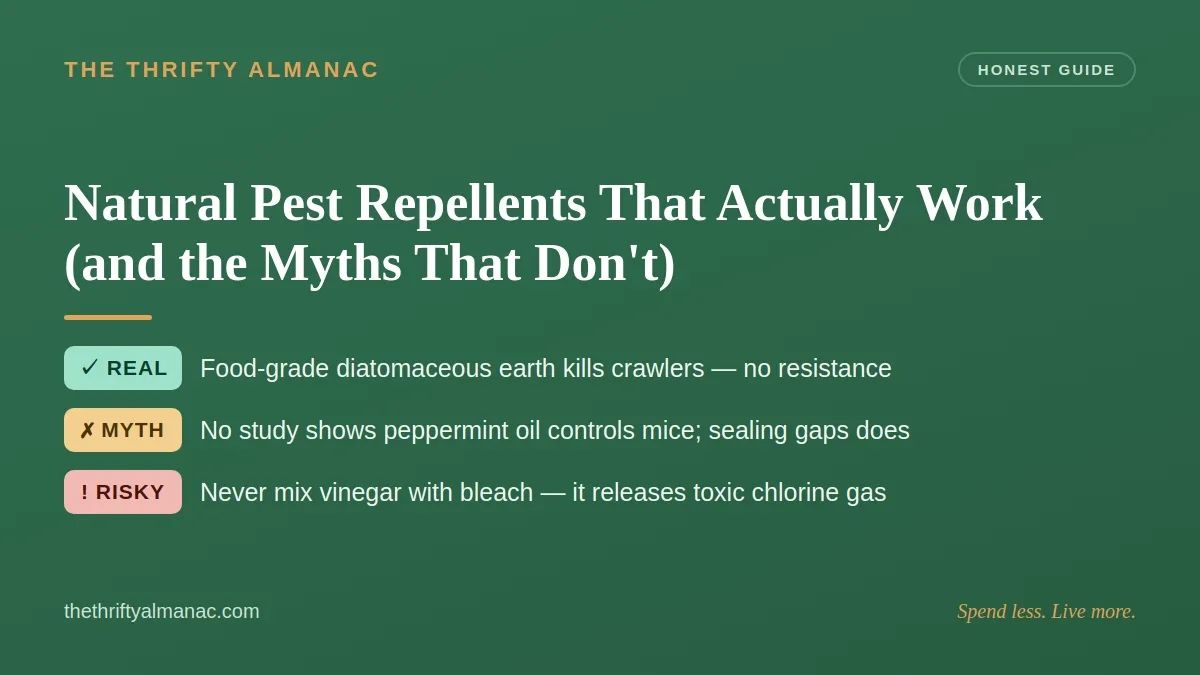
Why it works: diatomaceous earth kills mechanically, not chemically. It "causes insects to dry out and die by absorbing the oils and fats from the cuticle of the insect's exoskeleton," with abrasive sharp edges (NPIC). Because it's physical scraping rather than a poison, a bug can't evolve resistance to it (Cooperative Extension).
The limit: the same dust that shreds a bug irritates your lungs — breathed in, DE "can irritate the nose and nasal passages," and a large amount can cause coughing and shortness of breath (NPIC). It also only works dry: while wet, "the slurry has no effect" (Cooperative Extension), so a mopped or rained-on line must be reapplied — and buy food-grade, made for household use, not pool-filter grade.
Cedar — for clothes moths, in a tight chest
What it is and how to use it: aromatic red cedar blocks and chests, the classic guard for wool sweaters. Keep clothing in a tightly built cedar chest, and sand the surface lightly to expose fresh wood when the scent fades.
Why it works — a little: aromatic eastern red cedar contains an oil that "can kill small larvae, but it doesn't affect large larvae," and "after several years, cedar loses this quality," per UC IPM. So the value isn't a smell moths "avoid" — it's a weak killing effect on the smallest larvae, and UC IPM says a tightly built chest matters more than the type of wood.
The limit: cedar will not clear an active infestation. To kill every life stage, UC IPM says to launder items for 20 to 30 minutes in water at least 120°F, dry-clean them, or bag and freeze them for several days below 18°F. That guidance is specific to clothes moths — don't stretch cedar into a cure-all for every pantry pest.
Fans and intact screens — for mosquitoes
What it is and how to use it: plain moving air and intact mesh — no scent involved, which is exactly why it's dependable. Point a fan at where you sit outdoors, and patch every screen tear indoors; a finger-sized hole is an open door.
Why it works: the American Mosquito Control Association describes mosquitoes as "relatively weak fliers" that manage only about 1 to 1.5 miles per hour — slow enough that a fan's moving air physically hampers them and reduces landing and biting.

The limit: the effect only reaches where the air moves or the mesh holds — protection at your chair, not population control — and for skin, the repellents with real field data behind them do more work than any breeze. And be wary of viral "a fan cuts bites by X percent" figures; that precise number circulates only on commercial blogs.
The scent remedies with weak or lab-only evidence — keep expectations low
These popular kitchen tricks have a kernel of truth, but none is proven to control an established problem. The oil-based ones especially tend to promise more than the evidence supports. Use them as cheap nudges while you do the sealing work.
Peppermint oil — for mice
The folk method is a few drops of pure peppermint oil on a cotton ball at entry points, refreshed as the scent evaporates — a convention, not an evidence-backed spec. No authoritative .gov or .edu study shows peppermint controls an established mouse problem; the sourced answer is exclusion and sanitation (CDC). Treat peppermint as, at best, an unproven minor deterrent along an already-sealed entry point — never rodent control. That gap between the folk claim and the results is where the peppermint-oil mouse trick breaks down.
Citrus peels and vinegar — for ant trails
Foraging ants follow chemical pheromone trails to food, and those trails fade when they aren't reinforced (peer-reviewed research). So wiping a trail — a citrus peel rubbed along the path, or a vinegar-and-water spray — erases the scent line and scatters the foragers. It's cheap and genuinely disrupts the parade; just skip acidic sprays on granite and marble, where they can etch. And never mix vinegar with bleach — the combination releases toxic chlorine gas.
The catch is the ceiling: breaking a trail scatters the foragers you see, but never the nest sending them. Expect them back until you seal the entry point — or, for a stubborn colony, put out bait that workers carry home.

Catnip — for mosquitoes
Catnip has an eye-catching lab result that's also the most oversold. Iowa State University researchers reported at the American Chemical Society's 2001 meeting that nepetalactone, the oil in catnip, was about ten times more effective than DEET at repelling mosquitoes. But read it carefully: that's extracted, concentrated oil in a lab test, not a pot on the windowsill — and even the oil is short-lived, highly volatile, and lacks the residual protection DEET gives (peer-reviewed comparison). A plant or crushed leaves delivers a mild, brief effect at most — and if you have cats, you've built them a favorite hangout.
The myths: natural-sounding fixes that don't deliver
Being honest about failures saves money. Two popular "solutions" have real authoritative pushback:
- Ultrasonic plug-in repellers. The glowing box that claims to drive off pests with sound has a long regulatory paper trail. In 2001 the FTC sent warning letters to more than 60 makers and retailers of ultrasonic pest devices, telling them to have "competent and reliable scientific evidence" for their claims; two years later it brought enforcement action against sellers such as Lentek International, noting the CDC's position that ultrasonic products are not effective against mosquito bites. Spend the money on steel wool and a caulk gun instead.
- A decorative "mosquito-repelling plant" on the porch. Citronella, lavender, and marigolds get marketed as living bug shields, but a plant just sitting there does little. As UF/IFAS experts put it, unless you're extracting a plant's oils and applying them like a spray, "they're not doing much just sitting in your garden" (UF/IFAS). The oils can repel once extracted; it's the passive plant that fails. Coffee grounds, cinnamon, and cucumber peels fall in the same bucket — a weak, brief nuisance to a few ants at best.
Safety — especially around cats and dogs
"Natural" does not mean "harmless" — concentrated essential oils and DE dust both carry real risks, and pets are the most vulnerable. The ASPCA advises never applying oils directly to your pet and keeping them out of paws' reach; if a pet shows signs like unsteadiness, depression, vomiting, or diarrhea, contact your vet or the ASPCA Animal Poison Control Center at (888) 426-4435. Poison-control sources flag oils documented to poison dogs and cats — wintergreen, sweet birch, pine, cinnamon, pennyroyal, eucalyptus, tea tree (melaleuca), and citrus/d-limonene — with cats especially sensitive to how they metabolize phenols (Pet Poison Helpline). So don't diffuse oils heavily where a pet lives, and wear a mask while DE dust is airborne (NPIC).
When to stop DIY and call a professional
Natural repellents keep a clean home clean; they do not reverse an established infestation or protect the structure of your house. Call a licensed pro when:
- You keep seeing rodents or roaches despite sealing gaps and cleaning up.
- You have bed bugs, termites, or carpenter ants tunneling in wood.
- There's a wasp nest by a doorway.
The pattern holds across every source: these remedies disrupt or deter, but the authoritative kill methods — baiting, freezing, exclusion — target the source, not a trail or a scent.

Common mistakes
- Skipping prevention and expecting the repellent to do it all — it works only as a second layer, behind sealing and sanitation.
- Applying once and forgetting — nearly every remedy fades, and DE quits the moment it gets wet.
- Piling on diatomaceous earth — a thick mound gets walked around; a thin film cuts insects down. And buy food-grade, not pool-grade.
- Diffusing oils around cats, or expecting a potted plant to repel mosquitoes — one is a pet hazard, the other simply does little.
FAQ
Do natural repellents work as well as store-bought sprays?
For keeping a small problem small, several hold their own — DE physically kills crawling insects, and wiping ant trails disrupts foragers. What none does is eradicate an established colony or nest. Think prevention and deterrence, not extermination. For an infestation that has already dug in — like bed bugs — repellents won't cut it, and you'll need the full removal playbook.
Is peppermint oil a reliable way to get rid of mice?
No. There's no authoritative evidence that peppermint controls an established mouse problem. The sourced answer is sealing entry points with steel wool and caulk and removing food and water, per the CDC — treat peppermint as an unproven extra, not the plan.
Does a catnip plant really beat DEET on mosquitoes?
The famous "10 times DEET" figure is from an Iowa State lab test of extracted, concentrated catnip oil — not a plant on your patio. A potted plant or crushed leaves gives a mild, short-lived effect at best, because the oil is highly volatile.
The takeaway: a handful of these remedies earn a spot in your cupboard, but every one works only as backup to sealing gaps and putting food away — spend on evidence, not gadgets, and you'll get real results without wasting a dime. Spend less. Live more. — The Thrifty Almanac






0comments