

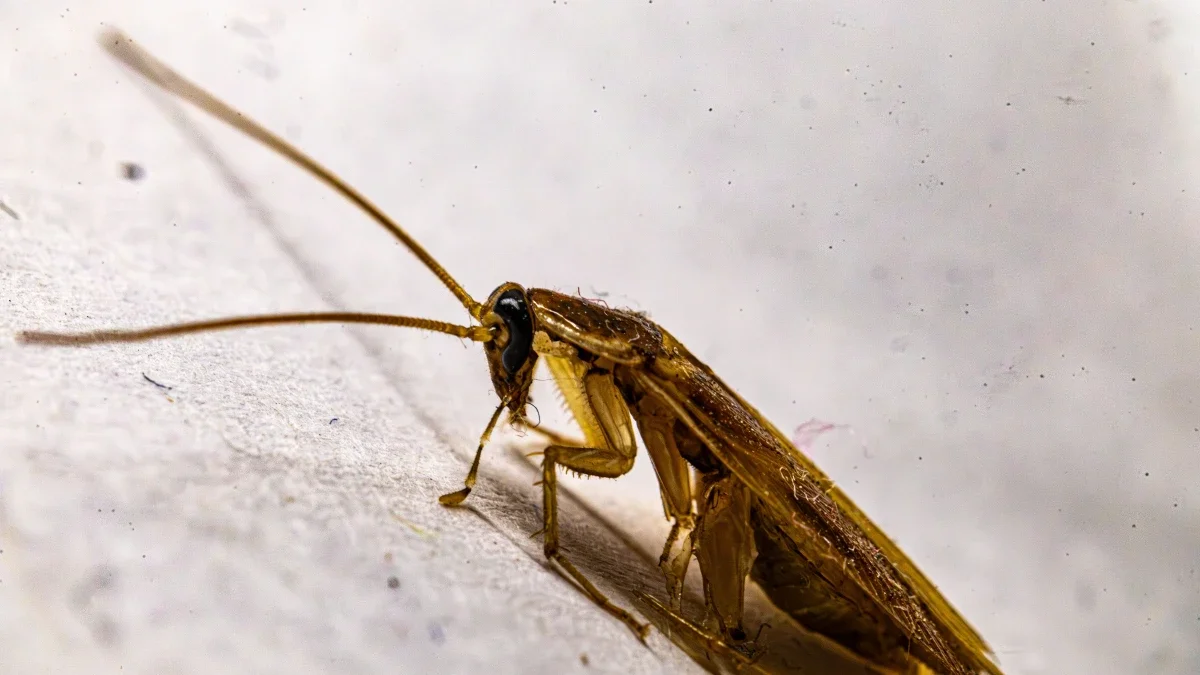
You did the thing. You put the gel bait down exactly where the label said, wiped the counters every night, took the trash out before bed, and pulled the fridge out to hit the warm spot behind it. For a week or two it looked like you'd won. Then one night you flick on the kitchen light and there they are again, a couple of them strolling across the counter like they pay rent. It's easy to decide you're just bad at this, or that the bait you bought is garbage.
Here's the honest version the "sprinkle this and they're gone" videos skip: in an apartment, your unit is not a sealed box. German cockroaches, the small tan ones that actually breed indoors, move through the shared skeleton of the building, pipe chases, wall voids, and the gaps where plumbing and wiring pass between units. If the apartment next door, upstairs, or below you still has a colony, you were never fighting your roaches. You were fighting the building's, and you were doing it alone.
Why your four walls aren't a sealed box
WHAT: The roach you're most likely dealing with in an apartment is the German cockroach, described by university entomologists as the most common indoor pest precisely because it thrives "especially in multi-unit housing environments," per the UC Statewide IPM Program. If the bugs you're seeing are big, reddish, and wandering in from drains or the basement, you may have a different species with a different fix, so it's worth checking which roach you actually have before you spend a dime.
WHY: A single building is riddled with hidden highways. As Purdue Extension puts it plainly, "Cockroaches can travel from neighboring apartments and rooms to your home through holes and cracks." That's the whole trap. You can knock the population in your kitchen down to near zero, and roaches from an untreated unit will simply walk back in through the gap around your sink pipe. Treat only your apartment and you're bailing a boat with the hole still in it.
What's actually on you: seal the doors they use

HOW: The single most useful thing a renter can do, more than any spray, is close the openings roaches use to get in and hide. Purdue's guidance for multi-family units is specific: "Seal wall and ceiling cracks and holes, especially where kitchen cabinets meet wall/floor surfaces," and "Seal around electrical and plumbing outlets." Use silicone caulk for cracks, and copper mesh or steel wool stuffed into the larger gaps around pipes where caulk alone won't hold. Work the shared walls first, the ones you have in common with a neighboring apartment, since those are the routes between colonies; the partition walls between your own rooms matter far less.
WHY: This does two jobs at once. It slows the flow of roaches coming in from a neighbor's colony, and it removes the tight, dark harborage they need to breed. UC IPM is blunt about how much that matters: "Limiting hiding areas or avenues of access to living areas is an essential part of an effective management strategy." Pop off the outlet cover plates on a shared wall and you'll often find the hole the wiring passes through is wide open. That's a front door. For the full room-by-room pass, see our DIY pest control guide.
Gel bait is your best interior weapon, not a fogger
HOW: Inside your unit, gel bait does the real killing. UC IPM: "Gel baits are very effective when placed in or near locations where cockroaches harbor or forage." Placement beats quantity. Purdue's instruction is to "Apply numerous spots at cockroach hiding places or active areas," and that "Each spot only needs a pea-size amount," meaning many small dabs tucked into cracks, hinges, and corners, not one fat blob in the open.
LIMIT: Skip the total-release foggers. They blast pesticide into open air where the roaches aren't, drive survivors deeper into wall voids (often straight toward the neighbor and back), and coat your counters in residue. The gap between the two approaches is big enough that we broke it out on its own in gel bait vs. foggers. And don't sabotage your own bait: spraying insecticide right next to a bait spot can make roaches avoid it.
Starve them out: food, and especially water

HOW: Roaches can go a surprisingly long time without food but not without water, so a dripping trap or a damp cabinet under the sink is worth more to them than your crumbs. Fix leaks fast; Purdue lists "Fix water leaks in units and common areas" at the top of its sanitation checklist. Then take the EPA basics seriously: "Keep counters, sinks, tables and floors clean and free of clutter," "Store food in airtight containers," and clean spills the same night.
WHY: Sanitation alone won't clear an established infestation, which is its own myth, but a clean, dry unit makes your gel bait the most attractive meal in the room. That's exactly what you want. Hungry roaches eat bait faster.
| What you control inside your unit | What only the building or landlord can fix |
|---|---|
| Seal gaps around your pipes, outlets, and cabinet edges | Inspect and treat neighboring units on the same schedule |
| Place fresh gel bait at harborage points | Reach wall voids, pipe chases, and shared utility runs |
| Fix your own leaks, store food airtight, clean nightly | Repair building-wide plumbing leaks and structural gaps |
| Report the problem in writing and keep records | Arrange coordinated professional treatment across units |
The part you genuinely can't DIY
Here's where the honest answer stops being comfortable. If the source colony is in another unit or in shared voids, no amount of caulk and bait inside your apartment ends it for good. Purdue's guide, written for the people who run these buildings, says it directly: "good control cannot be achieved without cooperation among residents, management staff, and the pest control company." Real apartment roach control is a building-level job, inspecting the units next door, above, and below, and treating them together on the same timeline so the roaches have nowhere to flee. It's why a competent pest program maps which units have reported complaints and works them as a cluster, rather than chasing one call at a time while the colony shuffles between apartments.
HOW: Report the problem to your landlord or property manager in writing, an email or a dated letter, not just a phone call, and keep copies. Note when you first saw them, where, and photograph what you can. Ask specifically whether the neighboring units are being inspected and treated, because a one-apartment visit rarely holds. In many places, keeping a rental reasonably free of pest infestations is treated as part of the landlord's duty to provide habitable housing, and a written record is what makes that duty enforceable. This isn't legal advice; rules vary by state and city, so check your local tenant resources if it gets that far.
Roaches aren't just gross: the health angle

There's a reason to push on this beyond disgust. Cockroach infestations are a documented asthma trigger, and the risk lands hardest in exactly the setting this article is about. UC IPM notes that indoor cockroaches "have been identified as risk factors for development of asthma in children, especially within multi-unit housing environments." The EPA is just as direct: "Droppings or body parts of cockroaches and other pests can trigger asthma."
What builds up over months of a low-grade infestation isn't only the roaches you see; it's the allergen load in household dust from their droppings and shed body parts. That's another reason sealing and cleaning matter even while you wait on the building to act, because you're lowering exposure, not just the visible count. Damp-wiping surfaces and vacuuming settled dust removes that allergen more effectively than dry dusting, which mostly stirs it back into the air you breathe. If someone in your home has worsening asthma or breathing symptoms, this isn't medical advice, so talk to a doctor.
The honest bottom line
Treat your apartment like it's the whole battlefield and you'll lose slowly and expensively. The parts you own, sealing the pipe and outlet gaps, placing gel bait where roaches actually hide, killing your leaks, and locking up food, genuinely cut the population and are worth doing today. But if reinfestation keeps happening no matter how clean and sealed your unit gets, that isn't your failure. It's the signal that the colony lives somewhere you can't reach, and the fix is the coordinated, building-wide treatment your landlord is responsible for arranging. Do your half well, document everything, and make the building do the other half.





0comments