

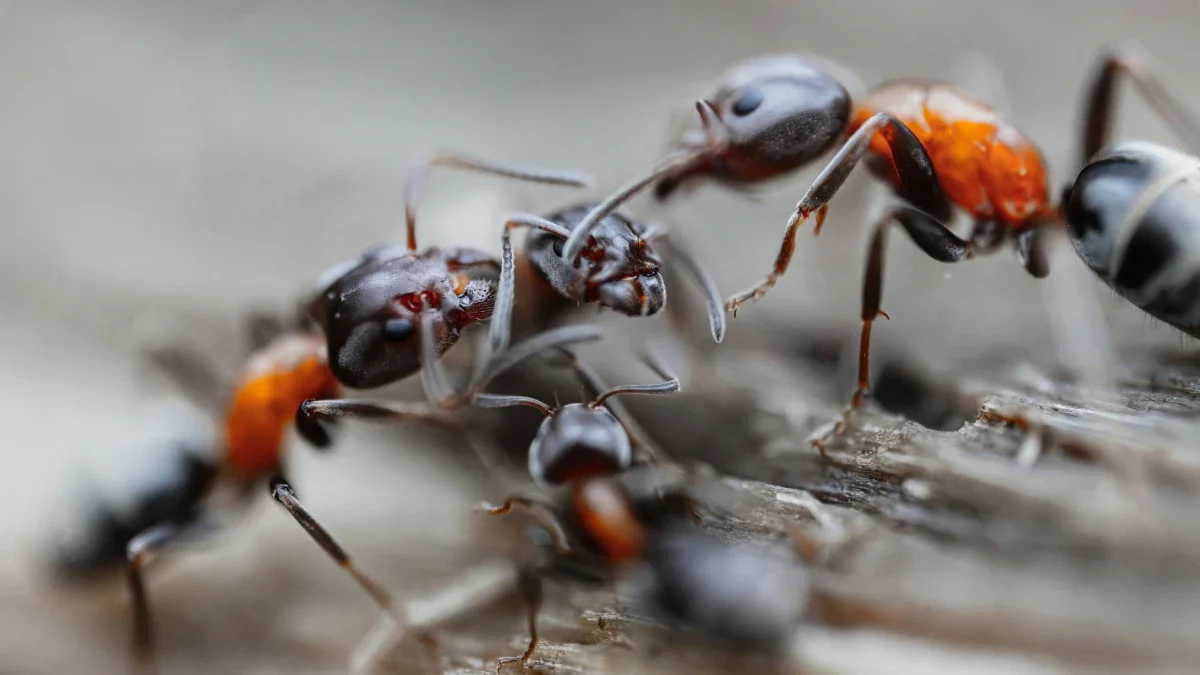
A thin line of ants runs from behind the toaster to a bead of jam by the sink. You grab the spray, hit the line, wipe up the bodies, and feel like you won. For a day. Maybe two. Then the trail is back — sometimes in the same spot, sometimes a few inches over, sometimes wider than before. It gets easy to decide the ants are unkillable or the kitchen is cursed.
Here's the honest version the "kill them on sight" advice skips: the ants on your counter are scouts, not the colony. The nest — and the queens that actually keep it running — sits somewhere you can't see, often outdoors in a wall void, under a slab, or out in the yard. Spraying the visible line kills the messengers and barely touches the thing producing them. University extension programs have said this plainly for years, and it reframes the whole job. You are not trying to kill the ants you can see. You are trying to get the ants you can see to poison the ones you can't.
The difference between a kitchen that clears in a week and one that never does comes down to which of these two moves you make:
| The move | What it kills | What the colony does next |
|---|---|---|
| Spray the visible trail | The scouts on the counter — a small fraction of the colony | Sends fresh scouts; may reroute or split activity into new spots |
| Wipe the trail, then bait slow | The queens and brood back in the hidden nest | Collapses over days as foragers share the poisoned food |
Work the steps below in order. None of them involve a spray can.
Step 1: Wipe the trail — don't spray it
WHAT: That tidy single-file line isn't the ants being polite. Each forager lays a chemical breadcrumb — a pheromone trail — so nestmates can follow the exact route to the food and back. The trail is a shared map, and erasing it is the first thing you do.
HOW: Skip the insecticide and reach for dish soap. The guidance from UC IPM is blunt: "Clean up invading ants with a sponge and soapy water as soon as they enter to remove the scent trail they leave behind." Wipe the whole run — counter, backsplash, the gap by the window — not just the knot of ants.
WHY: Soapy water breaks up the pheromone chemistry and drops the traffic following it. A pesticide spray doesn't do that job any better, and it leaves residue on a food-prep surface for no gain. As the same UC IPM page puts it, "Spraying ants indoors with pesticides will not prevent more ants from entering." Erasing the map does more than killing the mapmakers — which is the whole reason baiting beats spraying, explained further in why ants keep coming back.
Step 2: Follow the line to the entry point

WHAT: Before you wipe every last trace, watch where the line comes in. Ants don't teleport onto a counter; they follow a gap — a crack by a window frame, the seam where the backsplash meets the wall, a pipe or cable penetration under the sink.
HOW: Trace the busiest line back to its smallest opening and mark it. That spot does double duty: it's where you'll set bait in the next step, and it's the gap you'll seal for good once the colony is gone. Penn State Extension's durable fix is caulk: "Prevent ants from entering your home by sealing off all cracks and crevices around windows, doors, and pipes with caulking."
LIMIT: Timing matters here. Don't caulk the active entry shut the moment before you bait — the foragers need that door open to carry poison home. Seal the secondary gaps now, leave the one active entry open until the bait has done its work, then close it last.
Step 3: Set a slow bait and walk away
WHAT: A bait is food laced with a slow insecticide, and the whole design depends on the poison being slow. UC IPM spells out the mechanism: "The pesticide must be slow-acting so workers won't be killed before they get back to the nest."
HOW: Place a small amount of bait right at the active entry and along the now-wiped trail — a store-bought gel or bait station works, or a homemade sugar bait. If you go homemade, boric acid dissolved in a weak sugar solution is the classic ant recipe, and the ratio is the entire game: too strong and it kills the scout before it gets home. The concentration and method are laid out in our boric acid guide, which includes the ant-specific bait ratio.
WHY: Foragers share liquid food with the whole nest, so a bait turns them into unwitting couriers. The landscape guidance from UC IPM describes it precisely: "Slow-acting insecticide baits take advantage of this behavior. Foraging ants collect and carry the insecticide and spread it throughout the entire colony during food sharing, thereby poisoning ants underground and queens in their nest." Penn State Extension puts the payoff in one line: "Worker ants carry the pesticide/food mixture back to the nest and feed the queen, thus killing the colony."
LIMIT: Never spray insecticide on or near the bait, and don't swap to a "faster" product because the ants aren't dropping quickly enough. Speed is the enemy of a bait, not a feature.
Step 4: Starve the competition

WHAT: Your bait has to out-compete every crumb, grease film, and drip in the kitchen. If the whole counter is a buffet, one dab of bait is easy to ignore.
HOW: UC IPM's short list is the target: "Store food in clean, sealed containers not plastic bags or open packaging. Clean up crumbs, grease, and spills. Fix leaky faucets since water can attract ants." Penn State comes at it from the same angle: "Eliminate sources of food and water--repair water leaks, clean up all spills and crumbs, and don't let snacks or pet food sit out."
WHY: Sugar ants aren't only after sugar. A damp sponge, a pet bowl, a greasy stovetop — all of it reads as food or water to a colony. Clearing the easy meals makes your one deliberate food source, the bait, the most attractive thing in the room.
Step 5: Wait a week — and resist "boosting" it
WHAT: Baiting is slow on purpose, and the first sign it's working looks like failure: more ants, not fewer, swarming the bait. That surge is recruitment — foragers calling in nestmates to haul the food home. It's exactly what you want to see.
HOW: Leave the bait undisturbed and give it time. UC IPM sets the expectation clearly: "Although baits require users to be patient, they can provide more effective and longer control of ants than sprays. Control with insecticide baits may take more than one week."
WHY: The moment you lose patience and spray, you kill the couriers before delivery and reset the clock. As UC IPM notes, "Insecticide sprays kill only the foraging ants; more ants will emerge from their nests." And the foragers you'd be killing are a sliver of the colony — the program's odorous house ant guide puts a number on it: "Killing workers does little to control the colony, because as few as 1% of a colony's foraging worker ants are able to provide sufficient food to support nestbound queens and larvae." There's also a way to actively make things worse. Many common house ants multiply by budding — "Colonies begin in the spring and summer months by budding, which occurs when a mated queen crawls out of the nest with some workers to establish a new colony" — so a repellent spray that scatters foragers without ever reaching the queens can leave you fighting several trails where you started with one.
When it isn't ordinary kitchen ants

Most kitchen invaders are small, sugar-seeking ants that are a nuisance, not a hazard, and the five steps above handle them. A few situations call for a different response. Large, dark ants roughly a quarter-inch long — especially alongside little piles of what looks like sawdust (frass) or a faint rustling inside walls — can mean carpenter ants nesting in damp wood, which is a moisture-and-structure problem, not just a food one. Winged ants streaming indoors can signal a nest inside the structure itself. In those cases, and any time you suspect ants are tied to wet or damaged wood, don't lean on kitchen bait alone — have a licensed inspector confirm what you're dealing with before it becomes a repair bill. For a wider map of what's DIY-sized versus a call-a-pro job, start with our DIY pest control guide.
Ant stings are a separate matter from kitchen foraging, but if any insect sting brings on a severe reaction — swelling well beyond the bite, hives, or trouble breathing — treat it as a medical emergency and get care, not a pest question.
The honest bottom line
The ants on your counter are scouts reporting back to a nest you can't see, so killing them on sight fixes nothing. Wipe the pheromone trail with soapy water instead of spraying it, find and mark the entry, set a slow bait the foragers will carry home, clear the competing crumbs and drips, and then — the hard part — wait a week without reaching for the can. The method is patient and a little boring, which is precisely why it works when the fast approach keeps failing. If you'd rather run the natural-first version of the same plan, our natural ant-control walkthrough lays it out step by step.



0comments