

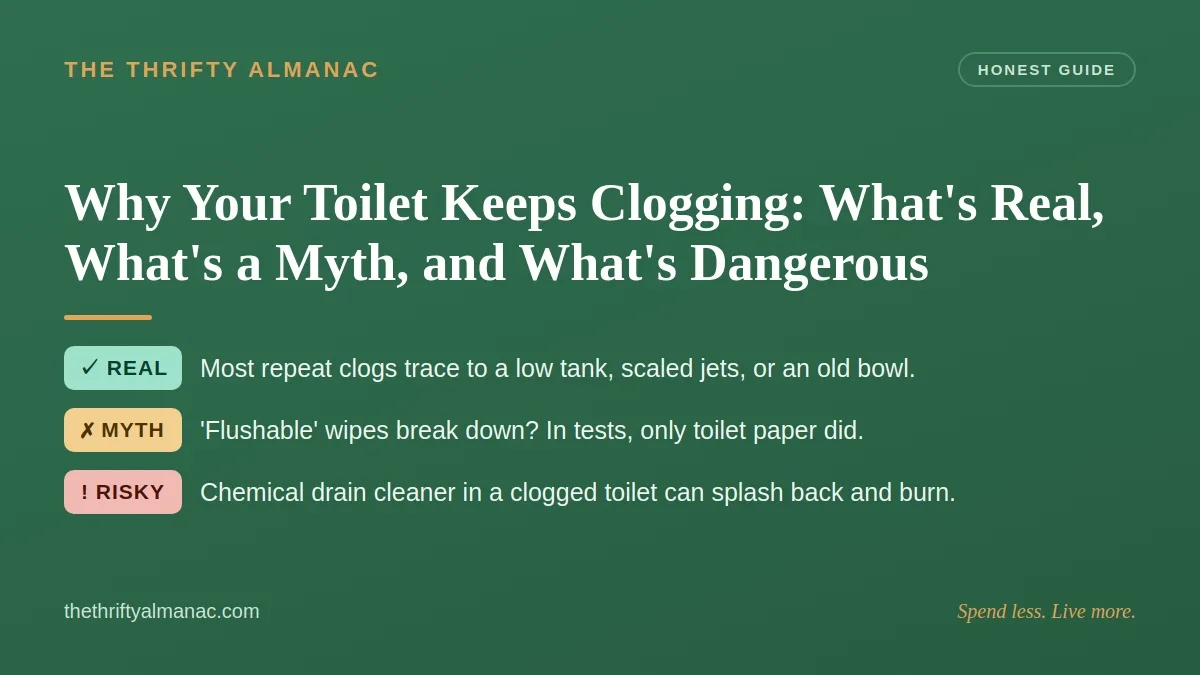
Some toilets clog once in a blue moon. Others back up every other week. The reassuring part: a repeat-clogging toilet is almost never bad luck — it's usually one of four fixable things, most costing less than a pizza to sort out.
Below is the honest version: the fixes that actually work, the "remedies" that waste money, and the one move that can splash caustic chemicals back at your face. Most of this is do-it-yourself territory, the kind of small home fixes that pay for themselves — though a couple of situations are a real hazard we'll flag clearly.
Why the same toilet keeps clogging (it's one of four fixable things)
Modern toilets are capped by law at 1.6 gallons per flush, and EPA WaterSense models use 1.28 gallons or less, about 20 percent under that standard. That's plenty to clear a normal load, so a toilet that clogs again and again is usually being blocked from using its water. Four culprits cover nearly every case:
- The tank isn't filling enough for a full-force flush.
- Hard-water scale is choking the little holes that feed the bowl.
- It's a weak first-generation low-flow toilet that never flushed well.
- Something non-flushable is stuck in the trap, snagging everything after it.
Work through them cheapest first. A plunger and a screwdriver are cheap fixes that head off a big call-out fee, so try them before you dial a plumber.

Cause 1: the tank isn't filling enough for a full flush
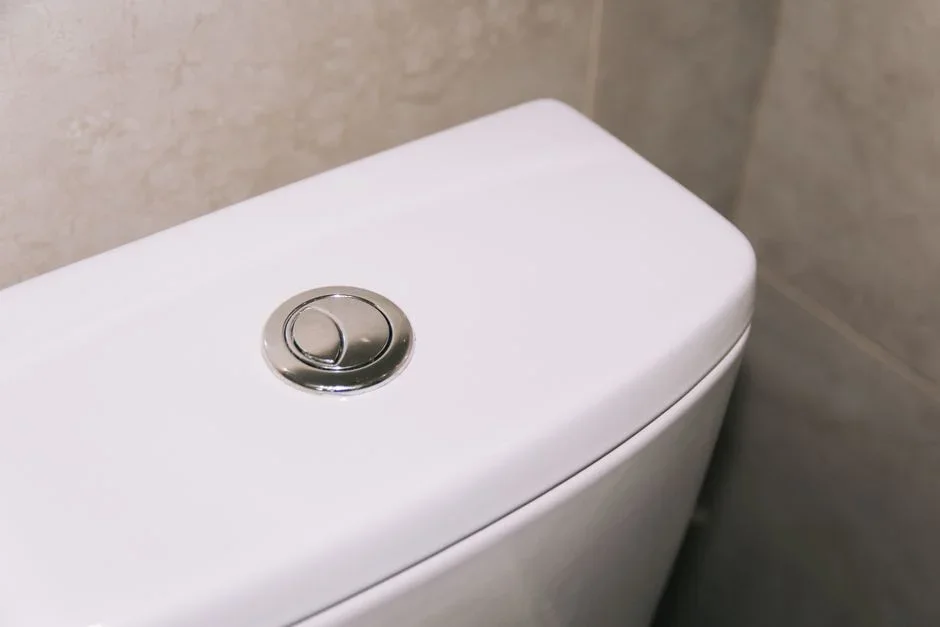
This is the most common cause, and the most overlooked. A toilet flushes by dumping the tank's water into the bowl fast enough to start a siphon; too little water and the flush limps, so whatever you sent down hangs up in the trap.
Lift the lid and find the tall overflow tube in the middle. Home-repair guides put the correct level at half an inch to an inch below the top of that tube. If yours sits lower, raise the float — usually a screw or clip on the fill valve — then flush and check. This is practitioner guidance, not a government lab, so the real test is whether one flush now clears the bowl. If the tank won't hold that line, a worn flapper or fill valve is the likely culprit, both cheap swaps.
Cause 2: hard-water scale is choking the rim and siphon jets
Under the rim sits a row of small holes (the rim jets) plus a larger siphon jet near the bottom, and water shoots through them on every flush. Hard water — which the USGS defines as dissolved calcium and magnesium, with anything above 180 mg/L counted as "very hard" — leaves those minerals behind as scale that, USGS notes, builds up on surfaces and can impede flow. Clog the jets and less water enters the bowl, so the flush weakens a little more each year — the toilet that "slowly got worse."
The fix is a mild acid. Warm white vinegar poured into the overflow tube runs through the passages that feed the jets; left to soak, it dissolves carbonate scale, and a bent wire clears the individual holes. Home-improvement guides recommend descaling the rim jets with vinegar and a long soak before flushing through. The chemistry is sound, but the routine is practitioner advice, not a controlled study — so repeat it if the first soak barely helps.
Cause 3: you have a first-generation low-flow toilet
When federal law dropped flush volumes to 1.6 gallons on January 1, 1994, some makers did the engineering right. Others, according to the industry's Maximum Performance (MaP) program, launched in 2002, simply shrank the tank trim inside their old 3.5-gallon models without redesigning the bowl — producing toilets that clogged on a normal load and needed two or three flushes.
So if you've blamed "low-flow," you're half right: the culprit was never 1.6 gallons, it was bad bowls. Modern MaP-rated and WaterSense bowls clear a full load on 1.28 gallons or less, while pre-1994 toilets used 3.5 to 5 gallons or more, the oldest up to 6 gallons per flush. Check the date stamp under the tank lid; for a first-gen model, less paper per flush helps, but replacement is the durable fix — EPA estimates an efficient toilet cuts toilet water use 20 to 60 percent, saving nearly 13,000 gallons and more than $170 a year. That underperformance story is MaP's — an industry body, not a government source, though widely cited.
Cause 4: something non-flushable is lodged in the trap
Every toilet has an S-shaped trap just past the bowl. It holds the water seal, but its bends are also where wipes, cotton balls, floss and paper towels catch — and once something lodges, it snags the next thing, and the next, until even a strong flush can't push past.
Reach for a real flange plunger first — the kind with a soft rubber sleeve that folds out to seal the toilet's drain opening; a flat cup plunger can't seal the curved bowl. Seat the flange and use firm, straight strokes. If that fails, step up to a toilet closet auger built to reach the trap, and remember that what genuinely breaks up a clog is mechanical, not chemical. One hard rule: never feed a bare drain snake into the bowl — plumbing guides warn a toilet auger has a protective sleeve that shields the porcelain, while a standard snake's exposed coil can scratch, crack, or shatter it.
The fix-it tier list: what to try, in order
Put it together and the ranking is simple: A-tier fixes first, F-tier "solutions" never. Pair the repairs with a little routine prevention, and most repeat-clog toilets stop being a problem.
| The move | Verdict | What it targets | Cost & effort |
|---|---|---|---|
| Flange plunger, firm strokes | REAL (A-tier) | Trap clogs | A few dollars, minutes |
| Toilet closet auger | REAL (A-tier) | Deeper trap clogs | Inexpensive, minutes |
| Raise the tank waterline | REAL (A-tier) | A weak flush | Free |
| White-vinegar descale of the jets | REAL (A-tier) | Hard-water scale | A few dollars, an evening soak |
| Replace a first-gen bowl (WaterSense/MaP) | REAL (C-tier) | An old, weak toilet | Bigger spend, pays back over time |
| "Flushable" wipes | MYTH (F-tier) | Nothing; they cause clogs | Wastes money |
| Chemical drain cleaner in the bowl | DANGEROUS (F-tier) | Nothing; it sits in the trap | Risk of caustic burns |
Myths that waste your money
Myth: "flushable" wipes are actually flushable
They aren't, and it isn't close. In a widely cited Ryerson University study summarized by McGill's Office for Science and Society, only 11 of 101 products fully disintegrated, and all 11 were toilet paper. The baby and cleaning wipes stayed intact. Makers build wipes with polymer binders and extra fibers for strength, so they don't fall apart in your trap or the sewer, where they bind with grease into "fatbergs" that McGill says cost cities hundreds of millions of dollars a year to clear. "Flushable" means it fits down the hole, not that it breaks down.
Myth: pour hydrogen peroxide in the tank to fix a weak flush
Hydrogen peroxide is a fine cleaner and mild disinfectant, with a real list of jobs where it earns its spot in the cabinet. A weak flush isn't one of them. That's mechanical (a low tank level or worn flapper) or mineral (limescale-blocked jets); peroxide raises no water level and doesn't dissolve limescale, which needs an acid like vinegar. It cleans the tank and changes nothing about the flush — a cleaner mistaken for a repair. That worn flapper does turn up somewhere else, though: it is the first suspect when a water bill suddenly doubles.
Myth: chemical drain cleaner will clear a toilet clog
It usually won't: it's the wrong tool aimed at the wrong spot, and it's the most dangerous item on this list, which is why it gets its own warning below.
When it's actually dangerous: stop and call a pro
Most clogs are a DIY afternoon. These four are not.
Chemical drain cleaner in standing toilet water
Drain cleaners are built for sink drains, not toilets. Poison Control notes they contain corrosive sulfuric or hydrochloric acids and sodium or potassium hydroxide that burn on contact, and that dangerous splashing happens when a product is poured from too high or forced into a completely blocked drain — exactly a clogged toilet full of standing water. Its caustics guidance is blunt: burns happen instantly, and the injury can't be reversed, only treated, and a splash to skin or eyes needs running water for at least 20 minutes before you get medical help. Plumbers add that it just sits in the trap without reaching many clogs, and that the reaction's heat can crack porcelain — but the burn risk is the reason to skip it.
Never mix products to "boost" it
If one cleaner didn't work, don't add a second. Bleach plus an acid-based toilet-bowl cleaner releases chlorine gas, and bleach plus ammonia forms chloramine gases; Washington State's health department confirms both reactions and their respiratory dangers. Even low levels irritate the eyes, nose and throat, and high concentrations in a small bathroom can be fatal. Never mix bleach with acids or any other cleaning product.
A sewage backup coming up the drain
If dirty water pushes up out of the toilet or a nearby drain, treat it as a biohazard. The CDC warns that human waste and sewage carry disease-causing bacteria, viruses and parasites and tells workers to wear protective gear and wash their hands with soap and water right after contact. State health guidance treats thorough handwashing as the single most important step to protect your health, alongside prompt disinfection of the fouled surfaces. If it's more than a small overflow, call a professional.
Several fixtures backing up at once
One slow toilet is a property-side clog. But if several fixtures gurgle or back up together, or your neighbors have the same trouble, the blockage may be in the municipal sewer main. City guidance says that's the point to contact the city's sewer operations instead of plunging harder — a whole-house backup is a plumber-or-city call, full stop.
Common mistakes
- Flushing "twice to be sure." If the first flush is weak, a second won't fix the cause — check the tank level.
- Using a flat cup plunger. It can't seal a toilet; get a flange plunger with a fold-out sleeve.
- Running a hardware-store drain snake into the bowl. The bare coil cracks porcelain — use a closet auger.
- Reaching for chemical drain cleaner. It sits in the trap, risks caustic splashback, and rarely reaches the clog.
- Trusting "flushable" wipes. They stay intact in your pipes; keep them out of the bowl.
FAQ
Why does my toilet clog even when I only flush toilet paper?
Usually a weak flush, not the paper. A low tank level or scaled-over rim jets means less water reaches the bowl, so even a normal paper load hangs up in the trap. Check the tank waterline first, then the jets.
Is it safe to leave vinegar in the toilet overnight?
Yes. White vinegar is a mild acid and is fine to soak in the bowl or tank passages overnight to dissolve scale. Just never combine it with bleach or a bleach-based cleaner, which produces chlorine gas.
Will a new toilet really flush better on less water?
A well-designed one will. The trouble with early low-flow toilets was bowl design, not the 1.6-gallon limit. Modern MaP-rated and WaterSense bowls clear a full load on 1.28 gallons or less while saving a household more than $170 a year.
The takeaway: A toilet that keeps clogging is a diagnosis, not a curse, so fix the flush, skip the wipes and the chemicals, and you'll rarely reach for the plunger again. Spend less. Live more. — The Thrifty Almanac




0comments