

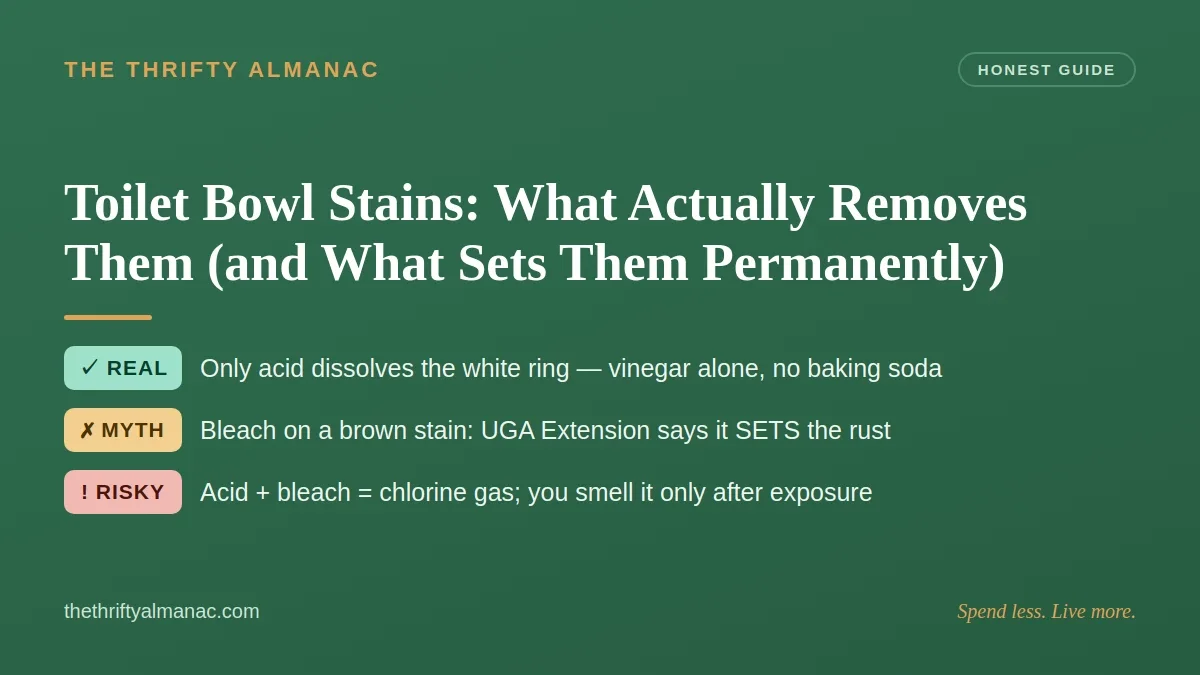
The stain has a color, and the color is the diagnosis. A chalky gray ring at the waterline, a rust-brown streak from the rim, a pink smear at the back, black flecks under the rim — four unrelated problems with four different fixes, and the bottle almost everyone reaches for first solves only one of them.
Nothing below comes from scrubbing trials in our own bathroom. It comes from the public record: federal drinking water standards, extension guidance, poison center toxicology, and the fixture manufacturer's own care instructions.
Read the color before you buy anything
EPA's secondary drinking water standards list the visible nuisance effect of each contaminant, and that list doubles as a stain key. Iron's standard is 0.3 mg/L, with effects of "rusty color; sediment; metallic taste; reddish or orange staining." Manganese sits at 0.05 mg/L: "black to brown color; black staining; bitter metallic taste."
| Color | What it usually is | Wipe test | Tool that actually works |
|---|---|---|---|
| White or gray ring at the waterline | Carbonate scale from hard water | Rock hard, doesn't smear | Acid (plain white vinegar or an acid bowl cleaner) |
| Brown or orange streaks | Dissolved iron, or iron bacteria on well water | Bonded to the glaze; tank slime is separate | Acid or a dedicated rust remover — never chlorine bleach |
| Pink or salmon film | Serratia marcescens bacteria or Rhodotorula yeast | Slimy, wipes off, comes back in weeks | Detergent or disinfectant, plus drying and cadence |
| Black under the rim | Biofilm or manganese staining | Wipes off = biology; won't budge = mineral | Detergent for biology, acid plus a water test for manganese |
Treat this as a starting point, not a verdict. Two causes can share one bowl — scale traps iron, biofilm grows over both — and only a water report confirms iron or manganese levels. These are aesthetic standards, not health limits: a stained toilet does not mean unsafe drinking water.

Why chlorine bleach is the wrong first reflex
Bleach is the default reach for anything toilet-related, and on three of the four stains above it ranges from useless to actively harmful. University of Georgia Extension puts the rust case bluntly: "Do not use chlorine bleach on rust. Chlorine bleach will set these stains." That page is a textiles resource, but the chemistry of hypochlorite oxidizing iron doesn't care what surface it sits on, and every rust remedy it recommends is an acid or an oxygen bleach instead.
Bleach also does nothing to carbonate scale: dissolving a mineral deposit takes acid, and bleach is alkaline. Where it genuinely earns its place is the living stains — the pink film and biological black growth. That's one job out of four, a poor return for the bottle bought most often. Our rundown of which pantry staples genuinely clean sorts the same question for the rest of the house.
The white ring: only acid dissolves it
Hardness is measured as calcium carbonate, and the Maryland Geological Survey uses the common bands: soft 0–60 mg/L, moderately hard 61–120, hard 121–180, very hard above 180, noting that "white scale often forms on plumbing fixtures and in shower stalls." Other extension services publish slightly different band edges, so treat the numbers as a rough tier system rather than one universal standard. Look up your municipal water quality report; if you land in the very hard range, this ring is a recurring appointment, not a one-time failure.
The method is simple. Get the acid onto the ring undiluted — lowering the bowl water first so the cleaner meets the deposit instead of a gallon of standing water is mechanical common sense, not agency guidance, and no one has published a soak time worth quoting. Let it sit, agitate with a nylon brush, and repeat rather than escalate. The same acid-versus-alkaline logic decides what works on the tile around the fixture, which is why grout responds to a completely different product than the bowl does.
The baking soda and vinegar problem
The fizz is the reaction eating itself. Nathan Kilah, Senior Lecturer in Chemistry at the University of Tasmania, describes what forms — water, carbon dioxide, and sodium acetate — and "sodium acetate is an even weaker base than baking soda, so it doesn't do much to clean the surface you're trying to scrub." On typical recipes, after the bubbling stops, over 99% of the added baking soda remains. The paste isn't useless — abrasive powder plus a brush lifts some soil — but on a mineral ring the acid was the only ingredient that could dissolve anything, and combining is what destroys it. Use one or the other. Which combinations are merely pointless and which are genuinely hazardous is the subject of our guide to DIY cleaners and the mixes to avoid.
Cola gets floated as a substitute. A dental erosion study measured cola pH between 2.53 and 3.40, so it is genuinely acidic, but no authoritative source has tested it on limescale. The honest read: a costlier vinegar substitute that leaves sugar behind.
Brown and orange: iron, not dirt
If your streaks keep returning within days of cleaning, the source is the water, not your effort. On wells there are two distinct versions. Dissolved iron stains the porcelain. Iron bacteria are living colonies, and Penn State Extension describes their signature as "orange or opaque slimy strands inside toilet tanks" along with reddish, yellow, brown, or gray deposits. Minnesota Department of Health reports the same tell and notes that iron bacteria "are not known to cause disease".
Shock chlorination is the standard well treatment, with two caveats from Penn State: "It can be impossible to entirely remove iron or sulfur bacteria," and if you find yourself repeating it more often than every six months, the well needs a different control strategy. For the bowl itself, UGA's rust guidance translates simply: acid, or a commercial rust remover used per its label.
Pink is alive, and it will come back
Pink is the most misdiagnosed stain in the bathroom, because it looks like rust. NDSU Extension is direct: "It is bacteria known as Serratia marcescens." Mycologist Michael Taylor of Flinders University adds the yeast Rhodotorula as the other candidate, but says Serratia is the likelier culprit.

Because it's alive, strength matters less than cadence and dryness. Taylor's advice is to clean every two to three weeks, starving the microbes of the soap residue and skin cells they feed on, and to dry wet areas. NDSU suggests a one-time dose of ¼ cup of bleach in the tank for 15 to 20 minutes, then flushed out — a single dose that leaves, not a tablet that lives there. For healthy households the pink film is a nuisance; households with immunocompromised members should keep a tighter schedule.
Black under the rim: mold or manganese
Two causes, one appearance. Run the wipe test: biological growth is slimy, lifts with detergent, and regrows in weeks. Manganese staining is bound to the surface and will not smear. For the biological version, EPA's guidance is unglamorous and effective — "Scrub mold off hard surfaces with detergent and water, and dry completely" — plus fixing the moisture feeding it. The mineral version needs acid plus a water test against that 0.05 mg/L manganese threshold. The wipe test is a heuristic; a water report settles it.
Pumice: the last resort, honestly rated
A wet pumice stick does shear off hardened crusts that acid alone won't lift. Most articles reassure you it can't scratch the glaze because pumice is softer — a claim that traces to sellers and cleaning blogs, not to any standards body. The fixture manufacturer points the other way: Kohler's care guidance says "never use an abrasive material such as a brush or scouring pad to clean surfaces."
So rank it honestly: last resort, after acid has failed, with real risk to the finish. Keep the stone and the porcelain soaked the whole time, use light pressure, restrict it to glazed vitreous china, and start somewhere inconspicuous. A dulled bowl attracts stains faster — the failure mode nobody warns about.
The mix that sends people to the emergency room
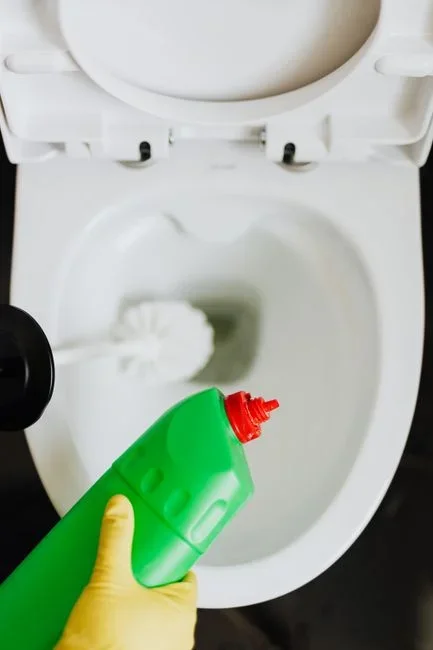
Everything above has one predictable failure mode: acid gives partial results, and the reader adds bleach. Poison Control states the rule chemically — "When an acid is mixed with a hypochlorite solution (such as bleach), chlorine gas is formed" — and documents a real case of exactly this task: an acid toilet bowl cleaner followed by bleach in the same unflushed bowl, with immediate eye, nose, throat, and lung irritation. Vinegar counts as an acid. So does any bowl cleaner listing hydrochloric acid, which Virginia Department of Health confirms is sold to consumers as a toilet bowl cleaner and which can cause severe skin burns and, in the eyes, blindness.
The numbers explain why this is an emergency rather than an inconvenience. ATSDR's toxicological profile puts the mean odor threshold at 0.2 to 0.4 ppm and notes that 400 ppm can be lethal to humans in 30 minutes. By the time the smell registers, you are already exposed. A CDC review of five household exposures, reported in that same profile, describes nose irritation, sore throat, chest tightness, cough, and difficulty breathing.
If it happens: leave the area immediately and breathe fresh air, ventilate the room from outside it, then shower for 20 minutes and change clothes. In the US, call Poison Control at 1-800-222-1222 — free, confidential, 24/7 — and call 911 if breathing is difficult. The same rule covers ammonia: EPA warns never to mix chlorine bleach with cleaners containing ammonia.
Drop-in tank tablets and what they quietly cost
The tablet promises a clean bowl with no effort, and it's the one product the fixture manufacturer names directly: "Do not use in-tank toilet cleaners as they can damage the flush valve or other working parts." A one-time bleach dose is a different exposure entirely — minutes, then flushed out, versus a tablet dissolving against rubber parts for weeks.
The part they attack is cheap; ignoring it is not. EPA WaterSense reports that a worn flapper can silently leak thousands of gallons a year, and that fixing simple household leaks saves about 10 percent on a water bill. Test yours tonight: a few drops of food coloring in the tank, and if color reaches the bowl within 10 minutes you have a leak — then flush right away so the dye doesn't stain. Replace flappers at least every five years. The other popular tank additive has its own tradeoffs, covered in our piece on what hydrogen peroxide really does in drains and tanks.
Stopping the ring from coming back
Recurring stains are a water and humidity problem wearing a cleaning problem's clothes. Pull your water quality report, or test your well, for hardness, iron, and manganese — those three numbers predict the white, brown, and black stains. For the living stains, EPA's target is indoor humidity below 60 percent, ideally 30 to 50 percent, and it recommends running the bathroom fan or opening a window when showering. A short cleaning every couple of weeks costs less, in money and in finish, than the acid-and-pumice rescue a neglected ring eventually demands.
Common mistakes
- Bleaching a brown stain. UGA Extension says chlorine bleach sets rust. Reach for acid or a rust remover instead.
- Fizzing baking soda into vinegar. Over 99% of the baking soda survives, and the acid you needed is gone. Use one or the other.
- Adding bleach after an acid cleaner didn't finish the job. That's the chlorine gas case Poison Control documents.
- Reaching for pumice first. The manufacturer warns abrasives scratch and dull the glaze. It's a last resort, not a shortcut.
- Leaving a tablet in the tank. Kohler warns it can damage the flush valve and working parts, and a failing flapper leaks quietly.
FAQ
Is the pink ring in my toilet dangerous?
For a healthy household it's a nuisance. NDSU Extension identifies it as Serratia marcescens, a common environmental bacterium that thrives on soap residue in damp bathrooms. Clean regularly, dry surfaces, and run the fan. Households with immunocompromised members should be more diligent about the schedule.
What if I already mixed bleach and an acid cleaner?
Leave the room immediately and get fresh air, then ventilate the space from outside it. Shower for 20 minutes and change your clothes. In the US, call Poison Control at 1-800-222-1222, and call 911 if breathing is difficult. Because the odor threshold is so low, smelling it means you've already been exposed.
Why do the stains come back so fast?
Because the source is upstream. Hardness above the "very hard" band keeps depositing scale, iron above EPA's secondary standard keeps depositing rust, and a damp bathroom keeps regrowing pink and black films. Treat the water and the humidity, and the scrubbing gets easy.
The takeaway: Identify the stain by its color before you open a bottle, because the wrong product either wastes your money or, mixed with the right one, sends you outside gasping for air. Spend less. Live more. — The Thrifty Almanac






0comments