

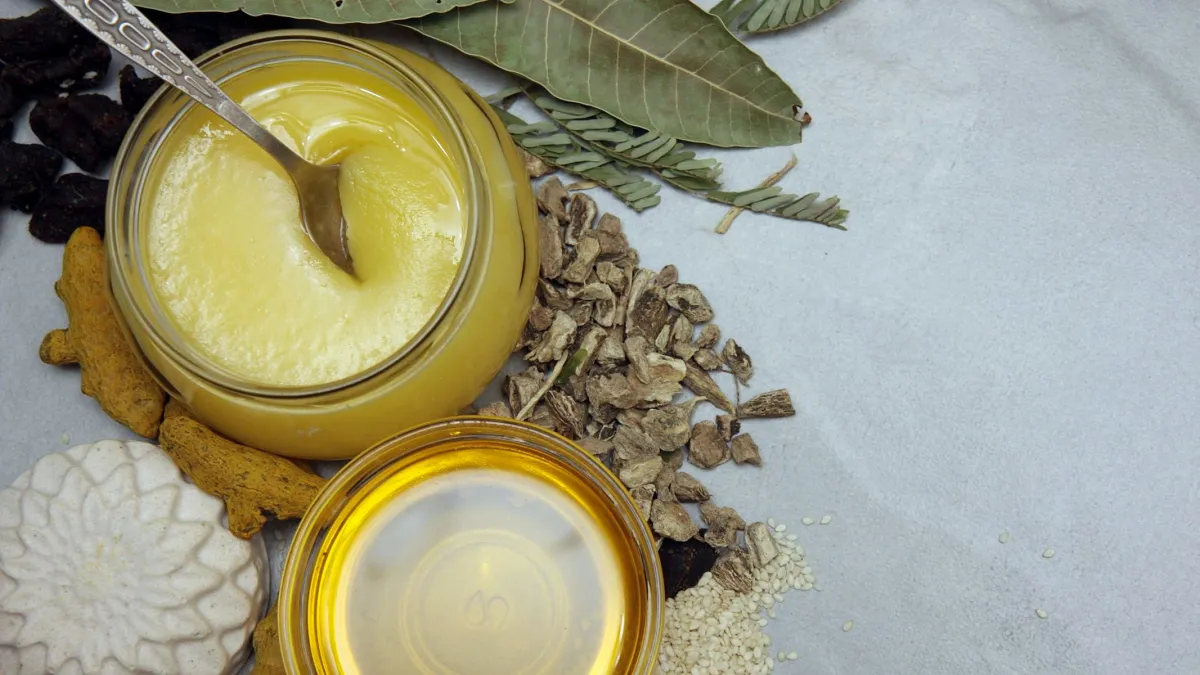
The jar of ghee you opened in early summer is still in the cabinet, half full. The label says it needs no refrigeration, yet the butter it came from lives in the fridge. So how long does ghee last once the seal is broken, and should the open jar move to the fridge?
How long does ghee last?
The answer changes with where the jar sits and whether it has been opened. USDA's FoodKeeper lists ghee at 6 to 8 months in the pantry and 1 to 2 years in the refrigerator, and four ghee makers' pages tell you to use an opened jar kept at room temperature within about 3 months.
FoodKeeper gives a single pair of numbers for ghee. It does not separate opened jars from unopened ones, and it does not say what date the months count from. An Oregon extension expert (Lane County) answering on Ask Extension in May 2025 says there is no research on how long ghee specifically keeps. It applies the rule for cooking oils instead: once opened, they "keep good quality for 1-3 months at room temperature."
That 1 to 3 months is about quality, meaning rancid flavor. FoodKeeper does not say whether its ghee numbers mean quality or safety. The safety warnings in the sources concern water in the jar and ghee canned or flavored at home.
Here is how the common claims hold up:
| Claim | Verdict | Why |
|---|---|---|
| Opened store-bought ghee can stay in the pantry | REAL | Brand pages: no fridge needed |
| Ghee never goes bad | MYTH | It oxidizes; brands give time limits |
| Scooping with a wet spoon | RISKY | Moisture can lead to mold |
| Home-canned ghee on the shelf | RISKY | No safe home canning method |
One brand disagrees with the MYTH row: OMGhee, an Australian company that ships to the U.S., says "Ghee lasts indefinitely when stored in a cool dark pantry." Pure Indian Foods says ghee "does not stay completely fresh much longer than one year without the use of preservatives." For pantry foods with a better claim to a long life, see the guide to foods that never expire.
What ghee makers say about storage
Check your own jar first, because brands sold in the U.S. disagree:
| Brand | Unopened | Opened, room temperature |
|---|---|---|
| 4th & Heart | 18 months | Use within 3 months |
| Pure Indian Foods | 9–12 months from purchase | Up to 3 months, then fridge |
| Ancient Organics (2025 FAQ) | Not stated | Up to 3 months, then fridge |
| OMGhee (Australia) | Not split; "indefinitely" | About 3 months |
| Organic Valley | Up to 1 year | Not stated |
| Milkio (New Zealand) | 18 months from manufacture | Up to 18 months from manufacture |
| Nanak | 9 months from manufacture | Not stated |
For an opened jar on the counter, most brands that give a number say about 3 months. Milkio says up to 18 months from the manufacturing date. Pure Indian Foods says, and Ancient Organics' 2025 FAQ said, the jar can then go in the fridge for up to a year.
Several big sellers give no months on their product pages. Trader Joe's says its ghee "can be kept at room temperature" in an airtight container. Kirkland Signature says "Refrigeration is optional," and Thrive Market's product page says "No refrigeration necessary."
Bulletproof disagrees with itself: its FAQ says "several months," while a 2019 Bulletproof blog post said ghee "won't go bad for years." This guide suggests using the number on your jar, and about 3 months for an opened jar at room temperature when the jar gives none.
Why ghee outlasts butter on the counter
The difference is water. A normal salted butter has about 16 to 17% water, according to the National Center for Home Food Preservation (NCHFP), and FoodKeeper says butter "may be left at room temperature for 1 - 2 days." USDA's 1993 specifications for ghee allow 0.3% moisture at most. That document covers ghee "eligible for official certification," so it is not a rule every jar on a U.S. shelf must meet. Ask Extension says clarifying butter "removes extra water and milk solids, allowing for much longer storage even at room temperature."

What wears ghee down is oxidation. Ask Extension says that once a container of oil or fat is opened, oxygen starts to turn it rancid. In a 2015 study of ghee stored for 21 days at temperatures from about 43°F to 140°F, temperature moved two oxidation measures more than the antioxidants tested did. In their background section, the authors note that how far ghee degrades depends mainly on storage temperature, oxygen availability and whether the ghee is liquid or solid.
A 2024 study from Iran kept two traditional ghees, made in small local workshops, at 77°F for 6 months. Peroxide values in both rose significantly. One sample went over the acceptable acidity limit in the sixth month; the other stayed within it. That was traditional workshop ghee, not a sealed jar from a U.S. store.
Pantry or fridge after opening?
Decide by how warm your kitchen gets and how fast you use the jar. Organic Valley says "you don't have to refrigerate," but in summer or a very warm kitchen "you may want to keep ghee in the refrigerator," adding that it "softens very quickly when you take it out." Bulletproof says the same for a warmer climate. OMGhee suggests the fridge if you cook with ghee only every few weeks. Ancient Organics' listing on Good Eggs says "Store refrigerated after opening for the longest shelf life."
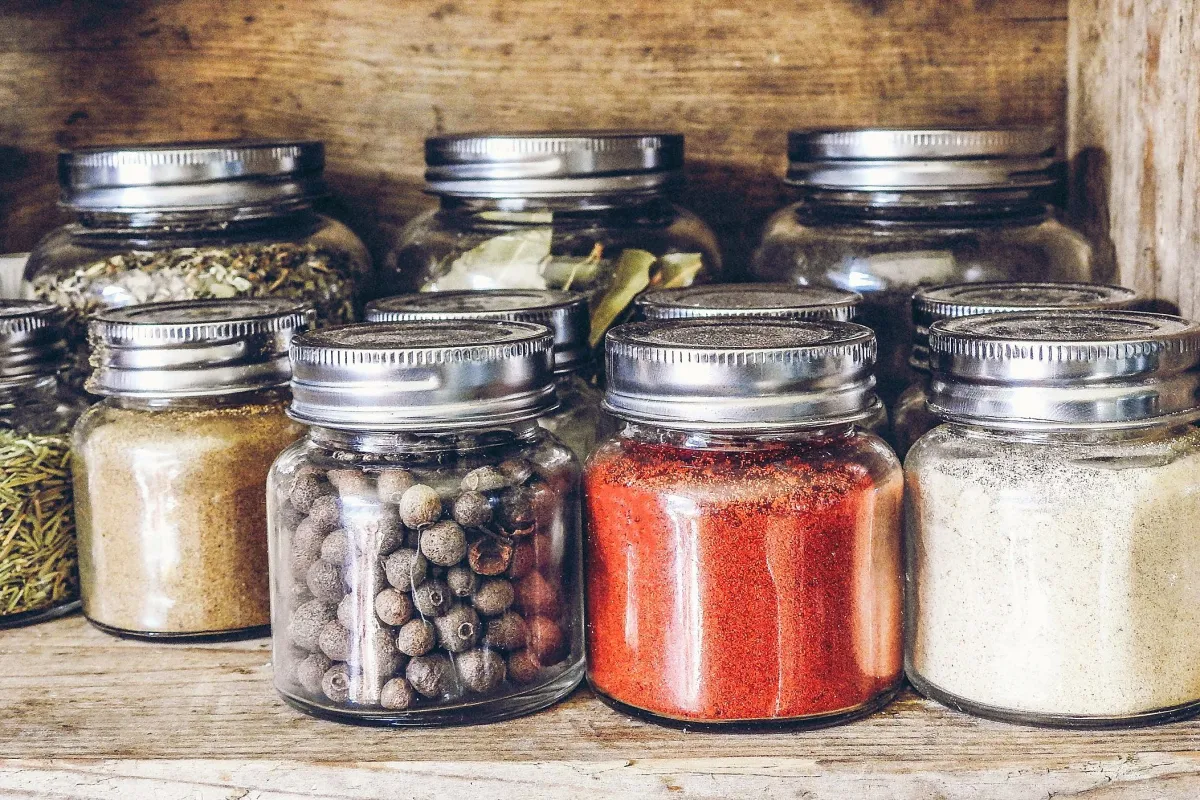
For the pantry, Pure Indian Foods says to keep an opened jar in a kitchen cabinet away from light and moisture. If you cannot finish a large jar in 3 months, it suggests filling a small glass jar for daily use and keeping the large one, lid tightly closed, in the fridge.
The freezer also works, according to Pure Indian Foods, and Milkio says frozen ghee keeps "for six months or more, depending on the manufacturing date." Ask Extension has only heard, anecdotally, that ghee freezes well for up to a year. For other foods that keep longer frozen, see the guide to freezer tricks that make food last.
Grainy or liquid: how to tell if ghee has gone bad
Texture changes with temperature and is not on its own a sign of spoilage. 4th & Heart says ghee can turn liquid in warm conditions (85°F or above) and may come back grainy when it hardens, and that "the product is still safe to consume."
Smell tells you more. Ancient Organics' 2025 FAQ said "If it does not smell sweet, it has spoiled." For a jar that smells a little off but is still within its Best By date, Pure Indian Foods suggests heating a small amount to see whether the smell changes, and scraping out any ghee that has turned white inside the jar. That advice is about stale ghee, not mold.
Pure Indian Foods says to always use a clean, dry spoon, because moisture or contaminants "can produce mold." USDA's guide to moldy food has no entry for ghee or butter. Its general advice: "Don't sniff the moldy item," and "If food is covered with mold, discard it." For jams and jellies, it says microbiologists recommend against scooping out the mold and using the rest, and it says to discard moldy peanut butter. This guide suggests the same for ghee: if you see any mold, even a small spot, throw out the jar rather than scraping off the top.
Homemade ghee and ghee with garlic or herbs
This guide suggests treating homemade ghee more carefully than a sealed store jar. FoodKeeper has no separate line for homemade ghee, and for longer storage Ask Extension says to keep fats in the refrigerator or freezer.
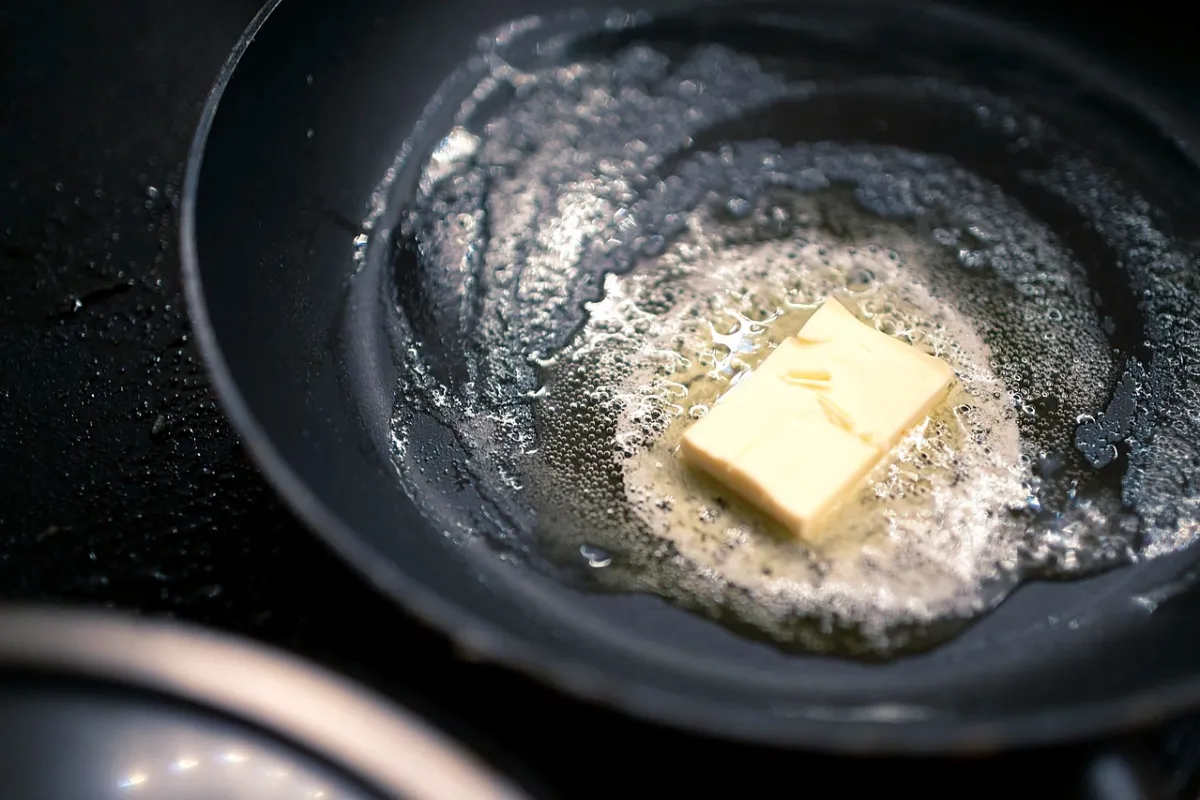
Garlic or herbs change the risk. A 2011 review in Food Protection Trends says the FDA warned consumers in 1993 not to prepare homemade spices in oil, margarine or butter for extended storage. It urged them to refrigerate all such products and to throw out any suspected of spoiling or left unrefrigerated. The bulletin, as described, does not name ghee. NCHFP says oils flavored with herbs should be made for fresh use, kept in the refrigerator and "used within 2 to 3 days."
Do not try to make ghee shelf-stable by canning it. Ask Extension says "there are no safe instructions for canning ghee, butter, or cooking oils at home." For butter sealed in jars, NCHFP says "It is not clear what the botulism risk is from such a high-fat product," but that a low-acid food sealed in a jar at room temperature needs processing to destroy spores. The guide to freezing butter covers canning butter.
Safety note: Ask Extension says there are no established processing times for canning ghee at home in a boiling water canner or a pressure canner, and that improperly canned low-acid foods are a leading cause of botulism poisoning; it recommends refrigeration or freezing for long-term storage. For homemade spice mixtures in fat, the FDA's 1993 bulletin (as described in Food Protection Trends, 2011) urged refrigeration and throwing out any product suspected to be spoiled or left unrefrigerated. If ghee has any visible mold, this guide suggests throwing out the jar; USDA's general advice is not to sniff moldy food and to discard food covered with mold, wrapped, in a covered trash can that children and animals can't get into.
Sources and how we checked
We used agency and extension pages plus peer-reviewed studies for storage times and safety. Brand figures come from the makers' own web pages. All were viewed on October 29, 2026. USDA's FoodKeeper data and the FSIS mold page blocked automated access, so we read them in a browser. Several brand pages blocked automated access too; we read them in a browser or through Wayback Machine snapshots. We found no FDA or Ask USDA page about ghee storage, no U.S. agency storage time for homemade ghee, and no peer-reviewed study that followed store-bought ghee at room temperature for a year. We left out shelf-life predictions made with the Rancimat method at 37°C (99°F), because a 2014 thesis found that method predicted a shelf life 2.47 times longer than the actual one at 35°C (95°F).
- USDA FSIS: FoodKeeper data, "Ghee" and "Butter" entries (undated); Molds on Food: Are They Dangerous? (updated August 22, 2013).
- USDA Agricultural Marketing Service: USDA Specifications for Ghee (effective October 19, 1993).
- Ask Extension (answer from Lane County, Oregon): storing ghee longterm (May 30, 2025).
- National Center for Home Food Preservation, University of Georgia: canning FAQs on butter and herbs in oil (butter answer dated spring 2006).
- Nummer BA et al., Current Food Safety Issues of Home-prepared Vegetables and Herbs Stored in Oil, Food Protection Trends (2011).
- Asha A et al., Antioxidant activities of orange peel extract in ghee (butter oil) stored at different storage temperatures, Journal of Food Science and Technology (December 2015).
- Nezhad Razmjoui Akhgar F and Shaviklo AR, six-month storage study of two Iranian ghees, Food Research Journal, University of Tabriz (September 2024; English extended abstract).
- Mehta BM, methods for monitoring oxidative deterioration of ghee, Ph.D. thesis, Anand Agricultural University (2014; abstract).
- Ghee makers: 4th & Heart FAQ; Pure Indian Foods grassfed organic ghee; Ancient Organics FAQ (May 2025 snapshot) and Good Eggs listing; Organic Valley ghee; Milkio, opened ghee (August 18, 2022) and Can ghee be frozen? (January 17, 2023); OMGhee organic ghee (August 2025 snapshot); Nanak ghee sell sheet (2023; April 2025 snapshot).
- Store brands: Trader Joe's Clarified Butter (Ghee); Kirkland Signature Organic Ghee; Thrive Market Organic Ghee (July 2026 snapshot).
- Other brands: Bulletproof FAQ (September 2026 snapshot) and Ghee vs. butter (2019 snapshot).
Updated: October 30, 2026





0comments