

You're clearing out the pantry: a can with a date you can't read, a bag of flour older than you'd admit, a jar of honey gone cloudy and hard. Is any of it still good — or about to make someone sick? Most of what people believe about "expiration" aims at the wrong thing, and a couple of the real dangers get waved right past.
So here's the honest tier-list, part of our wider set of practical home hacks for a leaner household: the pantry staples that genuinely last for years, the "it never goes bad" beliefs that are myths, and the one assumption that can actually hurt you. Every number below traces to a food-safety agency or a university extension service, linked so you can check it yourself.
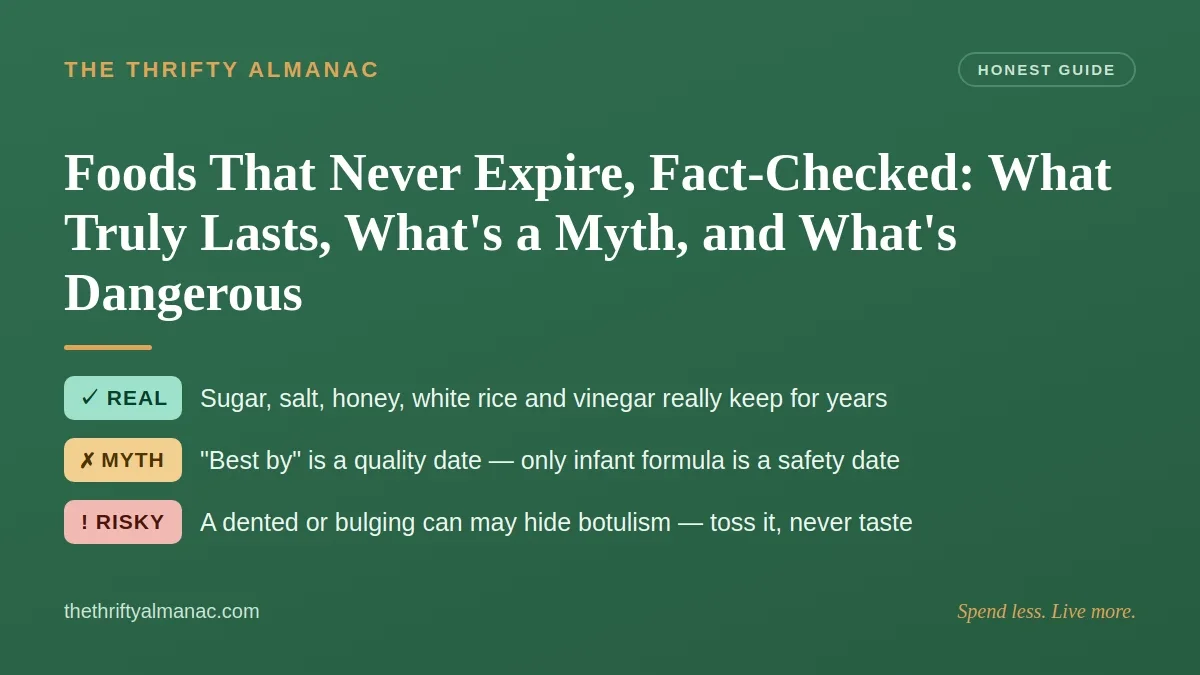
The one rule that kills the myth: "best by" is about quality, not safety
This reframes everything else. Those printed dates — "best by," "use by," "sell by" — are the manufacturer's best guess at peak quality, not a safety cliff. Regulators don't even require them on most food. As Penn State Extension lays out, the labels describe quality — with exactly one legal exception in the United States. Infant formula is the only product the FDA requires to carry a date, because formula loses nutrients over time.
For everything else, the USDA's food-safety arm is blunt: food that shows no signs of spoilage should stay wholesome past its printed "best if used by" date. That doesn't mean anything lasts forever — the dangerous cans come later. The date on the box is a flavor guide, not a countdown. If you like sorting fact from folklore in the kitchen, we do the same thing with the old kitchen tricks handed down from grandma.
The one-line version: Dates mean quality. The only safety-relevant date is on infant formula.
Tier S: the genuine near-forever staples
These earn the "never really expires" label — as long as they stay cool, dry, and sealed. They resist spoilage for one reason: microbes need water or oil to grow, and these offer neither. It is the same principle you lean on when drying food at home without a dehydrator: pull the water out and spoilage organisms have nothing to work with. A tight container and a dark shelf do most of the work, which is why a little smart pantry organizing on a budget pays off for years.

| Staple | How long it keeps | Why it lasts | The honest caveat |
|---|---|---|---|
| White / granulated sugar | Indefinite | Too dry for microbes | Hardens into lumps — still safe to use |
| Salt | Indefinite | Draws water, never feeds bacteria | Cakes up; can absorb nearby odors |
| Honey | Indefinite | Very low water content | Crystallizes; only fails if moisture gets in |
| White rice | Indefinite | Bran and oils already milled off | Brown rice is a different story (below) |
| Distilled white vinegar | Indefinite | Acidity preserves itself | May look cloudy; still fine |
"Indefinite" means microbiological non-spoilage — not that texture never drifts. Utah State notes sugar stays safe even when it turns rock-hard. Honey that's gone cloudy and stiff hasn't spoiled either; it has crystallized, and you can revive it by setting the open jar in hot, not boiling, water until the crystals melt.
Tier A: long-lasting, but with an asterisk
Here's where honesty beats the clickbait lists. These three get filed under "immortal" — and all three need a footnote.
Cornstarch
It won't spoil if you keep it bone-dry, but sources won't call it forever: Ohio State's pantry chart prints roughly 18 months for best quality. Long-lasting when sealed and dry — not eternal like sugar or salt.
Pure vanilla extract
Its staying power comes from alcohol, and pure extract (not imitation) can actually improve with age. Storage charts still print a conservative two-year unopened window because the volatile aroma oils slowly escape. Long-lived, yes; "never expires," not quite.
Maple syrup
This one deserves a bold asterisk. Unopened, pure maple syrup keeps about two years — then roughly a year in the fridge once you break the seal, or it grows mold. UMaine Extension is blunt that opened syrup can't sit safely in the pantry, and that if mold shows up you throw the bottle out — the mycotoxins can survive boiling, so skimming and reheating won't save it.
The myths people actually believe
Myth: "canned food lasts forever"
An intact, well-stored commercial can can stay safe a long time — but quality runs on a clock. The USDA puts high-acid canned foods like tomatoes and pineapple at about 12 to 18 months for best quality, and low-acid foods like meat, fish, and most vegetables at two to five years. Heat speeds the decline; storing cans above 100°F sharply raises spoilage risk. "Forever" is the myth. "Safe well past the date if the can is sound" is the truth — and a damaged can is a separate danger, covered next.
Myth: "honey is magic and never changes"
Honey is remarkably stable, but it does change. It crystallizes with age — natural, harmless, reversible. The real limit is moisture: if water works in, the dilution lets yeasts take hold, and honey that's fermenting — bubbling, or smelling sour — has spoiled and should go. Its near-immortality depends on staying dry and sealed.
Myth: "brown rice keeps as long as white"
White rice is near-immortal precisely because the oily bran and germ have been milled away. Brown rice still has them, and the germ's oils go rancid — Michigan State Extension puts intact whole grains at about six months in a cool, dry place and up to a year in the freezer. Strip those oils out and you get shelf-stable white rice; leave them in and the clock is running. Buy brown rice in amounts you'll actually use, and keep it cold.
The dangerous assumption: when a can can kill you
Everything above is about quality and waste. This is about a toxin that can be fatal — so it gets its own bright line.

Never taste-test a suspect can to "check" it. The toxin that causes botulism is invisible, odorless, and tasteless, and even a small taste can be deadly. Throw out — without opening or sampling — any can or jar that is:
- bulging, swollen, or with a lid that flexes
- dented along a seam, rusted through, or leaking
- cracked, or with a broken seal
- spurting liquid when opened, or smelling off
Clemson's rule is the one to memorize: when in doubt, throw it out. The higher-risk category is home-canned low-acid foods — green beans, corn, asparagus, meats — which the CDC names as the top cause of foodborne botulism, and which need pressure canning rather than a boiling-water bath. For a suspect low-acid jar, the NCHFP says to treat it as toxic — detoxify it by boiling 30 minutes, or seal it in a bag and bin it, and never taste. For canning methods, follow the CDC and NCHFP guides, not a family recipe card.
The hidden risk even dry staples have: pantry pests
"Dry equals safe forever" has one more blind spot: bugs. Flour, grains, rice, and cereal routinely harbor weevils, flour beetles, and Indian meal moths — and, unpleasantly, the infestation often starts before you buy it, from eggs already in the product. Dryness doesn't stop them. University of Minnesota Extension recommends freezing newly bought flour and grains for several days to kill any eggs, then storing everything airtight so one bad bag can't spread. This is an ick-and-waste problem, not a botulism-level one — but it still costs you the whole bag, and clearing an infestation once it has started takes more than a fresh container.
Bottom line: how to store for the long haul
The system is short:
- Cool, dark, dry, airtight. That one habit turns "shelf-stable" into "still good years from now."
- First in, first out. Rotate older cans and bags to the front so nothing hides past its prime.
- Mind the refrigerate-after-opening exceptions. Maple syrup is the classic trap — treat it like a perishable once it's open, and pitch it at the first sign of mold.
- Trust your senses on cans. Sound can, past the date, no off signs — usually fine. Dented, bulging, or foul — gone, no taste test.
- Read dates as quality guides. The only one that's a genuine safety date is on infant formula.
| Tier | Examples | The rule |
|---|---|---|
| Near-forever | Sugar, salt, honey, white rice, white vinegar | Keep dry and sealed; texture changes are fine |
| Long, with an asterisk | Cornstarch, pure vanilla, maple syrup | Great shelf life — but refrigerate maple once open |
| Myth | "Canned food and brown rice last forever" | Quality runs on a clock; brown rice goes rancid |
| Danger | Dented, bulging, leaking, foul cans | Throw out, never taste — possible botulism |
Common mistakes
- Tossing food the day the date hits. For everything but infant formula, that date is about flavor, not safety — you're throwing away good food and money.
- Taste-testing a questionable can. The botulism toxin has no taste or smell; "just a little to check" can be fatal. Discard on sight.
- Leaving opened maple syrup in the pantry. It molds. Refrigerate it, and pitch it if mold appears — you can't boil the toxin out.
- Assuming brown rice keeps like white. Its oils go rancid in months; buy small and store it cold.
- Trusting "dry" to stop bugs. Weevils and moths ride in with the flour. Freeze new bags for a few days and go airtight.
FAQ
Does honey really never expire?
Kept dry and sealed, honey lasts more or less indefinitely, and crystallized honey is fine — just warm the open jar in hot water. The exception is moisture: if water gets in, honey can ferment, and bubbling or a sour smell means it has spoiled.
Is it safe to eat canned food years past the date?
If the can is undamaged and stored somewhere cool, very likely yes — the date is a quality marker, and the USDA gives low-acid cans two to five years for best quality. A dented, bulging, rusted, or leaking can is the exception: discard it without tasting.
What foods actually never expire?
The genuinely near-forever group is small: white and granulated sugar, salt, honey, white rice, and distilled white vinegar — all kept cool, dry, and sealed. They may harden, cake, or cloud, but they don't spoil.
When should I get medical help over a bad can?
If someone has eaten from a suspect can and develops signs of botulism — blurred or double vision, drooping eyelids, slurred speech, or trouble swallowing or breathing — treat it as an emergency and get medical help or reach Poison Control right away. Botulism is rare but serious.
The takeaway: Trust the storage, not the date — keep staples cool, dry, and sealed, and remember the one rule that beats all the folklore: a dented or bulging can is the only "expired" food here that can truly hurt you. Spend less. Live more. — The Thrifty Almanac



0comments